Questions

1 Marks Question

Take a timed test

136 questions · self-marked practice — reveal the answer and mark yourself.

Question 11 Mark
Identify True/ False statements. Correct each false statement to make it true.
Presence or absence of hymen is not a reliable indicator of virginity or sexual experience. (True/ False)
Answer
True.
View full question & answer
Question 21 Mark
Fill in the blanks:
Zygote divides to form _____________ which is implanted in uterus.
Answer
Zygote divides to form blastocyst, fertilization which is implanted in uterus.
View full question & answer
Question 31 Mark
Fill in the blanks:
The structure which provides vascular connection between fetus and uterus is called _____________.
Answer
The structure which provides vascular connection between fetus and uterus is called placenta.
View full question & answer
Question 41 Mark
Fill in the blanks:
Fertilisation takes place in _____________.
Answer
Fertilisation takes place in fallopian tube.
View full question & answer
Question 51 Mark
Identify True/ False statements. Correct each false statement to make it true.
Leydig cells synthesise androgens. (True/ False)
Answer
True.
View full question & answer
Question 61 Mark
Fill in the blanks:
Humans reproduce _____________. (asexually/ sexually)
Answer
Humans reproduce sexually.
View full question & answer
Question 71 Mark
How many eggs do you think were released by the ovary of a female dog which gave birth to 6 puppies?
Answer
Six eggs were released by the ovary of a female dog which gave birth to six puppies.
View full question & answer
Question 81 Mark
Fill in the blanks:
Ovulation is induced by a hormone called _____________.
Answer
Ovulation is induced by a hormone called luteinizing hormone.
View full question & answer
Question 91 Mark
Fill in the blanks:
Male and female gametes are _____________. (diploid/ haploid)
Answer
Male and female gametes are haploid.
View full question & answer
Question 101 Mark
Identify True/ False statements. Correct each false statement to make it true.
Menstrual cycle ceases during pregnancy. (True/ False)
Answer
True.
View full question & answer
Question 111 Mark
Fill in the blanks:
Fertilisation is _____________ in humans. (external/ internal)
Answer
Fertilisation is internal in humans.
View full question & answer
Question 121 Mark
Fill in the blanks:
The fusion of male and female gametes is called _____________
Answer
The fusion of male and female gametes is called fertilization.
View full question & answer
Question 131 Mark
Fill in the blanks:
Humans are _____________. (oviparous, viviparous, ovoviviparous)
Answer
Humans are viviparous.
View full question & answer
Question 141 Mark
Fill in the blanks:
The process of release of ovum from a mature follicle is called _____________.
Answer
The process of release of ovum from a mature follicle is called ovulation.
View full question & answer
Question 151 Mark
Identify True/ False statements. Correct each false statement to make it true.
Oogenesis takes place in corpus luteum. (True/ False)
Answer
False.
Oogenesis takes place in the ovary.
View full question & answer
Question 171 Mark
Identify True/ False statements. Correct each false statement to make it true.
Androgens are produced by Sertoli cells. (True/ False)
Answer
False.
Androgens are produced by Leydig cells found in seminiferous tubules of the testis.
View full question & answer
Question 181 Mark
Identify True/ False statements. Correct each false statement to make it true.
Spermatozoa get nutrition from Sertoli cells. (True/ False)
Answer
True.
View full question & answer
Question 191 Mark
Identify True/ False statements. Correct each false statement to make it true.
Leydig cells are found in ovary. (True/ False)
Answer
False.
Leydig cells are found in the seminiferous tubules of the testis.
View full question & answer
Question 201 Mark
Where is acrosome present in humans? Write its function.
Answer
On the sperm head, has enzymes to dissolve the follicles of ovum/facilitate entry of sperm nucleus for fertilisation/help the sperm enter into the cytoplasm of the ovum.
View full question & answer
Question 211 Mark
Name the embryonic stage that gets implanted in the uterine wall of a human female.
Answer
Blastocyst/Blastula.
View full question & answer
Question 221 Mark
Where does fertilisation normally take place in a human female?
Answer
Fallopian tubes/ (ampulla of) oviduct.
View full question & answer
Question 231 Mark
Write the location and function of the Sertoli cells in humans.
Answer
In the seminiferous tubules/testes, nourishes sperms/germ cells.
View full question & answer
Question 241 Mark
Name the type of cell division that takes place in the zygote of an organism exhibiting haplontic life cycle.
Answer
Meiosis.
View full question & answer
Question 251 Mark
How does colostrum provide initial protection against diseases to newborn infants? Give one reason.
Answer
Colostrum has abundant antibodies/IgA to develop resistance in newborn babies.
View full question & answer
Question 261 Mark
What is the role of cervix in the human female reproductive system?
Answer
Cervix helps in regulating the passage of sperms into the uterus and forms the birth canal to facilitate parturition.
View full question & answer
Question 271 Mark
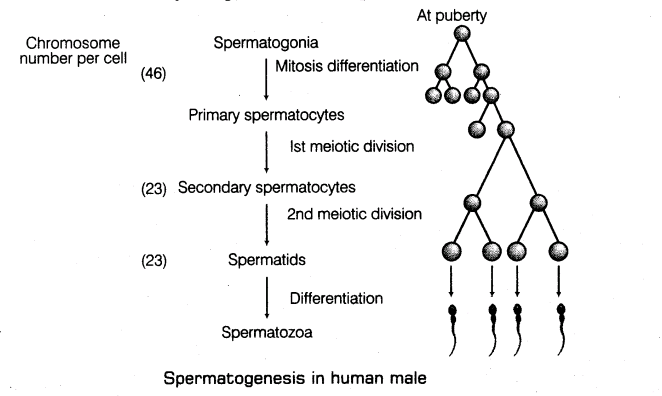
A spermatogonial cell has 30 chromosomes. How many chromosomes will be found in:
  1. The primary spermatocyte.
  2. The spermatid?
Answer
  1. 30
  2. 15
View full question & answer
Question 291 Mark
Given below are the stages in human reproduction. Write them in correct sequential order.
Insemination, Gametogenesis, Fertilisation, Parturition, Gestation, Implantation
Answer
Gametogenesis, Insemination, Fertilisation, Implantation, Gestation, Parturition.
View full question & answer
Question 301 Mark
Which type of cell division forms spermatids from the secondary spermatocytes?
Answer
Second meiotic division.
View full question & answer
Question 331 Mark
Given below are the events in human reproduction. Write them in correct sequential order.
Insemination, gametogenesis, fertilisation, parturition, gestation, implantation.
Answer
Gametogenesis → Insemination → Fertilisation → Implantation → Gestation → Parturition.
View full question & answer
Question 361 Mark
During reproduction, the chromosome number (2n) reduces to half (n) in the gametes and again resume the original number (2n) in the offspring, what are the processes through which these events take place?
Answer
Halving of chromosomal number takes place during gametogenesis by meosis and regaining the 2n number occur as a result of fertilisation by fusion of male and female gametes.
View full question & answer
Question 381 Mark
Female reproductive organs and associated functions are given below in column A and B. Fill in the blank boxes.
Column A
Column B
Ovaries
Ovulation
Oviduct
A
B
Pregnancy
Vagina
Birth
Answer
A-Fertilisation.
B-Uterus.
View full question & answer
Question 421 Mark
Where does fertilization take place in human female?
Answer
Ampullary-isthmic junction of the fallopian tube.
View full question & answer
Question 431 Mark
Name the stages when oogenesis and spermatogenesis initiate in human female and male, respectively.
Answer
Oogenesis starts during embryonic developmental stages of the female foetus while, spermatogenesis starts at puberty.
View full question & answer
Question 441 Mark
What is trophoectoderm?
Answer
The outer layer of blastocyst is referred to as trophoectoderm or trophoblast.
View full question & answer
Question 461 Mark
Mention the importance of LH surge during menstrual cycle.
Answer
LH surge is essential for the events leading to ovulation.
View full question & answer
Question 481 Mark
Spermatids possess haploid chromosome number. Explain.
Answer
Spermatids are produced by meiosis during spermatogenesis. Thus, they possess haploid number of chromosomes.
View full question & answer
Question 491 Mark
Explain the function of umbilical cord.
Answer
Umbilical cord transports nutrients and respiratory gases and metabolic wastes to and from mother and foetus.
View full question & answer
Question 501 Mark
How is the entry of only one sperm and not many ensured into an ovum during fertilisation in humans?
Answer
During fertilisation a sperm head comes in contact with zona pellucida layer of ovum and induces changes in the membrane that block the entry of additional sperms.
View full question & answer
Question 511 Mark
State the stage at which oogonia reach their maximum number.
Answer
Before birth at five months of foetal life, oogonia reach their maximum number.
View full question & answer
Question 521 Mark
What is semen?
Answer
Seminal plasma (secreted by the male reproductive glands) along with the spermatozoa, constitute semen.
View full question & answer
Question 531 Mark
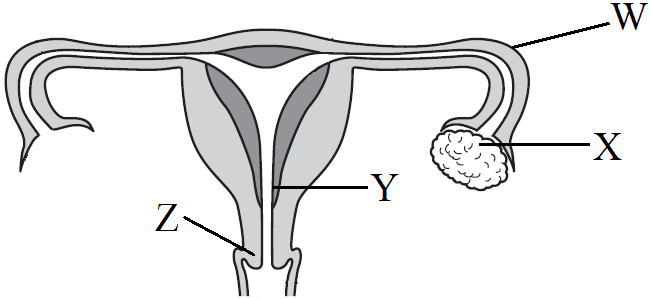
The diagram shows the female reproductive system. Where do fertilisation and implantation occur?
Answer
Fertilisation takes place in Fallopian tube (W) and implantation takes place in uterus (Y).
View full question & answer
Question 541 Mark
How is the first sign of growing foetus noticed?
Answer
The first sign of growing foetus is noticed by listening to the heart sounds through a stethoscope.
View full question & answer
Question 551 Mark
Luteal phase of the menstrual cycle is also called the secretory phase. Give reason.
Answer
In this phase, progesterone stimulates the endometrial glands of the uterus to secrete a nutrient fluid for the foetus hence, also called the secretory phase.
View full question & answer
Question 561 Mark
Match Column I with Column II.
S. No.
Column I
S. No.
Column II
A.
Acrosome
1.
Motility of sperm towards the egg.
B.
Head
2.
Powerhouse of the sperm; contains a number of mitochondria.
C.
Tail
3.
Contains the genetic material.
D.
Middle piece
4.
Contains enzymes to dissolve egg envelopes.
Answer
S. No.
Column I
S. No.
Column II
A.
Acrosome
4.
Contains enzymes to dissolve egg envelopes.
B.
Head
3.
Contains the genetic material.
C.
Tail
1.
Motility of sperm towards the egg.
D.
Middle piece
2.
Powerhouse of the sperm; contains a number of mitochondria.
View full question & answer
Question 571 Mark
Name the important mammary gland secretions that help in resistance of the new born baby.
Answer
Colostrum.
View full question & answer
Question 591 Mark
Somatic chromosome number is 40. What shall be the chromosome number in the cells of seminiferous tubules?
Answer
40 chromosomes.
View full question & answer
Question 611 Mark
Males in whom testes fail to descend to the scrotum are generally infertile. Why?
Answer
If the testes fail to descend to the scrotum, gametogenesis could be inhibited. The process of spermatogenesis requires a marginally lesser ambient temperature than that in the abdominal cavity.
View full question & answer
Question 621 Mark
Mention the function of trophoblast in human embryo.
Answer
Trophoblast is the outer layer of blastocyst which helps in the attachment of blastocyst to the endometrium of the uterus.
View full question & answer
Question 631 Mark
When and where do chorionic villi appear in humans? State their functions.
Answer
Chorionic villi appear after implantation on the trophoblast. It becomes interdigitated with uterine tissue to form the placenta and increases the surface area for exchange of materials between the mother and the embryo.
View full question & answer
Question 641 Mark
What is the significance of ampullary–isthmic junction in the female reproductive tract?
Answer
First cleavage division of zygote occurs in the ampullary-isthmic junction in the female reproductive tract.
View full question & answer
Question 661 Mark
What do you mean by foetal ejection reflex?
Answer
These are mild uterine contraction induced by the signals for parturition originated from fully developed foetus and placenta.
View full question & answer
Question 671 Mark
List the changes that the primary ooctye undergoes in the tertiary follicular stage in the human ovary.
Answer
The primary oocyte within the tertiary follicle grows in size and completes its first meiotic division to form secondary oocyte and first polar body.
View full question & answer
Question 681 Mark
Are there any homologous organs in male and female reproductive system? If yes, give examples.
Answer
Yes. For example, the external reproductive organ penis in males and clitoris in females.
View full question & answer
Question 701 Mark
Name the hormones produced only during pregnancy in a human female. Mention their source organ.
Answer
During pregnancy, placenta produces hormones like human chorionic gonadotropin and human placental lactogen and ovary produces relaxin.
View full question & answer
Question 711 Mark
Name the cells that nourish the germ cells in the testes. Where are these cells located in the testes?
Answer
Sertoli cells. They are found on the inner lining of seminiferous tubule.
View full question & answer
Question 721 Mark
Sperms have a tail, whereas eggs do not. Why?
Answer
Because eggs are non-motile (stationary) and sperms have to travel up to eggs.
View full question & answer
Question 731 Mark
Identify the odd one out in each of the following sets:
  1. Rete testis, vas deferens, isthmus, epididymis.
  2. Seminal vesicles, ampulla, prostate, bulbourethral glands.
Answer
  1. Isthmus.
  2. Ampulla.
View full question & answer
Question 741 Mark
Mention the location and the function of Leydig cells in humans.
Answer
Leydig cells are present in the regions called interstitial spaces outside the seminiferous tubules. They synthesise and secrete androgens (testosterone).
View full question & answer
Question 751 Mark
Sperms have a tail whereas egg does not, why?
Answer
Sperms swim by vibrating their tail in the fluid while eggs do not require it.
View full question & answer
Question 761 Mark
What is corona radiata?
Answer
The follicle cells that envelope the egg outside zona pellucida are called corona radiata.
View full question & answer
Question 791 Mark
What is endometrium?
Answer
It is the innermost glandular layer of uterus which lines the uterine cavity. Here, implantation of blastocyst takes place. It undergoes cyclical changes during menstrual cycle.
View full question & answer
Question 801 Mark
Mention the difference between spermiogenesis and spermiation.
Answer
Spermiogenesis: It is the transformation of spermatids into spermatozoa or sperms.
Spermiation: It is the release of sperms from seminiferous tubules.
View full question & answer
Question 811 Mark
What is the function of bulbourethral glands?
Answer
The secretions of the bulbourethral glands help in the lubrication of the penis.
View full question & answer
Question 821 Mark
How many sperms will be produced from 100 primary spermatocytes and how many eggs will be produced from 100 primary oocytes?
Answer
400 sperms and 100 ova.
View full question & answer
Question 831 Mark
Name the process of the rupture of Graafian follicle and the subsequent release of the egg from the ovary.
Answer
Ovulation.
View full question & answer
Question 841 Mark
How many primary follicles are left in each ovary in a human female at puberty?
Answer
60,000-80,000 primary follicles are left in each ovary.
View full question & answer
Question 851 Mark
Mark the odd one the following groups.
Fimbriae, Labia minora, Infundibulum, Isthmus.
Answer
Labia minora.
View full question & answer
Question 891 Mark
Mark the odd one the following groups.
Luteinizing hormone, Progesterone, Chorionic gonadotropin, Estrogen.
Answer
Luteinizing hormone.
View full question & answer
Question 901 Mark
Match Column I with Column II.
S. No.
Column I
S. No.
Column II
A.
Cleavage
1.
Outer layer of the blastocyst that attaches to the endometrium during implantation.
B.
Implantation
2.
Mitotic divisions of the zygote in quick succession.
C.
Inner cell mass
3.
Embedding of the blastocyst in the endometrium of uterus.
D.
Trophoblast
4.
Release of secondary oocyte from the ovary.
E.
 
5.
Group of cells attached to one end of trophoblast that differentiate into embryo proper.
Answer
S. No.
Column I
S. No.
Column II
A.
Cleavage
2.
Mitotic divisions of the zygote in quick succession.
B.
Implantation
3.
Embedding of the blastocyst in the endometrium of uterus.
C.
Inner cell mass
5.
Group of cells attached to one end of trophoblast that differentiate into embryo proper.
D.
Trophoblast
1.
 
Outer layer of the blastocyst that attaches to the endometrium during implantation.
View full question & answer
Question 921 Mark
Arrange the following parts of mammary gland in correct order in which milk secreted from the cells of alveoli of lobes reaches the nipple. Lactiferous duct, mammary duct, mammary tubules, mammary ampulla.
Answer
The correct order is Mammary tubules → Mammary duct Mammary ampulla Lactiferous duct.
View full question & answer
Question 931 Mark
When do the oogenesis and the spermatogenesis initiate in human females and males respectively?
Answer
Oogenesis in human females initiate at the foetal/ embryonic stage.
Spermatogenesis in human males starts at puberty.
View full question & answer
Question 941 Mark
What is corpus luteum?
Answer
It is the remaining part of Graafian follicle after ovulation in the luteal phase which acts as an endocrine gland.
View full question & answer
Question 951 Mark
Name the process of release of spermatozoa from Sertoli cells into cavity of seminiferous tubule.
Answer
Spermiation.
View full question & answer
Question 961 Mark
Mark the odd one the following groups.
Rete testis, Vasa efferentia, Epididymis, Ampulla.
Answer
Ampulla.
View full question & answer
Question 981 Mark
How does colostrum provide Initial proteitton agannt diseases to newborn infants? Give one reason.
Answer
Colostrum contains necessary antibodies (IgA and IgG) that provide protection against diseases to newborn infants.
View full question & answer
Question 991 Mark
Which part of the blastula is destined to form the germ layers of the developing embryo in humans?
Answer
Inner cell mass.
View full question & answer
Question 1001 Mark
From which germ layers do the following organs differentiate?
  1. Kidney.
  2. Urinary bladder.
Answer
  1. Mesoderm.
  2. Endoderm.
View full question & answer
Question 1021 Mark
Cervix contains the largest and the strongest sphincter in its wall. Give reason.
Answer
Cervix can hold about 7kg of foetus and fluid in the uterus against the pull of gravity for several days during pregnancy. Thus, it contains the largest and strongest sphincter.
View full question & answer
Question 1031 Mark
Why are menstrual cycles absent during pregnancy.
Answer
High level of progesterone and estrogens during pregnancy suppress the gonadotropins which is required for the development of new follicles. Therefore, a new cycle cannot be initiated.
View full question & answer
Question 1061 Mark
The corona radiata of an ovum acts as a barrier for the penetration of sperms. How do sperms overcome this barrier?
Answer
The acrosome of the sperm contains sperm lysin (hyaluronidase) which dissolve the mucopolysaccharide, hyaluronic acid by which the cells of corona radiata glued together.
View full question & answer
Question 1071 Mark
Mark the odd one the following groups.
Bulbourethral gland, Prostate, Seminal vesicle, Seminiferous tubule.
Answer
Seminiferous tubule.
View full question & answer
Question 1081 Mark
State where the signals for parturition arise from, in humans.
Answer
The signals for parturition arise from the fully-developed foetus and the placenta.
View full question & answer
Question 1091 Mark
Define Lactation.
Answer
Lactation is the process of feeding the new born baby with the milk secreted by the mammary glands.
Endometrium is the inner most glandular layer of the uterine wall that undergoes cyclical changes during menstrual cycle, where implantation occurs; it also forms a part of the placenta.
View full question & answer
Question 1101 Mark
What is the role of cervix of the human female system in reproduction?
Answer
Cervix helps in regulating the passage of sperms into the uterus and forms the birth canal to facilitate parturition.
View full question & answer
Question 1111 Mark
What name is given to the cells of inner cell mass, that have the potential to give rise to all tissues and organs in a human being?
Answer
Stem cells.
View full question & answer
Question 1121 Mark
How many ova will be produced by one fully grown primary oocyte?
Answer
One ova is produced by one fully grown primary oocyte.
View full question & answer
Question 1131 Mark
How is a primary spermatocyte different from a secondary spermatocyte?
Answer
  1. A primary spermatocyte is diploid and has 46 chromosomes; it undergoes meiosis I and forms two secondary spermatocytes.
  2. A secondary spermatocyte is haploid and has 23 chromosomes; it undergoes meiosis II and forms two spermatids.
View full question & answer
Question 1151 Mark
Observe the relationship between first two words and suggest suitable word for the fourth one:
  1. Ovary : Mesovarium :: Uterus: A.
  2. Male : Penis :: Female : B.
  3. Male gametes: Sperms:: Female gametes: C.
Answer
  1. A - Pelvic wall.
  2. B - Clitoris.
  3. C - Ova.
View full question & answer
Question 1161 Mark
What is urethral meatus?
Answer
The urethra originates from the urinary bladder and extends through penis to its external opening called urethral meatus.
View full question & answer
Question 1181 Mark
How does the sperm penetrate through the zona pellucida in human ovum?
Answer
The sperm penetrates through zona pellucida with the help of secretions from acrosome.
View full question & answer
Question 1201 Mark
State the function of trophoblast in human embryo.
Answer
Trophoblast forms chorionic villi, which become part of the placenta.
View full question & answer
Question 1211 Mark
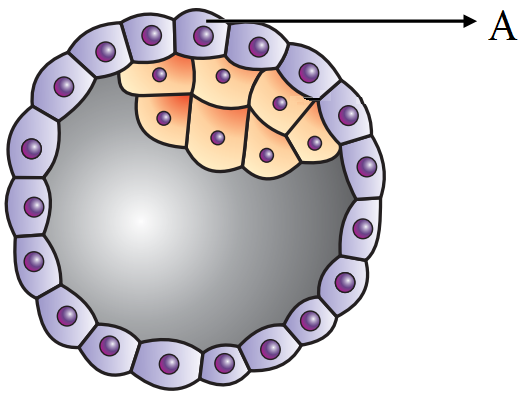
Identify the figure given and the part labelled “A”.
Answer
It is a mammalian blastocyst.
A is trophoblast.
View full question & answer
Question 1221 Mark
Define spermiogenesis. Where does it occur?
Answer
Spermiogenesis is the formation of haploid, microscopic and functional spermatozoa (male gametes) from the spermatids. It takes place in the testes (male reproductive organ).
View full question & answer
Question 1231 Mark
State the functions of acrosome.
Answer
Acrosome contains hydrolytic enzymes used to penetrate the egg during fertilisation.
View full question & answer
Question 1271 Mark
The basal parts of the endometrium remain intact during menstruation. Give reason.
Answer
The basal parts of endometrium remain intact as they form the source of new endometrial lining and glands for the next cycle.
View full question & answer
Question 1291 Mark
What is meant by gestation period?
Answer
The time period between implantation and parturition, when the embryo completes its growth and development, is called gestation period.
View full question & answer
Question 1301 Mark
Which part of the blastula is destinated to form germ layers of the developing embryo in humans?
Answer
ICM (Inner Cell Mass).
View full question & answer
Question 1311 Mark
Write the physiological reason, why a woman generally cannot conceive a child after 50 years of age.
Answer
Menopause, i.e. stoppage of menstrual cycles occurs around 50 years of age; since no ovulation occurs, the woman cannot conceive after this age.
View full question & answer
Question 1321 Mark
Name any two hormones found in the blood of a pregnant female only.
Answer
Relaxin and human chorionic gonadotropin.
View full question & answer
Question 1331 Mark
What is the function of umbilical cord?
Answer
Placenta is connected to embryo through umbilical cord and helps in transport of substance to and from the embryo.
View full question & answer
Question 1341 Mark
Mention the functions of trophoblast in human embryo.
Answer
Trophoblast is cells forming the outer layer of a blastocyst, which provide nutrients to the embryo and develop into a large part of the placenta. They are formed during the first stage of pregnancy and are the first cells to differentiate from the fertilized egg.
View full question & answer
Question 1351 Mark
What are chorionic villi?
Answer
Chorionic villi are the finger-like projections formed by the trophoblast immediately after implantation; they form the foetal part of the placenta.
View full question & answer
Question 1361 Mark
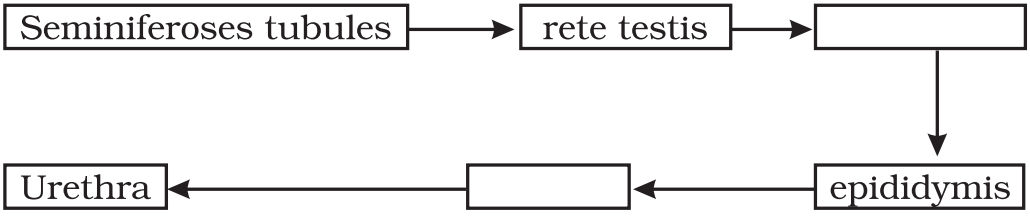
What is the name of network formed by the fusion of open ends of seminiferous tubules? Where does this network lead to?
Answer
Rete testis. It leads to vas deference.
View full question & answer