Question types

Microbes in Human Welfare question types

552 questions across 8 question groups — pick any mix to generate a BIOLOGY paper with step-by-step answer keys.

552
Questions
8
Question groups
5
Question types
Sample Questions

Microbes in Human Welfare questions

One sample from each question group in this chapter. Select any group above to see the full set with answer keys.

Q 203 Marks Question3 Marks
Three water samples namely river water, untreated sewage water and secondary effluent discharged from a sewage treatment plant were subjected to BOD test. The samples were labelled A, B and C; but the laboratory attendant did not note which was which. The BOD values of the three samples A, B and C were recorded as 20mg/L, 8mg/L and 400mg/L, respectively. Which sample of the water is most polluted? Can you assign the correct label to each assuming the river water is relatively clean?
View full solution
Arrange the following in the decreasing order (most important first) of their importance, for the welfare of human society. Give reasons for your answer.
View full solution
As we know, our rivers Ganga and Yamuna are getting polluted day-by-day. Many factories discharge sewage effluents into these rivers. The load of pollution in these rivers also increases due to municipal sewage and many things thrown by people in the name of worship. The government has however taken some steps to save these rivers.
  1. What are the values shown by people who throw wastes in rivers?
  2. How could we help in decreasing pollution of rivers?
  3. State some advantages of saving the river
  4. State the action taken by the government to stop the pollution in these rivers.
View full solution
Anukool is a big businessman in Delhi, but belongs to a small village. He went to his village during Christmas holiday. He was very disturbed to see women still using cowdung's cakes to prepare food there. He decided to set up a biogas plant so that people can use gas obtained from it for cooking. The villagers were very thankful to Anukool for his valuable help.
  1. What is biogas?
  2. What are the uses of biogas?
  3. Name some microorganisms involved in biogas production.
  4. What are the values shown by Anukool?
View full solution
Two statements are given-one labelled Assertion and the other labelled Reason. Select the correct answer to these questions from the codes (a), (b), (c) and (d) as given below.
  1. Both assertion and reason are true and reason is the correct explanation of assertion.
  2. Both assertion and reason are true but reason is not the correct explanation of assertion.
  3. Assertion is true but reason is false.
  4. Both assertion and reason are false.
Assertion: An organism which acts as herbicide is called bioherbicide.
Reason: Phytophthora palmivora is a mycoherbicide.
View full solution
Two statements are given-one labelled Assertion and the other labelled Reason. Select the correct answer to these questions from the codes (a), (b), (c) and (d) as given below.
  1. Both assertion and reason are true and reason is the correct explanation of assertion.
  2. Both assertion and reason are true but reason is not the correct explanation of assertion.
  3. Assertion is true but reason is false.
  4. Both assertion and reason are false.
Assertion: The alcoholic content of fortified wines are high.
Reason: The fermentation is stopped before all the sugars are being converted.
View full solution
Two statements are given-one labelled Assertion and the other labelled Reason. Select the correct answer to these questions from the codes (a), (b), (c) and (d) as given below.
  1. Both assertion and reason are true and reason is the correct explanation of assertion.
  2. Both assertion and reason are true but reason is not the correct explanation of assertion.
  3. Assertion is true but reason is false.
  4. Both assertion and reason are false.
Assertion: Azolla is used as a biofertiliser in rice fields.
Reason: Azolla shows the presence of N2 - fixing bacteria in its leaf cavities.
View full solution
Two statements are given-one labelled Assertion and the other labelled Reason. Select the correct answer to these questions from the codes (a), (b), (c) and (d) as given below.
  1. Both assertion and reason are true and reason is the correct explanation of assertion.
  2. Both assertion and reason are true but reason is not the correct explanation of assertion.
  3. Assertion is true but reason is false.
  4. Both assertion and reason are false.
Assertion: Immobilised yeasts cause less fermentation.
Reason: Brewer's yeast produces beer not wine.
View full solution
Two statements are given-one labelled Assertion and the other labelled Reason. Select the correct answer to these questions from the codes (a), (b), (c) and (d) as given below.
  1. Both assertion and reason are true and reason is the correct explanation of assertion.
  2. Both assertion and reason are true but reason is not the correct explanation of assertion.
  3. Assertion is true but reason is false.
  4. Both assertion and reason are false.
Assertion: Azotobacter fixes nitrogen in symbiotic form.
Reason: Azotobacter form root nodules in the roots of leguminous plants.
View full solution
Read the following and answer any four questions from (i) to (v) given below:

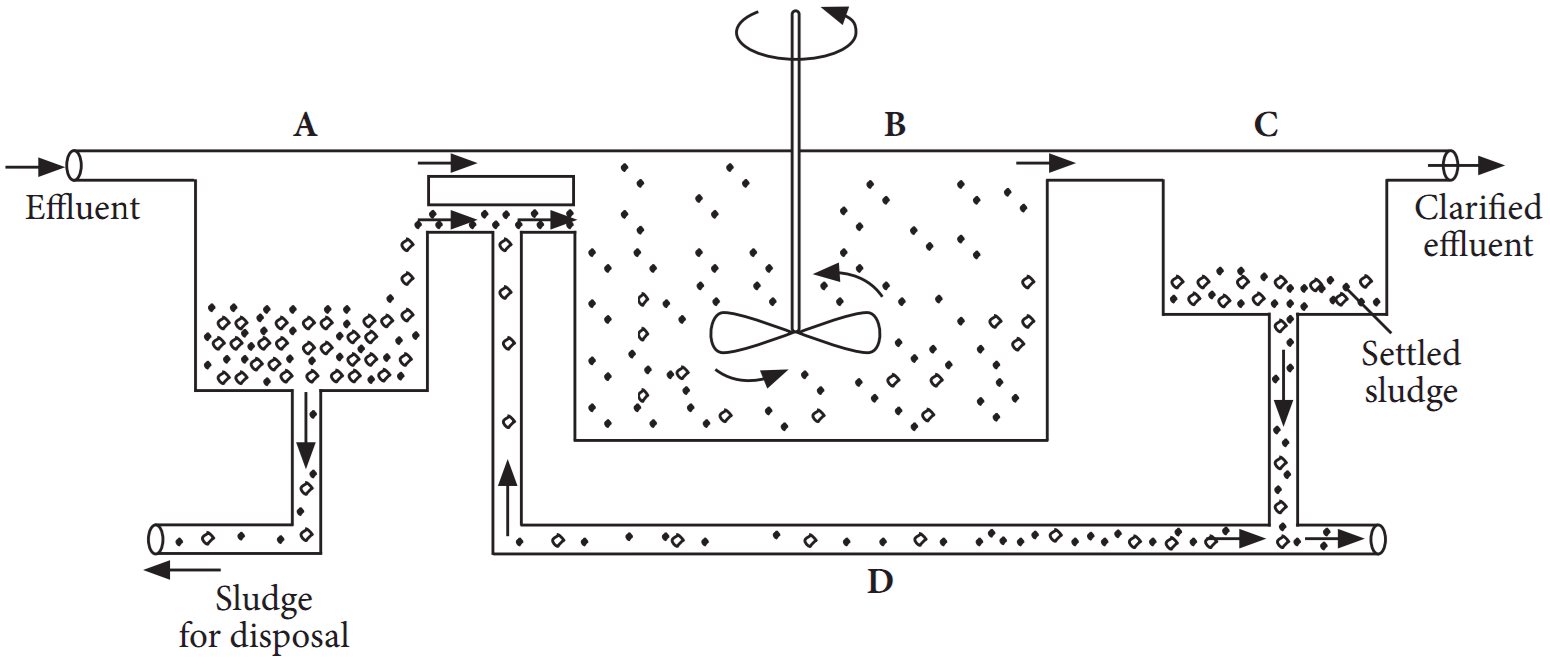
Saurin, a M.Sc student, get an assignment on sewage treatment plant (STP) to study the microbial load. After visiting such plant in his locality, he makes a simplified diagram of the STP for his project. Study the diagram given below and answer the following questions.

  1. In the diagram 'A' denotes:
  1. Aeration tank.
  2. Primary settling tank.
  3. Secondary settling tank.
  4. Sludge digester.
  1. Which of the following is incorrect regarding the sludge released from A?
  1. It is formed after primary treatment.
  2. It does not require aeration.
  3. It possesses floes of decomposer microbes.
  4. It is used in landfills.
  1. A large number of aerobic heterotrophic microbes grow in:
  1. A
  2. B
  3. C
  4. Both (a) and (b).
  1. What is denoted by 'D' in the given diagram?
  1. Primary sludge.
  2. Primary effluent.
  3. Activated sludge.
  4. Secondary effluent.
  1. Assertion: The colloided and finely suspended matter of sewage form aggregates which are called floes.

Reason: Floes contain masses of bacteria, slime and fungal filaments.

  1. Both assertion and reason are true and reason is the correct explanation of assertion.
  2. Both assertion and reason are true but reason is not the correct explanation of assertion.
  3. Assertion is true but reason is false.
  4. Both assertion and reason are false.
View full solution
Read the following and answer any four questions from (i) to (v) given below:
Enzymes are best known for their ability to catalise biochemical reactions without undergoing any change. A large number of enzymes are being used in biotechnological industry. Most of them are obtained from microbes. Proteases degrade proteins and polypeptides. Most of the commercially applicable proteases are alkaline and are biosynthesised mainly by bacteria such as Pseudomonas, Bacillus and some fungi like, Aspergillus. These enzymes are used in clearing beer, softening of bread and meat, degumming of silk, etc. Alkaline serine proteases have the largest applications in bio-industry. Alkaline proteases have shown their capability to work under high pH, temperature and in presence of inhibitory compounds. Another important group of enzymes is amylases. Amylolytic enzymes act on starch. These are obtained from Aspergillus, Rhizopus and Bacillus sp. These are used in softening and sweetening of bread, production of alcoholic beverages from starchy materials, clearing of turbidity in juices caused by starch, etc.
  1. Polypeptides are degraded by:
  1. Amylases.
  2. Proteases.
  3. Pectinases.
  4. Lipases.
  1. Amylolytic enzymes are not obtained from:
  1. Aspergillus.
  2. Aspergillus.
  3. Mucor.
  4. Bacillus.
  1. Clearing of turbidity in juices caused by starch is achieved by:
  1. Amylases.
  2. Proteases.
  3. Rennet.
  4. Both (a) and (b).
  1. Select the incorrect option from the following.
  1. Enzymes are proteinaceous substances.
  2. Enzymes are substrate specific.
  3. Enzymes are large sized molecules.
  4. Microbial enzymes can work only in normal temperature and pH.
  1. A farmer harvests corns and prepares corn starch. He wants to prepare some corn syrup from this. for the conversion he needs to use enzyme ______.
  1. Amylase.
  2. Glucoamylases.
  3. Glucoisomerases.
  4. All of these.
View full solution
Read the following and answer any four questions from (i) to (v) given below:

Discovery of penicillin by Alexander Fleming in 1928 marked the beginning of the remarkable era in medical field. Penicillin was the first antibiotic extracted from Penicillium notatum. Antibiotics are used to treat bacterial diseases. These can be broad spectrum which can kill diverse group of disease causing bacteria and narrow spectrum which is effective only against one group of pathogenic strain. Antibiotics can act as bactericides or bacteriostatic. Bactericidal antibiotics kill bacteria by - disruption of cell wall synthesis (e.g., penicillin, cephalosporin, etc.), inhibition of SOS ribosome function (e.g.; erythromycin), inhibition of 30S ribosome function (e.g., streptomycin, neomycin), inhibition of amino acid-tRNA binding to ribosome (e.g., tetracyline). etc. Bacteriostatic antibiotics do not kill the bacteria rather they restrict the growth of bacteria. Penicillin belongs to $\beta$-lactum group of antibiotics and it inhibits bacterial cell wall synthesis by binding and inactivating protein. It inhibits transpeptidation of reaction and blocks cross-linking of the cell wall. It is used to treat tonsilitis, sore throat, gonorrhoea, rheumatic fever and some pneumonia types.

  1. The first antibiotic was extracted from a:
  1. Lichen.
  2. Fungus.
  3. Eubacteria.
  4. Acti-nomycetes.
  1. Which of the following kills bacteria by interfering SOS ribosome function?
  1. Cephalosporin.
  2. Erythromycin.
  3. Streptomycin.
  4. Neomycin.
  1. $\beta$-lactum group of antibiotics kill the bacterial pathogen by:
  1. Disruption of plasma membrane.
  2. Inhibition of translation of mRNA.
  3. Inhibition of translation of mRNA
  4. Inhibition of transcription of mRNA.
  1. Penicillin is not used to treat.
  1. Pneumonia.
  2. Tonsilitis.
  3. Rheumatic fever.
  4. Candidiasis.
  1. Assertion: Cephalosporins act by disruption of bacterial cell wall synthesis mechanism.

Reason: Cephalosporins are bacteriostatic antibiotics.

  1. Both assertion and reason are true and reason is the correct explanation of assertion.
  2. Both assertion and reason are true but reason is not the correct explanation of assertion.
  3. Assertion is true but reason is false.
  4. Both assertion and reason are false.
View full solution
Read the following and answer any four questions from (i) to (v) given below:
Green manuring is the fanning practice where a leguminous plant which has derived enough benefits from its association with appropriate species of Rhizobium, is ploughed into the field soil and then a non-legume is sown and allowed to get benefitted from the already present nitrogen fixer. Some legumes, such as, Crotolaria juncea, Sesbania rostrata, Lencaena leucocephala, etc. are used as green manure. Rhizobia, that fix atmospheric nitrogen in the form of nitrate, live in the roots ofleguminous plants. These nutrients are used by non-leguminous plants through the practice of green manuring.
  1. Green manures mainly provide nutrient enriched in:
  1. Magnesium.
  2. Sulphur.
  3. Nitrogen.
  4. Both (a) and (b).
  1. Which of the following plants is used as green manure in crop fields?
  1. Saccharum.
  2. Dichanthium.
  3. Phyllonthus.
  4. Crotolaria.
  1. Green manure plants belong to the Family:
  1. Lamiaceae.
  2. Papilionaceae.
  3. Liliaceae.
  4. Poaceae.
  1. Due to excess use of chemical fertilisers rich in nitrate, ________ disease occurred in children.
  1. Jaundice.
  2. Septicemia.
  3. Methemoglobinemia.
  4. Botulism.
  1.  A green manure is:
  1. Rice.
  2. Maize.
  3. Sorghum.
  4. Sesbania.
View full solution
Read the following and answer any four questions from (i) to (v) given below:
Disposal of untreated sewage into the river or freshwater pond causes huge water pollution. Four water samples from different sources (A, B, C, D) are collected and tested for BOD value in a lab to assess their quality. The BOD values are presented in the given table. Water samples are collected from primary effluent, secondary effluent, untreated sewage and river water. Study the given table and answer the following.
Sample BOD
A 20mg/ L
B 5mg/ L
C 300mg/ L
D 400mg/ L
  1. The source of sample 'C' is:
  1. River water.
  2. Primary effluent.
  3. Secondary effluent.
  4. Untreated sewage water.
  1. If sewage in untreated condition is disposed off in a freshwater body then.
  1. BOD and dissolved oxygen both will increase.
  2. BOD will increase and dissolved oxygen will decreas.
  3. BOD will decrease and dissolved oxygen will increase.
  4. BOD and dissolved oxygen both will decrease.
  1. A large number of pathogenic microbes can be present in water sample of:
  1. C
  2. A
  3. D
  4. Both (a) and (c).
  1. High value of BOD in sample O is due to:
  1. High amount of organic wastes and aerobic microbes.
  2. High amount of inorganic wastes and anaerobic microbes.
  3. High amount of organic wastes and anaerobic microbes.
  4. High amount of inorganic wastes and aerobic microbes.
  1. River water is represented by the sample.
  1. A
  2. B
  3. C
  4. D
View full solution

Generate a Microbes in Human Welfare paper free

Pick question groups from the list above, set marks and difficulty, and export a branded PDF with step-by-step answer keys. First 3 chapters free — no signup.

Download App