Questions

5 Marks Questions

Take a timed test

22 questions · self-marked practice — reveal the answer and mark yourself.

Question 15 Marks
Do you think microbes can also be used as source of energy? If yes, how?
Answer
Yes, microbes can be used as a source of energy. Bacteria such as Methane bacterium is used for the generation of gobar gas or biogas.
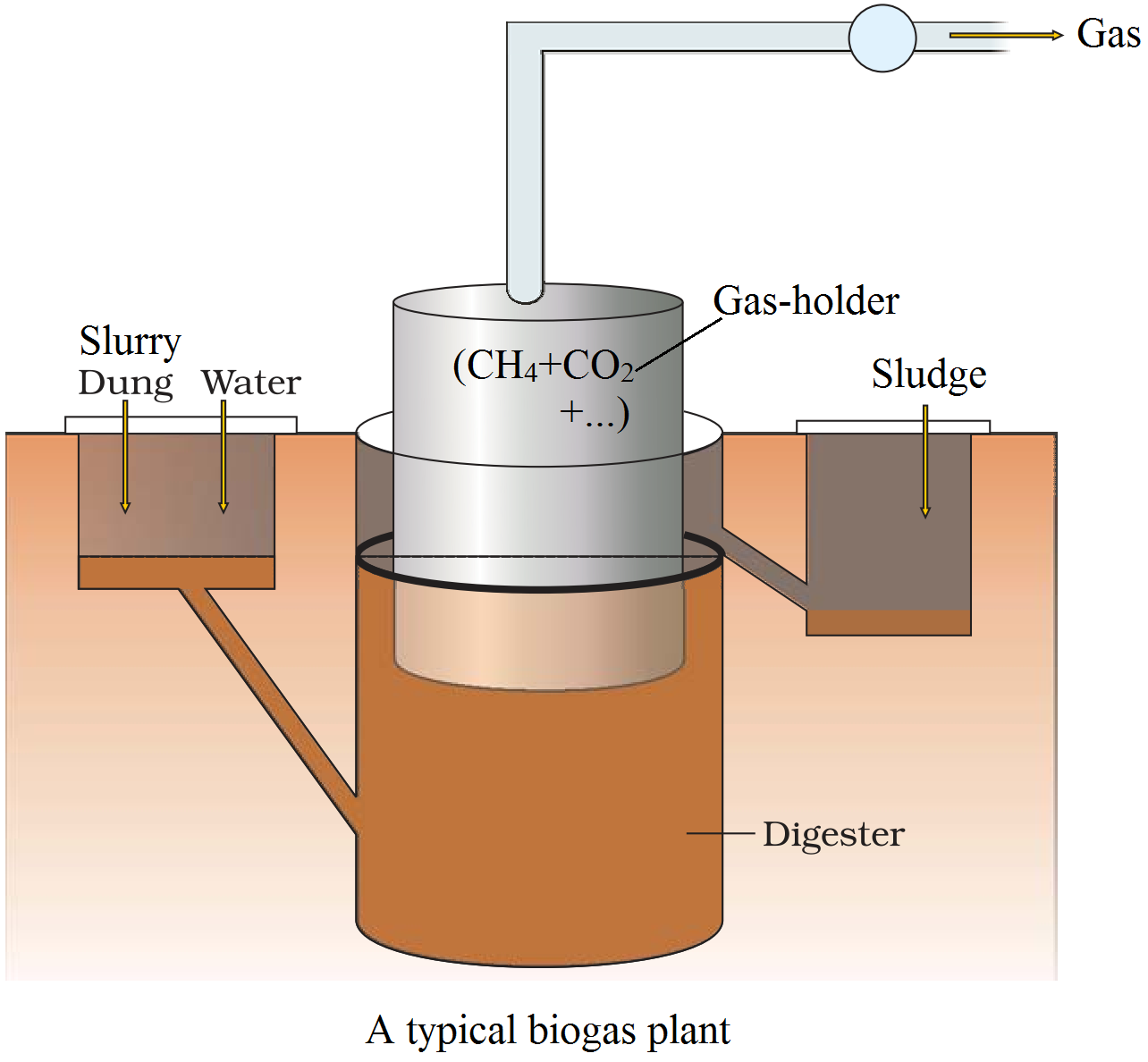
  1. The generation of biogas is an anaerobic process in a biogas plant, which consists of a concrete tank (10-15 feet deep) with sufficient outlets and inlets.
  2. The dung is mixed with water to form the slurry and thrown into the tank. The digester of the tank is filled with numerous anaerobic methane-producing bacteria, which produce biogas from the slurry.
  3. Biogas can be removed through the pipe which is then used as a source of energy, while the spent slurry is removed from the outlet and is used as a fertilizer.
View full question & answer
Question 25 Marks
Arrange the following in the decreasing order (most important first) of their importance, for the welfare of human society. Give reasons for your answer.
Answer
Biogas, Citric acid, Penicillin and Curd.Curd: Less important for society - as it depends on individual use and has only nutritions value.
Citric acid: Industrial use, not for dissipation in community. Penicillin: Medicinal use of microbes, good for health of society, commercially more usable. Biogas: Most important for community welfare as:
  1. It reduces excreta, waste from community.
  2. It produces inflammable gases, can be used as energy source.
  3. It is a renewable source.
  4. It has multidimensional utility.
  5. It is easily maintained and dissipated for community purpose.
View full question & answer
Question 35 Marks
Microbes can be used to decrease the use of chemical fertilisers and pesticides. Explain how this can be accomplished.
Answer
Microbes play an important role in organic farming, which is done without the use of chemical fertilizers and pesticides. Bio-fertilizers are living organisms which help increase the fertility of soil. It involves the selection of beneficial micro-organisms that help in improving plant growth through the supply of plant nutrients. Biofertilizers are introduced in seeds, roots, or soil to mobilize the availability of nutrients. Thus, they are extremely beneficial in enriching the soil with organic nutrients. Many species of bacteria and cyanobacteria have the ability to fix free atmospheric nitrogen. Rhizobium is a symbiotic bacteria found in the root nodules of leguminous plants. Azospirillium and Azotobocter are free living nitrogen-fixing bacteria, whereas Anabena, Nostoc and Oscillitoria are examples of nitrogen-fixing cyanobacteria. Bio-fertilizers are cost effective and eco- friendly. Microbes can also act as bio-pesticides to control insect pests in plants. An example of bio-pesticides is Bacillus thuringiensis, which produces a toxin that kills the insect pests. Dried bacterial spores are mixed in water and sprayed in agricultural fields. When larvae of insects feed on crops, these bacterial spores enter the gut of the larvae and release toxins, thereby it. Similarly, Trichoderma are free living fungi. They live in the roots of higher plants and protect them from various pathogens. Baculoviruses is another bio-pesticide that is used as a biological control agent against insects and other arthropods.
View full question & answer
Question 45 Marks
As we know, our rivers Ganga and Yamuna are getting polluted day-by-day. Many factories discharge sewage effluents into these rivers. The load of pollution in these rivers also increases due to municipal sewage and many things thrown by people in the name of worship. The government has however taken some steps to save these rivers.
  1. What are the values shown by people who throw wastes in rivers?
  2. How could we help in decreasing pollution of rivers?
  3. State some advantages of saving the river
  4. State the action taken by the government to stop the pollution in these rivers.
Answer
  1. People are careless, superstitious and unaware.
  2. We can help in decreasing pollution of rivers by adopting following habits.
  1. By throwing litter or polybags in dustbin instead of rivers.
  2. By using environment friendly household products such as washing powder, household cleaning agents, etc.
  3. By planting more and more trees, which prevent fertilisers, pesticides and contaminated water from running into nearby rivers.
  1. Some advantages of saving rivers are-
  1. Constant supply of water and food to us.
  2. Huge supply of all natural fertilisers, which is good for growing crops.
  1. Government has initiated Ganga Action Plan and Yamuna Action Plan to save these rivers from pollution.
View full question & answer
Question 55 Marks
In what way anaerobic sludge diagestion is important in sewage treatments?
Answer
Once the BOD of sewage or waste water is reduced significantly, the effluent is then passed into a settling tank where the bacterial ‘floes’ are allowed to sediment. This sediment is called activated sludge. A small part of the activated sludge is pumped back into the aeration tank to serve as the inoculum. The remaining major part of the sludge is pumped into large tanks called anaerobic sludge digesters. Here, other kinds of bacteria, which grow anaerobically, digest the bacteria and the fungi in the sludge. During this digestion, bacteria produce a mixture of gases such as methane, hydrogen sulphide and carbon dioxide. These gases form biogas and can be used as a source of energy as it is inflammable.
View full question & answer
Question 65 Marks
Anukool is a big businessman in Delhi, but belongs to a small village. He went to his village during Christmas holiday. He was very disturbed to see women still using cowdung's cakes to prepare food there. He decided to set up a biogas plant so that people can use gas obtained from it for cooking. The villagers were very thankful to Anukool for his valuable help.
  1. What is biogas?
  2. What are the uses of biogas?
  3. Name some microorganisms involved in biogas production.
  4. What are the values shown by Anukool?
Answer
  1. Biogas is a mixture of gases produced from degradable organic matter by activity of microorganisms.
  2. It is used as a fuel for heating, cooking, lighting, power for irrigation, etc.
  3. Microorganisms involved are methanogens such as Methanobacterium.
  4. Anukool is helpful, intelligent, has human values and care for people.
View full question & answer
Question 75 Marks
More than 25% of human population is suffering from hunger and malnutrition. Scientists have developed techniques where microbes are grown on industrial scale as a source of good protein which can be grown from waste water, animal manure and even sewage.
Based on the above information answer the following questions.
  1. In what ways would it be helpful to humans?
  2. What can be the response to such new ventures?
  3. What values have been manifested in the above case?
Answer
  1. It would be helpful to humans as microorganisms are fast growing, the food is rich in nutrients and it reduces pollution.
  2. Initially, there can be very low response, but it is expected to have high response (as of mushroom culture in the recent years).
  3. Recycling nutrients and minimising pollution for the betterment of the environment.
View full question & answer
Question 85 Marks
Draw a diagrammatic sketch of biogas plant, and label its various components given below: Gas Holder, Sludge Chamber, Digester, Dung + water chamber.
View full question & answer
Question 95 Marks
Ramesh is a small scale farmer and holds 2.5 acres of land. He would like to increase the yield in his farm. Rahul, a student of MSc. (Agriculture) advised him to go to the agricultural department centre of his locality to get biofertilisers according to the variety of the crop. He also suggested Ramesh to stop the use of chemical fertilisers.
  1. Explain the term biofertilisers.
  2. Name the biofertiliser that is used mostly in paddy fields.
  3. What are the values shown by Rahul?
Answer
  1. The chemical fertilisers are being used in increasing amounts in order to increase the agricultural output. However, due to excessive use of these chemical fertilisers, there is increase in pollution of water bodies. Thus, 'there is a pressure to shift to organic farming.
  2. Cyanobacteria.
  3. Rahul is helpful in nature. He uses his knowledge for the benefit of the society. Moreover, he is concerned to protect the environment from pollution as he discouraged the use of chemical fertilisers.
View full question & answer
Question 105 Marks
“Microbes play a dual role when used for sewage treatment as they not only help to retrieve usable water but also generate fuel”. Explain.
Answer
  • Microbes naturally present in the sewage are employed in the secondary treatment of the sewage.
  • The effluent from the primary treatment is passed into large aeration tanks.
  • This allows the rapid growth of aerobic microbes into flocs which consume the organic matter of the sewage and reduces the BOD.
  • Then the effluent is passed into a settling tank, where the flocs are allowed to sediment forming the activated sludge.
  • Major parts of this activated sludge is pumped into anaerobic sludge digesters, where the anaerobic bacteria digest microbes in the activated sludge.
  • During this digestion bacteria produce a mixture of gases like methane, hydrogen sulphide and carbon dioxide, which form the biogas and can be used as a source of energy. The effluent is generally released into rivers and streams.
View full question & answer
Question 115 Marks
Discuss the role of microbes as biofertilisers in detail.
Answer
The chemical fertilisers are being used in increasing amounts in order to increase the agricultural output. However, due to excessive use of these chemical fertilisers, there is increase in pollution of water bodies. Thus, there is a pressure to shift to organic farming Biofertilisers are organisms that enrich the nutrient quality of soil by enhancing the availability of nutrients to the crops. The main sources of biofertilisers are as given below
Bacteria
Nitrogen-fixing bacteria fix atmospheric nitrogen into organic form, which is used by the plant as nutrient, e.g. Rhizobium is a symbiotic bacterium that lives in the root nodules of legumes and fixes atmospheric nitrogen into organic compounds. Azotobacter and Azospirill are free-living bacteria, which absorb free nitrogen from the soil, air and convert it into salts of nitrogen compounds.
Fungi
They also form symbiotic association with plants, i.e. mycorrhiza, which absorb phosphorus from soil and passes it to the plants. Many members of genus Glomus form mycorrhiza. Plants with mycorrhizal association show other benefits also such as.
  1. Resistance to root-borne pathogens.
  2. Tolerance to salinity and drought.
  3. Increase in plant growth and development.
Cyanobacteria
These are autotrophic microbes found in aquatic and terrestrial environments. Most of them fix atmospheric nitrogen, e.g. Anabaena, Nortoc, Oscillatoria, etc. In paddy fields, cyanobacteria serve as important biofertiliser. Blue-Green Algae (BGA) also add organic matter to the soil. Thus, increasing its fertility, but still BGA are not very popularly used.
View full question & answer
Question 125 Marks
What is biogas? Explain its production with the help of a diagram.
Answer
It is a mixture of gases, but the major content is methane gas. It is produced by the anaerobic microbial activity during digestion of biomass with the help of certain bacteria. Biogas is used as fuel. The excreta of cattle commonly called gobar is rich in methanogenic bacteria. Thus, cattle dung can be used for generation of biogas, commonly called gobar gas.
Cattle dung is available in large quantities in rural areas hence, biogas plants are mostly functional in rural areas.
Biogas plant consists of a concrete tank (10-15 feet deep) in which bio-wastes are collected and slurry of dung is fed. A floating cover is placed over the slurry, which keeps on rising, as the gas is produced in the tank due to the microbial activity.

Methanobacterium in the dung acts on the bio-waste to produce biogas. An outlet is also present which connects to a pipe that supply biogas to the nearby houses. There is another outlet from which spent slurry is removed that can be used as fertiliser. The biogas thus produced is used for cooking and lighting. Biogas production technology was developed in India mainly by Khadi and Village Industries Commission (KVIC) and Indian Agricultural Research Institute (IARI).
View full question & answer
Question 135 Marks
Enumerate the role of microbes in producing some household products.
Answer
Microbes in Household Products:
  1. Curd:
  • Curd is formed by adding a small amount of curd to milk, which acts as a starter.
  • Lactobacillus and lactic acid bacteria (LAB) present in starter, multiply at suitable temperature and convert milk into curd.
  • Acids released by LAB during the growth coagulates and partially digest milk protein, casein.
  • Benefits of LAB:
  1. Increases vitamin B12 amount thus increasing nutrient quality of milk.
  2. Checks disease-causing microbes in stomach.
  1. Dough:
  • Dough is formed by fermentation by bacteria.
  • Bread is made by fermentation by Saccharomyces cerevisiae or commonly called baker’s yeast.
  • $CO_2$ released during the process of fermentation gives the puffy appearance to dough.
  • It is used to make foods like idli, dosa, bread, etc.
  1. Toddy:
  • It is a traditional drink of Southern India.
  • It is made by fermentation of sap from palm trees by bacteria.
  1. Cheese:
  • Cheese is formed by partial degradation of milk by different microorganisms.
  • Swiss cheese is formed by the bacterium Propionibacterium sharmanii. Its characteristic feature is formation of large holes due to production of large amount of CO2.
  • Roquefort cheese is formed by ripening with the fungi Penicillium roqueforti for a particular flavour.
View full question & answer
Question 145 Marks
Why should biological control of pests and pathogens be preferred to the conventional use of chemical pesticides? Explain how the following microbes act as biocontrol agents:
  1. Bacillus thuringiensis.
  2. Nucleopoly hedrovirus.
Answer
Biological control of pests and pathogens is preferred because:
  1. The chemicals cause pollution of water bodies as well as ground water, besides getting stored in the plants.
  2. The chemicals are toxic thus extremely harmful to human beings and other animals.
  1. Bacillus thuringiensis: B. thuringiensis toxin genes when introduced into plant, become resistant to attack by insect pests. They are available in sachets as dried spores, which are mixed with water and sprayed onto vulnerable plants. When they are eaten by the insect larvae, the toxin is released in the gut where it becomes active and kills the larvae. Specific Bt toxin genes obtained from B. thuringiensis are used in several crop plants which make them resistant to insect pest.
  2. Nucleopolyhedrovirus: These viruses are excellent candidates for species-specific, narrow spectrum insecticidal applications. This is especially desirable when beneficial insects are being conserved to aid in an overall integrated pest management (IPM) programme.
View full question & answer
Question 155 Marks
Why is aerobic degradation more important than anaerobic degradation for the treatment of large volumes of waste waters rich in organic matter. Discuss.
Answer
Organic matter in waste water consumes lot of oxygen to carry on various biological processes. It results in reduction of oxygen level in the surrounding air and thus can increase air pollution. Consumption of oxygen by organic matter in waste water is measured by BOD (Biochemical Oxygen Demand). A higher level of BOD indicates a higher polluting potential of wastewater. It is important to reduce the BOD so that pollution can be reduced. Hence, aerobic degradation is more important than anaerobic degradation for the treatment of large volumes of waste waters rich in organic matter. BOD level is reduced by aerobic degradation which is carried out by floc. Flocs are associations of bacteria and fungi which form meshlike structures. Flocs eat away most of the organic matter in waste water and thus help in reducing BOD. Once BOD is pulled down below a threshold level, the sludge is ready for anaerobic degradation.
View full question & answer
Question 165 Marks
Write short notes on:
Yamuna Action Plan
Answer
Yamuna Action Plan: In order to protect the major rivers of India from sewage pollution, the Ministry of Environment and Forests has initiated development of sewage treatment plants under the National River Conservation Authority, e.g., Ganga Action Plan and Yamuna Action Plan. Industries contribute chemical effluents to the river’s pollution load and the toxicity kills aquatic animals in large sections of the river. Under these plans, a large number of sewage treatment plants were built so that only treated sewage is discharged into the rivers.
View full question & answer
Question 175 Marks
Describe the main idea behind the biological control of pests and diseases.
Answer
It is a method of controlling pests in agriculture that relies on natural predation and not on chemicals. Organic farmers believe that 'biodiversity furthers health'. The more diversity a landscape has, the more sustainable it is. Therefore, they work to create a system where the insects (pests) are not eradicated, but kept at manageable levels by a complex system of checks and balance within a living and vibrant ecosystem.
Unlike conventional farming practices where chemical methods are used to kill both useful and harmful life forms indiscriminately, this is a holistic approach, as it seeks to develop an understanding of the webs of interaction between the myriad of organisms, including both flora and fauna in the field. Biological farming approach requires familiarity with various life forms, their habitat, predators as well as pest, their life cycle, patterns of feeding, etc. to use them in biocontrol measures and reduce the dependence on chemicals and pesticides.
View full question & answer
Question 185 Marks
Ganga has recently been declared the national river. Discuss the implication with respect to pollution of this river.
Answer
The Ganga is the largest river in India with an extraordinary religious ‘ importance for Hindus. Situated along its banks are some of the world’s oldest inhabited cities like Varanasi and Patna. It provides water to about 40% of India’s population across 11 states, serving an estimated population of 500 million people or more, which is larger than any other river in the world.
A number of initiatives have been undertaken to clean the river but failed to deliver desired results. After getting elected, India’s Prime minister Narendra Modi affirmed to work for cleaning the river and controlling pollution. Subsequently, Namami Ganga project was announced by the Government in July 2014 budget. An estimated Rs 2,958 crores have been spent till July 2016 in various efforts to clean up the river.
View full question & answer
Question 195 Marks
Which type of food would have lactic acid bacteria. Discuss their useful application.
Answer
Lactic acid bacteria are present in milk products which are prepared by fermentation. They are also found in pickled vegetables and wines.Following are some useful application of lactic acid bacteria:
  • Used for making curd and cheese.
  • Used for making pickled vegetables. Kimchi is a popular South Korean dish and it contains lactic acid.
  • Lactic and bacteria are used for making probiotics. Probiotics are taken as supplements in order to restore the gut flora. Probiotics can help in getting rid of diarrhoea, irritable bowel syndrome, etc.
  • Many types of bread are made with the help of lactic acid bacteria.
View full question & answer
Question 205 Marks
What are biofertilisers? Name the categories of organisms used as biofertilisers with an example for each. How do they function in organic farming?
Answer
MICROBES AS BIOFERTILISERS
The chemical fertilisers are being used in increasing amounts in order to increase the agricultural output. However, due to excessive use of these chemical fertilisers, there is increase in pollution of water bodies. Thus, there is a pressure to shift to organic farming Biofertilisers are organisms that enrich the nutrient quality of soil by enhancing the availability of nutrients to the crops. The main sources of biofertilisers are as given below.
Bacteria
Nitrogen-fixing bacteria fix atmospheric nitrogen into organic form, which is used by the plant as nutrient, e.g. Rhizobium is a symbiotic bacterium that lives in the root nodules of legumes and fixes atmospheric nitrogen into organic compounds. Azotobacter and Azospirillum are free-living bacteria, which absorb free nitrogen from the soil, air and convert it into salts of nitrogen compounds.
Fungi
They also form symbiotic association with plants, i.e. mycorrhiza, which absorb phosphorus from soil and passes it to the plants. Many members of genus Glomas form mycorrhiza. Plants with mycorrhizal association show other benefits also such as.
  1. Resistance to root-borne pathogens.
  2. Tolerance to salinity and drought.
  3. Increase in plant growth and development.
Cyanobacteria
These are autotrophic microbes found in aquatic and terrestrial environments. Most of them fix atmospheric nitrogen, c.g. Anabaena, Nostoc, Oscillatoria, etc. In paddy flelds, cyamulleria Seive important biofertiliser. Blue-Green Algae (BGA) also add organic matter to the soil. Thus, increasing its fertility, but still BGA are not very popularly used.
View full question & answer
Question 215 Marks
Complete the given table.
Name of the organism Product/ Enzyme/ Bioactive male cule
Aspergillus niger (i)
(ii) Ethanol
(iii) Cyclosporin-A
(iv) Acetic acid
Monascus purpureus (v)
Streptococcus (vi)
Answer
  1. Citric acid
  2. Saccharomyces cerevisiae
  3. Trichoderma polysporum
  4. Acetobacter aceti
  5. Statin
  6. Streptokinase
View full question & answer
Question 225 Marks
Describe the main ideas behind the biological control of pests and diseases.
Answer
Biological control of pests and diseases is based on the interdependency among various components of an ecosystem. This approach is also based on the acknowledgement of potential harm caused by chemical control of pests and diseases.
  • Checks and balances in ecosystem: In any given ecosystem; various organisms are dependent on each other and on abiotic factors. Pests are also part of the ecosystem. It is only when their population goes beyond a certain level that they turn problematic for farmers. If the system of natural check and balances can be understood, then it would be pretty easy for farmers to control the pests without harming useful insects.
  • Drawbacks of chemical control: Synthetic pesticides are highly effective in pest control but their use leads to collateral damage. Many useful insects are killed in the process. This problem can be removed by using biological control.
  • Minimizing pollution: Use of pesticides has another drawback, i.e. creating soil pollution and groundwater pollution. If biological control is applied, then chances of soil pollution and groundwater pollution can be minimized.
View full question & answer