Question 14 Marks
Read the following text carefully and answer the questions that follow:
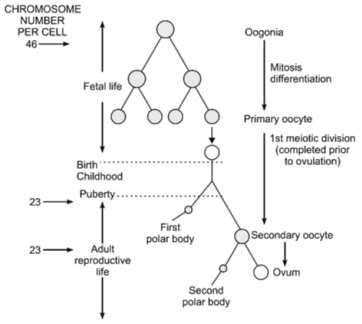
The process of formation of a mature female gamete is called oogenesis which is markedly different from spermatogenesis. A schematic representation of Oogenesis is shown below study the flow chart carefully.
i. How is a primary oocyte different from a secondary oocyte? (1)
ii. Mention the changes taking place during the transition of a secondary follicle to Graafian follicle in the oogonia. (1)
iii. How many primary follicles are left in each ovary in a human female at puberty? (2)
OR
What happen to graafuan follicle after ovulation? (2)
The process of formation of a mature female gamete is called oogenesis which is markedly different from spermatogenesis. A schematic representation of Oogenesis is shown below study the flow chart carefully.
i. How is a primary oocyte different from a secondary oocyte? (1)
ii. Mention the changes taking place during the transition of a secondary follicle to Graafian follicle in the oogonia. (1)
iii. How many primary follicles are left in each ovary in a human female at puberty? (2)
OR
What happen to graafuan follicle after ovulation? (2)
Answer
View full question & answer→i. The primary oocyte is a diploid cell whereas secondary oocyte is a haploid cell. The primary oocyte is formed when oogonia are at the prophase-I of the meiotic division in the foetal ovary whereas secondary oocyte is formed from primary oocyte after meiosis - I division to produce ova in females during the stage of puberty.
ii. The secondary follicle is then transformed into a tertiary follicle characterized by antrum, which is a fluid-filled cavity. At this phase, the primary oocyte grows in size inside the tertiary follicle to complete the first meiotic division. The tertiary follicle finally transitions to form the Graafian follicle.
iii. large number of primary follicles degenerate in females during the period from birth to puberty by the process called follicular atresia. As a result, about 60000-80000 primary follicles are left in each ovary at puberty.
OR
After ovulation, the remaining cells of Graafian follicle are stimulated by LH to develop corpus luteum (an endocrine gland which secrete progesterone hormone).
ii. The secondary follicle is then transformed into a tertiary follicle characterized by antrum, which is a fluid-filled cavity. At this phase, the primary oocyte grows in size inside the tertiary follicle to complete the first meiotic division. The tertiary follicle finally transitions to form the Graafian follicle.
iii. large number of primary follicles degenerate in females during the period from birth to puberty by the process called follicular atresia. As a result, about 60000-80000 primary follicles are left in each ovary at puberty.
OR
After ovulation, the remaining cells of Graafian follicle are stimulated by LH to develop corpus luteum (an endocrine gland which secrete progesterone hormone).