Questions

1.5 Marks Questions

Take a timed test

6 questions · self-marked practice — reveal the answer and mark yourself.

Question 12 Marks
What is LAB? What is its role in human stomach?
Answer
Lactic Acid Bacteria (LAB) or Lactics constitute a diverse group of microorganisms associated with plants, meat, and dairy. They are used in the manufacture of dairy products such as acidophilus milk, yogurt, buttermilk, and cheeses.
Role of LAB in human stomach:
lactic acid bacteria have a number of well-established benefits. They can improve lactose digestion, play a role in preventing and treating diarrhea and act on the immune system, helping the body to resist and fight infection. It play a very beneficial role in checking disease-causing microbes
View full question & answer
Question 22 Marks
Write the various major steps of fermentation.
Answer
The major steps of fermentation are as follows:
i. Sterilisation of the fermentors/bioreactor and nutrient medium in steam, under pressure.
ii. Inoculation of a selected strain of the yeast.
iii. Recovery of the product.
View full question & answer
Question 32 Marks
In the given figure, give the name and functions of parts labelled A and B.
Image
Answer
A. Trophoblast - Gets attached to the endometrium and draws nutritive material secreted by uterine endometrium gland.
B. Inner cell mass - Differentiates as Embryo.
View full question & answer
Question 42 Marks
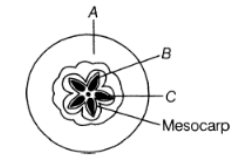
i. Given below is a TS of an apple. Identify A, B, and C.
Image
ii. Why is an apple categorised as a false fruit?
Answer
i. A Thalamus, B - Seed, C - Endocarp.
ii. In apple, along with the ovary the thalamus also contributes to fruit formation. So, apple is called false fruit.
View full question & answer
Question 52 Marks
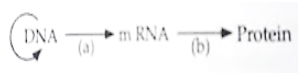
The flow of genetic information is shown below. Name the process of (a) and (b).
Image
Answer
Process 'a' is Transcription and process 'b' is Translation.
View full question & answer
Question 62 Marks
When a foreign DNA is introduced into an organism, how it is maintained in the host and how it is transferred to the progeny of the organism?
Answer
Foreign gene is usually ligated to a plasmid vector and introduced in the host. As plasmid replicates and makes multiple copies of itself, so does the foreign gene gets replicated and its copies are made. When the most organism divides, its progeny also receive the plasmid DNA containing the foreign gene.
View full question & answer