Question types

MODEL PAPER 5 question types

38 questions across 6 question groups — pick any mix to generate a BIOLOGY paper with step-by-step answer keys.

38
Questions
6
Question groups
5
Question types
Sample Questions

MODEL PAPER 5 questions

One sample from each question group in this chapter. Select any group above to see the full set with answer keys.

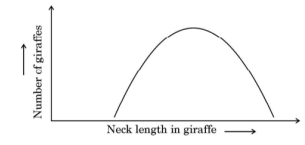
Select the option that gives the correct description of the process of Natural Selection with respect to the length of the neck of giraffe.
Image
  • A
    Stabilising selection as giraffes with medium neck lengths are selected.
  • B
    Directional selection as giraffes with longer neck lengths are selected.
  • C
    Stabilising selection as giraffes with longer neck lengths are selected further.
  • D
    Disruptive selection as giraffes with smaller and longer neck lengths are selected.
View full solution
The natural method of birth control in which the couples avoid coitus from day 10 to 17 of the menstrual cycle is called:
  • A
    Periodic abstinence
  • B
    Lactational amenorrhea
  • C
    Copulation abstinence
  • D
    Withdrawal
View full solution
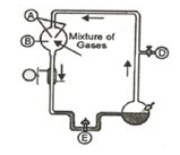
The diagram represents the Miller experiment. Choose the correct combination of labelling.
Image
  • A
    A - electrodes, B - NH3+ H2O,C - hot water, D-tap, E - U trap
  • B
    A - electrodes, B - NH3 + H2 + H2O + CH4, C-steam, D- Vacuum, E - U trap
  • C
    A- electrodes, B-(NH3 + H2+ H2O + CH4), C-cold water, D - Vacuum, E - U Trap.
  • D
    A - electrodes,B - NH4 + H2 + CO2 + CH3, C-hot water, D - Vacuum, E - U Trap.
View full solution
Write the name of the bioactive molecules produced by the microbes listed below, and their role in the field of medical sciences.
a. Monascus purpureus
b. Trichoderma polysporum
View full solution
Image
i. Look at the above sequence and mention the event A, B and C.
ii. What does central dogma state in molecular biology? How does it differ in some viruses?
View full solution
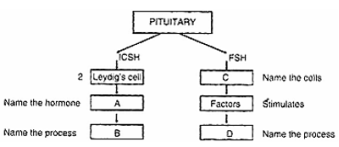
Given below is an incomplete chart showing the influence of hormones on gametogenesis in males. Observe the chart carefully and fill in the blanks A, B, C and D
Image
View full solution
Q 113 Marks Question3 Marks
Given below is an equation describing the Species-Area relationship between species richness and area for a wide variety of taxa as angiosperm plants, birds, bats etc.
S = CAZ
a. Give a graphical representation of the given equation showing Species-Area relationship.
b. What does S represent in the given equation?
c. What is the value of Z (regression coefficient) for frugivorous birds and mammals in the tropical forests of different continents?
View full solution
Q 143 Marks Question3 Marks
Study the table showing the population interaction between species Z and Y respectively. Assign the appropriate +/- signs for A, B, D, E and respective interactions for C and F.
Species 'Z'Species 'Y'Name of Interaction
ABMutualism
--C
DEParasitism
+OF
View full solution
Q 153 Marks Question3 Marks
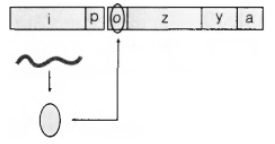
Given below is a schematic representation of a lac operon. Answer the following questions:
Image
i. Identify i and p.
ii. Name the inducer for this operon.
iii. Explain the function of inducer for this operon.
View full solution
Answer the following questions with respect to recombinant DNA technology:
i. Why is plasmid considered to be an important tool in rDNA technology? From where can plasmids be isolated? (Any two sources)
ii. Explain the role of ori and selectable marker in a cloning vector.
iii. r-DNA technology cannot proceed without restriction endonuclease. Justify.
View full solution
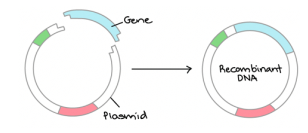
A vector is a way to take a sequence of DNA, usually, and introduce it into another place. So what vectors do is allow you to propagate the DNA you're interested in, in the organism you've chosen to propagate it in. So the simplest one is the origins of recombinant DNA technology: They made copies of RNAs, and they were able to insert these into what is known as plasmids.
Image
Unless the vector and source DNA are cut, fragments separated and joined, the desired recombinant vector molecule cannot be created.
i. How are the desirable DNA sequences cut?
ii. Explain the technique used to separate the cut fragments.
iii. How are the resultant fragments joined to the vector DNA molecule?
View full solution
a. Why did Hershey and Chase use radioactive 32P and 35S in their experiments? Explain.
b. Following the experiments conducted by them, write what conclusion did they arrive at and how.
View full solution
i. Describe the arrangement of nuclei and cells in a mature embryo sac of a typical angiosperm.
ii. Explain the devices the flowering plants have developed to prevent the following types of pollination:
1. Prevents both autogamy and geitonogamy
2. Prevents autogamy, but not geitonogamy
View full solution
Assertion (A): Fossils are remains of dead organisms.
Reason (R): Palaeontology is helpful in study of evolution.
  • A
    Both A and R are true and R is the correct explanation of A.
  • B
    Both A and R are true but R is not the correct explanation of A.
  • C
    A is true but R is false.
  • D
    A is false but R is true.
View full solution
Assertion (A): Test-tube baby has raised several legal problems.
Reason (R): It involves in vitro fertilization followed by embryo transfer.
  • A
    Both A and R are true and R is the correct explanation of A.
  • B
    Both A and R are true but R is not the correct explanation of A
  • C
    A is true but R is false.
  • D
    A is false but R is true.
View full solution
Assertion (A): Decomposition process is slower if detritus is rich in lignin and cutin.
Reason (R): Decomposition is largely an oxygen requiring process.
  • A
    Both (A) and (R) are true and (R) is the correct explanation of (A).
  • B
    Both (A) and (R) are true, but (R) is not the correct explanation of (A).
  • C
    (A) is true, but (R) is false.
  • D
    (A) is false, but (R) is true.
View full solution
Assertion (A): Yeasts such as Saccharomyces cerevisiae are used in baking industry.
Reason (R): Carbon dioxide produced during fermentation causes bread dough to rise by thermal expansion.
  • A
    Both A and R are true and R is the correct explanation of A.
  • B
    Both A and R are true but R is not the correct explanation of A.
  • C
    A is true but R is false.
  • D
    A is false but R is true.
View full solution
Read the following text carefully and answer the questions that follow:
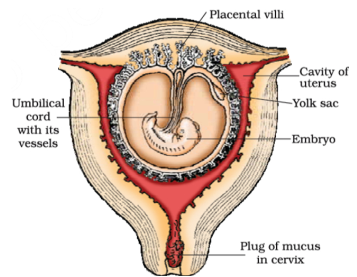
After implantation, finger-like projections appear on the trophoblast called chorionic villi which are surrounded by the uterine tissue and maternal blood. The chorionic villi and uterine tissue become interdigitated with each other and jointly form a structural and functional unit between the developing embryo (foetus) and the maternal body.
Image
i. Name the hormone crucial in parturition. Does the parturition signal originate from the mother or the fetus?(1)
ii. When and where do chorionic villi appear in humans? (1)
iii. Woman has conceived and implantation has occurred. Discuss the impact of progesterone and estrogen. (2)
OR
Fetal ejection reflex leads to parturition. Justify (2)
View full solution
Read the following text carefully and answer the questions that follow:
Malaria and dengue fever are major mosquito-borne public health problems in tropical countries. The authors report a malaria and dengue co-infection in an 11-year-old boy who presented with sustained fever for 10 days. The physical examination revealed a flushed face, injected conjunctivae and left submandibular lymphadenopathy. His peripheral blood smear showed few ring-form trophozoites of Plasmodium falciparum. His blood tests were positive for dengue NS-1 antigen and IgM antibody, and negative for IgG antibody. After the initiation of antimalarial treatment with artesunate and mefloquine, his clinical condition gradually improved. However, he still had low-grade fever that persisted for 6 days. Finally, he recovered well without fluid leakage, shock or severe bleeding.
i. Name the fish that help in eradication of mosquito larvae.
ii. What is the reason of symptoms of malaria?
iii. Name the body parts and host in which following events takes place in life cycle of plasmodium.
a. asexual reproduction
b. sexual reproduction.
OR
Name some vector borne diseases and their vector.
View full solution

Generate a MODEL PAPER 5 paper free

Pick question groups from the list above, set marks and difficulty, and export a branded PDF with step-by-step answer keys. First 3 chapters free — no signup.

Download App