Questions

3 Marks Question

Take a timed test

8 questions · self-marked practice — reveal the answer and mark yourself.

Question 13 Marks
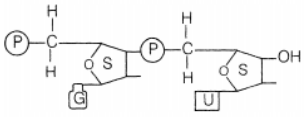
Answer the questions based on the dinucleotide show below.
Image
i. Name the type of sugar to which guanine base is attached to.
ii. Name the linkage connecting the two nucleotides.
iii. Identify the 3' end of the dinucleotide. Give a reason for your answer.
Answer
i. Pentose sugar or deoxyribose sugar.
ii. Two nucleotides are linked through 3'-5' phosphodiester linkage to form a dinucleotide.
iii. The ribose sugar has a free 3'-OH group which is referred to as 3' end of the polynucleotide chain.

View full question & answer
Question 23 Marks
Which one of the two in-situ or ex-situ biodiversity conservation measures help the larger number of species to survive? Explain.
Answer
→ In situ conservation will help the larger number of species to survive because this method involves protection and conservation of the whole ecosystem and its biodiversity. Regions with very high levels of species richness and high degree of endemism is identified and then it is marked off as a protected area. Thus in situ method helps to conserve species without disturbing their natural habitat. Hotspots, protected areas and National parks are some of the methods used in situ conservation.
→ On the other hand, ex situ involves taking threatened animals and plants out from their natural habitat and placing them in special settings such as Zoological parks or botanical gardens where they can be given protection. However, this method is not ideal to conserve large variety of species.
View full question & answer
Question 33 Marks
With the help of three examples, explain the broadly utilitarian argument for conservation of biodiversity.
Answer
The broadly utilitarian argument described as biodiversity plays a major role in many ecosystem services that nature provides.
i. Broadly utilitarian mainly explains the broad and general use of biodiversities like oxygen,
ii. pollination, and
iii. aesthetic value which is not limited to particular species.
View full question & answer
Question 43 Marks
Differentiate between an Expanding age pyramid and a Stable age pyramid. Substantiate your answer with diagrams.
Answer
Expanding age pyramidStable age pyramid
The population of pre-reproductive age is greater than population of reproductive ageThe population of pre-reproductive age equals to population of reproductive age
Image
View full question & answer
Question 53 Marks
Name and explain the two types of immune responses in humans.
Answer
There are two immune response.
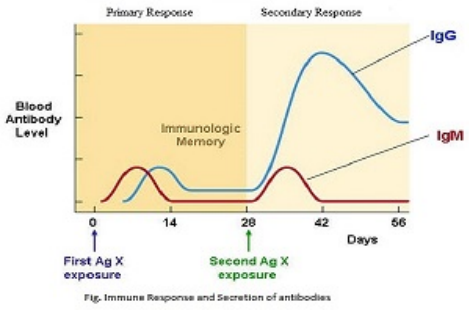
i. The primary immune response occurs when an antigen comes in contact with the immune system for the first time. During this time the immune system has to learn to recognize the antigen and how to make an antibody against it and eventually produce memory lymphocytes.
ii. The secondary immune response occurs when the second time (3rd, 4th, etc.) the person is exposed to the same antigen. At this point, immunological memory has been established and the immune system can start making antibodies immediately.
Image
View full question & answer
Question 63 Marks
i. Write how parasites have evolved with adaptation to co-exist with their hosts in an ecosystem.
ii. Parasites are host specific and tend to co-evolve. How would the parasite respond if the host evolves a certain mechanism to resist or reject the parasite?
Answer
i. Parasites have evolved with special adaptations to co-exist with their hosts in an ecosystem in the following ways:
Loss of unnecessary sense organs
Presence of adhesive organs or suckers to cling on to the host iii. Loss of digestive system and high reproductive capacity.
ii. If the host evolves special mechanisms for rejecting or resisting the parasite, the parasite also evolves mechanisms to counteract and neutralise them, in order to be successful with the same host species. In accordance with their life styles, parasites evolve special adaptations and co-evolve with the host.
View full question & answer
Question 73 Marks
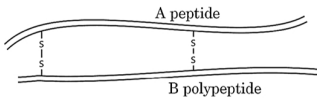
A schematic diagram of matured human insulin is given below:
Image
How is the process of its formation naturally in the human body different from that of its formation by rDNA technology? Explain.
Answer
Insulin production in human body:
- Synthesised naturally in the form of proinsulin consisting of polypeptide chain A and polypeptide chain B, linked together by disulphide bonds and an extra stretch called C-peptide
- The C-peptide is removed during processing and proinsulin matures into functional insulin.
Insulin production by rDNA technology
- Two DNA sequences corresponding to chain A and chain B of human insulin are synthesised
- They are introduced into two different plasmids of E.coli
- Chain A and chain B are produced separately
- extracted and combined by disulphide bond to form human insulin.
View full question & answer
Question 83 Marks
State Mendel's law of dominance. How did he deduce the law? Explain with the help of a suitable example.
Answer
Mendel's Laws of inheritance: The offspring always exhibits a dominant trait from the two alleles received from parents, the only dominant allele is expressed and other will be suppressed.
In a cross between tall (TT) plant and dwarf (tt) plant, the tall trait appears in F1, tallness and dwarfness appear in F2, In the ratio
of 3:1.
View full question & answer