Questions

3 Marks Question

Take a timed test

8 questions · self-marked practice — reveal the answer and mark yourself.

Question 13 Marks
Bio-diversification of life started to occur almost 3 billion years ago. Since then new species have been evolving and then disappearing en masse from earth.
a. How many episodes of mass extinctions of species have already taken place and which one is in progress in the current era?
b. How is current episode in progress different from the previous episodes and why? Explain.
Answer
a. $\bullet$ Five extinctions have already occurred
    $\bullet$ Sixth is in progress
b. $\bullet$ Sixth extinction is much faster / sixth extinction is 100 to 1000 times faster
    $\bullet$ Human activities like industrialisation, loss of habitat, over exploitation, land reforms.
View full question & answer
Question 23 Marks
Explain the concept of co-extinction by taking two examples.
Answer
When a species becomes extinct, the plant and animal species associated with it in an obligatory way also becomes extinct.
Examples:
$\bullet$ When a host (fish) species becomes extinct, the plant and animal species associated with it in an obligatory way also become extinct.
$\bullet$ Coevolved plant-pollinator mutualism where extinction of one leads to the extinction of other (any other example) / The coevolved orchid Ophrys and bee pollinator.
View full question & answer
Question 33 Marks
Answer the following questions with reference to opioids, the commonly abused drug :
a. Where in our body are the specific opioid receptors present?
b. What is heroin chemically known as?
c. Write the scientific name of the plant from which opioids are extracted.
Answer
a. Opioid receptors are present in various regions of the body, including the central nervous system (brain and spinal cord) and peripheral nervous system.
b. Heroin is chemically known as diacetylmorphine.
c. Opioids are extracted from the opium poppy plant, scientific name of the plant is Papaver somniferum.
View full question & answer
Question 43 Marks
While creation and presence of variation are directionless, natural selection is directional as it is in the context of adaptation. Comment.
Answer
Variations keep on occurring in each subsequent generation. But most of them may not be retained by the organism because nature may not support such variations. When a particular variation passes the test of natural selection, then only it is inherited in a species in the long run. Hence, it can be said that creation and presence of variation is directionless but natural selection and adaptation are directional.
View full question & answer
Question 53 Marks
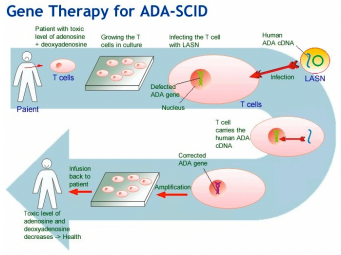
This image highlights the process of Gene Therapy of ADA-SCID.
Image
i. Mention the cause of ADA deficiency in humans.
ii. How has genetic engineering helped patients suffering from it?
Answer
i. Deletion of the gene for ADA in an individual leads to ADA deficiency disorder Adenosine Deaminase (ADA) enzyme is crucial for immune system to function.
ii. Gene therapy is helpful in the treatment of ADA deficiency.
The treatment involves the following steps:
a. Lymphocytes from the blood of patient are grown on a culture outside the body.
b. A functional ADA, cDNA (using a retroviral vector) is then introduced into these lymphocytes.
c. Such genetically engineered lymphocytes are returned to the blood of patient.
d. Periodic infusion of such genetically engineered lymphocytes is required by the patient.
View full question & answer
Question 63 Marks
Explain the difference between commensalism and mutualism types of interactions, with the help of a suitable example of each.
Answer
Commensalism: This is the interaction in which one species benefits and the other is neither harmed nor benefitted. An orchid growing as an epiphyte on a mango branch, and barnacles growing on the back of a whale benefit while neither the mango tree nor the whale derives any apparent benefit.
Mutualism: This interaction confers benefits on both the interacting species. Lichens represent an intimate mutualistic relationship between a fungus and photosynthesising algae or cyanobacteria. Similarly, the mycorrhizae are associations between fungi and the roots of higher plants. The fungi help the plant in the absorption of essential nutrients from the soil while the plant in turn provides the fungi with energy-yielding carbohydrates.
View full question & answer
Question 73 Marks
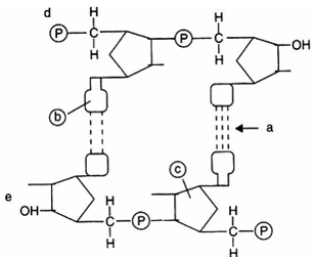
Study the given portion of double-stranded polynucleotide chain carefully. Identify a, b, c and the 5' end of the chain.
Image
Answer
a. Hydrogen bonds
b. Purine base
c. Pentose sugar (Deoxyribose)
d. 5' end of the chain - d
View full question & answer
Question 83 Marks
Generally, it is observed that human males suffer from hemophilia more than human females, who rarely suffer from it. Explain giving reasons.
Answer
Haemophilia is a recessive X-linked genetic type disorder. Haemophilia is more common among males than females because males only inherit one X-chromosome. There are 46 chromosomes in humans Females have XX chromosome while males have X and Y chromosome. So, male offspring inherit X-chromosome from their mother and Y-chromosome from them father Males only have one X-chromosome and if the X-chromosome and this is the reason that males are suffering from haemophilia is the x - chromosome carries the mutation. While in females as they have so X chromosomes, and this is a recessive disorder.
View full question & answer