MCQ 11 Mark
Assertion (A): Homologous organs have common ancestry and similar functions.
Reason (R): Analogous organs have unlike origin and dissimilar function.
Reason (R): Analogous organs have unlike origin and dissimilar function.
- ABoth A and R are true and R is the correct. explanation of A.
- BBoth A and R are true but R is not the correct explanation of A.
- CA is true but R is false.
- DBoth A and R are false.
Answer
View full question & answer→Both A and R are false.
Explanation: Homologous organs are those which have the same essential structure, which they inherit from common ancestors though they may be very differently modified in adaptation to different functions.
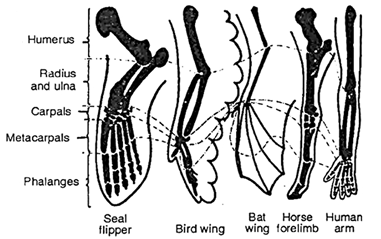
Fig. Homology in the forelimbs of seal, bird, bat, horse and man (apparently different but constructed on the same basic pattern).
For example - in case of whales hind limbs are only represented internally and are not apparent externally, the forelimbs modified into paddles and retain the bones of the shoulder, forearm, wrist and fingers all of which are enclosed in a finshaped sac; the head is fish-like but possesses all the mammalian bones. Analogous organs are those which have similar structure connected with similarity of function have superficial resemblance to one another, but are of unlike origin. For example, the wings of a bat and wings of a bird doing the same flying function possess superficial resemblances to each other.
Explanation: Homologous organs are those which have the same essential structure, which they inherit from common ancestors though they may be very differently modified in adaptation to different functions.
Fig. Homology in the forelimbs of seal, bird, bat, horse and man (apparently different but constructed on the same basic pattern).
For example - in case of whales hind limbs are only represented internally and are not apparent externally, the forelimbs modified into paddles and retain the bones of the shoulder, forearm, wrist and fingers all of which are enclosed in a finshaped sac; the head is fish-like but possesses all the mammalian bones. Analogous organs are those which have similar structure connected with similarity of function have superficial resemblance to one another, but are of unlike origin. For example, the wings of a bat and wings of a bird doing the same flying function possess superficial resemblances to each other.