Questions

2 Marks Questions

Take a timed test

149 questions · self-marked practice — reveal the answer and mark yourself.

Question 12 Marks
Why is the Human Genome project called a mega project?
Answer
Human genome project was considered to be a mega project because it had a specific goal to sequence every base pair present in the human genome. It took around 13 years for its completion and got accomplished in year 2006. It was a large scale project, which aimed at developing new technology and generating new information in the field of genomic studies. As a result of it, several new areas and avenues have opened up in the field of genetics, biotechnology, and medical sciences. It provided clues regarding the understanding of human biology.
View full question & answer
Question 22 Marks
Group the following as nitrogenous bases and nucleosides:
Adenine, Cytidine, Thymine, Guanosine, Uracil and Cytosine.
Answer
Nitrogenous Bases - Adenine, Uracil and Cytosine, Thymine; Nucleosides - Cytidine, guanosine.
View full question & answer
Question 32 Marks
If a double stranded DNA has 20 per cent of cytosine, calculate the per cent of adenine in the DNA.
Answer
The percent of cytosine = 20 (given)
% of C = % of G
Therefore, the percent of guanine = 20
The percent of thymine + adenine will be 100 - (20 + 20) = 60
Therefore, the percent of adenine will be $\frac{60}2=30$
View full question & answer
Question 42 Marks
List two essential roles of ribosome during translation.
Answer
The important functions of ribosome during translation are as follows.
  • Ribosome acts as the site where protein synthesis takes place from individual amino acids. It is made up of two subunits. The smaller subunit comes in contact with mRNA and forms a protein synthesizing complex where as the larger subunit acts as an amino acid binding site.
  • Ribosome acts as a catalyst for forming peptide bond. For example, 23s r-RNA in bacteria acts as a ribozyme.
View full question & answer
Question 52 Marks
Depending upon the chemical nature of the template (DNA or RNA) and the nature of nucleic acids synthesised from it (DNA or RNA), list the types of nucleic acid polymerases.
Answer
There are two different types of nucleic acid polymerases.
  • DNA-dependent DNA polymerases
  • DNA-dependent RNA polymerases
The DNA-dependent DNA polymerases use a DNA template for synthesizing a new strand of DNA, where as DNA-dependent RNA polymerases use a DNA template strand for synthesizing RNA.
View full question & answer
Question 62 Marks
How are translational region and untranslational regions in mRNA different from each other?
Answer
S. No.
Translational region
Untranslational region
1.
It is the sequence of ribonucleotides in mRNA, that is flanked by start codon at the 5' end and a stop codon at the 3' end.
These are the sequences of ribonucleotides in mRNA, that are before the start codon at the 5' end and after the stop codon at the 3'end.
2.
This region is translated into a polypeptide.
These sequences are not translated into polypeptide.
View full question & answer
Question 72 Marks
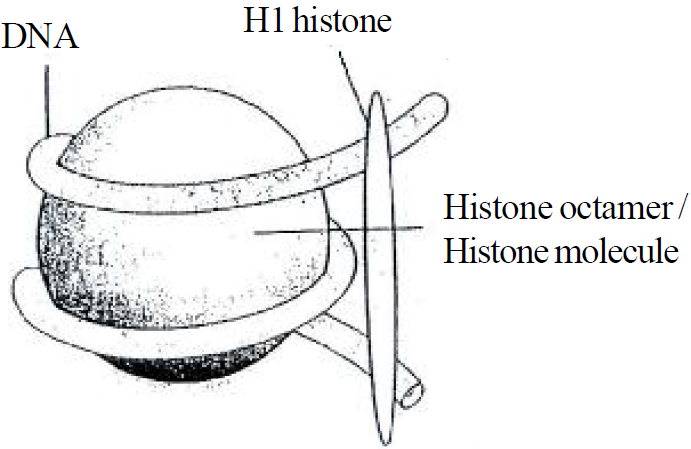
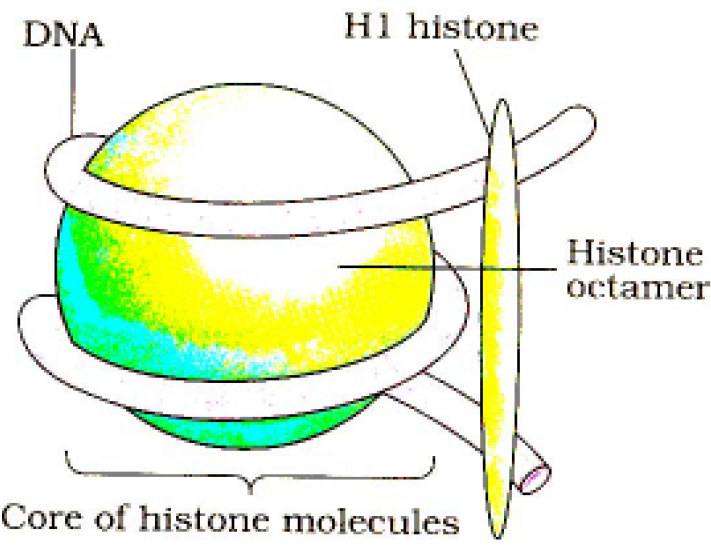
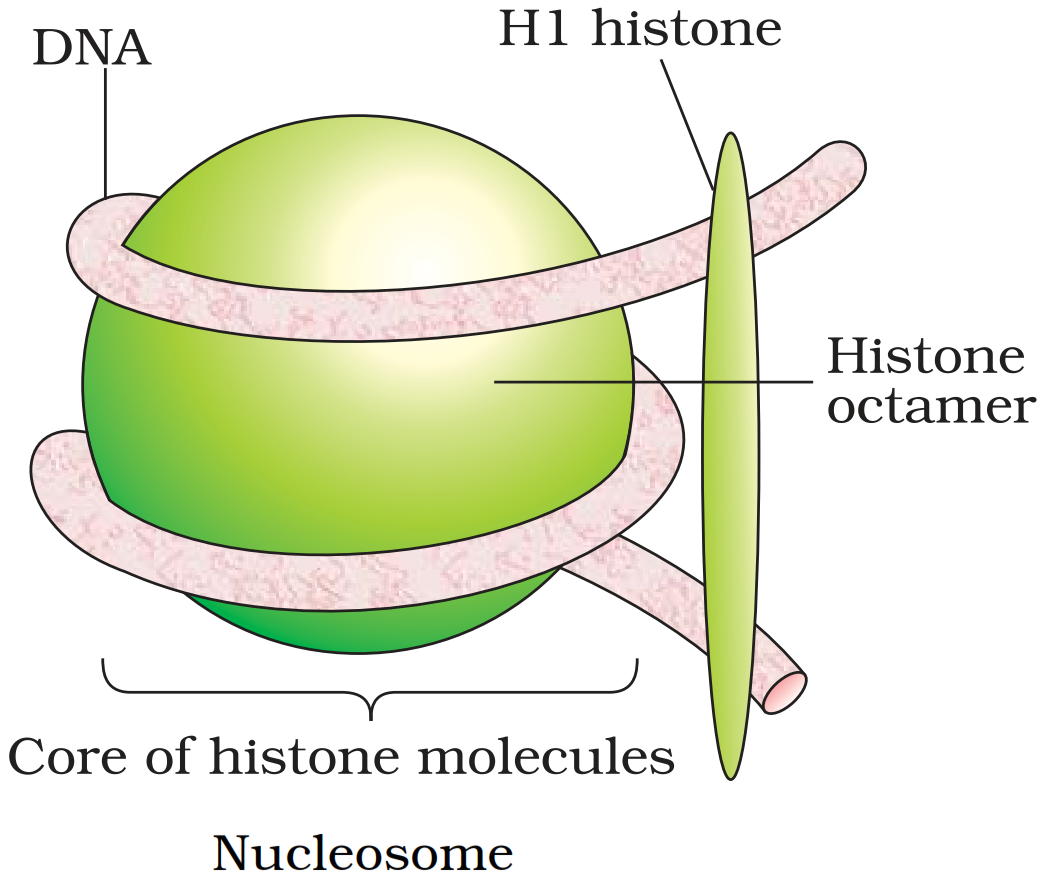
How is a nucleosome formed? Draw the diagram of a nucleosome.
Answer
DNA packing in eukaryotes is carried out with the help of lysine and argenine rich basic protein called histones. The unit of compaction is nucleosome.
  1. Histones are organised to form a unit of eight molecules called histone octamer.
  2. The negatively charged DNA is wrapped around the positively charged histone octamer, form a structure called nucleosome.
​​​​​​​
View full question & answer
Question 82 Marks
Retrovirus do not follow central dogma. Comment.
Answer
Genetic material of retrovirus is RNA. At the time of synthesis of protein, RNA is reverse transcribed to its complementary DNA first, then transcriped to RNA and proteins. Hence, retrovirus are not known to follow central dogma.
View full question & answer
Question 92 Marks
How is the translation of mRNA terminated? Explain.
Answer
When a stop codon UAG/UGA/UAA, presents itself on the mRNA, it has no corresponding tRNA/does not code for any amino acid, release factor binds to the stop codon and translation ends.
View full question & answer
Question 102 Marks
A low level of expression of lac operon occurs at all the time. Can you explain the logic behind this phenomena.
Answer
In the complete absence of expression of lac operon, permease will not be synthesised which is essential for transport of lactose from medium into the cells. And if lactose cannot be transported into the cell, then it cannot act as inducer. Hence, cannot relieve the lac operon from its repressed state. Therefore, lac operon is always expressed.
View full question & answer
Question 112 Marks
Three codons on mRNA are not recognised by transfer RNA. What are they? What is the general term used for them? What is their significance in protein synthesis?
Answer
These codons are UAA, UAG and UGA. The general name given to these codons is nonsense codons. These codons do not specify any amino acid but the termination of polypeptide chain is signalled by them.
View full question & answer
Question 122 Marks
List the three major functions of a gene.
Answer
Three major functions of a gene are:
  1. It should be able to store information and to express itself when required.
  2. It should be heritable from one generation to next.
  3. It should be autocatalytic, i.e., should be able to produce its own replica.
View full question & answer
Question 132 Marks
In a nucleus, the number of ribonucleoside triphosphates is 10 times the number of deoxy x10 ribonucleoside triphosphates, but only deoxy ribonucleotides are added during the DNA replication. Suggest a mechanism.
Answer
DNA polymerase is highly specific to recognise only deoxyribonucleoside triphosphates. Therefore, it cannot hold RNA nucleotides.
View full question & answer
Question 142 Marks
Based on your understanding of genetic code, explain the formation of any abnormal hemoglobin molecule. What are the known consequences of such a change?
Answer
Normally human beings have following types of hemoglobin, $\mathrm{Hb}^{\mathrm{A}}, \mathrm{Hb}^{\mathrm{A} 2}$ and Hb . Alteration in genes for beta chain on hemoglobin results in formation of $\mathrm{Hb}^{\mathrm{S}}$ type of hemoglobin. This type of hemoglobin molecule is responsible for sickle cell anemia.
View full question & answer
Question 152 Marks

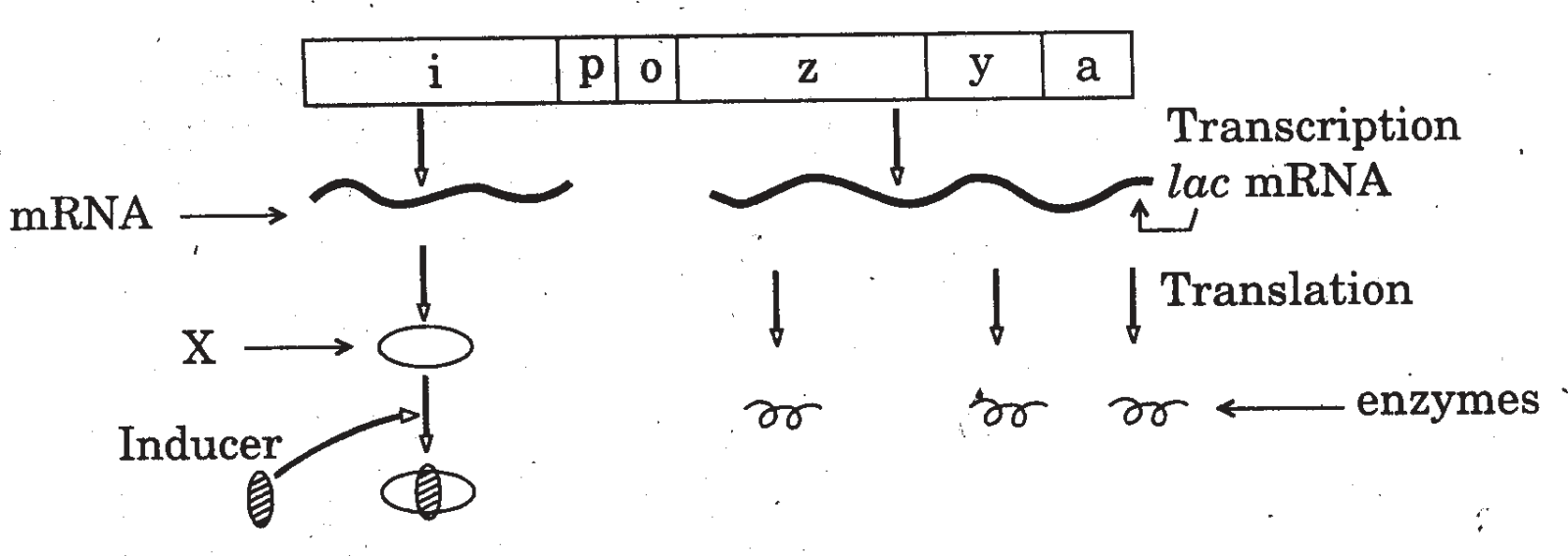
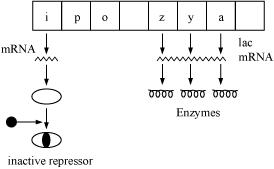
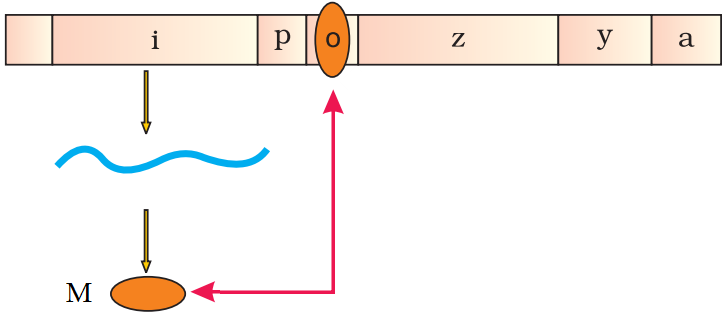
Given above is a schematic representation of the lac operon in E.coli. What is the significant role of 'i' gene in switching 'on' or 'off' the operon?
Answer
  1. The 'i' gene codes for the repressor protein, which is synthesised constitutively (all the time).
  2. It has a significant role in switching "off" of the operon, as the repressor binds to the operator and prevents the transcription of the structural genes.
  3. But in the presence of lactose as inducer, it is inactivated by the interaction with the inducer; the RNA polymerase gets access to the promoter and transcription proceeds, i.e. the operon is switched 'on'.
View full question & answer
Question 162 Marks
Distinguish between heterochromatin and euchromatin. Which of the two is transcriptionally active?
Answer
  Euchromatin   Heterochromatin
i. Loosely packed i. Densely
ii. Stains light ii. Stains dark
iii. Transcriptionally active iii. Transcriptionally inactive
View full question & answer
Question 172 Marks
Name a few enzymes involved in DNA replication other than DNA polymerase and ligase. Name the key functions for each of them.
Answer
Helicase – opens the helix,
  1. Topoisomerases– removes the supercoiling of DNA.
  2. Primase: synthesises RNA primer.
  3. Telomerase: to synthesises the DNA of telomeric end of chromosomes.
View full question & answer
Question 182 Marks
Differentiate between codons and anticodons.
Answer
S. No.
Codons
Anticodons
1.
It is a sequence of three nucleotides, which codes for a particular amino acid.
An anticodon is a sequence of three nucleotides that is complementary to the codon of a particular amino acid.
2.
It is found on mRNA and decides the sequence of amino acid in a polypeptide.
It is found on tRNA and recognises the codon on mRNA during translation.
View full question & answer
Question 192 Marks
Protein synthesis machinery revolves around RNA but in the course of evolution it was replaced by DNA. Justify.
Answer
Since RNA was unstable and prone to mutations, DNA evolved from RNA with chemical modifications that makes it more stable.
DNA has double stranded nature and has complementary strands. These further resist changes by evolving a process of repair.
View full question & answer
Question 202 Marks
Write the full form of SNPs, BAC and YAC.
Answer
  • SNPs: Single nucleotide polymorphisms.
  • BAC: Bacterial artificial chromosome
  • YAC: Yeast artificial chromosome
View full question & answer
Question 212 Marks
What do you mean by nucleoid?
Answer
In prokaryotes, the DNA is organised in large loops held by positively charged proteins in a region called nucleoid.
View full question & answer
Question 232 Marks
There is only one possible sequence of amino acids when deduced from a given nucleotides. But multiple nucleotides sequence can be deduced from a single amino acid sequence. Explain this phenomena
Answer
Some amino acids are coded by more than one codon (known as degeneracy of codons), hence on deducing a nucleotide sequence from an amino acid sequence, multiple nucleotide sequence will be obtained. For e.g., Ile has three codous: AUU, AUC, AUA hence a depeptide Met–Ile can have the following nucleotide sequence:
  1. AUG – AUU.
  2. AUG – AUC.
  3. AUG – AUA.
And if, we deduce amino acid sequence the above nucleotide sequences, all the three will code for Met–Ile.
View full question & answer
Question 242 Marks
Comment on the utility of variability in number of tandem repeats during DNA fingerprinting.
Answer
Tandemness in repeats provides many copies of the sequence for fingerprinting and variability in nitrogen base sequence in them. Being individual-specific, this proves to be useful in the process of DNA fingerprinting.
View full question & answer
Question 252 Marks
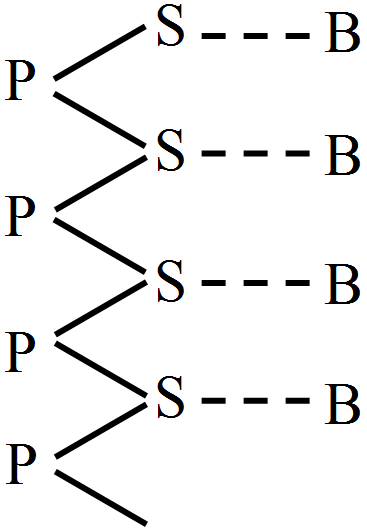
Refer to the following diagram of a strand of nucleotide to answer questions a-d.
  1. What molecule is represented by S?
  2. What molecule is represented by B?
  3. How many different types of B are in DNA?
  4. What type of bond is represented by the dotted lines?
Answer
  1. Sugar.
  2. Base.
  3. Four (A, T, G, C).
  4. Hydrogen.
View full question & answer
Question 262 Marks
Differentiate between euchromatin and heterochromatin.
Answer
S.No.
Euchromatin
Heterochromatin
1.
In a nucleus, some regions of chromatin are loosely packed and stain light. These are referred to as euchromatin.
The chromatin that is more densely packed and stains dark are called heterochromatin.
2.
It is transcriptionally active chromatin.
Heterochromatin is inactive.
View full question & answer
Question 272 Marks
DNA is unzipped twice in a cell. Mention the two events and the enzymes responsible for it.
Answer
  1. During DNA replication i.e., in the S-phase of interphase enzyme-DNA polymerase.
  2. During transcription for protein synthesis-enzyme-DNA dependent RNA polymerase.
View full question & answer
Question 282 Marks
  1. What is teminism?
  2. What do you understand by UTR? Mention its role in translation.
Answer
  1. Reverse transcription is known as teminism, which was first reported by Temin and Baltimore. RNA of some viruses (Retroviruses) first synthesises DNA through reverse transcription. The DNA then transfers information to RNA, which takes part in translation of coded information to form polypeptide.
  2. An mRNA has some additional translations which are not coded, these are referred as untranslated regions (UTRs). The UTRs are present at both 5' end (before start codon) and at 3' end (after stop codon). They are required for efficient translation process.
View full question & answer
Question 292 Marks
In an experiment, DNA is treated with a compound which tends to place itself amongst the stacks of nitrogenous base pairs. As a result of this, the distance between two consecutive base increases. from 0.34nm to 0.44nm calculate the length of DNA double helix (which has $2 × 10^9$bp) in the presence of saturating amount of this compound.
Answer
The length of DNA double helix can be calculated by multiplying the distance between two consecutive base pairs with total number of base pairs.
$ 0.44 \times 10^{-9} \mathrm{~m} \times 2 \times 10^9 \mathrm{bp} $
$ =0.88 \mathrm{~m}$
View full question & answer
Question 302 Marks
What are untranslated regions (UTRs)?
Answer
mRNA has some additional sequences that are not translated and are called untranslated regions (UTRs). The UTRs are present both at 3'-end (before the start codon) and at 5'-end (after the stop codon). They only help in efficient translation process.
View full question & answer
Question 312 Marks
What are the functions of (i) methylated guanasine cap, (ii) poly-A “tail” in a mature on RNA?
Answer
  1. Function of methylated guanosine cap: It regulates nuclear export of mRNA. It promotes translation. (Fully processed hnRNA is called mRNA).
  2. Function of poly-A tail: Protects RNA from degradation by exonucleases. Plays important role in transcription termination.
View full question & answer
Question 322 Marks
What is splicing? Why is splicing necessary in eukaryotic genes?
Answer
The process by which non-coding regions (intron) on hnRNA are removed and coding regions (exon) are joined to produce mRNA is called splicing. Splicing is necessary in eukaryotes to remove the non-coding introns from hnRNA to produce a meaningful functional mRNA. Prokaryotes do not have introns in the mRNA.
View full question & answer
Question 332 Marks
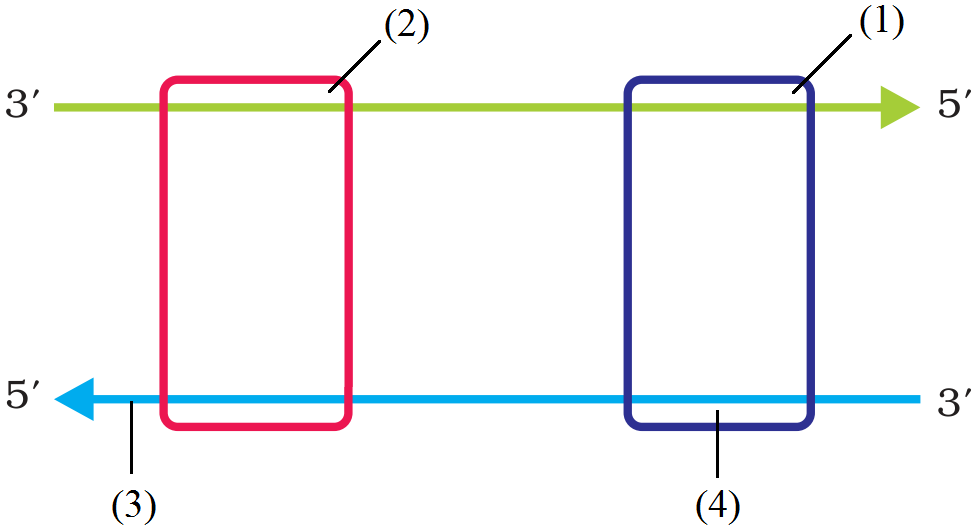
In the following diagram the two DNA strands represented are ready for transcription.
  1. Label the parts marked 1 to 4 and state their functions in transcription.
  2. Which one of the two strands of DNA has nucleotide sequence similar to the mRNA that will be transcribed and why?
Answer
  1.  
  1. Template strand: It functions as templete to synthesise m-RNA.
  2. Promoter: It is a DNA sequence that provides binding site for RNA polymerase.
  3. Coding strand: It does not code for any region of RNA.
  4. Terminator: It provides DNA sequence which stops transcription.
  1. The coding strand will have sequence similar to mRNA strand as this possesses complementary sequence to template strand.
View full question & answer
Question 342 Marks
List the various markers that are used in DNA finger printing.
Answer
Different DNA marker systems such as Restriction Fragment Length Polymorphisms (RFLPs), Random Amplified Polymorphic DNAs (RAPDs), Amplified Fragment Length Polymorphisms (AFLPs), Simple Sequence Repeats (SSRs) which also called as microsatellites, Single Nucleotide Polymorphisms (SNPs) and others have been developed.
View full question & answer
Question 352 Marks
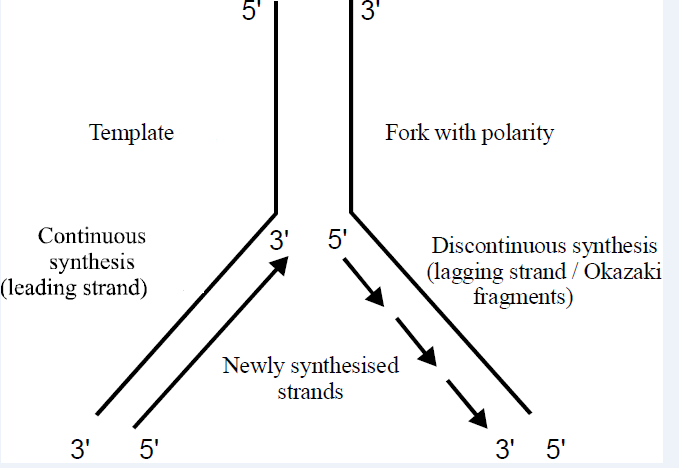
Draw a neat labelled sketch of a replicating fork of DNA.
Answer

Polarity of the two strands of the fork to be shown and polarity as well as arrow mark of the lagging and leading strands to be shown with correct labelings.
View full question & answer
Question 362 Marks
Name the category of codons, UGA belongs to. Mention another codon of the same category. Explain their role in protein synthesis.
Answer
  1. It is a stop/ termination codon.
  2. UAA or UAG.
  3. They terminate the translation process, i.e. they stop the elongation of the polypeptide chain during translation.
View full question & answer
Question 372 Marks
  1. Name the scientist who suggested that the genetic code should be made of a combination of three nucleotides.
  2. Explain the basis on which he arrived at this conclusion.
Answer
  1. George Gamow.
  2. There are four bases and 20 amino acids.
(There should be at least 20 different genetic codes for these 20 amino acids)

Only possible combinations that would meet the requirement is combinations of 3 bases that will give 64 codons.
View full question & answer
Question 382 Marks
Would it be appropriate to use DNA probes such as VNTR in DNA fingerprinting of a bacteriophage?
Answer
Bacteriophage does not have repetitive sequence such as VNTR in its genome as its genome is very small and have all the codon sequenced. Therefore, DNA fingerprinting is not done for bacteriophages.
View full question & answer
Question 392 Marks
  1. A short length of a DNA molecule contains 120 adenine and 120 cytosine bases. What is the total number of nucleotides in that DNA fragment?
  2. A DNA contains 20,000 base pairs. How many nucleotides would be present in it?
Answer
  1. 480 nucleotides.
  2. 40,000 nucleotides.
View full question & answer
Question 402 Marks
Enumerate the goals of human genome project.
Answer
The goals of HGP are as follows:
  1. Determine the sequence and number of all the base pairs (three billion) in the human genome.
  2. Identify all the genes (25000) present in human DNA.
  3. Determine the function of all the genes and identify the various genes that cause genetic disorders.
  4. Store the information in data bases.
  5. Improve tools for data analysis
  6. Find out possibilities of transfer of technology developed during HGP to industry.
  7. Address ethical, legal, and social issues (ELSI) that may arise from the project.
View full question & answer
Question 412 Marks
The backbone of DNA strands contains atoms joined by covalent bonds, whereas the bases between the two strands are hydrogen bonded. Based upon your knowledge of bonds, what is the significance of the type of bonding existing in a DNA molecule?
Answer
Covalent bonds are stronger and tend to hold the backbone together. Hydrogen bonds are much weaker and tend themselves to breaking to enable replication or transcription.
View full question & answer
Question 422 Marks
Retroviruses do not follow central Dogma. Comment.
Answer
Francis and Crick proposed the central dogma in molecular biology. According to this, genetic information flows from DNA → RNA → Protein. In retroviruses, genetic information flows in reverse direction, i.e. Protein → RNA → DNA. Hence, it is said that retroviruses do not follow central dogma. The process followed by retroviruses is also called reverse transcription because of the opposite sequence of the process involved.
View full question & answer
Question 432 Marks
Differentiate between the genetic codes given below:
  1. Unambiguous and Universal.
  2. Degenerate and Initiator.
Answer
(a)
Unambiguous:
One codon codes for only one amino acid.
Universal:
Genetic code/codons are(nearly) same for all organisms/from bacteria to human.
(b)
Degenerate:
More than one codon coding for the same amino acid.
Initiator:
Start codon/AUG.
View full question & answer
Question 442 Marks
  1. Draw a neat labelled diagram of a nucleosome.
  2. Mention what enables histones to acquire a positive charge.
Answer
  1.  
  1. Basic amino acid residues of lysines, arginines.
View full question & answer
Question 452 Marks
An mRNA strand has a series of codon out of which three are given below:
  1. AUG
  2. UUU
  3. UAG
  1. What will their DNA codon be translated into?
  2. What are the DNA codon that would have transcribed these RNA codon?
Answer
  1.  
  1. AUG: Methionine
  2. UUU: Phenylalanine.
  3. UAG: No amino acid is coded as it is a stop codon.
  1. TAC, AAA, ATC.
View full question & answer
Question 462 Marks
Differentiate between codon and an anticodon.
Answer
Codon
Anticodon
The sequence of 3 nitrogen bases on mRNA that codes for a particular amino acid during translation is called codon.
The sequence of 3 nitrogenous bases on tRNA that are complementary to the codon on mRNA for a particular amino acid during translation is called anticodon.
View full question & answer
Question 472 Marks
Recall the experiment done by Frederick Griffith. If RNA, instead of DNA was the genetic material, would the heat killed strain of Streptococcus have transformed the R-strain into virulent strain? Explain your answer.
Answer
RNA is more labile and prone to degradation (owing to the presence of 2'-OH group in its ribose). Hence heat-killed S-strain may not have retained its ability to transform the R-strain.
View full question & answer
Question 482 Marks
A3' ............ 5'B
C5’ ........... 3'D.
AB and CD represent two strands of a DNA molecule. When this molecule undergoes replication, forming a replication fork between A and C in the above.
  1. Name the templete strand for replication.
  2. Using which strand as the templete, will there be continuous synthesis of a complementary DNA strand
  3. Complementary to which strand will okazaki segments get synthesised, discontinuous synthesis occurs.
  4. What are templete strands and Okazaki pieces?
  5. In which direction is a new strand synthesised?
Answer
  1. AB and CD
  2. AB strand
  3. CD strand
  4. The strands which dictates the sequence of the new strand, is the templete strand. Okazaki pieces are short stretches of DNA synthesised in the 5' 3' direction on discontinuous strand.
  5. In 5' → 3' direction.
View full question & answer
Question 492 Marks
What is the cause of discontinuous synthesis of DNA on one of the parental strands of DNA? What happens to these short stretches of synthesised DNA?
Answer
The DNA-dependent DNA polymerases catalyse polymerisation only in one direction, that is 5' → 3'. This creates some additional complications at the replicating fork. Consequently, on leading strand (the template with polarity 3' → 5'), the replication is continuous, while on the lagging strain (the template with polarity 5' → 3'), it is discontinuous. The discontinuously synthesised fragments are later joined by the enzyme DNA ligase.
View full question & answer
Question 502 Marks
What do you understand by operon. Name the first operon to be discovered?
Answer
An operon is a part of genetic material (or DNA), which acts as a single regulated unit having one or more structural genes, an operator gene, a promoter gene, a regulator gene, a repressor and an inducer or co-repressor The first operon to be discovered was lac-operon.
View full question & answer
Question 512 Marks

  1. Provide the triplet of bases (codon) for (a) Valine (b) Proline,
  2. Write the nucleotide sequence of the DNA strand from which this mRNA was transcribed.
  3. What does the last codon of this RNA stand for?
Answer
  1.  
  1. GUU
  2. CCU
  1. TAC AAA TAC GGA CAA AGA ATT
  2. Stop codon/ Nonsense codon
View full question & answer
Question 522 Marks
Name four non-human organisms whose genomes have been sequenced.
Answer
  1. Bacteria.
  2. Yeast.
  3. Caenorhabditis elegans (a nematode).
  4. Drosophila.
  5. Rice.
  6. Arabidopsis.
View full question & answer
Question 532 Marks
Do you think that the alternate splicing of exons may enable a structural gene to code for several isoproteins from one and the same gene? If yes, how? If not, why so?
Answer
Functional mRNA of structural genes need not always include all of its exons. This alternate splicing of exons is sex-specific, tissue-specific, and even developmental stage-specific. By such alternate splicing of exons, a single gene may encode for several isoproteins and/ or proteins of similar class. In absence of such a kind of splicing, there should have been new genes for every protein/ isoprotein. Such an extravagancy has been avoided in natural phenomena by way of altemate splicing.
View full question & answer
Question 542 Marks
Certain molecular processes are given in column (A). Provide the terms given to these processes in column (B), after selecting them from the terms:
Recombination, gene regulation, prokaryotic transcription, eukaryotic transcription, translation, replication, gene transfer, DNA fingerprinting
S.No.
Column A
Column B
(i)
DNA → DNA
 
(ii)
DNA → hRNA
 
(iii)
mRNA → Protein
 
(iv)
Repressor Protein + Operator → No transcription
 
Answer
S.No.
Column A
Column B
(i)
DNA → DNA
Replication.
(ii)
DNA → hRNA
Eukaryotic transcription.
(iii)
mRNA → Protein
Translation.
(iv)
Repressor Protein + Operator → No transcription
Gene regulation.
View full question & answer
Question 552 Marks
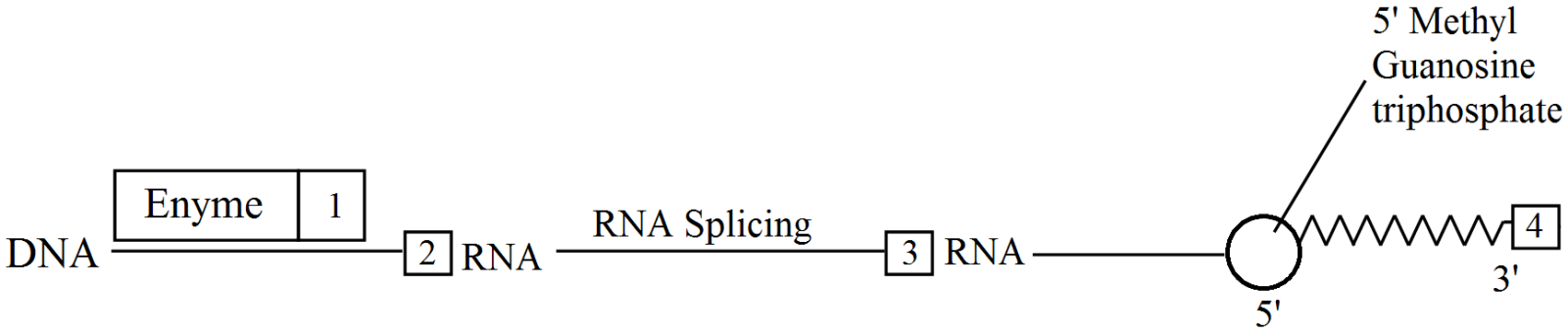
Given below is a sequence of steps of transcription in a eukaryotic cell. Fill up the blanks (1, 2, 3, 4) left in the sequence.
Answer
  1. DNA dependent-RNA polymerase
  2. hn
  3. mRNA
  4. Polyadenylate tail
View full question & answer
Question 562 Marks
Given below is the sequence of coding strand of DNA in a transcription unit 3' A A T G C A G C T A T T A G G – 5' write the sequence of:
  1. Its complementary strand.
  2. The mRNA.
Answer
  1. Its complementary strand,
5’ – T T A C G T C G A T A A C C – 3’.
  1. The mRNA,
5’ – U U A C G U C G A U A A C C – 3’.
View full question & answer
Question 572 Marks
List any three enzymes involved in the process along with their functions.
Answer
Enzymes for DNA replication:
  • Various enzymes are required as catalysts during DNA replication in living cells.
  • DNA-dependent DNA polymerase: It catalyses the polymerisation of deoxynucleotides on DNA template.
  • Helicase: It unwinds the DNA strand to form the replication fork.
  • DNA ligase: It joins the Okazaki fragments which are formed on the lagging strand.
View full question & answer
Question 582 Marks
How do histones acquire positive charge?
Answer
Histones are rich in basic amino acids, Lysine, Arginine (present as residues in their side chains), which are positively charged.
View full question & answer
Question 602 Marks
What is ribozyme?
Answer
The 23S rRNA in bacteria is called ribozyme, which catalyses the peptide bond formation.
View full question & answer
Question 612 Marks
Why does hnRNA need to undergo splicing? Where does splicing occur in the cell?
Answer
  1. Since hnRNA contains both exons (the coding sequences) and introns (the non-coding sequences), it has to undergo splicing, to remove the introns.
  2. Splicing occurs in the nucleus of the cell.
View full question & answer
Question 622 Marks
Write down the possible levels of regulation of gene expression in eukaryotes.
Answer
The possible regulation of gene expression can occur at following:
  1. Transcriptional level, i.e. during formation of primary transcript.
  2. Processing level (during splicing).
  3. During transport of mRNA from the nucleus to the cytoplasm
  4. Translational level.
View full question & answer
Question 632 Marks
The base sequence of one strand of DNA is TACTAGGAT.
Answer
  1. Write the base sequence of the RNA got after transcription of the given sequence.
  2. What is the distance maintained between the two consecutive pairs of bases in the DNA molecule?
  3. Who contributed the base complementary rule?
View full question & answer
Question 642 Marks
What is a promoter in a transcription unit? Where is it located in DNA with reference to the structural gene(s)?
Answer
  1. It is a DNA sequence that provides the binding site for RNA polymerase for transcription.
  2. It is located towards the 5' end (upstream) of the structural gene (of the coding strand).
View full question & answer
Question 662 Marks
Following are the features of genetic codes. What does each one indicate?
Stop codon; Unambiguous codon; Degenerate codon; Universal codon.
Answer
Stop codon - Does not code for any amino acid/terminates the synthesis of polypeptide chain.
Unambiguous codon - One codon codes for one amino acid only.
Degenerate codon - Some amino acid are coded by more than one codon.
Universal codon - Genetic code is same for all organisms (bacteria to humans).
View full question & answer
Question 672 Marks
What are introns and exons? What process removes the unwanted RNA region and joins those that code for amino acids?
Answer
Introns: The non-coding region of DNA or gene are called introns.
Exons: The coding region of DNA or gene which translate polypeptide are called exons. RNA splicing is the process that removes the unwanted RNA region and joins those that code for amino acids.
View full question & answer
Question 682 Marks
What is a terminator in a transcription unit? Where is it located in a structural gene? Mention its significance in transcription.
Answer
  1. Terminator is a sequence of DNA that defines the end of transcription.
  2. It is located towards the 3' end (downstream) of the coding strand.
View full question & answer
Question 692 Marks
Write the full form of VNTR. How is VNTR different from‘Probe’?
Answer
VNTR-Variable Number Tandem Repeats,
Probe- is labelled/radioactive (single stranded hybridise DNA fragments).
View full question & answer
Question 702 Marks
What are the functions of DNA polymerase?
Answer
  1. DNA polymerase uses a DNA template to catalyse the polymerisation of deoxynucleotides during the process of DNA replication.
  2. RNA primer is removed from the 5' end by the exonuclease activity of DNA polymerase.
  3. DNA polymerase is also involved in proof-reading and DNA repair. The wrongly introduced bases can be removed by the activity of this enzyme.
View full question & answer
Question 712 Marks
Mention any four applications of DNA fingerprinting?
Answer
DNA fingerprinting is used in:
  1. DNA forensics, for identification of criminals
  2. DNA fingerprinting, for solving paternity disputes
  3. Determining population and genetic diversities
  4. Studying the breeding patterns of animals facing the danger of extinction.
View full question & answer
Question 722 Marks
Given below is one of the strands of a DNA segment:
$3'\xrightarrow{\text{TACGTACGTACGTACG}}5'$
  1. Write its complementary strand.
  2. Write a possible RNA strand that can be transcribed from the above DNA molecule formed.
Answer
  1. $5'\xrightarrow{\text{ATGCATGCATGCATGC}}3'$ $\Big(\text{polarity}=\frac{1}{2},\text{nucleotide sequence}=\frac{1}{2}\Big)$
  2. $5'\xrightarrow{\text{AUGCAUGCAUGCAUGC}}3'$ $\Big(\text{polarity}=\frac{1}{2},\text{nucleotide sequence}=\frac{1}{2}\Big)$
View full question & answer
Question 732 Marks
What do you understand by the antiparallel arrangement of DNA strands?
Answer
The two DNA strands run parallel to each other but in opposite direction. In one chain the direction is 5' 3' while in the other one it is 3' 5'.
View full question & answer
Question 742 Marks
A genetic code is specific and nearly universal. Justify.
Answer
The genetic code is nearly universal, i.e. particular codon codes for the same amino acid in all organisms except in mitochondrial codons and few Protozoans.
View full question & answer
Question 752 Marks
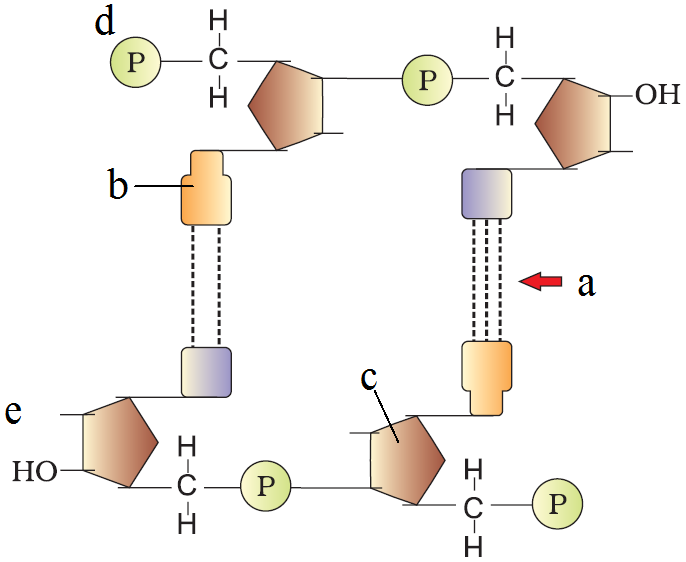
Study the given portion of double$-$stranded polynucleotide chain carefully. Identify $a, b, c$ and the $5\ '$ end of the chain.
Answer
  1. $a-$ Hydrogen bonds.
  2. $b-$ Purine base.
  3. $c-$ Pentose $($deoxyribose$)$ sugar.
  4. $d- 5\ '$ end.
View full question & answer
Question 762 Marks
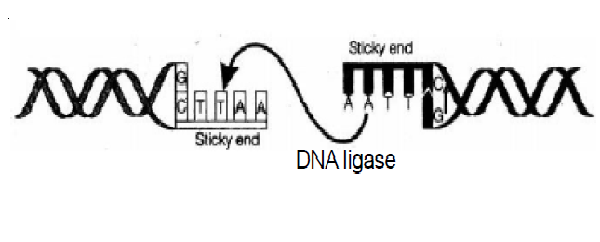
Discuss the role the enzyme DNA ligase plays during DNA replication.
Answer
(Discontinuous) DNA fragments are joined/sealed by them. // sticky ends of vector and foreign DNA, joined by them. The following diagram can be considered in lieu of explanation.
View full question & answer
Question 772 Marks
The total number of genes in humans is far less (< 25,000) than the previous estimate (upto 1,40,000 gene). Comment.
Answer
Repeated sequences make up very large portion of the human genome. Repetitive sequences are stretches of DNA sequences that are repeated many times, sometimes hundred to thousand times. They are thought to have no direct coding functions, but they shed light on chromosome structure, dynamics and evolution. Less than 2 percent of the genome codes for proteins.
View full question & answer
Question 782 Marks
Who proposed the famous double stranded helical structure of DNA?
Answer
James Watson and Francis Crick in 1953.
View full question & answer
Question 792 Marks
During DNA replication, why is it that the entire molecule does not open in one go? Explain replication fork. What are the two functions that the monomers (d NTPs) play?
Answer
For long DNA molecules, since the two strands of DNA cannot be separated in its entire length (due to very high energy requirement), the replication occur within a small opening of the DNA helix, referred to as replication fork.
View full question & answer
Question 812 Marks
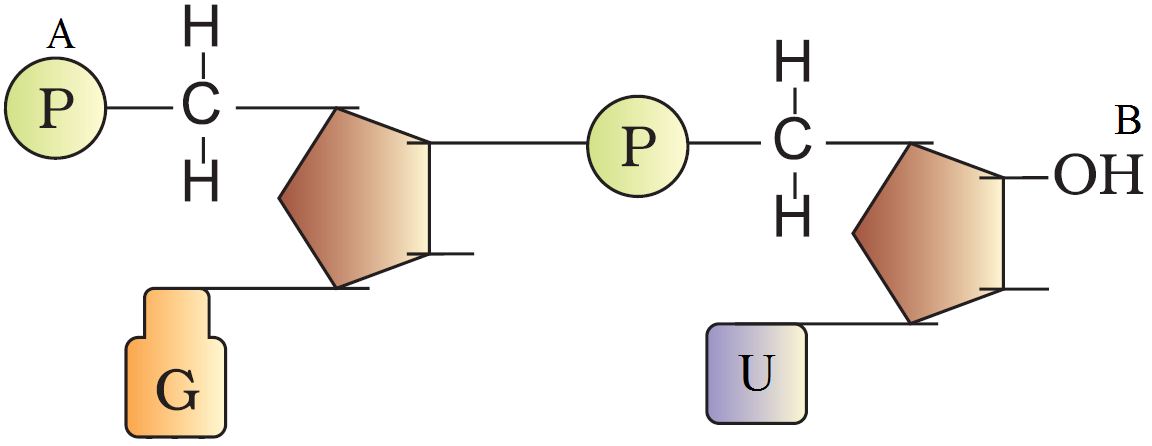
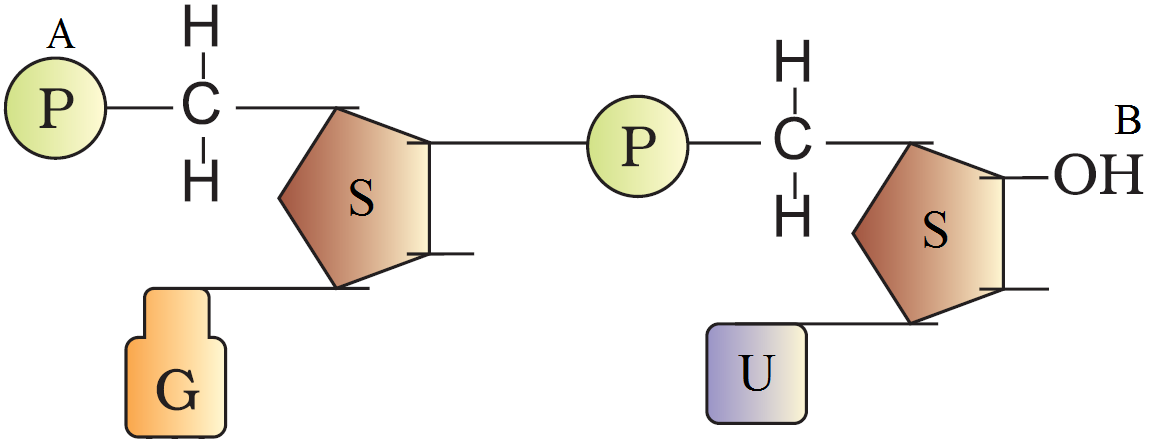
Answer the questions based on the dinucleotide shown below:
  1. Name the type of sugar, the guanine base is attached to.
  2. Name the linkage connecting the two nucleotides.
  3. Identify the 3' end of the dinucleotide. Give a reason for your answer.
Answer
  1. Ribose.
  2. 3' - 5' phosphodiester linkage.
  3. B- is 3' end.
Here the ribose has a free 3' OH group.
View full question & answer
Question 822 Marks
Calculate the length of the DNA of bacteriophage lambda that has 48502 base pairs.
Answer
Distance between two consecutive base pairs = 0.34 × 10 - 9m
The length of DNA in bacteriophage lambda = 48502 × 0.34 × 10 - 9m = 16.49 × 10 - 6m
View full question & answer
Question 832 Marks
Explain what happens in frameshift mutation. Name one disease caused by the disorder.
Answer
The mutation in which addition/ insertion or deletion of one or two bases changes the reading frame from the site of mutation is called frameshift mutation. It may result in polypeptide with different sequences of amino acid. A disease caused by frameshift mutation is muscular dystrophy.
View full question & answer
Question 842 Marks
Describe the termination process of transcription in bacteria.
Answer
After the elongation as the polymerase reaches the terminator region, the nascent RNA along with RNA polymerase fall off. RNA polymerase associates transiently with the termination factor-Rho (p) to terminate the transcription.
View full question & answer
Question 852 Marks
"Genes contain the information that is required to express a particular trait." Explain.
Answer
The genes present in an organism show a particular trait by way of forming certain product. This is facilitated by the process of transcription and translation (according to central dogma of Biology)
View full question & answer
Question 862 Marks
Although a prokaryotic cell has no defined nucleus, yet DNA is not scattered throughout the cell. Explain.
Answer
DNA (being negatively charged) is held with some proteins (that have positive charges) in a region termed as ‘nucleoid’. The DNA in nucleoid is organised in large loops held by proteins. Also the DNA in form of single chromosomes is attached to mesosome at a point.
View full question & answer
Question 872 Marks
During in vitro synthesis of DNA, a researcher used 2’, 3’ - dideoxy cytidine triphosphate as raw nucleotide in place of 2’ - deoxy cytidine. What would be the consequence?
Answer
2’, 3’ - dideoxy cytidine triphosphate is a reverse transcriptase inhibitor. Reverse transcriptase is a viral DNA polymerase which facilitates DNA replication in HIV and other retroviruses. The commercial name of ddC is Zalcitabine and it is sold as a pharmaceutical product for management of HIV. If 2’, 3’ - dideoxy cytidine triphosphate is used as a raw nucleotide in place of 2’ - deoxy cytidine, it will stop DNA replication. The researcher will not be able to proceed on his experiment because of contrary effect of his chosen reagent.
View full question & answer
Question 882 Marks
A tRNA is charged with amino acid methionine
  1. Name the process involved in the attaci ment.
  2. Point out the mRNA codon and anticodon on tRNA for this amino acid.
  3. What is heterochromatin?
Answer
  1. Initiation
  2. mRNA codon = AUG
tRNA anticodon = UAC
  1. The densely packed and dark stained/ transcriptionally inactive chromatin is known as the heterochromatin.
View full question & answer
Question 892 Marks
Structural genes may be monocistronic or polycistronic. Bring out the differences between the two.
Answer
  1. Monocistronic RNA:
  • It is the length of RNA which has information to code for one polypeptide; it is found mostlyin eukaryotes.
  1. Polycistronic RNA:
  • It is a long mRNA, which has information to code for more than one polypeptide; it is found in prokaryotes.
View full question & answer
Question 902 Marks
State the role of AUG codon at the 5' end and UAG at 3' end of a certain mRNA during translation.
Answer
  1. The codon AUG is the initiation codon and codes for methionine, the initiator amino acid.
  2. UAG is a stop codon that does not code for any amino acid and brings about the termination of the translation process.
View full question & answer
Question 912 Marks
Illustrate schematically the process of initiation, elongation and termination during transcription of a gene in a bacterium.
View full question & answer
Question 922 Marks
What is aminoacylation? State its significance.
Answer
Amino acids are activated in the presence of ATP and linked to (cognate) t-RNA.
Carries amino acid to the site of protein synthesis/reaches amino acids to the respective codon.
View full question & answer
Question 932 Marks
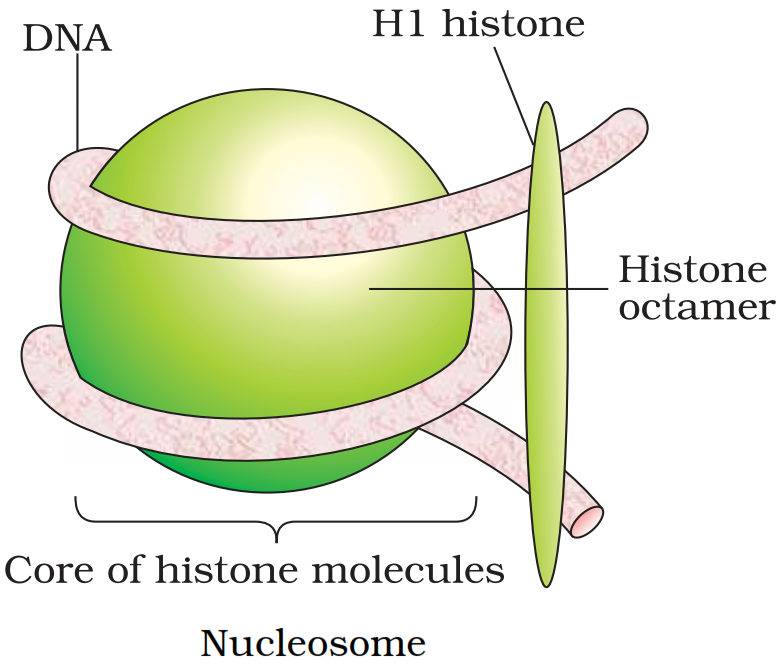
Describe the structure of a nucleosome.
Answer
A unit of eight molecules of positively charged histones, negatively charged DNA, wrapped around the histones octamer, contains 200 bp of DNA helix.
DNA is negatively charged, histone is positively charged, 200 bp of DNA helix.
View full question & answer
Question 942 Marks
Differentiate between a cistron and an exon.
Answer
S. No.
Cistron
Exon
1.
A cistron is a segment of DNA coding for a polypeptide.
Exon is the coding sequence or expressed sequence of DNA/ hnRNA.
2.
It includes both introns and exons.
Only exons appear in a mature or processed mRNA.
View full question & answer
Question 952 Marks
Name the category of virus that carries reverse transcriptase? What is the purpose of this enzyme?
Answer
Retroviruses carry reverse transcriptase. This enzyme catalyses the formation of DNA from RNA which integrates with DNA of host cell.
View full question & answer
Question 962 Marks
State the functions of Ribozyme and release factor in protein synthesis, respectively.
Answer
  1. Ribozyme catalyses the formation of peptide bond in bacteria.
  2. The release factor binds to the stop codon and terminates translation and releases the polypeptide synthesised.
View full question & answer
Question 972 Marks
Recall the experiments done by Frederick Griffith, Avery, MacLeod and McCarty, where DNA was speculated to be the genetic material. If RNA, instead of DNA was the genetic material, would the heat killed strain of Pneumococcus have transformed the R-strain into virulent strain? Explain.
Answer
RNA is more labile and prone to degradation (owing to the presence of 2’ OH group in its ribose). Hence heat-killed S-strain may not have retained its ability to transform the R-strain into virulent form if RNA was its genetic material.
View full question & answer
Question 982 Marks
Give two reasons why both the strands of DNA are not copied during transcription.
Answer
Both the strands of DNA are not copied during transcription for the following reasons:
  1. If both the strands of DNA are copied, two different RNAs (complementary to each other) and hence two different polypeptides would be formed; if a segment of DNA produces two polypeptides, the genetic information machinery becomes complicated.
  2. The two complementary RNA molecules (produced simultaneously) would form a double-stranded RNA rather than getting translated into polypetides.
  3. RNA polymerase carries out polymerisation in the 5' → 3' direction and hence, the DNA strand with 3' → 5' polarity acts as the template strand.
View full question & answer
Question 992 Marks
  1. Name the molecule 'M' that binds with the operator.
  2. Mention the consequences of such binding.
  3. What will prevent the binding of the molecule 'M' with the operator gene? Mention the event that follows.
Answer
  1. M is the repressor.
  2. When the repressor binds to the operator, transcription of structural genes by RNA-polymerase is prevented.
  3.  
  1. An inducer can prevent the binding of repressor to operator.
  2. Consequently, the RNA-polymerase gets access to the promoter and transcription proceeds.
View full question & answer
Question 1002 Marks
Draw schematically a single polynucleotide strand (with at least three nucleotides). Provides labels and directions.
View full question & answer
Question 1012 Marks
Comment on the utility of variability in number of tandem repeats during DNA finger printing.
Answer
Variability in number of tandem repeats (VNTR) is highly useful in DNA finger printing. DNA sample is subjected to gel electrophoresis or Southern blotting. After that VNTR manifests as a pattern of lines of different lengths. The variability in lengths of lines and their respective arrangement varies from one individual to another. This is more or less unique the way a person’s finger print is. Thus, VNTR helps in establishing exact identity of an individual through DNA finger printing.
View full question & answer
Question 1022 Marks
Explain the process of charging of tRNA. Why is it essential in translation?
Answer
The amino acids are activated in the presence of ATP and linked to their cognate tRNA. This process is called charging of tRNA or amino-acylation of tRNA. When two such charged tRNAs are brought close enough, the formation of peptide bond between them would be favoured energetically. The presence of a catalyst would enhance the rate of peptide bond formation.
View full question & answer
Question 1032 Marks
What is a terminator? What is its significance in transcription?
Answer
The terminator is a component of transcription unit, which defines the end of the process of transcription. It is a code on the mRNA for which the tRNA has no anticodon and so the polypeptide chain breaks.
View full question & answer
Question 1042 Marks
What are chromatin? Why are they seen as ‘beads on string’ structure under electron microscope?
Answer
One nucleosome contains approximately 200 base pairs of DNA helix. Nucleosomcs are the repeating units of chromatin, which are threadlike stained 1colo"r.d) bodies. present in nucleus, The nucleosomes in chromatin look like 'beads-on-string' when observed under an Electron Microscope (EM).
View full question & answer
Question 1052 Marks
Explain the dual function of AUG codon. Give the sequence of bases it is transcribed from and its anticodon.
Answer
Codes for Methionine, and is an initiation codon.The sequence of bases from which it is transcribed is T AC.
Its anticodon is UAC.
View full question & answer
Question 1062 Marks

  1. Name the molecule ‘X’ synthesised by ‘i’ gene, How does this’ molecule get inactivated?
  2. Which one of the structural genes codes for β-galactosidase?
  3. When will the’ transcription of this gene stop?
Answer
  1. Repressor Lactose (inducer) binds with the repressor molecule.
  2. Z gene.
  3. When all the lactose molecules are consumed/repressor becomes free to bind with operator.
View full question & answer
Question 1072 Marks
What is amplification with reference to DNA fingerprinting?
Answer
The process of multiplication of DNA by subjecting the desired DNA to polymerase chain reaction is called amplification.
View full question & answer
Question 1082 Marks
DNA is the genetic material in most of the organisms, while RNA is the genetic material in a few viruses. What are the four general/ common functions performed by RNA in other organisms?
Answer
Functions of RNA:
  1. It functions as a messenger and brings the genetic information of DNA to ribosomes.
  2. It is an adapter, i.e., it transports specific amino acid and reads the codon on mRNA.
  3. It is a structural component of ribosomes.
  4. It also acts as a catalyst in prokaryotes for peptide bond formation.
View full question & answer
Question 1092 Marks
Mention the role of ribosomes in peptide-bond formation. How does ATP facilitate it?
Answer
Provides the sites for the binding of amino acid, acts as a catalyst (23S r RNA) for the formation of peptide bond ATP provides the energy for the bond formation.
View full question & answer
Question 1102 Marks
Would it be appropriate to use DNA probes such as VNTR in DNA finger printing of a bacteriaphage?
Answer
Bacteriaphage does not have repetitive sequences such as VNTRs in its genome as its genome is very small and have all the coding sequence. DNA finger printing is not done for phages.
View full question & answer
Question 1112 Marks
Following is the DNA sequence representing a part of the gene:
TAC CCC CAC GAG TTA TAT ATA CGG GGG CAT CAT ATG From it derive
  1. The RNA transcript
  2. The spliced mRNA (assuming that all codons containing a C represent the intron)
  3. The number of amino acids it can code for
Answer
  1. AUG GGG GUG CUC AAU AUA UAU GCC CCC GUA GUA UAC
  2. AUG GGG GUG AAU AUA UAU GUA GUA
  3. 8 amino acids.
View full question & answer
Question 1122 Marks
Why is it essential that tRNA binds to both an amino acid and an mRNA codon during protein synthesis?
Answer
tRNA is an adaptor molecule, which is meant for transferring amino acids to ribosomes for synthesis of polypeptides, tRNAs carry specific amino acids at particular points during polypeptide synthesis as per codons of mRNA, and the codons are recognised by anticodons of tRNAs. Thus, the coded information from DNA is translated by bringing amino acids in a particular sequence.
View full question & answer
Question 1132 Marks
Mention the differences between DNA replication and transcription.
Answer
S. No.
Replication
Transcription
1.
When replication starts, the total DNA of the organism replicates.
In transcription, only a segment of one of the strands is copied.
2.
Adenine pairs with thymine.
Uracil is the complementary base for adenine.
View full question & answer
Question 1142 Marks
Complete the following table using alphabets (a to k)
DNA triplet
3’ → 5’
mRNA codon
5’ → 3’
Anticodon
Amino acid
a
b
UAC
c
d
UGG
e
Tryptophan
AAG
f
g
h
i
j
GAC
k
Answer
  1. TAC
  2. AUG
  3. Methionine
  4. ACC
  5. ACC
  6. UUC
  7. AAG
  8. Phenylalanine
  9. GAC
  10. CUG
  11. Leucine
View full question & answer
Question 1152 Marks
AUG GAC CUG AUA UUU UGA is the base sequence in a strand of mRNA.
  1. Write the base sequence of the DNA strand from which it has been transcribed.
  2. Upon translation, how many amino acids will the resulting peptide have?
Answer
  1. TAC CTG GAC TAT AAA ACT
  2. Five amino acids.
View full question & answer
Question 1162 Marks
Explain the two factors responsible for conferring stability to double helix structure of DNA.
Answer
Presence of H-bonds, the plane of one base pair stacks over the other, complementarity, presence of thymine in place of uracil.
View full question & answer
Question 1172 Marks
What are structural genes? Name the three structural genes present in the lac operon of Escherichia coli?
Answer
Structural genes are those genes which actually synthesise mRNAs. The lac operon of Escherichia coli contains three structural genes (z, y and a).
View full question & answer
Question 1182 Marks
Answer the questions based on the dinucleotide structure shown below.
  1. Name the type of sugar guanine base is attached to.
  2. Name the linkage connecting the two nucleotides.
  3. Identify the 3 end of the dinucleotide. Give a reason for your answer.
Answer
  1. Deoxyribose.
  2. Two nucleotides are linked through 3' → 5' phosphodiester linkage to form a dinucleotide.
  3. B is 3' end, here the sugar has a free 3' OH group.
View full question & answer
Question 1192 Marks
State the difference between the structural genes in a Transcription Unit of Prokaryotes and Eukaryotes.
Answer
 
Prokaryotes
Eukaryotes
1.
Polycistronic
Monocistronic.
2.
No split genes / Not interrupted coding sequence
Split genes/interrupted coding sequences/exon and intron.
View full question & answer
Question 1202 Marks
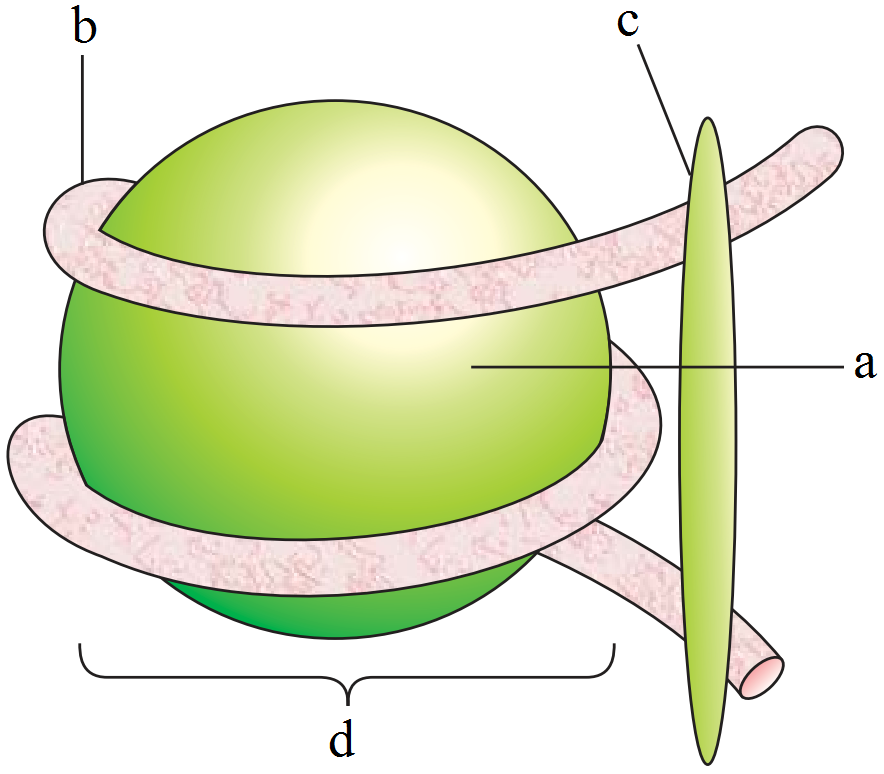
  1. What is this diagram representing?
  2. Name the parts a, b and c.
  3. In the eukaryotes the DNA molecules are organised within the nucleus. How is the DNA molecule organised in a bacterial cell in absence of a nucleus?
Answer
S.No.  
A. Nucleosome
B. a-Histone octamer
b-DNA
c-$H_1$ Histone
C. In prokaryotes, the DNA is held with some positively charged proteins to form a nucleoid. The DNA is then organized as large loops held by the proteins.
View full question & answer
Question 1212 Marks
Why RNA is not a suitable genetic material in comparison with DNA? Explain.
Answer
  1. RNA functions as an enzyme and is therefore reactive and unstable.
  2. Uracil present in the RNA is less stable as compared to thymine of DNA.
  3. Being unstable RNA mutates at a much faster rate, that is why RNA viruses have shorter life span and mutate and evolve very fast. Such rapid changes are harmful to higher forms of life.
View full question & answer
Question 1222 Marks
If the length of E.coli DNA is 1.36mm, calculate the number of base pairs in E.coli.
Answer
Given, length of E.coli DNA $=1.36 \mathrm{~mm}=1.36 \times 10^{-3} \mathrm{~m}$.
Distance between two consecutive base pairs$=0.34 \mathrm{~nm}$
$=0.34 \times 10^{-9} \mathrm{~m}$.
Hence, for E.coli total number of base pairs
$=\frac{1.36\times 10^{-3}}{0.34\times10^{-9}}=4\times 10^6\text{bp}$
View full question & answer
Question 1232 Marks
A mRNA strand has a series of codons out of which three are given below:
  1. AUG
  2. UUU
  3. UAG
  1. What will these DNA codons be translated into?
  2. What are the DNA codons that would have transcribed these RNA codons?
Answer
  1.  
  1. AUG signals the synthesis of polypeptide (start signal) and codes for the amino acid methionine.
  2. UUU codes for phenylalanine.
  3. UAG do not specify any amino acid and hence is called nonsense codon. It signals the termination of polypeptide chain (stop signal).
  1. TACAAAATC
View full question & answer
Question 1242 Marks
Mention the two assumptions that led to the HGP.
Answer
The two factors/ assumptions are that:
  1. Genetic make up of an organism lies in the DNA sequences.
  2. Iftwo individuals differ, then their DNA sequences should also be different.
View full question & answer
Question 1252 Marks
What is meant by semi-conservative nature of DNA replication?
Answer
After DNA replication, the daughter DNA formed contains one parental strand and one newly synthesised strand. Such type of DNA replication is called semi-conservative DNA replication.
View full question & answer
Question 1262 Marks
A tRNA is charged with the amino acid methionine:
  1. At what site in the ribosome will the tRNA bind?
  2. Give the anticodon of this tRNA.
  3. What is the mRNA codon for methionine?
  4. Name the enzyme responsible for this binding.
Answer
  1. If it behaves as starting codon it will bind at P site, otherwise it will bind at A site.
  2. UAC
  3. AUG
  4. Aminoacyl tRNA synthetase.
View full question & answer
Question 1272 Marks
Regulation of lac operon can be visualised as regulation of enzyme synthesis by its substrate. Explain the statement.
Answer
  1. Lactose is the inducer for lac operon.
  2. The active form of lactose binds to the repressor protein and brings about a conformational change in the repressor.
  3. As a result, the repressor is inactive, i.e. it cannot bind to the operator.
  4. This provides access of the RNA polymerase to structural genes and transcription and production of enzymes continue and metabolism of lactose takes place.
  5. In its absence, the repressor is active and binds to the operator, thereby switching off the process.
View full question & answer
Question 1282 Marks
Who postulated an adapter molecule to link the genetic code and the amino acids? What are its functions?
Answer
Francis Crick proposed the presence of an adapter molecule, i.e. rRNA.
  1. It has an amino acid binding end; so it transports a specific amino acid to the site of protein synthesis.
  2. By its anticodon, it recognises the codon at the A site and binds to it by hydrogen bonds and ultimately releases the amino acid it carries.
View full question & answer
Question 1292 Marks
Mention the possible levels of regulation of gene expression in eukaryotes.
Answer
The possible levels of regulation in eukaryotes could be at:
  1. Transcriptional level, i.e. formation of primary transcript.
  2. Processing level, i.e. regulation of splicing.
  3. Transport of mRNA from the nucleus to the cytoplasm.
  4. Translational level.
View full question & answer
Question 1302 Marks
Pick out the untranslated regions from the following mRNA and mention their location.
5'-ACGUCGAUGGCGUUUUAGGAGGAA-3'
Answer
  1. ACGUCG- at the 5' end before the initiation codon.
  2. GAGGAA- at the 3' end after the termination codon.
  3. They are normally located in front of the initiation codon at the 5' end and behind the termination codon at the 3' end of the coding strand of DNA.
View full question & answer
Question 1312 Marks
Name the two most commonly employed hosts and the vectors for human gene cloning.
Answer
Bacteria and yeast are the hosts.
Bacterial Artificial Chromosomes (BACs) and Yeast Artificial Chromosomes (YACs) are the vectors.
View full question & answer
Question 1322 Marks
Write two possible uses of single nucleotide polymorphism.
Answer
Single nucleotide polymorphism helps in:
  1. Finding the chromosomal locations of disease associated genes or sequences of $\text{DNA}.$
  2. Tracing human history.
View full question & answer
Question 1332 Marks
Distinguish between codons and anticodons.
Answer
S. No.
Codons
Anticodons
1.
A codon is a sequence of three nucleotides, which codes for a particular amino acid.
An anticodon is a sequence of three nucleotides that is complementary to the codon of a particular amino acid.
2.
It is found on mRNA and decides the sequence of amino acids in a polypeptide.
It is found on tRNA and recognises the codon on mRNA during translation.
View full question & answer
Question 1342 Marks
List any four properties of a molecule to be able to act as a genetic material.
Answer
Properties of Genetic Material:
  1. The genetic material should be able to generate its replica so that one can be transmitted to the daughter cell/ next generation.
  2. It should be chemically and structurally stable.
  3. It should provide scope for slow changes (mutation) that are necessary for evolution.
  4. It should be able to express itself in the form of Mendelian characters.
View full question & answer
Question 1352 Marks
What is a cistron? Why is the structural gene in a transcription unit of eukaryotes called monocistronic and that in prokaryotes/bacteria called polycistronic? Give reasons.
Answer
Cistron is a segment of DNA coding for a polypeptide. In eukaryotes the transcriptional unit have interrupted coding sequences - exons and introns. It codes for only one polypeptide, so it is called monocistronic.
In prokaryotes structural genes have many coding sequences, so it is called polycistronic.
View full question & answer
Question 1362 Marks
Write the role of RNA primer during DNA replication.
Answer
The Role of RNA Primers During DNA replication, two pieces of DNA are separated and used to build new complementary strands of DNA. After the RNA primer has been made, DNA polymerase will bind to it and start creating a new strand of DNA by adding complementary nucleotides to the primer.
View full question & answer
Question 1372 Marks
How are the consecutive nucleotides linked together in a polynucleotide strands?
Answer
By phosphodiester bond.
View full question & answer
Question 1392 Marks
A cistron consists of 20 codons. How many amino acids will it code in the polypeptide transcribed? Why?
Answer
It will code for 19 amino acids because, the last codon on mRNA will be a terminating codon, which will not code for any amino acid.
View full question & answer
Question 1402 Marks
Why do moss plants produce very large number of male gametes? Provide one reason. What are these gametes called?
Answer
To compensate the loss of male gametes during their transport(to the non-motile female gamete) through water/to increase chances of fertilisation, antherozoids.
View full question & answer
Question 1412 Marks
Study the figure given below and answer the questions:
  1. How does the repressor molecule get inactivated?
  2. When does the transcription of lac mRNA stop?
  3. Name the enzyme transcribed by the gene ‘Z’.
Answer
  1. Binding of inducer/lactose to the repressor.
  2. In the absence of inducer lactose/when repressor binds with the operator.
  3. ß - galactosidase.
View full question & answer
Question 1422 Marks
Differentiate between leading strand and lagging strand.
Answer
S.No.
Leading strand
Lagging strand
1.
It is a replicated strand of DNA which grows continuously without any gap.
The lagging strand is a replicated strand of DNA which is formed in short segments called discontinuous.
2.
It does not require DNA ligase for its growth.
DNA ligase is required for joining okazaki fragments.
3.
The direction of growth of a leading strand is 5' → 3'.
The direction of the lagging strand is 3' → 5'.
4.
Only a single RNA primer is required.
Starting of each okazaki fragment requires a new RNA.
5.
Its template opens in 3' → 5' direction.
Its template opens in 5' → 3' direction
6.
Formation of leading strand begins immediately at the beginning of replication
Formation of lagging strand begins a bit later than that of leading strand.
View full question & answer
Question 1432 Marks
Two claimant fathers filed case against a lady claiming to be the father of her only daughter. How could this case be settled identifying the real biological father?
Answer
The DNA of the two claimants father and the daughter is extracted from the nuclei of white blood cells. The DNA molecules are then used for obtaining DNA finger prints (DNA profiles). Now the DNA fingerprints are matched to identify the real father.
View full question & answer
Question 1442 Marks
Name indicating their functions, a few additional enzymes, other than DNA polymerase and ligase, that are involved in the replication of DNA with high degree of processivity and accuracy.
Answer
  1. Helicase: Helicase opens the helix.
  2. Topoisomerases: Removes the supercoiling of DNA relieves the tension due to unwinding.
  3. Primase: Synthesises RNA primer.
  4. Telomerase: To synthesises the DNA of telomeric end of chromosomes.
View full question & answer
Question 1452 Marks
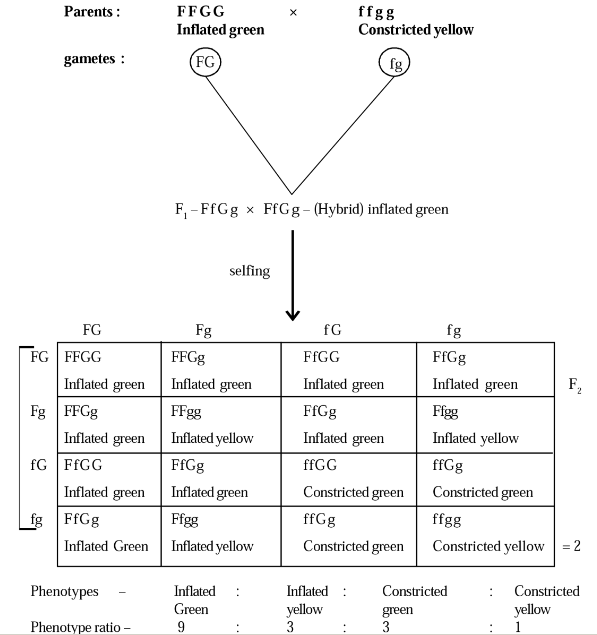
  1. A true-breeding pea plant, homozygous for inflated green pods is crossed with another pea plant with constricted yellow pods(ff gg). What would be the phenotype and genotype of $F_1$ and $F_2$ generations? Give the phenotype ratio of $F_2$ generation.
  2. State the generalisation proposed by Mendel on the basis of the above-mentioned cross.
Answer
  1.  
  1. Law of independent assortment.
View full question & answer
Question 1462 Marks
Explain the relationship between CFC's and Ozone in the stratosphere.
Answer
UV rays act on CFC's, release Cl atom, which act on ozone to release $O_2$, resulting in ozone layer depletion/causing ozone hole.
View full question & answer
Question 1472 Marks
What are the functions of
  1. Methylated guanosine cap and.
  2. Poly-A tail in a mature mRNA?
Answer
Methylated guanosine cap helps in binding of mRNA to smaller ribosomal sub-unit during initiation of translation. Poly-A tail provides longevity to mRNA’s life. Tail length and longevity of mRNA are positively correlated.
View full question & answer
Question 1482 Marks
What would happen if histones were to be mutated and made rich in amino acids aspartic acid and glutamic acid in place of basic amino acids such as lysine and arginine?
Answer
If histone proteins were rich in acidic amino acids instead of basic amino acids then they may not have any role in DNA packaging in eukaryotes as DNA is also negatively charged molecule. The packaging of DNA around the nucleosome would not happen. Consequently, the chromatin fibre would not be formed.
View full question & answer
Question 1492 Marks
What are the assumptions that led to the human genome project?
Answer
These assumptions led to the idea of determining the complete DNA sequence of human genome and consequently of human genome project. It was a mega project which took 13 years for its completion, i.e. from 1990 to 2003. It was coordinated by the US Department of Energy and the National Institute of Health.
The two main factors that contributed in the completion of this project are-
  1. Availability of simple and fast techniques for the determination of DNA sequences.
  2. Genetic engineering techniques, which help to isolate and clone any segment of DNA.
View full question & answer