Questions

1 Marks Question

Take a timed test

177 questions · 1 auto-graded MCQ + 176 self-marked written.

Question 11 Mark
Define the following terms and give one example for each:
Commensalism
Answer
Commensalism: Commensalism is an interaction between two species in which one species gets benefited while the other remains unaffected. An orchid growing on the branches of a mango tree and barnacles attached to the body of whales are examples of commensalisms.
View full question & answer
Question 31 Mark
Define the following terms and give one example for each:
Camouflage
Answer
Camouflage: It is a strategy adapted by prey species to escape their predators. Organisms are cryptically coloured so that they can easily mingle in their surroundings and escape their predators. Many species of frogs and insects camouflage in their surroundings and escape their predators.
View full question & answer
MCQ 51 Mark
Select the statement which explains best parasitism.
  • A
    One organism is benefited.
  • B
    Both the organisms are benefited.
  • C
    One organism is benefited, other is not affected.
  • One organism is benefited, other is affected.
Answer
Correct option: D.
One organism is benefited, other is affected.
View full question & answer
Question 61 Mark
Define the following terms and give one example for each:
Mutualism
Answer
Mutualism: It is an interaction between two species in which both species involved are benefited. For example, lichens show a mutual symbiotic relationship between fungi and blue green algae, where both are equally benefited from each other.
View full question & answer
Question 71 Mark
Define the following terms and give one example for each:
Interspecific competition
Answer
Interspecific competition: It is an interaction between individuals of different species where both species get negatively affected. For example, the competition between flamingos and resident fishes in South American lakes for common food resources i.e., zooplankton.
View full question & answer
Question 101 Mark
Name the type of association that the genus Glomus exhibits with higher plants.
Answer
Symbiosis/Mycorrhizae/Mutualism.
View full question & answer
Question 111 Mark
Mention any two significant roles prediction plays in nature.
Answer
Conduits of energy transfer to the next trophic level/prey population is kept under control/helps in biological control/maintains species diversity.
View full question & answer
Question 121 Mark
Why is the polar region not suitable habitat for tiny hummingbirds?
Answer
When volume is considered surface area is large, loss of heat is more in cooler regions/difficult to generate more heat.
View full question & answer
Question 131 Mark
Very small animals are rarely found in polar regions. Give two reasons.
Answer
Small animals have larger surface area relative to their volume loose heat very fast, due to small size, expend much energy to generate body heat through metabolism.
View full question & answer
Question 141 Mark
What does nature’s carrying capacity for a species indicate?
Answer
(In nature) a given habitat has enough (limited) resources to support a maximum possible number, no further growth in population is possible
View full question & answer
Question 151 Mark
How do mycorrhizae help the plants to grow better?
Answer
Absorbs phosphorus, provide resistance to root borne pathogens, enhanced to tolerate salinity/drought.
View full question & answer
Question 161 Mark
Name the two intermediate hosts which the human liver fluke depends on to complete its life cycle so as to facilitate parasitization of its primary host.
Answer
Snail and Fish.
View full question & answer
Question 171 Mark
Give an example of an organism that enters ‘diapause’ and why.
Answer
(Many species of) Zooplankton, unfavourable condition.
View full question & answer
Question 191 Mark
If 8 individuals in a laboratory population of 80 fruit flies died in a week, then what would be the death rate for population for the said period?
Answer
0.1, individuals per fruitfly per week.
View full question & answer
Question 201 Mark
Name the world’s most problematic aquatic weed. What is the nature of the water body in which the weeds grow abundantly?
Answer
Eicchornia crassipes/water hyacinth.Stagnant water/Eutrophic/nutrient enriched water bodies/polluted with nutrients.
View full question & answer
Question 211 Mark
What advantage does the sea anemone get in the sea anemone hermit crab facultative mutualism? Give an alternative term for this kind of mutualism.
Answer
Transport/ to reach new food sources, protocooperation.
View full question & answer
Question 221 Mark
How do seed-bearing plants tide over dry and hot weather conditions?
Answer
In seed-bearing plants, the seeds and other vegetative reproductive structures serve to tide over the unfavourable conditions, they germinate to form new plants under favourable conditions.
View full question & answer
Question 231 Mark
Why are green algae not found at lower depths of a sea?
Answer
Green algae or plants are not found beyond a certain depth, as light (not all colour components of visible spectrum) is not available.
View full question & answer
Question 241 Mark
What is the advantage of homeostasis to organisms that exhibit it?
Answer
Homeostasis enhances the overall fitness of organisms because all biochemical reactions and physiological functions proceed with maximal efficiency.
View full question & answer
Question 251 Mark
Mention the factors that determine the water holding capacity of soil.
Answer
Soil composition, grain size and aggregation.
View full question & answer
Question 271 Mark
Name two interspecific interactions where one partner is neutral, i.e. not affected.
Answer
Amensalism and commensalism.
View full question & answer
Question 281 Mark
Why is the problem of predation in plants is more severe than that in animals?
Answer
The problem is severe in case of plants as they cannot run away from the predators.
View full question & answer
Question 291 Mark
When and why do animals like frog/ bear hibernate?
Answer
If the unfavourable (stressful) conditions are for a short duration and if the animals are not able to migrate, they hibernate during extreme winter to avoid the stress by escaping in time.
View full question & answer
Question 301 Mark
Why has parasitism evolved in many taxonomic groups of organisms?
Answer
Parasitism has evolved because it ensures free lodging and food to the organism.
View full question & answer
Question 321 Mark
Name the interaction that exists between sucker fish and shark.
Answer
Sucker fish and shark is commensalism.
View full question & answer
Question 331 Mark
What is meant by ‘competitive release’?
Answer
Competitive release is a phenomenon in which a species whose distribution is restricted to a small geographical area because of the presence of a competitively superior species, is found to expand drastically when the competing species is removed.
View full question & answer
Question 341 Mark
Name two 'photoperiod' dependent processes, one each in plants and in animals.
Answer
Flowering in plants and migration in animals.
View full question & answer
Question 351 Mark
What causes the annual variation in the intensity and duration of temperature?
Answer
  1. Rotation of earth around the Sun.
  2. Tilt of the earth on its axis.
View full question & answer
Question 361 Mark
Name two organisms (one plant and one animal) which breed only once in their lifetime.
Answer
Bamboo; Pacific Salmon Fish.
View full question & answer
Question 371 Mark
Define migration. Mention the types of migration.
Answer
Migration is a two$-$way movement of an animal group to other places for food, appropriate climate and other reasons. Migration is of three types:
  1. Daily.
  2. Seasonal.
  3. Periodic.
View full question & answer
Question 391 Mark
What do you understand by age-pyramid? Give the integral form of equation of exponential growth of a population.
Answer
Graphic representation of different age groups found in a population with pre reproductive groups at the base, reproductive groups in the middle and postreproductive groups at the top is called age-pyramid.
$-\text{N}_\text{t}=\text{N}_0\text{e}^{\text{rt}}$
View full question & answer
Question 401 Mark
Define Allen's rule.
Answer
Mammals from colder climates generally have shorter ears and limbs to minimize heat loss. This is called Allen's rule.
View full question & answer
Question 411 Mark
Name the two intermediate hosts on which the human liver fluke depends to complete its life cycle so as to facilitate parasitisation of its primary host.
Answer
The human liver fluke requires two intermediate hosts, i.e. freshwater snail and fish to complete its life cycle and facilitates parasitisation of its primary host.
View full question & answer
Question 421 Mark
Write one common feature among predation, parasitism and commensalism.
Answer
In all these, the interacting species live closely together and one of the species is benefitted.
View full question & answer
Question 431 Mark
Give an example where animal$-$plant interaction involves $Co-$evolution.
Answer
  1. The mediterranean orchid, Ophrys and its pollinators $($bumble bees and bees$).$
  2. The fig species and its pollinator wasp.
View full question & answer
Question 441 Mark
What is meant by 'competitive release'?
Answer
Competitive release is a phenomenon in which a species whose distribution is restricted to a small geographical area because of the presence of a competitively superior species, is found to expand drastically when the competing species is removed.
View full question & answer
Question 451 Mark
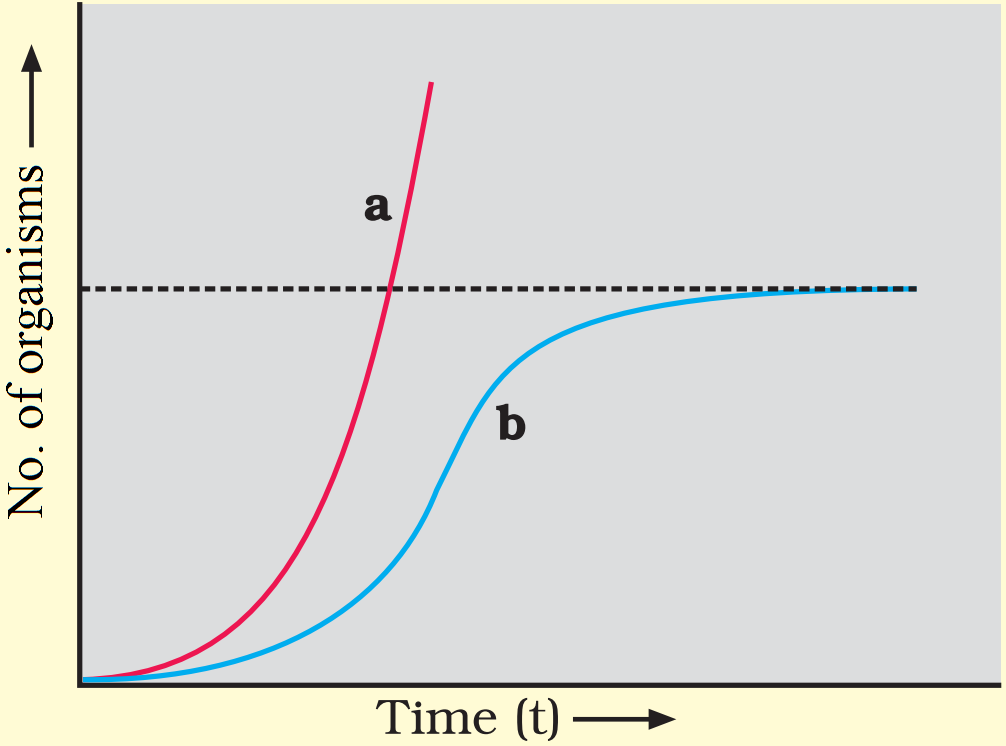
In the given population growth curve.
  1. What is the status of food and space in the curves $(a)$ and $(b)?$
  2. In the absence of the predators, which curve $(a)$ or $(b)$ would appropriately depict the prey population?
Answer
  1. In the curve $(a)$ there is unlimited supply while $(b)$ there are limited sources.
  2. Curve $(a).$
View full question & answer
Question 461 Mark
Why are mammals the most successful animals on earth?
Answer
The mammals are most successful animals on earth because they can maintain a constant body temperature with high range of tolerance whether in Antarctica or in Sahara desert.
View full question & answer
Question 471 Mark
Name two processes which influence population density.
Answer
Immigration and natality influence population density.
View full question & answer
Question 481 Mark
Name the interspecific interaction in which one is detrimental while the other is neutral.
Answer
It is amensalism.
View full question & answer
Question 491 Mark
Name the National Park in India where migratory birds arrive in winter from Siberia.
Answer
Keoladeo National Park.
View full question & answer
Question 501 Mark
In a pond, there were 200 frogs. 40 more were born in a year. Calculate the birth rate of the population of frogs in the pond.
Answer
The birth rate of frog population is 40/200, i.e. 200 per thousand or 20 percent or 0.2 per individual.
View full question & answer
Question 511 Mark
Define population density.
Answer
Population density refers to the total number of individuals of a species present per unit area or volume at a given time.
View full question & answer
Question 531 Mark
Mention the adaptations of mammals in polar seas.
Answer
Mammals have a thick layer of fat, which is called blubber below their skin that acts as an insulator and reduces loss of body heat (e.g. seals).
View full question & answer
Question 541 Mark
'Green algae are not likely to be found in the deepest strata of the ocean'. Give atleast one reason.
Answer
Green algae or plants are not found beyond a certain depth, as light (not all colour components of visible spectrum) can reach only till a certain depth in seas and oceans.
View full question & answer
Question 551 Mark
Name the association in which one species produces poisonous substance or a change in environmental conditions that is harmful to another species.
Answer
Amensalism.
View full question & answer
Question 561 Mark
What is meant by Allen's Rule?
Answer
Allen's rule refers to the reduction of heat loss in animals by having shorter ears and limbs.
View full question & answer
Question 571 Mark
Mention how closely related species of warblers are able to co-exist in a competitive environment.
Answer
Due to behavioural differences in their foraging activities.
View full question & answer
Question 581 Mark
When and why do some animals like snails go into aestivation?
Answer
  1. Summer.
  2. To survive from heat$/$ to escape from desiccation.
View full question & answer
Question 591 Mark
How are closely related species of warblers able to coexist in a competitive environment?
Answer
Due to behavioural differences in their foraging activities.
View full question & answer
Question 611 Mark
Define the following terms:
  1. Leaching.
  2. Photoperiodism.
Answer
  1. The removal or downward movement of soluble chemicals from soil by water is called leaching.
  2. The response of organism to number and duration of day lengths is called as photoperiodism.
View full question & answer
Question 621 Mark
Write four levels of biological organization which are basically concerned with ecology.
Answer
  1. Organisms.
  2. Populations.
  3. Communities.
  4. Biomes.
View full question & answer
Question 631 Mark
Name the type of interaction seen between whale and the barnacles growing on its back?
Answer
Commensalism.
View full question & answer
Question 641 Mark
Aquatic animals that change the osmotic concentration of their body fluids according to the environment are known by which name?
Answer
Osmoconformers.
View full question & answer
Question 651 Mark
What does J-shaped growth curve of a population indicate?
Answer
The J-shaped growth curve indicates the minimum or absence of environmental resistance.
View full question & answer
Question 661 Mark
Name the interaction that exists between Cuscula and shoe-flower plant.
OR
State the type of interaction that exists between ticks and dogs.
Answer
Parasitism.
View full question & answer
Question 671 Mark
Name the biome that has $(a)$ the maximum and $(b)$ the least annual mean precipitation$/$ rainfall.
Answer
  1. Tropical rain forest.
  2. Desert.
View full question & answer
Question 681 Mark
Define the following terms:
  1. Biotic community.
  2. Biome.
Answer
  1. Biotic community is defined as a group of different populations living at one place and interacting with one another in several ways.
  2. Biome is a major terrestrial biotic community characterised by distinctive live form, e.g., temperate deciduous forest, grassland etc.
View full question & answer
Question 691 Mark
What are the two primary requirements of a parasite from the host?
Answer
The two primary requirements of a parasite from the host are:
  1. Shelter.
  2. Nutrition.
View full question & answer
Question 701 Mark
Name the two factors that cause the formation of major biomes.
Answer
  1. Variation in the intensity and duration of temperature.
  2. Variation in precipitation.
View full question & answer
Question 721 Mark
Which growth curve indicates logistic growth of population? Write the equation for the Verhaulst-Pearl Logistic Growth of population.
Answer
Sigmoid growth curve.
$\text{dN}/\text{dt}=\text{r N}\Big[\frac{\text{K}-\text{N}}{K}\Big]$
View full question & answer
Question 731 Mark
What do you mean by the term eurythermal?
Answer
The organism which can tolerate and thrive in a wide range of temperatures is called eurythermal.
View full question & answer
Question 741 Mark
Mark the odd one in each of the following groups.
Aestivation, Migration, Hibernation, Diapause.
Answer
Migration.
View full question & answer
Question 751 Mark
Why is the problem of predation in plants more severe than that in animals?
Answer
Problem of predation is severe for plants because they cannot move away from their predators.
View full question & answer
Question 771 Mark
Why have life history variations evolved?
Answer
Life history variations have evolved in organisms to maximise their reproductive fitness or Darwinian fitness in their natural habitats.
View full question & answer
Question 781 Mark
Between amphibians and birds, which is more likely to be able to cope with global warming? Give reason.
Answer
Birds are more likely able to cope with global warming as they can tolerate a wide range of temperatures (eurythermals).
View full question & answer
Question 791 Mark
What is migration?
Answer
Migration refers to the movement of animals from the stressful habitat to a more hospitable area and return to the original place once the stressful period is over.
View full question & answer
Question 801 Mark
Species that can tolerate narrow range of temperature are called ________.
Answer
Species that can tolerate narrow range of temperature are called Stenothermic.
View full question & answer
Question 821 Mark
How do herbs and shrubs survive under the shadow of big canopied trees in forests?
Answer
The herbs and shrubs growing in the forests are adapted to photosynthesise optimally under very low lightconditions.
View full question & answer
Question 831 Mark
What is ecology at the organismic level?
Answer
Ecology at the organismic level is essentially physiological ecology, which tries to understand how different organisms are adapted to their environments in terms of not only survival but also reproduction.
View full question & answer
Question 841 Mark
What is a tree line?
Answer
When we go up the altitude, beyond a particular height no tree are found and the vegetation comprise only of shrubs and herbs. The altitude beyond which no tree is seen is known as tree line.
View full question & answer
Question 851 Mark
Why have many animals not evolved thermo regulation?
Answer
Thermoregulation is an energy-expensive phenomenon; considering the cost and benefit, many animals have not evolved thermoregulation.
View full question & answer
Question 861 Mark
Name the types of interactions found amongst species of a community?
Answer
Interspecific interactions are:
Predation, Parasitism, commensalism, Mutualism and competition.
View full question & answer
Question 871 Mark
What does ecological niche of an organism represent?
Answer
Ecological niche of an organism refers to the ranges of tolerance, the resources it utilises and its functional role in an ecosystem.
View full question & answer
Question 881 Mark
What causes the annual variations in the distinct seasons?
Answer
Cause of annual variations in the distinct seasons:
  1. Tilt of the earth on its axis.
  2. Rotation of earth around the sun.
View full question & answer
Question 891 Mark
Give two examples of mutualism in living organisms.
Answer
  1. Lichens formed jointly by an alga and fungus.
  2. Termites harbouring cellulose digesting protozoans.
View full question & answer
Question 901 Mark
An exotic variety of prickly pear introduced into Australia turned out to be invasive. How was it brought under control?
Answer
By introducing a cactus-feeding moth.
View full question & answer
Question 911 Mark
What are osmoconformers?
Answer
Osmoconformers are those organisms which regulate the osmolarity of their body fluids according to their surrounding medium.
View full question & answer
Question 921 Mark
Name a plant group which exhibits vivipary.
Answer
Vivipary means germination of seeds, while still attached to the tree. It is exhibited in halophytes.
View full question & answer
Question 931 Mark
What does sigmoid growth curve of a population indicate?
Answer
Sigmoid growth curve of a population indicates following characteristics:
  1. Initially the growth is slow.
  2. The growth becomes rapid and the curve becomes steady due to environmental resistance.
View full question & answer
Question 941 Mark
What is coevolution in parasitism?
Answer
Coevolution in parasitism refers to the process in which the parasite evolves mechanisms to counteract and neutralise the mechanisms evolved by the host to reject or resist the parasite.
View full question & answer
Question 951 Mark
Define stenohaline species.
Answer
Species that tolerate narrow range of salinity are called stenohaline species.
View full question & answer
Question 961 Mark
Between amphibians and birds, which will be able to cope with global warming? Give reason.
Answer
Birds will be able to cope with global warming; they are eurythermals and can tolerate a wide range of temperatures.
View full question & answer
Question 971 Mark
Give one example for each of the following types.
Chemical defense agent.
Answer
Capsaicin produced by bell pepper.
View full question & answer
Question 981 Mark
Name two organisms (one plant and one animal) which breed only once in their life time.
Answer
Pacific salmon fish and bamboo.
View full question & answer
Question 991 Mark
Define the terms 'acceleration' and 'deceleration' with respect to logistic growth curve of population.
Answer
Acceleration Increasing rate of populations. Deceleration Decreasing rate of populations.
View full question & answer
Question 1001 Mark
How do spines help the cactus plants survive in the desert?
Answer
  1. Leaves are reduced to spines to check transpiration.
  2. Spines keep away the browsing animals.
View full question & answer
Question 1011 Mark
Why are predators prudent' in nature?
Answer
Predators are prudent in nature because if a predator is too efficient and over-exploits its prey, then the prey might become extinct and following it, the predator will also become extinct.
View full question & answer
Question 1021 Mark
Provide an instance where the population size of species can be estimated indirectly, without actually counting them or seeing them.
Answer
Tiger population in natural parks is based on pugmarks.
View full question & answer
Question 1031 Mark
What is Allen’s rule?
Answer
According to Allen’s rule, mammals in colder climate have shorter ears and shorter limbs to minimise heat loss.
View full question & answer
Question 1041 Mark
Mark the odd one in each of the following groups.
Parasitism, Predation, Commensalism, Amensalism.
Answer
Amensalism.
View full question & answer
Question 1061 Mark
When and why do some animals like frogs hibernate?
Answer
  1. In winter.
  2. To tide over extreme cold conditions.
View full question & answer
Question 1071 Mark
Why the Calotropis plants are not grazed by goats and cattle?
Answer
Calotropis produces highly poisonous cardiac glycosides that can make the herbivore sick and hence, they are not grazed by goats and cattle.
View full question & answer
Question 1081 Mark
Name the interaction that exists between sucker fish and shark.
OR
Name the type of interaction that exists between barnacles and whale.

OR
Comment on the interaction between a clown fish living among the tentacles of a sea anemone.
Answer
The interaction is commensalism.
View full question & answer
Question 1091 Mark
Name the amino acid which is normally accumulated by xerophytes.
Answer
Amino acid normally accumulated by xerophytes is proline.
View full question & answer
Question 1111 Mark
Name the interaction in the following:
Smaller barnacles disappeared when Balanus dominated in the coast of Scotland.
Answer
Competition.
View full question & answer
Question 1121 Mark
Name the interaction in the following:
Ascaris worms living in the intestine of humans.
Answer
Parasitism.
View full question & answer
Question 1131 Mark
Name a part or an organ of our pody which is a unique habitat for hundreds of species of microbes.
Answer
Human intestine.
View full question & answer
Question 1141 Mark
Mention how do bears escape from stressful time in winter.
Answer
Bears escape from stressful time in winter by going into hibernation, also known as winter sleep.
View full question & answer
Question 1151 Mark
  1. What is 'r' in the population equation given as: dN/ dt = rN
  2. How does the increase and the decrease in the value of r affect the population size?
Answer
  1. 'r' is the intrinsic rate of natural increase
  2. Increase in 'r' increases the population size while decrease in 'r' decreases the population size.
View full question & answer
Question 1161 Mark
Define natality.
Answer
Natality is defined as the number of births that are added to the initial density in a population during a given period of time.
View full question & answer
Question 1181 Mark
Mention any two activities of animals which get cues from diurnal and seasonal variations in light intensity.
Answer
  1. Timing their foraging.
  2. Migratory activities.
  3. Reproduction.
View full question & answer
Question 1191 Mark
Mention any two reasons why plants depend on other organisms for their survival, even though they make their own organic food.
Answer
  1. Plants depend on animals (mainly insects) for pollination.
  2. They also depend on animals for dispersal of seeds and/ or fruits.
  3. They depend on the soil microbes, which can carry out decomposition of organic matter and return the inorganic nutrients to the soil for absorption by plants.
View full question & answer
Question 1201 Mark
What is the cause of altitude sickness at high altitudes?
Answer
It is due to the low atmospheric pressure of high altitudes that the body is unable to get enough oxygen.
View full question & answer
Question 1211 Mark
What are stenothermals?
Answer
The organisms which are restricted to a narrow range of temperature are called stenothermals.
View full question & answer
Question 1221 Mark
What is amensalism?
Answer
The mode of interaction between two species where one is harmed and the other is unaffected is called amensalism.
View full question & answer
Question 1231 Mark
List any two adaptive features evolved in parasites enabling them to live successfully on their hosts.
Answer
  1. Presence of adhesive organs or suckers to cling on the host.
  2. Loss of digestive system and high reproductive capacity.
View full question & answer
Question 1241 Mark
How do fishes in Antarctica region remain active in sea water?
Answer
Fishes in Antarctica region accumulate anti-freeze proteins and glycerol, which lower the freezing point of body fluids, making them capable to survive in adverse conditions.
View full question & answer
Question 1251 Mark
Species that can tolerate wide range of salinity are called _________.
Answer
Species that can tolerate wide range of salinity are called Euryhaline.
View full question & answer
Question 1271 Mark
When and why do animals like snails go into aestivation?
Answer
When the snails are not able to migrate from the stressful conditions in the habitat, they undergo aestivation during hot summers to avoid stress by escaping in time.
View full question & answer
Question 1281 Mark
What is the interaction between two species called?
Answer
The interaction between two species is called interspecific interaction.
View full question & answer
Question 1291 Mark
Give one function of aerenchyma in aquatic plants.
Answer
Aerenchyma gives buoyancy to the aquatic plants due to presence of air chambers.
View full question & answer
Question 1301 Mark
How do snails escape from the stressful time in summer?
Answer
Snails and fish go into aestivation in summer.
View full question & answer
Question 1321 Mark
What determines the type of benthic animals in an aquatic ecosystem?
Answer
The sediment characteristics determine the benthic animals in an aquatic ecosystem.
View full question & answer
Question 1331 Mark
Why has life history of variation evolved?
Answer
In order to maximise reproductive fitness of individual, life history of variation has evolved.
View full question & answer
Question 1341 Mark
What is mycorrhiza?
Answer
Mycorrhiza is a symbiotic association between a fungus and the roots of higher plants.
View full question & answer
Question 1351 Mark
What do you understand by the phenomenon, photonasty?
Answer
Flowers of some plants open or close in response to light and darkness, the phenomenon is called photonasty.
View full question & answer
Question 1381 Mark
An exotic variety of prickly pear introduced in Australia turned out to be invasive. How was it brought under control?
Answer
By introducing its predator, i.e. cactus-feeding moth in the country.
View full question & answer
Question 1391 Mark
Name the mechanism that promotes the coexistence of competing species. Name the scientist who showed this.
Answer
Resource partitioning, it was shown by Mac Arthur.
View full question & answer
Question 1401 Mark
Name the two intermediate hosts on which human liver fluke depend to complete its life cycle.
Answer
Snail and fish.
View full question & answer
Question 1411 Mark
What is meant by carrying capacity of the environment?
Answer
Carrying capacity is defined as the maximum number of individuals of a population that can be sustained by a given habitat or ecosystem.
View full question & answer
Question 1421 Mark
In the process of nitrogen fixation, plants contribute carbon to bacteria that are capable of fixing atmospheric N, gas, and the bacteria can supply the plants with a usable form of nitrogen.
Answer
Mutualism.
View full question & answer
Question 1441 Mark
What does the ecological niche of an organism represent?
Answer
Ecological niche of an organism represents the range of conditions it can tolerate, the resources it utilizes and its functional role in the ecosystem.
View full question & answer
Question 1451 Mark
Which feature of mammals, is the success rate of them, attributed to?
Answer
Their ability to maintain a constant body temperature irrespective of the environmental temperature.
View full question & answer
Question 1461 Mark
What are partial regulaters?
Answer
Partial regulaters are those species which have the ability to regulate, but only over a limited range of environmental conditions, beyond which they simply conform.
View full question & answer
Question 1471 Mark
Cows and dogs are eurythermal animals. Why are polar bears categorised as stenothermal animals? Give one reason.
Answer
Polar bears tolerates narrow range of temperature so these are called stenothermal animals, while cows and dogs can tolerate and survive variety of temperature and are called eurythermal animals.
View full question & answer
Question 1491 Mark
What are Eurythermic species?
Answer
Species that tolerate wide range of temperature are called Eurythermic species.
View full question & answer
Question 1501 Mark
What is commensalism?
Answer
Commensalism is the interaction in which one species benefits and the other is neither harmed nor benefited.
View full question & answer
Question 1531 Mark
Why did the Abingdon tortoise in Galapagos island become extinct?
Answer
Due to greater browsing efficiency of goats that were introduced in Galapagos Island.
View full question & answer
Question 1541 Mark
What do we call the species that can tolerate narrow range of temperature?
Answer
Stenothermal organisms.
View full question & answer
Question 1551 Mark
State Gause's competitive exclusion principle.
Answer
It states that two closely related species competing for the same resources cannot co-exist indefinitely and the competitively inferior one will be eliminated eventually by the superior one.
View full question & answer
Question 1571 Mark
Name the type of interaction seen between figs and wasps.
OR
Comment on the interaction between certain species of fig trees and wasps.
Answer
The interaction is mutualism.
View full question & answer
Question 1581 Mark
Name the interactions in each of the following?
  1. Cuscuta growing on a shoe flower plant.
  2. Mycorrhizae living on the roots of higher plants.
  3. Clown fish living among the tentacles of sea anemone.
  4. Koyel laying her eggs in crow's nest.
Answer
  1. Parasitism.
  2. Mutualism.
  3. Commensalism.
  4. Brood parasitism.
View full question & answer
Question 1601 Mark
Define mortality.
Answer
Mortality refers to the number of deaths in the population during a given period.
View full question & answer
Question 1611 Mark
Provide an instance where the population size of a species can be estimated indirectly, without actually counting them or seeing them.
Answer
Tiger census is carried out by counting the pug marks or faecal pellets.
View full question & answer
Question 1621 Mark
Which of the two, stenothermals or eurythermals, show wide range of distribution on earth and why?
Answer
Eurythermal organisms, e.g. birds show wide range of distribution because they can thrive in wide range of temperature.
View full question & answer
Question 1641 Mark
Why do people living in high altitude have more haemoglobin/ high RBC count?
Answer
To acclimatise in high altitude, the people have more haemoglobin/high RBC count to compensate for the low oxygen availability.
View full question & answer
Question 1651 Mark
Which one out of the eurythermal or stenothermal species, is likely to survive increased global temperatures? Give one reason for your answer?
Answer
Eurythermal species: They can tolerate and thrive in a wide range of temperatures.
View full question & answer
Question 1661 Mark
Define adaptation.
Answer
Adaptation is defined as any morphological, physiological or behavioural attribute of an organism that enables it to survive and reproduce in its habitat.
View full question & answer
Question 1671 Mark
Name two types of interspecific interactions, in which one species is benefitted and the other is harmed.
Answer
Predation and parasitism.
View full question & answer
Question 1681 Mark
Mention any two significant roles predation plays in nature.
Answer
  1. Predation helps to check the ecological balance in nature.
  2. Predation helps in maintaining species diversity as in abs.ce of predator there will be more interspecific competition.
View full question & answer
Question 1691 Mark
Give an example of an organism that enters diapause' and why.
Answer
Many zooplanktons in lakes and ponds enter diapause. They enter into diapause due to some adverse environmental conditions such as drought, extreme temperature, reduced food availability, which in turn, delays the overall development.
View full question & answer
Question 1721 Mark
What are ectotherms?
Answer
Ectotherms are those animals whose body temperature changes and matches with that of the environment in which they are living. They are also called cold-blooded animals.
View full question & answer
Question 1741 Mark
Why is population ecology considered an important area of ecology?
Answer
Population ecology is an important area of ecology, because it links ecology with population genetics and evolution; natural selection operates at the level of population.
View full question & answer
Question 1751 Mark
Give the name of two parasitic plants and two parasitic animals.
Answer
Parasitic plants are Cuscuta and Viscum and parasitic animals are mites and lice.
View full question & answer
Question 1761 Mark
Mention the adaptation the mammals of colder seas have.
Answer
The mammals of colder seas have a thick layer of fat (called blubber) beneath their skin, which acts as an insulator and reduces loss of body heat.
View full question & answer
Question 1771 Mark
Name the interaction in each of the following:
  1. Cuckoo lays her eggs in the crow's nest.
  2. Orchid grows on a mango tree.
  3. Ticks live on the skin of dogs.
  4. Sea anemone is often found on the shell of hermit crab.
Answer
  1. Brood parasitism.
  2. Commensalism.
  3. Ectoparasitism.
  4. Commensalism.
View full question & answer