Questions

Case study (4 Marks)

Take a timed test

10 questions · self-marked practice — reveal the answer and mark yourself.

Question 14 Marks
Read the following and answer any four questions from (i) to (v) given below:

Intrauterine devices are most widely accepted methods of contraception. These are used by females and are inserted by doctor or nurses in the uterus through vagina. However, these devices are not recommended for those who eventually intend to conceive.

  1. How does CuT prevent conception?
  1. Cu ions make uterus unsuitable for implantation.
  2. Cu ions make cervix hostile to the sperms.
  3. Cu ions suppress sperms motility.
  4. Cu ions inhibit ovulation.
  1. Which of the following IUDs makes uterus unsuitable for implantation?
  1. LNG-20.
  2. Multiload 375.
  3. Cu7.
  4. Lippes loop.
  1. Identify the correct statement for IUDs.
  1. They slowly release synthetic progesterone in the body.
  2. They increase phagocytosis of sperms within the uterus.
  3. They block entry of sperms through the cervix.
  4. Both (b) and (c).
  1. Select the correct matched pair.
  1. Hormone releasing IUD - LNG-20.
  2. Non-medicated IUD - Progestasert.
  3. Copper releasing IUD - Lippes loop.
  4. None of these.
  1. Assertion: IUDs can cause excess menstrual bleeding and pain.

Reason: IUDs can perforate uterus.

  1. Both assertion and reason are true, and reason is the correct explanation of assertion.
  2. Both assertion and reason are true, but reason is not the correct explanation of assertion.
  3. Assertion is true, but reason is false.
  4. Both assertion and reason are false.
Answer
  1. (c) Cu ions suppress sperms motility.

​​​​​​​​​​​​​​​​​​​​​​​​​​​​​​​​​​​​​​​​​​Explanation:

Cu ions suppress motility and fertilising capacity of sperms.

  1. (a) LNG-20.

​​​​​​​​​​​​​​​​​​​​​​​​​​​​​​​​​​​​​​​​​​​​​​​​​Explanation:

Hormone releasing IUDs (progestasert, LNG-20) make the uterus unsuitable for implantation and the cervix hostile to the sperms.

  1. (b) They increase phagocytosis of sperms within the uterus.
  2. (a) Hormone releasing IUD - LNG-20.

​​​​​​​​​​​​​​​​​​​​​​​​​​​​​​​​​​​​​​​​​​​​​​​​​​​​​​​​Explanation:

Lippes loop is a non-medicated IUD and progestasert is a hormone releasing IUD.

  1. (b) Both assertion and reason are true, but reason is not the correct explanation of assertion.
View full question & answer
Question 24 Marks
Read the following and answer any four questions from (i) to (v) given below:

Over population causes number of family problems. Strategies like birth control methods help to control population explosion. Natural methods of birth control do not involve medications or devices to prevent pregnancy, but rather rely on behavioural practices and/ or making observations about menstrual cycle.

  1. Which method helps in contraception by temporary absence of sex?
  1. Coitus interruptus.
  2. Withdrawal method.
  3. Rhythm method.
  4. Lactational amenorrhea method.
  1. Assertion: The effectiveness of coitus interruptus method is limited.

Reason: Some sperms may pass into vagina before ejaculation.

  1. Both assertion and reason are true, and reason is the correct explanation of assertion.
  2. Both assertion and reason are true, but reason is not the correct explanation of assertion.
  3. Assertion is true, but reason is false.
  4. Both assertion and reason are false.
  1. Why is lactational amenorrhea effective for about 4-5 months after parturition?
  1. Ovulation occurs on about the 14th day of menstruation.
  2. Ovulation does not occur during intense lactation.
  3. This method inhibits mobility of sperms.
  4. Both (b) and (c).
  1. Which fact is not the basis of periodic absence method of birth control?
  1. Ovum remains alive for about 1-2 days.
  2. Ovulation occurs on about 14th day of menstruation.
  3. Sperms survive for about 3 days.
  4. Alteration in uterine endometrium.
  1. On which days of menstrual cycle should coitus be avoided to prevent fertilisation?
  1. 10-17
  2. 6-13
  3. 1-5
  4. 15-28
Answer
  1. (c) Rhythm method.

​​​​​​​​​​​​​​​​​​​​​Explanation:

Rhythm method is temporary avoidance of sex in which couples avoid from intercourse from day 10-17 of menstrual cycle because ovulation can occur during this period.

  1. (a) Both assertion and reason are true, and reason is the correct explanation of assertion.
  2. (b) Ovulation does not occur during intense lactation.

​​​​​​​​​​​​​​​​​​​​​​​​​​​​​​​​​​​Explanation:

Ovulation does not occur during intense lactation following parturition. Hence, lactational amenorrhea is effective for about 4-5 months after parturition.

  1. (d) Alteration in uterine endometrium.
  2. (a) 10-17

​​​​​​​​​​​​​​​​​​​​​​​​​​​​​​​​​​​​​​​​​​Explanation:

Rhythm method is temporary avoidance of sex in which couples avoid from intercourse from day 10-17 of menstrual cycle because ovulation can occur during this period.

View full question & answer
Question 34 Marks
Read the following and answer any four questions from (i) to (v) given below:

Rohan, a 13 year old school student, has been diagnosed with AIDS. He often complains of fever, nausea, headache and lethargy. Doctor advised some drugs to prolong his life.

  1. What could be the most likely mode of transmission of disease to Rohan?
  1. Artificial insemination.
  2. Sexual intercourse with infected partner.
  3. Sexual intercourse with infected partner.
  4. Use of contaminated blade.
  1. Name the drug prescribed for treatment of this disease.
  1. Zidovudine.
  2. Taxol.
  3. Vinblastine.
  4. Both (a) and (c).
  1. Assertion: AIDS is an incurable STD.

Reason: AIDS virus attacks helper T-lymphocytes.

  1. Both assertion and reason are true, and reason is the correct explanation of assertion.
  2. Both assertion and reason are true, but reason is not the correct explanation of assertion.
  3. Assertion is true, but reason is false.
  4. Both assertion and reason are false.
  1. AIDS cannot be diagnosed by:
  1. ELISA.
  2. PCR.
  3. Western blotting.
  4. VDRL.
  1. AIDS can be transmitted by:
  1. Sharing towels.
  2. Kissing.
  3. Sharing contaminated needles.
  4. All of these.
Answer
  1. (d) Use of contaminated blade.
  2. (a) Zidovudine.

Explanation:

There is no cure of AIDS, however use of certain drugs can prolong the life of AIDS patients. E.g., Zidovudine, Didanosine.

  1. (b) Both assertion and reason are true, but reason is not the correct explanation of assertion.
  2. (d) VDRL.

​​​​​​​​​​​​​​Explanation:

AIDS can be diagnosed by ELISA test and western blotting test. Western blotting test is used for confirmation of ELISA positive cases. PCR is also used to diagnose AIDS. VDRL (Venereal Disease Research Laboratory) is not used to detect AIDS.

  1. (c) Sharing contaminated needles.

​​​​​​​​​​​​​​​​​​​​​Explanation:

Virus of AIDS is transmitted via blood and semen.

View full question & answer
Question 44 Marks
Read the following and answer any four questions from (i) to (v) given below:

A young couple married for 5 years is unable to bear a child in spite of not practicing any birth control method. Upon consultation, doctor advised them an assisted reproductive technology involving transfer of gametes into oviducts.

  1. Identify the technique adopted by the couple.
  1. ZIFT
  2. JUI
  3. GIFT
  4. ICSI
  1. What is the pre-requisite of this technique?
  1. Gamete formation should be normal.
  2. Fallopian tubes should be normal.
  3. Female should have thick endometrial lining.
  4. Male should be able to copulate the female.
  1. Assertion: GIFT is an in-vitro fertilisation technique.

Reason: In GIFT, gametes are fertilised outside the female body.

  1. Both assertion and reason are true, and reason is the correct explanation of assertion.
  2. Both assertion and reason are true, but reason is not the correct explanation of assertion.
  3. Assertion is true, but reason is false.
  4. Both assertion and reason are false.
  1. The procedure advised to couple involves the transfer of:
  1. Fertilised ovum.
  2. Embryo with 8 blastomeres.
  3. Sperms and unfertilised ovum.
  4. Embryo with 16 blastomeres.
  1. What is the success rate of this procedure?
  1. 30-50%
  2. < 20%
  3. 80-85%
  4. 27-30%
Answer
  1. (c) GIFT

​​​​​​​​​​​​​​​​​​​​​Explanation:

In GIFT (Gamete Intra Fallopian Transfer). Gametes (sperm and unfertilised ovum) are transferred into fallopian tubes.

  1. (b) Fallopian tubes should be normal.
  2. (d) Both assertion and reason are false.

​​​​​​​​​​​​​​​​​​​​​​​​​​​​​​​​​​​​​​​​​​​​​​​​​Explanation:

GIFT is an in-vivo technique, in which fertilisation take place inside the body of the female.

  1. (c) Sperms and unfertilised ovum.

​​​​​​​​​​​​​​​​​​​​​​​​​​​​​​​​​​​​​​​​​​​​​​​​​Explanation:

In GIFT technique, both the sperm and unfertilised oocytes are transferred into the fallopian tubes.

  1. (d) 27-30%
View full question & answer
Question 54 Marks
Read the following and answer any four questions from (i) to (v) given below:
A 23 year old Sahil has been diagnosed with an infection of reproductive tract caused by bacteria. He complains about burning sensation during urination, pus-containing discharge and pain around genitalia. This infection has incubation period of 2-5 days but can be cured.
  1. From which disease is Sahil suffering?
  1. Chlamydiasis.
  2. Herpes.
  3. Gonorrhoea.
  4. Syphilis.
  1. Which among the following reproductive tract infections is transmitted by bacteria?
  1. Trichomoniasis.
  2. Chancroid.
  3. Genital warts.
  4. Both (a) and (b).
  1. Which mode of treatment would be useful for Sahil?
  1. Cryosurgery.
  2. Use of Podophyllum preparation.
  3. Use of antibiotic ampicillin.
  4. It cannot be treated.
  1. What technique was used to diagnose Sahil's disease?
  1. Gram staining of discharge and culture.
  2. ELISA Test.
  3. Antibody detection.
  4. Antigen test.
  1. Find the odd one out.
  1. Treponema pallidum.
  2. Neisseria gonorrhoeae.
  3. Haernophilus ducreyi.
  4. Trichomonas vaginalis.
Answer
  1. (c) Gonorrhoea.

Explanation:

Sahil is suffering from gonorrhoea, a sexually transmitted disease caused by an bacterium, Neisseria gonorrhoeae.

  1. (b) Chancroid.

​​​​​​​​​​​​​​Explanation:

Trichomoniasis, chancroid and genital warts are STDs caused by protozoa, bacteria and virus respectively.

  1. (c) Use of antibiotic ampicillin.

​​​​​​​​​​​​​​​​​​​​​Explanation:

Gonorrhoea can be cured through use of appropriate antibiotics like penicillin and ampicillin.

  1. (a) Gram staining of discharge and culture.
  2. (d) Trichomonas vaginalis.

​​​​​​​​​​​​​​​​​​​​​​​​​​​​Explanation:

Treponem a pollidum, Neisseria gonorrhoeae and Haernophilus ducreyi are bacterial organisms which cause syphilis, gonorrhoea and chancroid respectively. Trichomonas vaginalis is an protozoan which causes trichomoniasis.

View full question & answer
Question 64 Marks
Read the following and answer any four questions from (i) to (v) given below:

A woman unable to conceive after many years of regular unprotected coitus went to specialised infertility clinic. On complete examination, woman was found to be normal, while male partner was diagnosed with infertility. Male partner is unable to copulate the female. Couple was advised to opt for assisted reproductive technology (ART).

  1. Which ART could have been useful for this couple?
  1. ZIFT
  2. IUT
  3. AI
  4. GIFT
  1. In which of the following infertility issues could this technique be used?
  1. Anovulation.
  2. Oligospermia.
  3. Low fructose content in seminal fluid.
  4. All of these.
  1. Which among the following techniques is useful to conceive when there is very low sperm count?
  1. GIFT
  2. Test-tube baby
  3. IUT
  4. JCSI
  1. Assertion: Artificial insemination (AI) is intra-uterine insemination.

Reason: In Al, sperms collected from donor are introduced into the uterus.

  1. Both assertion and reason are true, and reason is the correct explanation of assertion.
  2. Both assertion and reason are true, but reason is not the correct explanation of assertion.
  3.  Assertion is true, but reason is false.
  4. Both assertion and reason are false
  1. Success rate of artificial insemination technique is:
  1. 20-40%
  2. 60-70%
  3. 40-50%
  4. 5-7%
Answer
  1. (c) AI

Explanation:

Artificial Insemination (AI) is done in infertility cases, either due to inability of male partner to copulate the female or due to very low sperm count in the semen of male partner.

  1. (b) Oligospermia.

​​​​​​​Explanation:

Oligospermia is very low sperm count.

  1. (d) JCSI

​​​​​​​​​​​​​​Explanation:

ICSI is intra cytoplasmic sperm injection.

  1. (a) Both assertion and reason are true, and reason is the correct explanation of assertion.
  2. (a) 20-40%
View full question & answer
Question 74 Marks
Read the following and answer any four questions from (i) to (v) given below:
Population is defined as the total number of individuals of a species present in a particular area at a given time. 'The scientific study of human population is called demography. The rapid increase in population over a relatively short period is called population explosion. Four basic processes are involved in increase or decrease in the population size. Population shows two types of growth; exponential and logistic.
  1. Which of the following factors are responsible for population explosion?
  1. Decrease in number of people of reproducible age.
  2. Decline in infant mortality rate.
  3. Increase in maternal mortality rate.
  4. Rapid decline in death rate.
  1. A and B
  2. B and C
  3. B and D
  4. A and D
  1. What is the shape of curve showing logistic growth?
  1. Sigmoid.
  2. J-shape.
  3. Linear.
  4. Hyperbola.
  1. What is immigration?
  1. Number of individuals of the population who left the habitat.
  2. Number of individuals that have come into the habitat.
  3. Number of individuals of a species per unit area at given time.
  4. Number of births per 1000 individuals.
  1. Equation of Verhulst-Pearl logistic growth is:
  1. $\frac{\text{dN}}{\text{dt}}=\text{rN}$
  2. $\frac{\text{dN}}{\text{dt}}=\frac{\text{K-N}}{\text{k}}$
  3. $\frac{\text{dN}}{\text{dt}}=\text{rN}\Big(\frac{\text{K-N}}{\text{k}}\Big)$
  4. $\frac{\text{dN}}{\text{dt}}=\text{rN}\Big(1-\frac{\text{K-N}}{\text{k}}\Big)\text{r}$
  1. Which of the following contributes to decrease in population?
  1. Fertility.
  2. Natality.
  3. Social mobility.
  4. Emigration.
Answer
  1. (c) B and D

​​​​​​​​​​​​​​Explanation:

A rapid decline in death rate, maternal mortality rate, infant mortality rate and an increase in number of people in reproducible age are reasons for population explosion.

  1. (a) Sigmoid.

​​​​​​​​​​​​​​​​​​​​​​​​​​​​​​​​​​​Explanation:

Logistic growth shows S-shaped or sigmoid growth curve.

  1. (b) Number of individuals that have come into the habitat.
  2. (c) $\frac{\text{dN}}{\text{dt}}=\text{rN}\Big(\frac{\text{K-N}}{\text{k}}\Big)$

  3. (d) Emigration.

​​​​​​​​​​​​​​​​​​​​​​​​​​​​​​​​​​​​​​​​​​Explanation:

Emigration is the number of individuals of the population who left the habitat.

View full question & answer
Question 84 Marks
Read the following and answer any four questions from (i) to (v) given below:

Medical termination of pregnancy is termination of pregnancy before the fetus become viable. To reduce the incidence of illegal abortion and consequent maternal mortality, MTP Amendment Act, 2017 was enacted by the government of India. About 40-50 million MTPs are done in a year all over the world.

  1. Abortion can be safely done for about ______ weeks of pregnancy.
  1. 4
  2. 12
  3. 8-10
  4. 15-18
  1. How is MTP helpful in decreasing human population?
  1. By aborting normal female fetus.
  2. By aborting normal female fetus.
  3. By getting rid of unwanted pregnancies.
  4. None of these.
  1. Select an incorrect statement for MTP.
  1. Second trimester abortions are more risky than first trimester.
  2. It is being misused to abort normal female fetus.
  3. It helps to get rid of unwanted pregnancies.
  4. Child detected with congenital heart disease cannot be aborted.
  1. MTP was legalised by Government of India in:
  1. 1971
  2. 1982
  3. 1973
  4. 1991
  1. Assertion: MTPs are safe during first trimester of pregnancy.

Reason: After first trimester, fetus become intimately associated with the maternal tissues.

  1. Both assertion and reason are true, and reason is the correct explanation of assertion.
  2. Both assertion and reason are true, but reason is not the correct explanation of assertion.
  3. Assertion is true, but reason is false.
  4. Both assertion and reason are false.
Answer
  1. (b) 12

Explanation:

MTP is comparatively safe upto 12 weeks (the first trimester) of pregnancy. It becomes more risky after the first trimester period of pregnancy as the fetus becomes intimately associated with the maternal tissues.

  1. (c) By getting rid of unwanted pregnancies.

​​​​​​​​​​​​​​Explanation:

MTP helps to get rid of unwanted pregnancies due to casual unprotected intercourse, or where pregnancy can be harmful to either mother or fetus.

  1. (d) Child detected with congenital heart disease cannot be aborted.

​​​​​​​​​​​​​​​​​​​​​Explanation:

Child detected with congenital heart disease can be aborted upto 28th week of pregnancy under the guidance of family physician and the gynaecologist.

  1. (a) 1971

​​​​​​​​​​​​​​​​​​​​​Explanation:

Government of India legalised MTP in 1971 with some strict conditions to avoid its misuse.

  1. (a) Both assertion and reason are true, and reason is the correct explanation of assertion.

​​​​​​​​​​​​​​​​​​​​​​​​​​​​Explanation:

MTP is comparatively safe upto 12 weeks (the first trimester) of pregnancy. It becomes more risky after the first trimester period of pregnancy as the fetus becomes intimately associated with the maternal tissues.

View full question & answer
Question 94 Marks
Read the following and answer any four questions from (i) to (v) given below:

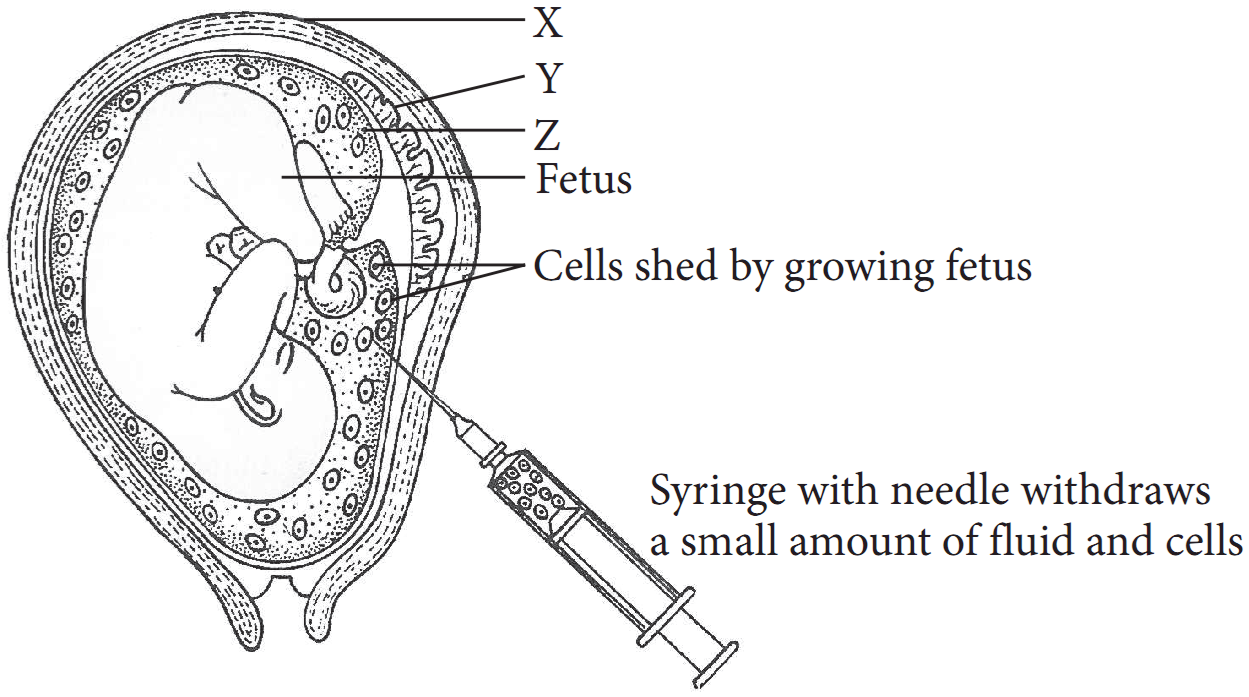
A technique known as amniocentesis is used to determine fetal abnormalities. This test chromosomal pattern in amniotic fluid. However, this technique is legally banned now.

  1. Identify X and Y in the above given figure.
S. No
X
Y
(a)
Amnion
Chorion
(b)
Uterine wall
Placenta
(c)
Placenta
Uterine wall
(d)
Uterine wall
Amnion
  1. What is the function of Z?
  1. Z is an amniotic fluid which prevents dessication of an embryo.
  2. Z is yolk sac which functions as site of early blood cell formation.
  3. Z is amnion, which takes part in placenta formation.
  4. None of these
  1. Which of the following diseases can not be diagnosed by amniocentesis?
  1. Down's syndrome.
  2. Sickle cell disease.
  3. Jaundice.
  4. Cystic fibrosis.
  1. Assertion: Amniocentesis is legally banned for sex determination.

Reason: Amniocentesis was being misused for aborting normal female fetus.

  1. Both assertion and reason are true, and reason is the correct explanation of assertion.
  2. Both assertion and reason are true, but reason is not the correct explanation of assertion.
  3. Assertion is true, but reason is false.
  4. Both assertion and reason are false.
  1. Which of these is a non-invasive technique of detecting fetal disorder?
  1. Fetoscopy.
  2. Chorionic villi sampling.
  3. Amniocentesis.
  4. Ultrasound imaging.
Answer
  1. (b) 
    S. No
    X
    Y
    (b)
    Uterine wall
    Placenta
  1. (a) Z is an amniotic fluid which prevents dessication of an embryo.
  2. (c) Jaundice.

Explanation:

Amniocentesis is a fetal disorder test based on the chromosomal pattem in the amniotic fluid surrounding the developing embryo. It detects genetic disorders like Down syndrome, sickle cell anaemia and cystic fibrosis.

  1. (a) Both assertion and reason are true, and reason is the correct explanation of assertion.
  2. (d) Ultrasound imaging.

Explanation:

Non-invasive techniques are available to determine the fetal condition. These techniques do not pose any risk to fetus. Ultrasound imaging is a non-invasive technique.

View full question & answer
Question 104 Marks
Read the following and answer any four questions from (i) to (v) given below:

Oral administration of small doses of hormones is contraceptive method used by the females. They are used in the form of tablets and hence called the pills. The oral pills are two types; mini pills and combined pills.

  1. Mini pills contain:
  1. Estrogen only.
  2. Progestin only.
  3. Combination of progesterone-estrogen.
  4. Inhibin.
  1. How do hormonal pills prevent pregnancy?
  1. By phagocytosing the sperms.
  2. By inhibiting ovulation.
  3. By preventing sperms from entering the vagina.
  4. All of these.
  1. Pill containing non-steroidal preparation, centchroman is:
  1. Mala D.
  2. Mala N.
  3. I-Pill.
  4. Saheli.
  1. Which among the following is incorrect for oral contraceptives?
  1. Oral pills alter the uterine endometrium and make it unsuitable for implantation.
  2. Oral pills have to be taken daily for 7 days starting within first five days of menstrual cycle.
  3. Oral pills increase the risk of intravascular clotting.
  4. Oral pills contain either progestin alone or combination of progestogen and estrogen.
  1. Assertion: Mala D, a combined contraceptive pill, have to be taken daily without a break.

Reason: Mala D contains synthetic progesterone and estrogen.

  1. Both assertion and reason are true, and reason is the correct explanation of assertion.
  2. Both assertion and reason are true, but reason is not the correct explanation of assertion.
  3. Assertion is true, but reason is false.
  4. Both assertion and reason are false.
Answer
  1. (b) Progestin only.

Explanation:

Mini pills contain progestin only, with no estrogen.

  1. (b) By inhibiting ovulation.

​​​​​​​Explanation:

Oral contraceptive pills inhibit ovulation and implantation.

  1. (d) Saheli.

​​​​​​​Explanation:

Saheli contains non-steroidal preparation called centchroman.

  1. (b) Oral pills have to be taken daily for 7 days starting within first five days of menstrual cycle.

​​​​​​​​​​​​​​Explanation:

Oral pills have to be taken daily for 21 days starting within first five days of menstrual cycle.

  1. (b) Both assertion and reason are true, but reason is not the correct explanation of assertion.
View full question & answer