Questions

3 Marks Question

Take a timed test

134 questions · self-marked practice — reveal the answer and mark yourself.

Question 13 Marks
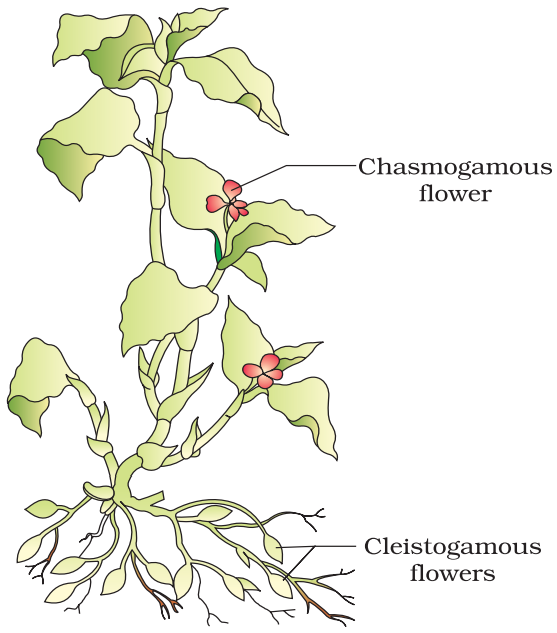
What are chasmogamous flowers? Can cross-pollination occur in cleistogamous flowers? Give reasons for your answer.
Answer
There are two types of flowers present in plants namely Oxalis and Viola - chasmogamous and cleistogamous flowers.
Chasmogamous flowers have exposed anthers and stigmata similar to the flowers of other species.
Cross-pollination cannot occur in cleistogamous flowers. This is because cleistogamous flowers never open at all. Also, the anther and the stigma lieclose to each other in these flowers. Hence, only self-pollination is possiblein these flowers.
View full question & answer
Question 23 Marks
What is apomixis and what is its importance?
Answer
Apomixis is the process of asexual production of seeds, without fertilisation.
Importance:
  • It is a cost effective method for producing seeds.
  • Hybrid seeds can be cultivated.
  • It has great use for plant breeding when specific traits of a plant have to be preserved.
View full question & answer
Question 33 Marks
What is meant by emasculation? When and why does a plant breeder employ this technique?
Answer
Emasculation means removal of anthers, with a forceps, from the flower bud before dehiscence.
Plant breeder employs this technique to prevent contamination of stigma with the undesired pollen. This is useful in artificial hybridisation, where desired pollen is required.
View full question & answer
Question 43 Marks
Explain the role of tapetum in the formation pollen-grain wall.
Answer
Tapetum is the innermost layer of the microsporangium. The tapetal cells are multinucleated and polyploid. They nourish the developing pollen grains. These cells contain ubisch bodies that help in the ornamentation of the microspores or pollen grains walls. The outer layer of the pollen grain is called exine and is made up of the sporopollenin secreted by the ubisch bodies of the tapetal cells. This compound provides spiny appearance to the exine of the pollen grains.
View full question & answer
Question 53 Marks
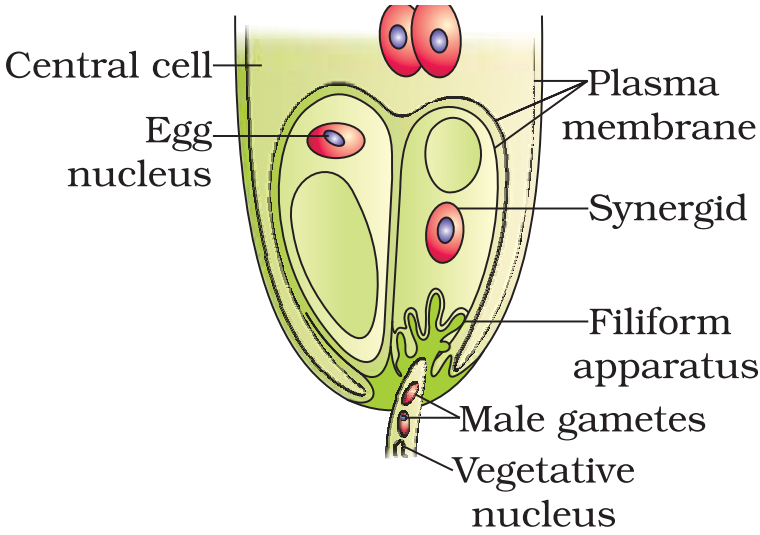
What is triple fusion? Where and how does it take place? Name the nuclei involved in triple fusion.
Answer
Fusion of second male gamete with die two polar nuclei located in the central cell to form the triploid primary endosperm nucleus (PEN) is called triple fusion or vegetative fertilization. This process takes place in the embryo sac. After reaching the ovary, pollen tube enters into the embryo sac from the micropylar end. After penetration, the tip of the pollen tube ruptures releasing the two male gametes. The one male gamete fuses with the egg to form the diploid zygote. This process is called syngamy and the other male gamete fuses with the two polar nuclei to form the triploid primary endosperm & this process is known as triple fusion. These two events of fertilization constitute the process of double fertilization.
View full question & answer
Question 63 Marks
What is bagging technique? How is it useful in a plant breeding programme?
Answer
Various artificial hybridization techniques (under various crop improvement programmes) involve the removal of the anther from bisexual flowers without affecting the female reproductive part (pistil) through the process of emasculation. Then, these emasculated flowers are wrapped in bags to prevent pollination by unwanted pollen grains. This process is called bagging.
This technique is an important part of the plant breeding programme as it ensures that pollen grains of only desirable plants are used for fertilization of the stigma to develop the desired plant variety.
View full question & answer
Question 73 Marks
  1. Trace the development of an endosperm after fertilisation with reference to coconut. Mention the importance of endosperm development.
  2. Write the importance of 'pollen bank'.
Answer
  1. In coconut Primary Endosperm Nucleus (PEN-3n) undergoes successive nuclear divisions, give rise to free- nuclear endosperm known as coconut water, white kernel is the cellular endosperm, provides nourishment to the growing embryo.
  2. Storage/cryopreservation (storage in liquid nitrogen at - 196 o C), to use in crop breeding programmes.
View full question & answer
Question 83 Marks
Why are some seeds referred to as apomictic seeds? Mention one advantage and one disadvantage to a farmer who uses them.
Answer
The development of seeds without involving meiosis and fertilization is called apomixes. It is kind of asexual reproduction that mimics Sexual Reproduction. These type of seed and embryo develop-Haplioid gametophytes (Apogmay) Diploid megaspores (Apospory)
Advantages of apomixes are Reduced cost of hybrid production Mucellar seedlings of citrus provide better clones.
View full question & answer
Question 93 Marks
Explain the process of pollination in Vallisneria. How is it different in water-lily, which is also an aquatic plant?
Answer
In Vallisneria pollination takes place through water, the female flower reach the surface of water by long stalk, male flowers/pollen grain released on to the surface of water, carried passively by water current reaching the female flowers/stigma.
In Water lily pollination takes place through wind or insect, female flower emerges above the surface of water and gets pollinated.
View full question & answer
Question 103 Marks
"Pollen grains in wheat are shed at 3-celled stage while in peas they are shed at 2-celled stage." Explain. Where are germ pores present in a pollen grain?
Answer
At the time of shedding wheat pollen consist of one vegetative and two male gametes (3 celled), While pea pollen consists of one vegetative and one generative cell. (2 celled)
Germ pores are present on the exine. (where sporopollenin is absent)
View full question & answer
Question 113 Marks
  1. Can a plant flowering in Mumbai be pollinated by pollen grains of the same species growing in New Delhi? Provide explanations to your answer.
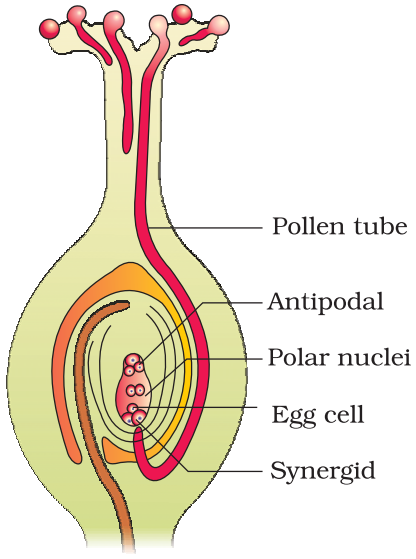
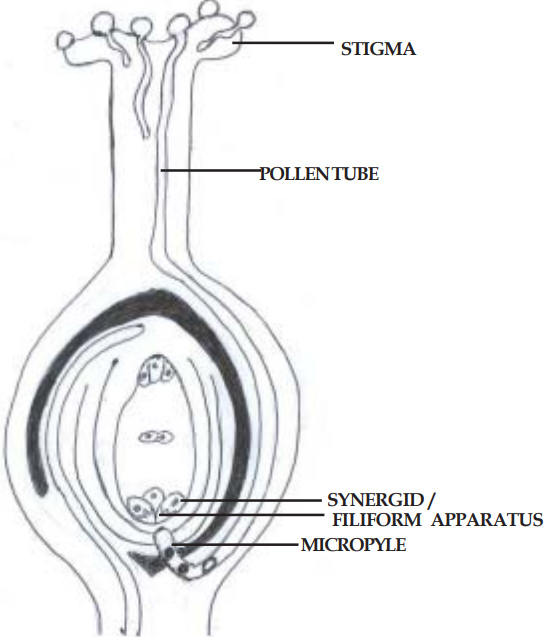
  2. Draw the diagram of a pistil where pollination has successfully occurred. Label the parts involved in reaching the male gametes to its desired destination.
Answer
  1. Yes, By artificial means.
  2. Diagram with following labellings: Stigma Pollen tube, Synergid/Filiform Apparatus, Micropyle.

View full question & answer
Question 123 Marks
  1. Write the two limitations of traditional breeding technique that led to promotion of micro propagation.
  2. Mention two advantages of micro propagation.
  3. Give two examples where it is commercially adopted.
Answer
  1. Failed to keep pace with demand, failed to provide fast and efficient system of crop improvement.
  2. Large number of plants can be developed in a short duration/production of genetically identical plants/somaclones/healthy plants can be recovered from diseased plants.
  3. Tomato/banana/apple.
View full question & answer
Question 133 Marks
State what is apomixis. Comment on its significance. How can it be commercially used?
Answer
Form of asexual reproduction producing seeds without fertilisation/type of asexual reproduction that mimics sexual reproduction to form seeds without fertilisation.

Parental characters are maintained in the progeny/offspring (as there is no meiosis/segregation of characters).

If desired hybrid seeds are made apomictic, the farmers can keep on using the hybrid seeds to raise new crops year after year.

View full question & answer
Question 143 Marks
  1. Describe the endosperm development in coconut.
  2. Why is tender coconut considered a healthy source of nutrition?
  3. How are pea seeds different from castor seeds with respect to endosperm?
Answer
  1. Endosperm formation, there are three types:
  1. Nuclear endosperm formation repeated free nuclear division take place, a cell wall formed after cell wall nuclear division referred liquid endosperm. Ex-coconut juice.
  2. Cellular endosperm formed with nuclear division, Acoraceal cellular endosperm development while monocot are helobial.
  3. Helobial endosperm formation between the first two nuclei after which one half develops endosperm a long the cellular pattern in coconut.
  1. Coconut water is considered as a ‘fluid of life’ It increase immunity. lender coconut water is a good source of ‘Laceric acid’.
  2. Endosperm internally, consists of two unequal portion of dicotyledonous seed the most common dicot seeds age of gram, pea castor etc. these testa hard end is of different colour in different seeds.
View full question & answer
Question 153 Marks
  1. Write the characteristic features of anther, pollen and stigma of wind pollinated flowers.
  2. How do flowers reward their insect pollinators? Explain.
Answer
  1. Pollen - light/large number/non sticky,

Anther - well exposed,

Stigma - large/feathery/open/sticky.

  1. Provides nectar/food for the larvae/pollen grains/safe place to lay eggs.
View full question & answer
Question 163 Marks
Fertilisation is essential for production of seed, but in some angiosperms, seeds develop without fertilisation.
  1. Give an example of an angiosperm that produces seeds without fertilisation Name the process.
  2. Explain the two ways by which seeds develop without fertilisation.
Answer
A. Members of Asteraceae/grasses/citrus/mango, apomixis.

B. Two ways -

  1. In some species, the diploid egg cell is formed without reduction division and develops into embryo without fertilisation.
  2. More often, as in many citrus and mango varieties some of the nucellar cells surrounding the embryo sac start dividing, protrude into the embryo sac and develop into the embryos.
View full question & answer
Question 173 Marks
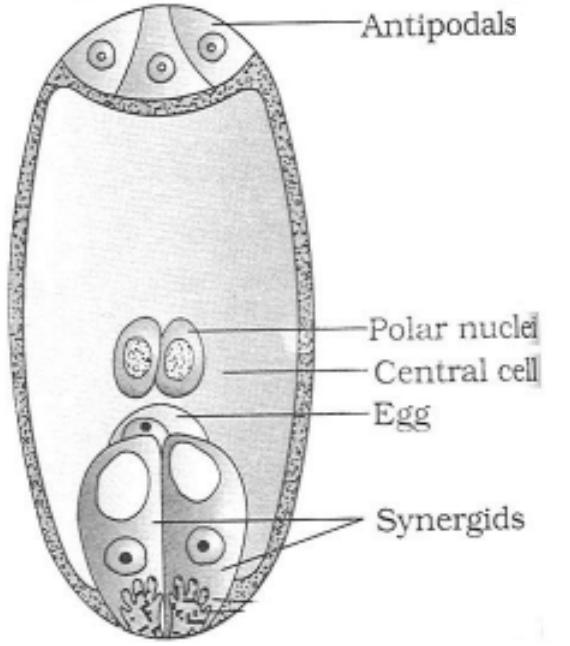
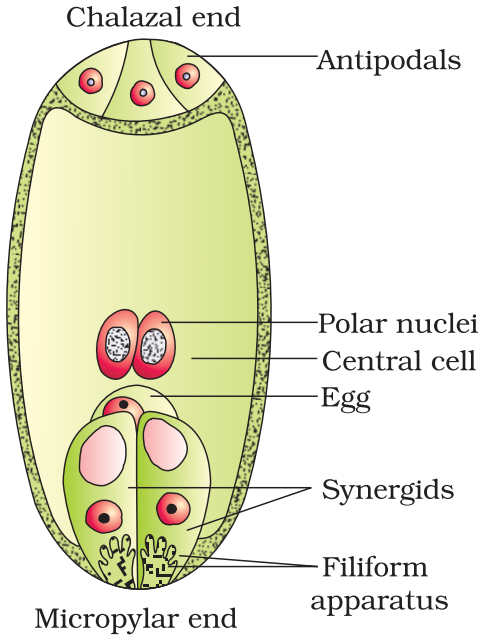
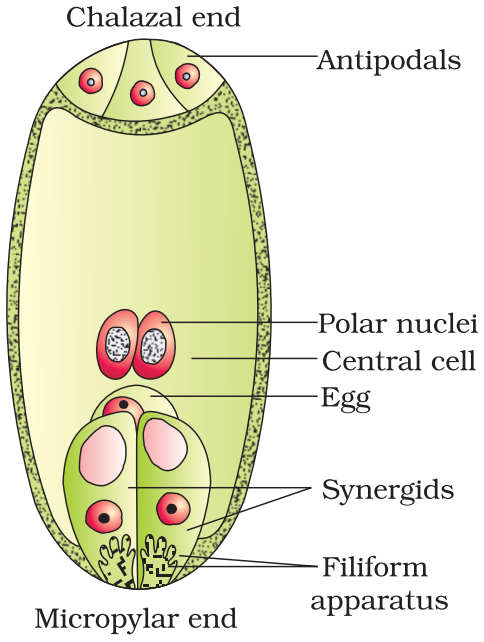
  1. Draw a labelled sketch of a mature 7-celled, 8-nucleate embryo-sac.
  2. Which one of the cell in an embryo-sac produce endosperm after double fertilisation?
Answer
  1.  

  1. Central cell.
View full question & answer
Question 183 Marks
Describe the development of endosperm after double fertilization in an angiosperm. Why does endosperm development precedes that of zygote?
Answer
Following fertilisation the PEN (primary endosperm nucleus) divides repeatedly to give rise to free nuclei, subsequent cell wall formation leading to formation of endosperm.
Cells of endosperm are filled with reserved food materials to be used for nutrition of the developing embryo/for providing food to the developing embryo.
View full question & answer
Question 193 Marks
A non biology person is quite shocked to know that apple is a false fruit, mango is a true fruit and banana is a seedless fruit. As a biology student how would you satisfy this person.
Answer
Apple- Thalamus (along with ovary) contribute to fruit.
Mango- Develops only from the ovary.
Banana- Develops from ovary but without fertlization/Parthenocarpy.
View full question & answer
Question 203 Marks
Double fertilisation is reported in plants of both, castor and groundnut. However, the mature seeds of groundnut are non-albuminous and castor are albuminous. Explain the post-fertilisation events that are responsible for it.
Answer
Development of endosperm (preceding the embryo) takes place in both, developing embryo derives nutrition from endosperm.
Endosperm is retained/persists/not fully consumed in castor, endosperm is consumed in groundnut.
View full question & answer
Question 213 Marks
Why are beehives kept in crop field during flowering period? Name any two crop fields where this is practiced.
Answer
To increase pollination efficiency, increase crop yield/honey yield.
Sunflower, Brassica, apple, pear.
View full question & answer
Question 223 Marks
Explain any three advantages the seeds offer to angiosperms.
Answer
  • Since reproductive process such as pollination and fertilisation are independent of water, seed formation is more dependable.
  • Seeds have better adaptive strategies for dispersal to new habitats and help the species to colonise in other areas.
  • As they have sufficient food reserves young seedlings are nourished until they are capable of photosynthesis on their own.
  • The hard seed coat provides protection to the young embryo.
  • Being products of sexual reproduction, they generate new genetic combinations/variations.
  • Dehydration and dormancy of mature seeds are crucial for survival under adverse conditions.
View full question & answer
Question 233 Marks
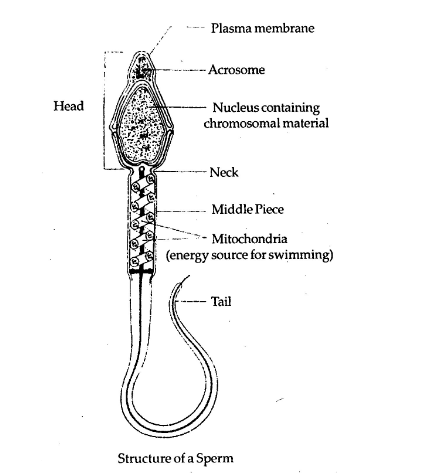
Draw a diagram of the microscopic structure of human sperm. Label the following parts in it and write their functions.
  1. Acrosome.
  2. Nucleus.
  3. Middle piece.
Answer
  1. Function of Acrosome:
  • It contains enzymes that help the sperm to enter and to fertilise the ovum.
  1. Function of Nucleus:
  • It stores the genetic information. It carries 23 chromosomes, out of which one is sex chromosome (either X or Y). Thus, it is responsible for determining the sex of the individual.
  1. Function of Middle piece:
  • The middle piece contains several mitochondria, which produce energy for the movement of the tail and motility of the sperm.


View full question & answer
Question 243 Marks
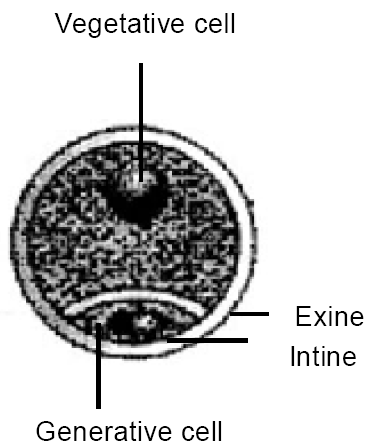
Draw a diagram of a male gametophyte of an angiosperm. Label any four parts. Why is sporopollenin considered the most resistant organic material?
Answer
Sporopollenin can withstand high temperature/strong acids/strong alkali.
View full question & answer
Question 253 Marks
Differentiate betweynated and insect pollinated flowers.
Answer
  1. Wind pollinated: Pollen grains are light non sticky/ well exposed stamens/ Large feathery stigma/ single ovule in each flower/ Small flowers packed in inflorescence.

  2. Insect pollinated: Pollen grains sticky/ Floral rewards/ Fragrant/ Nectar rich/ Large Flower/ Foul odour.

View full question & answer
Question 263 Marks
For a layman, both apple and banana are fruits. But a biology student categorises fruits as true fruits, false fruits and parthenocarpic fruits. Justify.
Answer
True Fruits: Fruits that develop from mature ovary and are a result of fertilisation.
False Fruits: Fruits that develops from ovary along with some other floral parts/ thalamus. parthenocarpic fruits - Fruits that develop without fertilisation
View full question & answer
Question 273 Marks
Draw a schematic transverse section of a mature anther of an angiosperm. Label its epidermis, middle layers, tapetum, endothecium, sporogenous tissue and the connective.
View full question & answer
Question 283 Marks
Differentiate between wind pollinated and insect pollinated flowers.
Answer
S. No. Wind Pollinated Insect Pollinated
1. Wind pollinated flowers don not have nectar Insect Pollinated flowers are rich in nectar to attract insects.
2. The petals are dull and does not attract the insects The petals of these flowers are very colorful and attractive.
3. They dont have any scent The scent of these flowers are another factor that attracts insects.
4. The pollen grains are non-sticky, light The pollen grains are sticky.
5. Stigma is feathery, to catch the pollen grain Stigma is non-feathery and sticky.
View full question & answer
Question 293 Marks
Pollen banks are playing a very important role in promoting plant breeding programme the world over. How are pollens preserved in the pollen banks? Explain. How are such banks benefitting our farmer? Write any two ways.
Answer
Pollen banks are used to store pollens for a very long period of time in viable conditions. Pollens are preserved in a bank using cryopreservation i.e., they are stored in a viable condition in low-temperature conditions (-196 degree Celsius) using liquid nitrogen.
The important applications of pollen banks for our farmers are the following:
  1. To preserve the agricultural biodiversity in the form of preservation of valuable genetic resources.
  2. These pollens can be used in various crop hybridization breeding programmes, biochemical and physiochemical studies such as the study of allergens etc.
View full question & answer
Question 303 Marks
What is artificial hybridisation? How is it useful in plant breeding?
Answer
"Artificial hybridisation is a crop improvement technique where only desired pollen grains are used for pollination, and the stigma is protected from contamination by unwanted pollen. It ensures that the plant breeder has complete control over the cross.
Major Steps Involved:
Emasculation:Removal of anthers from a bisexual flower before they dehisce, using forceps. (Note: Not required for unisexual flowers).
Bagging: Covering the emasculated (or unisexual) flower with a bag (usually made of butter paper) to prevent unwanted pollen from landing on the stigma.
Pollination: When the stigma becomes receptive, mature pollen from the desired parent is dusted on it.
Re-bagging: The flower is covered again to allow fruit development.
Utility in Plant Breeding:
Combination of Traits: It allows breeders to combine desirable characteristics (like high yield, disease resistance, and drought tolerance) from two different plants into a single superior variety.
Genetic Improvement: It is the primary method for creating high-yielding Hybrid Seeds used in modern agriculture.
Precision: It eliminates the chance of random, inferior pollination, ensuring that the progeny has the specific traits targeted by the breeder."
View full question & answer
Question 313 Marks
What are chasmogamous flowers? Can cross-pollination occur in cleistogamous flowers? Give reasons for your answers.
Answer
Chasmogamous Flowers: Flowers which have exposed anthers and stigma and open at maturity are called chasmogamous flowers. They are similar to the flowers of other species where the reproductive parts are accessible for pollination.
Detailed Explanation (Reasons):
Closed Structure: Cleistogamous flowers do not open at all; they remain permanently closed (bud-like).
Proximity: The anthers and stigma lie very close to each other within the closed flower.
Invariable Autogamy: When anthers dehisce in the flower buds, pollen grains come into contact with the stigma of the same flower to effect pollination. Since the flower never opens, there is no chance of foreign pollen landing on the stigma. Thus, they are invariably self-pollinating (autogamous).
View full question & answer
Question 323 Marks
Why are angiosperm anthers called dithecous? Describe the structure of its microsporangium.
Answer
The anthers of angiosperms are called dithecous because they are bilobed and each lobe of anther has two theca.
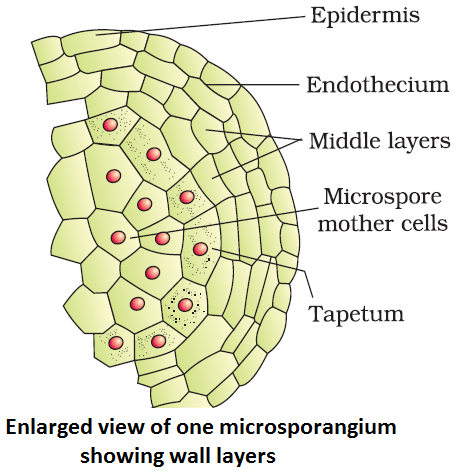
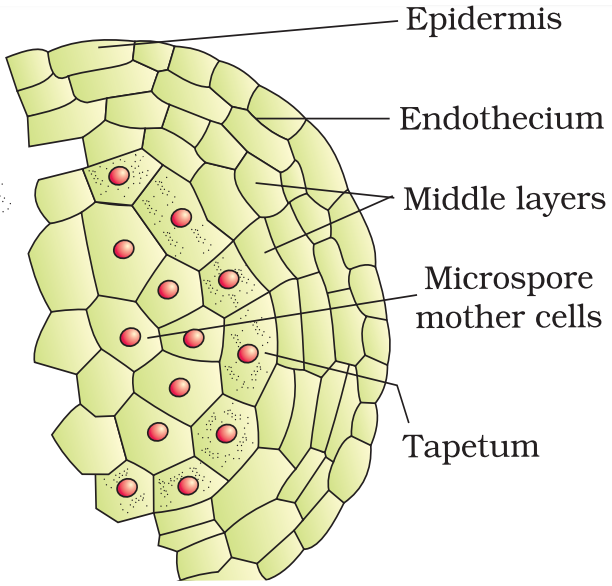
Microsporangium is surrounded by four wall layers named as epidermis, endothecium, middle layer and tapetum. In young anther, a group of compactly arranged homogenous cells called sporogenous tissue occupies the centre of each microsporangium which produce microspores or pollen grains.
View full question & answer
Question 333 Marks
During an excavation assignment, scientists collected pollen grains of a plant preserved in deeper layers of soil. Analyse the properties of pollen grains which help in the fossilization.
Answer
Pollen has an outer layer called exine which is made of sporopollenin.
It is the most resistant organic material known. It can withstand high temperature, strong acids and alkali as well. No enzyme that degrades sporopollenin is so far known.
View full question & answer
Question 343 Marks
Answer the following questions:
How does cleistogamy ensure autogamy?
Answer
Cleistogamous flowers do not open. Therefore, the pollens have to land on the stigma of the same flower. This ensures autogamy.
View full question & answer
Question 353 Marks
State the significance of pollination. List any four differences between wind pollinated and animal pollinated flowers.
Answer
Pollination is the phenomena of transfer of pollen grains from anthers to the stigma of a pistil. Pollination is prerequisite for the beginning of fertilisation.
S. No
Wind-pollinated flowers
Animal pollinated flowers
(i)
This kind of flower is pollinated by abiotic pollinating agent.
This kind of flower is pollinated by biotic pollinating agent.
(ii)
They are small and inconspicuous.
They are large, colourful, fragrant and rich in nectar.
(iii)
The pollen grains are dry, light and nonsticky so that they can be easily transported by wind.
The pollen gains are generally sticky in animal pollinated flowers.
(iv)
The flowers are often clustered so as to carry out pollination.
The flowers are grouped to become more conspicuous.
View full question & answer
Question 363 Marks
What will be the ploidy of the cells of the nucellus, microspore mother cell, the functional megaspore and female gametophyte?
Answer
Nucellus: Diploid.
Microspore mother cell: Diploid.
The functional megaspore: Haploid.
Female gametophyte: Haploid.
View full question & answer
Question 373 Marks
What does an interaction between pollen grain and its compatible stigma result in, after pollination? List two steps in sequence that follow after the process.
Answer
Events in pollen-pistil interaction:
  1. A compatible pollen grain starts its germination on the stigma.
  2. The intine grows out through one of the germ pores to form a pollen tube; the contents of the pollen grain move into the pollen tube.
  3. In those species, where the pollen grains are shed at the two-celled stage, the generative cell divides to form two male gametes.
  4. The pollen tube grows through the tissues of style and stigma and reaches the ovary.
  5. It enters the ovule through the micropyle and then enters the embryo sac through the filiform apparatus of one of the synergids.
  6. All these events, from the deposition of pollen grains on the stigma till the entry of pollen tube into the ovule, are collectively called pollen-pistil interaction.
The two events that follow this are:
  1. Syngamy, i.e., fusion of male and female gametes to form a zygote.
  2. Triple fusion, i.e., fusion of two polar nuclei (secondary nucleus) and a male gamete, to form the primary endosperm nucleus (PEN).
View full question & answer
Question 383 Marks
State what is apomixis. Comment on its significance. How can it be commercially used?
Answer
Apomixis is a type of asexual reproduction that mimics sexual reproduction to form seeds without fertilisation.
In apomictic seeds, parental characters are maintained in the progeny/ offspring as there is no meiosis or segregation of characters.
If desired hybrid seeds are made apomictics the farmers can keep on using the hybrid seeds to raise new crops year after year.
View full question & answer
Question 393 Marks
Answer the following questions:
Describe the endosperm development in coconut.
Answer
The primary endosperm nucleus (PEN) undergoes successive nuclear divisions to give rise to free nuclei. Subsequently, cell wall is formed towards the periphery and endosperm becomes cellular, leaving free nuclear endosperm in the central part. This division is followed by cytokinesis and thus endosperm becomes cellular and is called cellular endosperm.
View full question & answer
Question 403 Marks
Scutellum is the single cotyledon found in the monocot embryo only. Explain.
Answer
Embryo of monocors possesses only one coryledon at one end (lateral) of the embryonal axis and this coryledon is called scutellum.
At the lower end, the embryonal axis has radical and root cap enclosed in an undifferentiated sheath called coleorhiza. The portion of the embryonal axis above the level of artachment of scurellum is the epicotyl.
View full question & answer
Question 413 Marks
Vivipary automatically limits the number of offsprings in a litter. How?
Answer
Viviparity is a condition which is presents in both animals and plants. In case of animals; viviparity means an animal gives birth to young ones. In case of plants, viviparity means germination of embryo on the plant itself; without normal sequence of development of seed. Viviparity involves too much drain of resources on the mother. In case of animals; a female has to constantly supply the nutrients and oxygen to the growing foetus, if the foetus developing in the womb. Enough resources are not available to support a large litter and hence viviparity automatically limits the number of offsprings in a litter. This is true in case of plants also because a germinating embryo on the plant would require resources from the mother plant.
View full question & answer
Question 423 Marks
Cleistogamy can favour only autogamy. Justify
Answer
In cleistogamy, flowers never open at all. Hence, foreign pollen will not land on the stigma of such flowers. So, cleistogamy can favour only self – pollination.
View full question & answer
Question 453 Marks
List three strategies that a bisexual flower can evolve to prevent self – pollination.
Answer
Dichogamy: The condition in which the maturation of stigma and anther takes place at different times so as to prevent self – fertilisation.
Heterostyly: In this, anther and stigma are placed at different positions, so the pollens can not come in contact with stigma of the same flower.
Herkogamy: It is the non-transferred of pollen from anther to stigma of the same flower due to a mechanical barrier between anther and stigma.
View full question & answer
Question 463 Marks
‘Fertilisation is not an obligatory event for fruit production in certain plants’. Explain the statement.
Answer
This can be observed in parthenocarpic fruits. The ‘seedless fruits’ that are available in the market, such as pomegranate, grapes, etc., are good examples. Flowers of these plants are sprayed by a growth hormone that induces fruit development even though fertilisation has not occurred. The ovules of such fruits, however, fail to develop into seeds.
View full question & answer
Question 473 Marks
Embryo sacs of some apomictic species appear normal but contain diploid cells. Suggest a suitable explanation for the condition.
Answer
Many apomictic species have been seen to have normal looking embryo sacs. The only possibility of the embryo sac possessing diploid cells will be due to failure of meiotic division at the megaspore mother cell stage. Since the megaspore mother cell has a diploid nucleus, if it undergoes mitosis instead of meiosis, all the resulting nuclei and cells will be diploid in nature.
View full question & answer
Question 483 Marks
Answer the following questions:
Why is geitonogamy also referred to as genetical autogamy?
Answer
Geitonogamy is the transfer of pollen grains from the anther to the stigma of another flower of the same plant. Although geitonogamy is functionally cross-pollination involving a pollinating agent, genetically it is similar to autogamy, since the pollen grains come from the same plant.
View full question & answer
Question 493 Marks
Which one of the cell in an embryo-sac produce endosperm after double fertilisation?
Answer
Double fertilization involves two sperm cells; one fertilizes the egg cell to form the zygote, while the other fuses with the two polar nuclei that form the endosperm.
After fertilization, the fertilized ovule forms the seed while the tissues of the ovary become the fruit.
View full question & answer
Question 503 Marks
Where does triple fusion take place in a flowering plant? Why is it so called? Mention its significance.
Answer
Triple fusion involves fusion of one male gamete and two polar nuclei (or secondary nucleus; if the two have already fused) in the central cell of embryo sac.
Three nuclei are involved in triple fusion, i.e., one male nucleus and two polar nuclei in the central cell, therefore, the process is termed triple fusion.
View full question & answer
Question 513 Marks
Answer the following questions:
How do flowers reward their insect pollinators? Explain.
Answer
Insect pollinators are rewarded in following ways:
  1. The flowers offer floral reward like nectar and pollen grain.
  2. In some species floral reward provides safe place to lay eggs.
View full question & answer
Question 523 Marks
How does the study of different parts of a flower help in identifying in wind as its pollinating agent?
Answer
The adaptive floral characteristics of a wind pollinated plant are:
  1. The flowers are small and inconspicuous.
  2. The pollen grains are light and non-sticky so that they can be easily transported by wind.
  3. They have well-exposed stamens so that pollens get easily dispersed.
  4. They often have feathery stigma to catch the pollens grains.
  5. The pollen grains are dry and unwettable to prevent pollens from gaining moisture from air.
  6. The pistil usually has single ovule in each ovary.
View full question & answer
Question 533 Marks
Fertilisation is essential for production of seed, but in some angiosperms, seeds develop without fertilisation.
Give an example of an angiosperm that produces seeds without fertilisation. Name the process.
Answer
In the members of family Asteraceae, seeds develop without fertilisation. This process is called apomixis.
View full question & answer
Question 543 Marks
Answer the following questions:
Write the characteristic features of anther, pollen and stigma of wind pollinated flowers.
Answer
The characteristics of wind pollinated flowers are:
  1. Pollen grains are light in weight, non-sticky, dry and winged.
  2. Well-exposed stamens for easy dispersal of pollen grains in the wind.
  3. The stigma is sticky, large, feathery to trap pollen grains in air.
View full question & answer
Question 563 Marks
Are parthenocarpy and apomixis different phenomena? Discuss their benefits.
Hint: Yes, they are different. Parthenocarpy leads to development of seedless fruits. Apomixis leads to embryo development. 
Answer
Parthenocarpy is the condition in which fruits develop without seeds, while apomixis is a condition in which seeds develop without fertilization. Fertilization is absent in both the case but seeds are present in apomixis only. Benefits of Parthenocarpy: Seedless fruits are easier to consume; especially those fruits which naturally contain too many seeds, e.g. papaya, watermelon and banana.
Benefits of Apomixis: Apomixis can be used to produce apomicts hybrid seeds so that farmers will not need to buy hybrid seeds every year. This will help in drastically cutting the cost for farmers.
View full question & answer
Question 573 Marks
Answer the following questions:
Name the organic material exine of the pollen grain is made up of. How is this material advantageous to pollen grain?
Answer
Sporopollenin.
It is most resistant material to high temperature, strong acids on alkali and no enzymes can degrade it.
View full question & answer
Question 583 Marks
As a senior biology student you have been asked to demonstrate to the students of secondary level in your school, the procedure(s) that shall ensure cross-pollination in a hermaphrodite flower. List the different steps that you would suggest and provide reasons for each one of them.
Answer
Cross-pollination is done to mix two desired characters of two different species of a plant. For example, purple and white flower of a pea.
  1. Select two pea plants one with white and other with purple flower.
  2. Label them as male (white flowered) and female (purple flowered) plant.
  3. Cut anthers from purple flower with the help of scissors before their dehiscence to avoid self-pollination and cover it with white paper bag.
  4. Now, collect pollens from the white flower (male plant) with the help of brush.
  5. Dust the pollens on the stigma of female (purple flower) flower.
  6. Cover it again with paper bag till seed formation.
Hermaphrodites or bisexual flowers develop outbreeding devices to ensure cross-pollination and avoid self pollination.
View full question & answer
Question 593 Marks
Answer the following questions:
What advantages a seed provides to a plant?
Answer
Seeds offer several advantages to angiosperms. Firstly, since reproductive processes such as pollination and fertilisation are independent of water, seed formation is more dependable. Also seeds have better adaptive strategies for dispersal to new habitats and help the species to colonise in other areas. As they have sufficient food reserves, young seedlings are nourished until they are capable of photosynthesis on their own. The hard seed coat provides protection to the young embryo. Being products of sexual reproduction, they generate new genetic combinations leading to variations.
View full question & answer
Question 603 Marks
Fertilisation is essential for production of seed, but in some angiosperms, seeds develop without fertilisation.
Explain the two ways by which seeds develop without fertilisation.
Answer
Two ways by which seeds develop without fertilisation are:
  1. In some species, the diploid (2n) egg cell is formed without reduction division and develops into embryo without fertilisation.
  2. In many varieties of Citrus and mango fruits, some of the nucellar cells surrounding the embryo sac start dividing, protrude into the embryo sac and then develop into embryos.
View full question & answer
Question 613 Marks
What is geitonogamy? Give its one similarity to autogamy and xenogamy.
Answer
Geitonogamy is a type of pollination in which pollen grains of a flower are transferred to the stigma of another flower of the same plant.
Similarity to autogamy: Geitonogamy is genetically similar to autogamy in the respect that pollen grains are transferred to stigma of the flower, but on the same plant so both are genetically similar whereas autogamy occurs in bisexual flower.
Similarity to xenogamy: Geitonogamy is similar to xenogamy in the respect that pollen grains are transferred to stigma of different flower.
View full question & answer
Question 623 Marks
What does an interaction between pollen grains and its compatible stigma result in after pollination? List two steps in sequence that follow after the process.
Answer
When the pollen grains fall on the stigma, the pollen tube enters one of the synergids and releases two male gametes.

  1. One of the male gametes moves towards the egg cell and fuses with it to complete syngamy to form the zygote.
  2. The other male gamete fuses with the two polar nuclei and forms triploid Primary Endosperm Nucleus (PEN).

This is termed as triple fusion.

  1. Since, two kinds of fusion-syngamy and triple fusion take place, the process is known as double fertilization and is charactedstic of flowering plants.
View full question & answer
Question 633 Marks
Why do you think the exine should be hard? What is the function of germ pore?
Answer
Exine is the outermost layer of pollen grain which is made up of a highly resistant organic material called sporopollenin. Exine should be hard to withstand high temperature, strong acids and alkali. Germ pores are prominent apertures where sporopollenin is absent which later on protrudes out as pollen tube.
View full question & answer
Question 643 Marks
What is polyembryony and how can it be commercially exploited?
Answer
In some varieties of citrus and mango, the nucellar cells start dividing and protrude into the embryo sac. They eventually produce multiple embryos. This condition is called polyembryony. This is an apomictic condition in which embryos develop without fertilization. Polyembryony can be commercially exploited by producing seeds of hybrid varieties at lower cost. In case of hybrid plants, a farmer needs to buy seeds every year because plants from hybrid seeds fail to produce hybrid sees due to laws of inheritance. Buying fresh seeds in every season is very costly. If hybrid seeds are produced with polyembryonic condition, then it would be possible for the famers to utilize those seeds for the next year and subsequent years. This is still at research stage but there are bright prospects for future.
View full question & answer
Question 653 Marks
What are the possible types of pollinations in chasmogamous flowers. Give reasons.
Answer
A bisexual flower which normally open is called chasmogamous flower. Kinds of Pollination,
  • Autogamy: In this type, pollination is achieved within the same flower. Transfer of pollen grain from the anther to the stigma of the same flower. In a normal flower which opens and exposes the anthers and stigma complete autogamy is rather rare. Majority of flowering plants produce hermaphrodite flowers and pollen grains are likely to come in contact with the stigma of the same flower. Continued self-pollination result in inbreeding depression. Flowering plants have developed many devices to discourage self-pollination and to encourage cross-pollination.
  • Geitonogamy: Transfer of pollen grains from the anther to the stigma of another flower of the same plant.
  • Xenogamy: Transfer of pollen grains from anther to the stigma of a different plant.
View full question & answer
Question 663 Marks
Given below are the events that are observed in an artificial hybridisation programme. Selection of parents → Emasculation → Bagging → Collection of pollen from other male plant → Dusting of pollen on stigma — Rebagging.
While, planning for crop improvement involving dioecious plants, which of the above mentioned steps would not be relevant?
Answer
While planning for an artificial hybridization programme for crop improvement involving dioecious plants, there is no need of emasculation. Dioecious plants have both the male and female reproductive organs borne on separate individuals of the same species.
If the female parent produces unisexual flowers, emasculation is not required. The female flower buds are bagged before the flowers open. When the stigma becomes receptive, pollination is carried out using the desired pollen and the flower is rebagged. This protects them from contamination by unwanted pollen grains.
View full question & answer
Question 673 Marks
Answer the following questions:
How are pea seeds different from castor seeds with respect to endosperm?
Answer
In peas, the endosperm is used up and there is no endosperm present in the mature seed. In castor, the endosperm remains intact in the mature seed.
View full question & answer
Question 683 Marks
How is pollination carried out in water plants?
Answer
Pollination by water is called hydrophily. Some examples of water pollinated plants are Vallisneria and Hydrilla (both are angiospermic hydrophytes) which grow in fresh water & several marine sea-grasses such as Zostera. Not all aquatic plants use water for pollination. In a majority of aquatic plants such as water hyacinth and water lily, the flowers emerge above the level of water and pollinated by insects or wind as in most of the land plants.
View full question & answer
Question 693 Marks
Name the cell from which the endosperm develops in a coconut. Mention its ploidy. Explain the process of endosperm development in a coconut.
Answer
Endosperm develops from the primary endosperm cell. It is triploid (3n) in nature.
The endosperm develops from primary endosperm nucleus (PEN). The PEN undergoes successive nuclear divisions to give rise to free nuclei. This stage is called free nuclear endosperm. Subsequently, cell wall is formed on the periphery and endosperm becomes cellular.
View full question & answer
Question 713 Marks
Answer the following questions:
Still it is observed that it does not form a continuous layer around the pollen grain. Give reason.
Answer
Germs pores are present to allow pollen tube to emerge out for pollen germination.
View full question & answer
Question 733 Marks
Answer the following questions:
Why is tender coconut considered a healthy source of nutrition?
Answer
It is rich in many nutrients like Fats, Proteins, Carbohydrates, Minerals, Vitamins. Hence, tender coconut is considered a healthy source of nutrition.
View full question & answer
Question 743 Marks
Differentiate between perisperm and endosperm by giving one example of each.
Answer
S. No.
Perisperm
Endosperm
(i)
It is persistent nuclleus.
It is the nutritive tissue for embryo.
(ii)
It is diploid.
It is triploid.
(iii)
Example: Black pepper, Beet
Example: Maize, Rice, Wheat, Castor.
View full question & answer
Question 753 Marks
Draw a labelled sketch of a mature 7-celled, 8-nucleate embryo-sac.
Answer

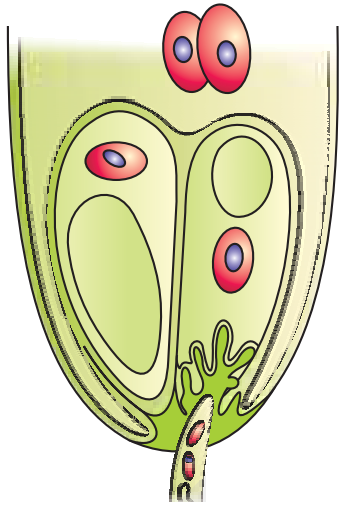
A diagrammatic representation of the mature embryo sac.

View full question & answer
Question 763 Marks
What is microsporogenesis? Where does it occur in angiosperms? What is its significance?
Answer
Each cell of the sporogenous tissue is a potential Pollen Mother Cell (PMC) or microspore mother cell and can give rise to microspore tetrad. This process of formation of microspore from a pollen mother cell through the process of meiosis is called microsporogenesis.
As the anthers mature and dehydrate, the microspores dissociate from one another and form tetrad and develop into pollen grnins. Inside each microsporangium. Several thousands of microspores or pollen grains are formed that are released with the dehiscence of anther.
In general, dehiscence of anther occurs through the rupture of anther lobe walls which causes release of several thousands of pollen grains at a time.
View full question & answer
Question 773 Marks
Given below are the events that are observed in artificial hybridisation programme. Arrange them in the correct sequential order in which they are followed in the hybridisation programme.
(a) Re-bagging; (b) Selection of parents; (c) Bagging; (d) Dusting the pollen on stigma; (e) Emasculation; (f) Collection of pollen from male parent.
Answer
(b) Selection of parents; (e) Emasculation; (c) Bagging; (f) Collection of pollen from male parent; (d) Dusting the pollen on stigma; (a) Re-bagging.
View full question & answer
Question 783 Marks
The generative cell of a 2-celled pollen divides in the pollen tube but not in a 3-celled pollen. Give reasons.
Answer
In a 3-celled pollen, the generative cell has already divided and formed 2 male gametes. Hence, it will not divide again in the pollen tube. As the generative cell has not divided in a 2-celled pollen, it divides in the pollen tube.
View full question & answer
Question 793 Marks
Is pollination and fertilisation necessary in apomixis? Give reasons.
Answer
No, they are not necessary. Apomixis is actually an alternative to sexual reproduction, although the female sexual apparatus is used in the process. In apomicts, embryos can develop directly from the nucellus or synergid or egg. Therefore, there is no need for either pollination or fertilisation.
View full question & answer
Question 803 Marks
Answer the following questions:
How does a farmer use the dormancy of seeds to his advantage?
Answer
Dormancy of mature seeds are important for storage of seeds which can be used as food throughout the year and also to raise crop in the next season.
View full question & answer
Question 813 Marks
Make a list of any three outbreeding devices that flowering plants have developed and explain how they help to encourage cross-pollination.
Answer
  1. Time of pollen release and stigma receptivity are different (not synchronised). This prevents self-pollination.
  2. Anther and stigma are placed at different positions, so the pollens cannot come in contact with the stigma of the same flower.
  3. Self incompatibility, which is a genetic mechanism to prevent the pollen germination on the stigma of the same flower.
View full question & answer
Question 823 Marks
Trace the development of female gametophyte (embryo sac) from megaspore mother cell in a flower. Give a labelled diagram of the final stage of female gametophyte.
Answer
  1. Megaspore is the first cell of the female gametophyte.
  2. The megaspore increases in size and its nucleus divides mitotically into two nuclei which move apart to opposite poles. Thus, a 2-nucleate embryo sac is formed.
  3. The two daughter nuclei undergo another mitotic division giving rise to the 4-nucleate stage.
  4. The third mitotic division gives rise to 8-nucleate 7-celled embryo sac.
  5. The central cell contains 2 nuclei known as polar nuclei.
  6. The three nuclei at the micropylar region form the egg apparatus.
  7. In the egg apparatus, the middle cell is the largest and is called oosphere/ egg/ ovum, while other two naked cells adjoining the egg cell are called synergids.
  8. The three nuclei at the chalazal end are surrounded by cytoplasm and cellular wall. These are called antipodal cells.

A diagrammatic representation of the mature embryo sac.

View full question & answer
Question 833 Marks
Name the two end products of double fertilization in angiosperms. How are they formed? Write their fate during the development of seed.
Answer
  1. Zygote and the primary endosperm nucleus are the products of double fertilisation.
  2. Zygote is formed by the fusion of the female gamete and one of the male gametes, i.e. syngamy.
  3. Primary endosperm nucleus is formed by the fusion of two polar nuclei (into a secondary nucleus) and one of the male gametes, i.e. triple fusion.
  4. The endosperm development from the primary endosperm cell precedes that of the zygote, to provide assured nutrition to the embryo.
  5. The zygote develops into the embryo after some amount of endosperm is formed.
View full question & answer
Question 843 Marks
Explain the process of artificial hybridisation to get improved crop variety in:
  1. Plants bearing bisexual flowers.
  2. Female parent producing unisexual flowers.
Answer
  1. In plants bearing bisexual flowers, the anthers are removed from the flower before they dehisce. This is called emasculation. The emasculated flowers are covered with a bag of butter paper to prevent contamination of stigma with unwanted pollen. This process is called bagging. When this stigma attains receptivity, mature pollen grains are dusted on the stigma and the flowers are rebagged to allow the fruits to develop.
  2. If the female parent produces unisexual flowers, emasculation is not done. The flower buds are bagged before the flowers open. When the stigma becomes receptive, pollen is dusted on stigma and the flower is rebagged.
View full question & answer
Question 853 Marks
Flowering plants have developed many devices to discourage self-pollination and to encourage cross-pollination. Explain three such devices.
Answer
The three outbreeding devices that flowering plants have developed to discourage self-pollination are:

  1. Unisexuality (Dicliny): Flowers are unisexual, so that self-pollination is not possible. The plants may be monoecious (bearing both male and female flowers, e.g. maize) or dioecious (bearing male and female flowers on different plants, e.g. mulberry, papaya).

  2. Dichogamy: Anthers and stigmas mature at different times in a bisexual flower for preventing self-pollination.

  • Protandry: Anthers mature earlier than stigma of the same flower. The pollen thus become available to stigmas of the older flowers, e.g. sunflower, Salvia.

  • Protogyny: Stigmas mature earlier, so that they get pollinated before the anthers of the same flowers develop pollen grains, e.g. Mirabilis jalapa, Gloriosa, plantago.

  1. The third device to prevent self-pollination is self-incompatibility. It is a genetic mechanism that prevents self-pollen from fertilising the ovules by preventing pollen germination or pollen tube growth in the pistil. All these methods encourage cross-pollination thus, causing genetic variations among them.
View full question & answer
Question 863 Marks
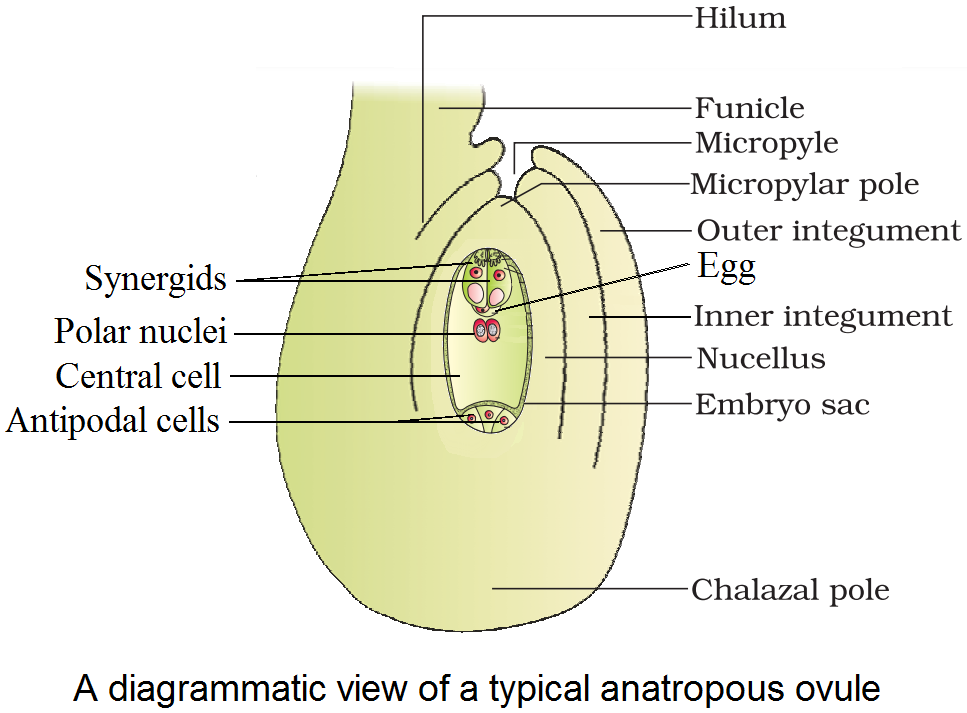
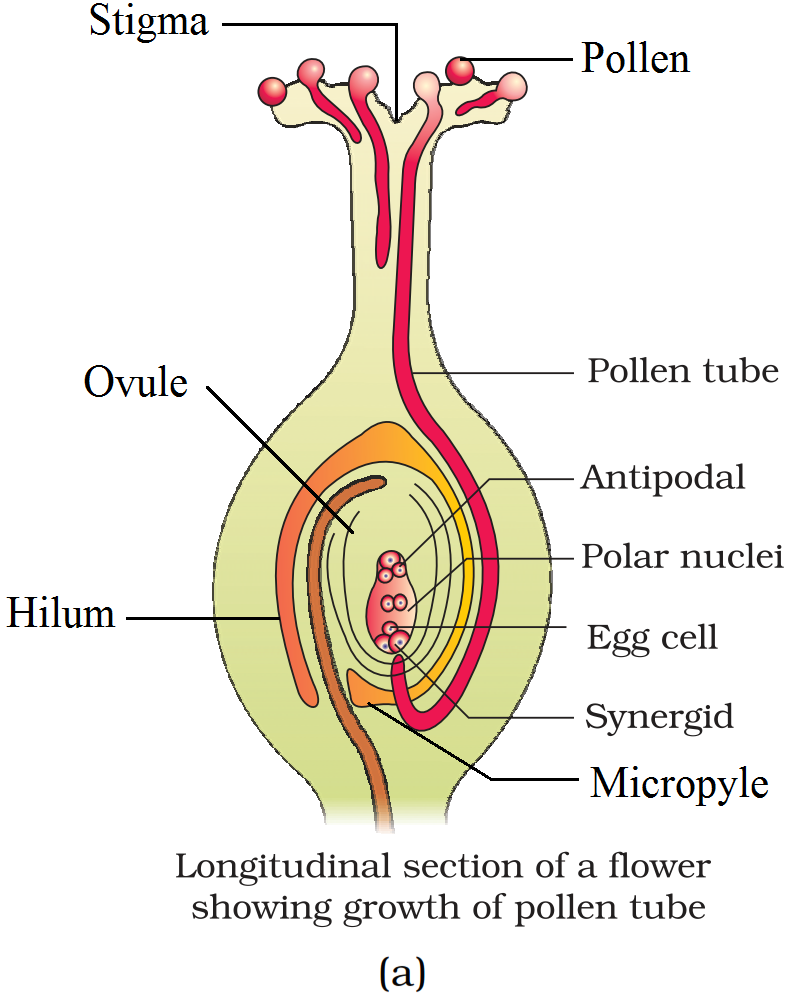
Draw a longitudinal section of a post-pollinated pistil showing entry of pollen tube into a mature embryo sac. Label filiform apparatus, chalazal end, hilum, antipodals, male gametes and secondary nucleus.
Answer

L.S. of pistil showing path of pollen tube growth;


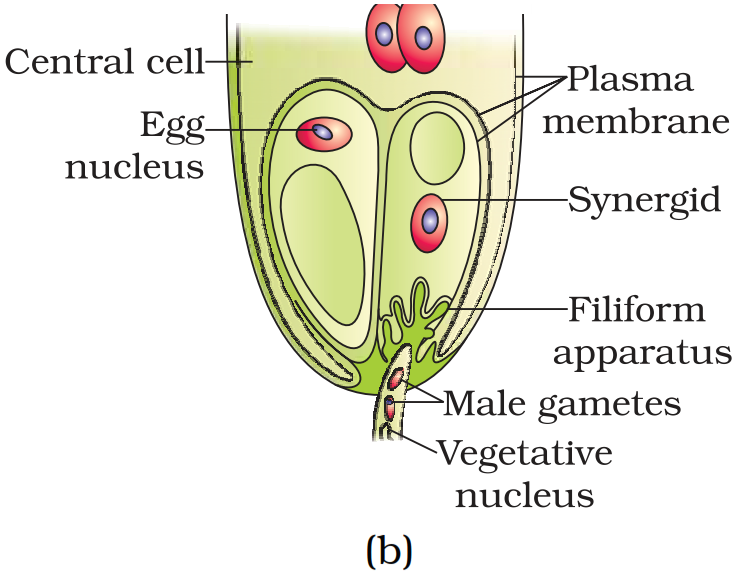
Enlarged view of an egg apparatus showing entry of pollen tube into a synergid.

View full question & answer
Question 873 Marks
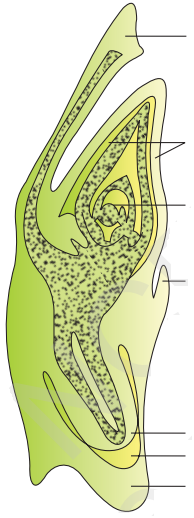
Draw a diagram of L. S. of an anatropous ovule of an angiosperm and label the following parts.
  1. Nucellus.
  2. Integument.
  3. Antipodal cells.
  4. Secondary nucleus.
Answer

A diagrammatic view of a typical anatropous ovule.

View full question & answer
Question 883 Marks
Differentiate between geitonogamy and xenogamy in plants. Which one between the two will lead to inbreeding depression and why?
Answer
S. No
Geitonogamy
Xenogamy
(i)
It is transfer of pollen grains from the anther to the stigma of another flower of same plant.
It is transfer of pollen grains from the anther to the stigma of a different plant.
(ii)
The pollen grains are genetically similar to the plant.
The pollen grains are genetically different from the plant.

Geitonogamy will lead to inbreeding depression because the pollen grains are genetically similar, which results in inbreeding. Continued inbreeding will thus reduce fertility and productivity.

View full question & answer
Question 893 Marks
Explain three outbreeding devices.
Answer
  1. Unisexuality: Male and female flowers are present on different plants.
  2. Dichogamy: The condition in which the stamens and stigma of a bisexual flower mature at different times.
  3. Protandry: This is the condition where anthers mature earlier than the stigma and release pollens.
View full question & answer
Question 903 Marks
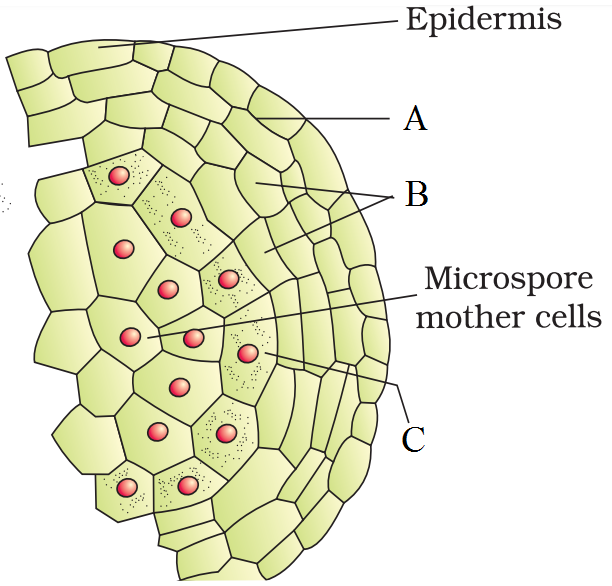
Given below is an enlarged view of onemicro sporangium of a mature anther.

  1. Name 'a', 'b' and 'c' wall layers.
  2. Mention the characteristics and function of the cells forming the wall layer 'c'.
Answer
  1.  
  1. Endothecium.
  2. Middle layers.
  3. Tapetum.
  1. The cells of tapetum possess.
  1. Dense cytoplasm and.
  2. More than one nucleus.

They nourish the developing pollen grains.

View full question & answer
Question 913 Marks
Flowering plants have developed many devices to discourage self-pollination and to encourage cross pollination. Explain three such devices.
Answer
The outbreeding devices are as follows:
  1. Self-incompatibility is the genetic mechanism that prevents self-pollen from fertilising the ovule by inhibiting pollen germination or retarding the growth of pollen tube.
  2. Certain plant species produce male and female flowers on different plants, i.e. the plants are dioecious; this prevents both autogamy and geitonogamy.
  3. Pollen release and stigma receptivity are not synchronised, either the anthers mature first on the pistil/ gynoecium matures first.
  4. The anthers and stigma of a flower are placed in such a way that the pollen of the flower cannot fall on the stigma of the same flower.
View full question & answer
Question 923 Marks
“Pollen grains has some harmful effects”. Discuss.
Answer
  1. Pollen grains cause severe allergies, bronchial respiratory disorders, asthma, bronchitis, etc.
  2. Parthenium (or carrot grass) came into India as contaminant with imported wheat and causes pollen allergy.
View full question & answer
Question 933 Marks
Draw the diagram of a microsporangium and label its wall layers. Write briefly on the role of the endothecium.
Answer

Endothecium performs the function of protection and help in dehiscence of anther to release the pollen.

View full question & answer
Question 943 Marks
Describe the endosperm development in angiosperms.
Answer
  1. The endosperm development starts from the primary endosperm cell (PEC).
  2. In the most common type of endosperm development, the primary endosperm nucleus (PEN) undergoes repeated mitotic divisions to give rise to a number of free nuclei in the primary endosperm cell.
  3. The number of free nuclei formed varies greatly with the species.
  4. At this stage of development, the endosperm is called free-nuclear endosperm.
  5. Subsequently, cell wall formation occurs and the endosperm becomes cellular.
  6. The cells are filled with reserve food materials. Endosperm development precedes that of embryo development as an adaptation to provide assured nutrition to the embryo.
View full question & answer
Question 953 Marks
Draw a transverse sectional view of an apple and label the following parts along with their technical names:
  1. Edible part.
  2. Encloses the embryo.
  3. Forms the fruit wall.
View full question & answer
Question 963 Marks
In the majority of angiosperms, the zygote divides by an asymmetric mitotic division and generates two cells. Discuss the fates of these cells.
Answer
  1. The smaller daughter cell with dense cytoplasm is situated towards the chalazal pole. It is called terminal cell or apical cell or embryonal cell.
  2. Another comparatively larger daughter cell situated towards the micropylar cell, is called basal cell. This cell divides transversely and gives rise to suspensor cells.
  3. The zygote gives rise to the proembryo and subsequently to the globular, heart-shaped and mature embryo.
View full question & answer
Question 973 Marks
How do flowers reward their insect pollinators? Explain.
Answer
  1. Insect pollinated flowers are large, colourful, fragrant and rich in nectar.
  2. A number of flowers are clustered into an inflorescence to make them conspicuous, when the flowers are small.
  3. Flowers have nectar glands and are highly fragrant to attract insects.
  4. The surface of pollen grains is sticky due to exine layer and stigma is sticky due to mucilaginous layer.
  5. In some species, floral rewards are to provide safe place for laying eggs, e.g. amorphophallus.
View full question & answer
Question 983 Marks
Differentiate between cleistogamous flower and chasmogamous flower.
Answer
Differentiate between cleistogamous flower and chasmogamous flower:
S. No.
Cleistogamous flowers
Chasmogamous flowers
 
1.
Cleistogamous flowers can only carry out self-pollination.
Chasmogamous flowers are usually cross-pollinated (and sometimes self-pollinated).
2.
Cleistogamous flowers are non showy and nconspicuous.
Chasmogamous flowers are showy and highly conspicuous.
3.
Cleistogamous flowers do not need any agents for pollination.
chasmogamous flowers are dependent on pollination agents since they are usually cross-pollinated.
View full question & answer
Question 993 Marks
Explain the process of emasculation and baggingof flowers. State their importance in breeding experiments.
Answer
  1. Emasculation refers to the practice of removal of anthers/ stamens from a bisexual flower before the pollen grains mature.
  2. It is necessary to prevent the self-pollen from contaminating the stigma.
  3. Bagging refers to the covering of the emasculated flowers with a suitable bag made of butter paper; it is essential to prevent contamination of the stigma of the emasculated flower with unwanted pollen grains.
  4. When the stigma becomes receptive, the pollen grains from the selected flowers are dusted on it and the flower is rebagged for the development of fruits and seeds. - If female parent bears unisexual flowers, there is no need for emasculation; but the female flower buds are bagged before they open.
  5. When the stigma becomes receptive, pollination is carried out with the desired pollen and the flowers are rebagged.
View full question & answer
Question 1013 Marks
Explain how false, true and parthenocarpic fruits are different from each other. Give one example of each.
Answer
S. NO
False fruit
True fruit
Parthenocarpic fruit
(i)
When any part of a flower other than the ovary, contributes to the formation of fruit, it is called a false fruit, e.g. Apple, strawberry.
When a fruit is formed only by the ovary, it is called a true fruit, - e.g. Tomato, brinjal.
When the ovary transforms into a fruit, without fertilisation, it is called a parthenocarpic fruit, e.g. banana.
View full question & answer
Question 1023 Marks
If the meiocyte of a maize plant contains 20 chromosomes, write the number of chromosomes in the endosperm and embryo of the maize grain and give reasons in support of your answer.
Answer
  1. The endosperm will have 30 chromosomes and the embryo will have 20 chromosomes.
  2. The meiocyte is a diploid cell(with 20 chromosomes) and it undergoes meiosis; hence, the haploid cells of maize will have 10 chromosomes.
  3. The endosperm develops from the primary endosperm cell, where the primary endosperm nucleus (PEN) is formed by triple fusion, i.e., fusion of three haploid nuclei-two polar nuclei (fuse to form a diploid secondary nucleus) and a haploid male gamete.
  4. So the endosperm cells are triploid with 30 chromosomes.
  5. The embryo develops from the zygote, which is formed by the fusion of a female gamete with a male gamete; so it is diploid with 20 chromosomes.
View full question & answer
Question 1033 Marks
Explain the characteristic features of flowers that facilitate wind pollination.
Answer
In wind pollinated flowers:
  1. The stamens are well-exposed, so that pollen grains are easily dispersed in wind currents.
  2. The stigma is large and often feathery, to easily trap the air-borne pollen grains.
  3. The pollen grains are light and non-sticky, to be transported in wind currents.
  4. There is a single ovule in the ovary of these flowers.
  5. Numerous small flowers are packed into an inflorescence.
  6. Pollen grains are produced in enormous quantity.
View full question & answer
Question 1043 Marks
Explain any three inbreeding devices in flowering plants.
Answer
Following are the inbreeding devices:
  1. There is synchromy between pollen release and stigma-receptivity; i.e. the anthers and pistil mature simultaneously.
  2. The anthers and stigma lie close to each other in such a way that pollen from the anther can fall on the stigma.
  3. Cleistogamous flowers (the bisexual flowers which do not open at all) are produced by some plants.
View full question & answer
Question 1053 Marks
Write the differences between wind-pollinated and insect-pollinated flowers. Give an example of each type.
Answer
S. No.
Wind-pollinated flowers
Insect-pollinated flowers
(i)
These produce large numbers of pollen grains.
These produce less number of pollen grains.
(ii)
These are dull, nectarless and scentless.
These are bright, scented and have nectar.
(iii)
Stamens are long and protrude above petals.
Stamens lie within the corolla tube.
(iv)
The pollen grains are dry, light, small and smooth. For example, ragweed.
The pollen grains are larger, heavier with appendages like hooks and barbs. For example, rose, sweet pea.
View full question & answer
Question 1063 Marks
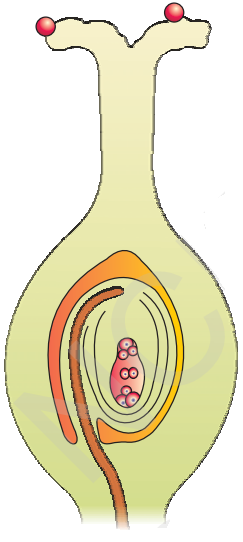
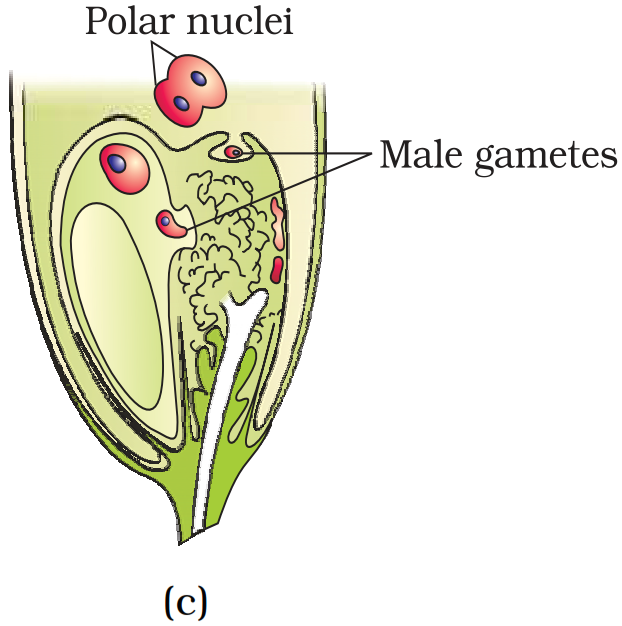
In the figure given below label the following parts: male gametes, egg cell, polar nuclei, synergid and pollen tube,

View full question & answer
Question 1073 Marks
Write the mode of pollination in Vallisneria and water lily. Explain the mechanism of pollination in Vallisneria.
Answer
Vallisneria is pollinated by water and water lily is pollinated by insects:

Pollination in Vallisneria:

  • In Vallisneria, the male flowers (later pollen grains) are released on the surface of water; the female flowers reach the surface of water by uncoiling of the long stalk.
  • When the passively floating male flowers/pollen grains meet the female flowers, pollination is effected, and the stalk of the female flower coils and the flower is drawn back inside the water column.

Pollination in Water lily:

  • Since the flowers emerge above the level of water, they are pollinated by insects.
View full question & answer
Question 1083 Marks
Draw and label the enlarged view of microsporangium of an Angiosperm. State the function of its innermost wall layer.
Answer


Enlarged view of one microsporangium showing wall layers.

Tapetum, the innermost wall layer provides nourishment to the developing pollen grains.

View full question & answer
Question 1093 Marks
During a biology lecture in class the teacher called apple seeds as seeds but maize seeds as grains. On hearing this Amit got confused and asks her teacher the reason behind this. The teacher appreciated Amit and cleared all his doubts.
  1. What is the difference between seed and grain?
  2. How are maize grains formed?
  3. Explain along with a labelled diagram of the vertical section of a maize grain.
  4. What values are shown by Amit?
Answer
  1. A seed is defined as an embryonic plant covered in a seed coat containing some food. On the other hand, a grain is a small edible fruit, usually hard on the outside, harvested from grassy crops.
  2. Maize grains are formed from female flowers after the fertilisation.
  3.  

  1. Amit is attentive, inquisitive and wants to gain knowledge.

View full question & answer
Question 1103 Marks
Kanchan went to a garden and saw some flowers which were closed. She assumed that those flowers must be buds. But she was astonished to see that all the flowers of that plant were closed and none of them was open. She was confused and asked her queries to her teacher.
  1. What do you think, are there any plants with closed flowers? Give an example.
  2. Are such plants get pollinated? Explain.
  3. What are such flowers/ plants called?
  4. What values are shown by Kanchan?
Answer
  1. Yes, there are some plants with closed flowers, e.g. Oxalis.
  2. Yes, such flowers undergo self-pollination. The pollen from the anthers of same flower are transferred to the stigma of the same flower.
  3. Such flowers are called cleistogamous flowers.
  4. Kanchan is very curious about nature, active and lively in her life.
View full question & answer
Question 1113 Marks
Ram saw a farmer spraying some chemicals on flowers. On asking farmer, he came to know that this act will lead to the formation of fruits without fertilisation. Ram thought that fruits developed in this way are not good to eat as chemicals are sprayed on it.
Next day, he asked his biology teacher about it, who explained him everything.
  1. What chemicals were sprayed by the farmer?
  2. Give difference between such a spray and usual pesticide spray?
  3. What is parthenocarpy? Give its types.
  4. What values are shown by Ram?
Answer
  1. The farmer was spraying auxins or gibberellins in low concentration which have been found to induce parthenocarpy in several plants, e.g. tomato, cucurbits, strawberry, fig, etc.
  2. This is called chemically induced parthenocarpy, which is not harmful for the consumers. However, pesticide sprays are harmful for our health.
  3. In parthenocarpy, fruit formation occurs without fertilisation. It can be of three types, i.e. genetical, environmental and chemically induced (as done by the farmer).
  4. Ram is an intelligent, observant, inquisitive boy who is concerned about the day-to-day activities that happen around him.
View full question & answer
Question 1123 Marks
Rohan saw Mr. Sharma collecting different plant specimens. He was confused to see him doing this collection and approached him asking about it.
Mr. Sharma told him that he will cross different plant specimens in his laboratory for obtaining better varieties of plants.
  1. Why is he interested in such experiments?
  2. Name this technique.
  3. What precautions he should take while applying this technique?
  4. What values are shown by Rohan?
Answer
  1. The crossing of different plant species and genera leads to combination of desirable characters to produce commercially superior varieties.
  2. Artificial hybridisation.
  3. In artificial hybridisation, only desired pollen grains should be used for pollination. The stigma should be protected from unwanted pollen. This can be achieved by emasculation and bagging techniques.
  4. Rohan is attentive, observant, inquisitive and wants to gain knowledge.
View full question & answer
Question 1133 Marks
Answer the following questions:
Mention any four strategies adopted by flowering plants to prevent self-pollination.
Answer
Contrivances or Devices forSelf-pollination (Autogamy)

Cross-pollination can be prevented by exhibiting:

  1. Cleistogamous flowers: These are bisexual closed flowers which never open and the anthers dehisce inside these closed flowers, e.g., Commelina.
  2. Homogamy: It is the condition of the maturity of anther and stigma at the same time, e.g., Catharanthus (Vinca).
  3. Close association between anther and stigma, e.g., Mirabilis.

Chasmogamous and cleistogamous flowers.

View full question & answer
Question 1143 Marks
Indicate the stages where meiosis and mitosis occur (1, 2 or 3) in the flow chart,

Answer
  1. Meiosis.
  2. Mitosis.
  3. Mitosis.
View full question & answer
Question 1153 Marks
Differentiate between an annual and a biennial plant. Provide one example of each.
Answer
S. No.
Annual Plants
Biennial Plants
(i)
These plants require a single season to complete their whole life cycle.
These plants require two seasons to complete their whole life cycle.
(ii)
They grow, set seeds and die within one year.
In the first year, they grow a healthy root system and short stem, and become dormant in winters. In second year, they grow quickly, flower, set seeds and die.
(iii)
For example, rice, wheat, etc.
For example, onion, carrot, etc.
View full question & answer
Question 1163 Marks
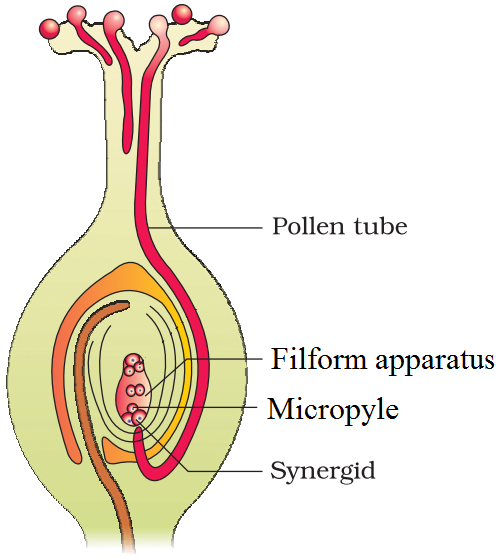
In the diagram given below, show the path of a pollen tube from the pollen on the stigma into the embryo sac. Name the components of egg apparatus.

View full question & answer
Question 1173 Marks
Write the differences between male and female gametophyte.
Answer
Differences between male and female gametophytes are:
S. No.
Male gametophyte
Female gametophyte
1.
It is derived from a microspore, which is produced inside the pollen chamber of anther.
It is derived from a megaspore, which is formed inside the nucellus of an ovule.
2.
The microspores are shed at maturity and transferred from anthers to stigma by the process called pollination
The megaspores do not shed from the ovule. They develop to form embryo sac within the ovule.
3.
The mature male gametophyte is 3-celled.
The mature female gametophyte is 7-celled.
View full question & answer
Question 1193 Marks
Draw the diagram of a mature embryo sac and show its 8-nucleate, 7-celled nature. Show the following parts: antipodals, synergids, egg, central cell, polar nuclei.
View full question & answer
Question 1203 Marks
  1. Can a plant flowering in Mumbai be pollinated by pollen grains of the same species growing in New Delhi? Provide explanation to your answer.
  2. Draw the diagram of a pistil where pollination has successfully occurred. Label the parts involved in reaching the male gametes to its desired destination.
Answer
  1. Yes, a plant flowering in Mumbai can be pollinated by pollen grains of the same species growing in New Delhi, It is mainly because there are certain agents of pollination that can carry pollen grains to long distance.

It is believed that pollidation by wind (anemophily) is more common because transport by wind-current can take pollens to distant places.

  1. The parts involved in transferring the male gametes to its desired destination are stigma, style, micropyle, filiform apparatus and synergids.
View full question & answer
Question 1213 Marks
  1. Do all pollen grains remain viable for the same length of time? Support your answer with two suitable examples.
  2. How are pollen grains stored in pollen banks? State the purpose of storing pollen grains in these banks.
Answer
  1. No; the pollen grains of different species remain viable for different periods of time.

e.g. pollen grains of cereals remain viable for less than 30 minutes whereas some members of Rosaceae, Leguminosae and Solanaceae retain the pollen viability for months.

  1. In the pollen banks, pollen grains are stored. In liquid nitrogen (at -196°C). Such stored pollen grains can be used for breeding programmes whenever necessary.
View full question & answer
Question 1223 Marks
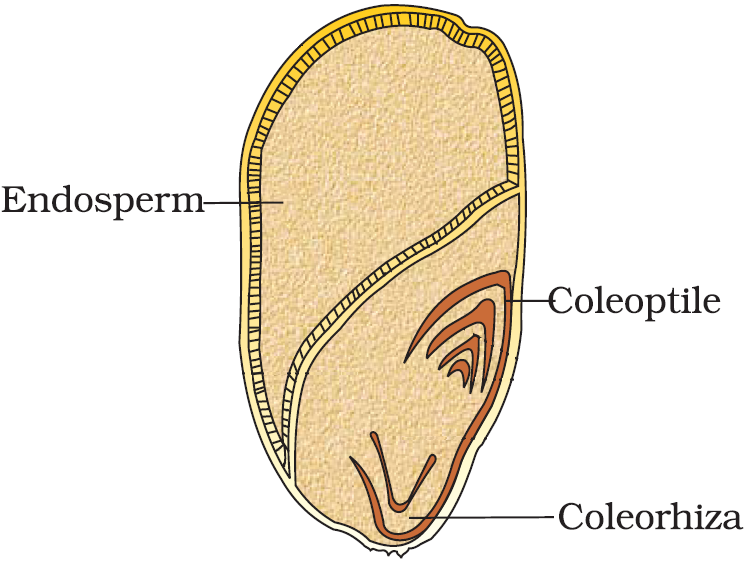
  1. Draw a diagram of a sectional view of a monocot seed (grain).
  2. Label and write the function of: Coleoptile, Coleorrhiza, Endosperm.
Answer
  1. .

  1.  
  • Coleoptile protects the plumule.
  • Coleorrhiza protects the radical.
  • Endosperm stores food materials to be used by the embryo during germination of the grain.
View full question & answer
Question 1233 Marks
  1. Name the organic material exine of the pollen grain is made up of. How is this material advantageous to pollen grain?
  2. Still it is observed that it does not form a continuous layer around the pollen grain. Give reason.
  3. How are 'pollen banks' useful?
Answer
  1. The organic material of exine of pollen grain is sporopollenin. This is the most resistant biological material known so far. It protects pollen grains from damages.
  2. Exine on pollen grain is not a continuous layer. It is thin at places and pollen tube germinates by growth of intine through these thin parts of exine called germ pores.
  3. Pollen banks can be used for storing pollen grains for years and for crop breeding programmes.
View full question & answer
Question 1243 Marks
  1. Draw a diagram of pistil showing pollen tube growth in angiosperm and label;
  1. Stigma.
  2. Male gametes.
  3. Micropyle.
  4. Ovule.
  1. Write the function of micropyle.
Answer
  1.  

  1. It is through the micropylar end the pollen tube enters the ovule. The micropyle helps in absorbing the water at the time of germination of seed.
View full question & answer
Question 1253 Marks
  1. Give one example each of albuminous and non albuminous seeds.
  2. Name the parts of the ovule and the embryo sac of an angiosperm that develop into.
  1. Perisperm.
  2. Seed coat.
  3. Endosperm, and.
  4. Embryonal axis.
Answer
  1. Albuminous seedCastor, Coconut, Sunflower.

Non-albuminous seed-Pea, groundnut.

  1. ​​​​​​​
  1. Nucellus.
  2. Integuments.
  3. Primary endosperm cell.
  4. Zygote.
View full question & answer
Question 1263 Marks
  1. Mention the exact location or the site in a flowering plant, where the following developments take place:
  1. Deposition of sporopollenin.
  2. Triple fusion.
  3. Release of male gametes.
  4. Megasporogenesis.
  1. Draw a labelled diagram of a male gametophyte of an angiosperm.
Answer
  1.  
  1. On the exine of pollen grains while in the microsporangia.
  2. In the central cell of embryo sac of the ovule.
  3. From the pollen tube into one of the synergids of the embryo sac.
  4. In the nucellus of the ovule.
  1.  
View full question & answer
Question 1273 Marks
  1. Mature seeds of legumes are non-albuminous.Then, can it be considered that double fertilization does not occur in legumes? Explain your answer.
  2. Write one similarity and one difference between autogamy and geitonogamy.
Answer
  1. No, it cannot be assumed like that because double fertilisation does occur in legumes.
  • The primary endosperm cell undergoes mitoses and forms the endosperm, whose cells are filled with reserve food materials.
  • But it is completely consumed by the developing embryo before the seed matures and there is no residual endosperm left in the seed; so the seeds are non-albuminous.
  1. Similarity
  • In both autogamy and geitonogamy, the pollen grains are genetically similar to the pistil.

Difference:

  • In autogamy, pollen grains of a flower fall on the stigma of the same plant; no pollinating agent is involved.
View full question & answer
Question 1283 Marks
  1. Do all pollen grains remain viable for the same length of time? Support your answer with two suitable examples.
  2. How are pollen grains stored in pollen banks? State the purpose of storing pollen grains in these banks.
Answer
  1. No, not all pollen grains remain viable for the same length of time.

Two suitable examples of the same are:

  • Some cereals like rice have pollen grains that lose viability within 30 minutes of their release.
  • Some members of family Leguminoseae, have pollen grains that have viability for a few months.
  1. 'Pollen Banks' store pollen grains for a period of time in viable conditions. These can be used for different studies and crop breeding techniques. It preserves the biodiversity by preserving genetic material.

The pollen grains can be stored by two methods:

  • Short term storage of pollen grains.
  • Long term storage of pollen.
View full question & answer
Question 1293 Marks
  1. Mature seeds of legumes are non-albuminous. Then, can it be considered that double fertilisation does not occur in legumes? Explain your answer.
  2. List the differences between the embryos of dicot (pea) and monocot (grass family).
Answer
  1.  
  • Double fertilisation occurs in legumes and there is also endosperm formation.
  • But, the developing embryo consumes the endosperm completely and there is no residual endosperm in the mature seed; hence the seeds of legumes are non-albuminous.
  1.  
S. No
Embryo of dicot (pea)
Embryo of monocot (grass)
(i)
It has two cotyledons.
It has only one cotyledon.
(ii)
The plumule and radicle are not covered by any protective sheath.
Plumule is covered by coleoptile and radicle by coleorhiza.
View full question & answer
Question 1303 Marks
  1. In plant breeding experiments, pistillate flowers are not emasculated, but are still bagged. Explain.
  2. Why are outbreeding devices developed by some flowering plants?
Answer
  1.  
  • In plant breeding experiments, pollen from the selected male parent only, are used for pollination.
  • To prevent contamination of the stigma by any other pollen grain, the pistillate flowers are bagged.
  1. Continued self-pollination leads to inbreeding depression; hence to discourage self-pollination, outbreeding devices are developed by flowers.
View full question & answer
Question 1313 Marks
  1. Describe in sequence, the process of microsporogenesis in angiosperms.
  2. Draw a labelled diagram of a two-celled final structure formed.
Answer
  1. Development of Pollen grain:
  1. Microsporocytes undergo mitotic divisions to increase the number of functional microspore mother cells.
  2. Each microspore mother cell undergoes meiosis to form a microspore tetrad.
  3. All the four microspores remain enclosed in a common wall.
  4. As the anther matures and dehydrates, they start separating from one another and each develops into a pollen grain.
  5. The nucleus undergoes a mitotic division resulting in the formation of a large vegetative cell and a small generative cell.
  6. The pollen grain develops a wall of two layers-the outer exine of sporopollenin and inner intine of pectin and cellulose.
  7. At this stage, the pollen grains are liberated; but in some cereals the generative cell undergoes mitosis to form two male gametes and the pollen grain is 3-celled, at the time of liberation.
  1. Mature Pollen Grain:
  1. A mature pollen grain has a wall of two layers.
  2. The outer layer called exine is thick, and is made of sporopollenin.
  3. The exine has prominent apertures, called germ pores, where sporopollenin is absent.
  4. The inner layer, called intine is thin and is made pf pectin and cellulose.
  5. A mature pollen grain is two-celled with a large vegetative cell and a small generative cell floating in the cytoplasm of the vegetative cell.
View full question & answer
Question 1323 Marks
  1. Draw a diagram of a pistil showing pollen tube growth in angiosperms and label.
  1. Stigma.
  2. Male gametes.
  3. Micropyle and.
  4. Ovule.
  1. Write the functions of micropyle.
Answer
  1.  

  1. Functions of micropyle:
  1. It is the passage through which the pollen tube enters the ovule.
  2. It remains as a small pore in the seed coat and facilitates the entry of water and oxygen during seed germination.
View full question & answer
Question 1333 Marks
Embryo sacs of some apomictic species appear normal but contain diploid cells. Suggest a suitable explanation for the condition.
Answer
Condition in which seeds are produced without fertilization is called apomixis. Apomixis is a kind of asexual reproduction but it mimics sexual reproduction. There are several mechanisms for apomixis. Once of them is seen in citrus and mango fruits. In this case, the nucleolus beings to divide and intrude into the embryo sac. It eventually develops into seed. Since nucellus is composed of diploid cells, embryo sac in such case has diploid cells.
It is also important to recall that fertilization cannot happen in those cells which were not formed after meiosis. Moreover, haploid cells are never involved in apomixes rather it is the diploid cells which bring apomixes. Hence, embryo sacs apomictic species appear normal but contain diploid cells.
View full question & answer