MCQ 11 Mark
Self$-$pollination is fully ensured if:
- A
- B
The style is longer than the filament.
- ✓
The flower is cleistogamous.
- D
The time of pistil and anther maturity is different.
AnswerCorrect option: C. The flower is cleistogamous.
View full question & answer→MCQ 21 Mark
In Ficus $($peepal$),$ pollination takes place by.
AnswerFemale fig wasps help in pollination in Ficus.
They enter the Ficus via ostiole, sub $-$ closed inflorescences to lay their own eggs and during this time pollen gets to stick to the body of wasp and thus pollination occurs.
View full question & answer→MCQ 31 Mark
Autogamy can occur in a chasmogamous flower if:
- A
Pollen matures before maturity of ovule.
- B
Ovules mature before maturity of pollen.
- ✓
Both pollen and ovules mature simultaneously.
- D
Both anther and stigma are of equal lengths.
AnswerCorrect option: C. Both pollen and ovules mature simultaneously.
Relative lengths of stigma and anther are not the only factors, time of maturity of pollens and ovules is also important in deciding the type of pollination. If pollens mature before ovules; they will become ineffective by the time the ovule matures. Hence, option $'c\ ’$ is the correct answer.
View full question & answer→MCQ 41 Mark
In a type of apomixis known as adventive embryony, embryos develop directly from the:
- ✓
- B
Synergids or antipodals in a embryo sac
- C
Accessary embryo sacs in the ovule
- D
AnswerAdventive embryony is the process of the embryonic development without fertilization.
The embryo does not develops from the reproductive cells or the gametes.
They may develop from the nucellus or integumentary cells.
View full question & answer→MCQ 51 Mark
Proximal end of the filament of stamen is attached to the
MCQ 61 Mark
Transfer of pollen to the stigma of another flower of the same plant is.
MCQ 71 Mark
Pollination by water occurs in:
MCQ 81 Mark
The development of fruits without fertilisation of the ovary, is called:
MCQ 91 Mark
The arrangement of the nuclei in a normal embryo sac in the dicot plants is:
- ✓
$3 + 2 + 3.$
- B
$2 + 3 + 3.$
- C
$3 + 3 + 2.$
- D
$2 + 4 + 2.$
AnswerCorrect option: A. $3 + 2 + 3.$
View full question & answer→MCQ 101 Mark
AnswerThe fruit of the coconut is a large, dry drupe composed of a thin outer layer $($exocarp$),$ a thick, fibrous middle layer called a mesocarp and a hard inner layer called an endocarp that surrounds a large seed.
View full question & answer→MCQ 111 Mark
An example of a seed with endoperm, perisperm and caruncle is:
AnswerCastor bean seeds contain an elaiosome $($caruncle$)$ which are fleshy structures that are attached to seeds of many plant species.
They are rich in lipids and proteins that attract ants, which disperse the seed $($myrmecochory$).$
Castor bean seeds are endospermic which means, the endosperm is the major storage tissue.
In perispermic seeds $($castor$),$ diploid maternal food storage tissue originates from the nucellus.
View full question & answer→MCQ 121 Mark
- ✓
Angiosperms and gymnosperms.
- B
Pteridophytes and angiosperms.
- C
Bryophytes and angiosperms.
- D
AnswerCorrect option: A. Angiosperms and gymnosperms.
View full question & answer→MCQ 131 Mark
In the embryos of a typical dicot and a grass, true homologous structures are:
- A
Coleorhiza and coleoptile.
- B
Coleoptile and scutellum.
- ✓
Cotyledons and scutellum.
- D
AnswerCorrect option: C. Cotyledons and scutellum.
Cotyledons of the typical dicot embryo are simple structures generally thick and swollen due to storage of food reserves $($as in legumes$)$ and embryo of monocots consists of one large and shield shaped cotyledon known as scutellum situated towards one side $($lateral$)$ of the embryonal axis$. eg.:$ grass family, Sorghum.
View full question & answer→MCQ 141 Mark
A dicotyledonous plant bears flowers but never produces fruits and seeds. The most probable cause for the above situation is.
- ✓
Plant is dioecious and bears only staminate flowers.
- B
- C
Plant is dioecious and bears both pistillate and staminate flowers.
- D
AnswerCorrect option: A. Plant is dioecious and bears only staminate flowers.
View full question & answer→MCQ 151 Mark
In an angiosperm, how many microspore mother cells are required to produce $100$ pollen grains?
- ✓
$25.$
- B
$50.$
- C
$75.$
- D
$100.$
View full question & answer→MCQ 161 Mark
- A
Formed by sexual reproduction.
- B
Formed by parthenogenesis.
- C
The one with remnant of endosperm.
- ✓
AnswerPerisperm, the nutritive tissue of the seed which originates from the tecrine or nucellus, outside the embryo sac.
It consits mainly of thin$-$walled parenchymatous cells rich in starch or oil, and, together with the endosperm within the embryo$-$sac, constitutes what was formerly known as albumen.
With the exception of some Alismaceas and Orchidaceas, almost all spermaphytes have perisperm in the early stages of the development of the seed; but in 'exalbuminous' seeds it, together with the endosperm, is absorbed before the seed is ripe.
View full question & answer→MCQ 171 Mark
The pollination by $........$ is called as zoophily.
AnswerPollination carried by the animals is known as zoophily.
The coloured corolla attracts insects for pollination.
It has sticky pollens which attach to the insect and are transferred from the anther to the stigma of the flower. For example, Arctium.
Pollination carried by the wind is known as anemophily.
It has lighter pollens or winged pollens which are easily carried by the wind. For example, pine.
Pollination carried by water is hydrophilly.
It has lighter pollen which is easily carried by the water currents. For example, hydrilla.
View full question & answer→MCQ 181 Mark
In drupe of coconut, the mesocarp is:
AnswerThe fruit of the coconut is a large, dry drupe composed of a thin outer layer $($exocarp$),$ a thick, fibrous middle layer called as a mesocarp and a hard inner layer called as an endocarp that surrounds a large seed.
View full question & answer→MCQ 191 Mark
A mature embryo is merely a spherical structure without the rudiments of plumule, radicle or cotyledons is seen in:
AnswerOrobanche is an obligates root parasite growing in the roots of plants like brinjal, potato, and mustard.
They have erect unbranched roots. In the embryo of these plants the plumule, radicle or cotyledons are poorly developed.
Instead, haustoria is formed for a parasitic mode of life.
View full question & answer→MCQ 201 Mark
The phenomenon of pollen grains being transferred to stigma by air is called:
AnswerThe phenomenon of pollen grains being transferred to stigma by air is called anemophily.
The pollen grains are light and non$-$sticky so that they can easily be carried by air currents.
The flowers have well$-$exposed stamens so that the pollens are easily dispersed into wind currents.
Flowers have a large feathery stigma to easily trap the airborne pollen grains.
Anemophily is quite common in grasses, maize, wheat, sugarcane, bamboo, etc.
View full question & answer→MCQ 211 Mark
Removal of stamens from bisexual parents before they burst and have shed their pollens is called:
AnswerRemoval of stamens from bisexual parents before they burst and have shed their pollens is called emasculation.
It is performed by plant breeders to obtain the desired variety of a plant by crossing a particular plant with the desired pollen grain.
View full question & answer→MCQ 221 Mark
Caruncle of albuminous dicot seed is derived from $.........$
Answer
- Cotyledon is a part of embryo present within the seed.
- Embryo is a part of seed that has precursors for roots, stem and leaves.
- Integument is the outermost multicellular covering of an ovule.
- Peduncle is the stalk of inflorescence $($flowers and fruits$).$
Caruncle is a fleshy, whitish structure present on micropylar end of seed, which arises due to the proliferation of cells at the tip of outer integument on the side of funiculus or all round the micropyle.
Hence, caruncle is derived from integument. View full question & answer→MCQ 231 Mark
The most common type of ovule is $.........$
View full question & answer→MCQ 241 Mark
Embryo sac is to ovule as $........$ is to an anther:
View full question & answer→MCQ 251 Mark
Fertilization involving carrying of male gametes by pollen tube is.
MCQ 261 Mark
A fruit developed from hypanthodium inflorescence is called as:
AnswerA syconium is a type of fruit in figs formed by an enlarged, fleshy, hollow receptacle with multiple ovaries on the inside surface.
It is actually a fleshy stem with a number of flowers, so it is considered both a multiple and accessory fruit.
View full question & answer→MCQ 271 Mark
Formation of additional embryo from part of the same embryo or embryo sac is:
MCQ 281 Mark
Polygonum type of embryo sac$/$typical female gametophyte of angiosperms is:
- A
$7-$Celled$, 7-$nucleate.
- ✓
$7-$Celled$, 8-$nucleate.
- C
$8-$Celled$, 7-$nucleate.
- D
$8-$Celled$, 8-$nucleate.
AnswerCorrect option: B. $7-$Celled$, 8-$nucleate.
View full question & answer→MCQ 291 Mark
The number of meiotic divisions, required to produce $400$ seeds in a pea plant, is:
- ✓
$500.$
- B
$400.$
- C
$300.$
- D
$200.$
AnswerCorrect option: A. $500.$
View full question & answer→MCQ 301 Mark
Non $-$ endospermic seeds are found in:
View full question & answer→MCQ 311 Mark
In an embryo sac, the cells that degenerate after fertilisation are:
- A
Synergids and primary endosperm cell.
- ✓
Synergids and antipodals.
- C
Antipodals and primary endosperm cell.
- D
AnswerCorrect option: B. Synergids and antipodals.
In an embryo sac, synergids and antipodals degenerate after fertilisation.
Post$-$fertilisation modifications:
| $1.$ |
Ovary
|
Fruit
|
| $2.$ |
Ovary wall
|
Pericarp $($fruit wall$)$
|
| $3.$ |
Ovule
|
Seed
|
| $4.$ |
Outer integument
|
Testa $($Outer seed coat$)$
|
| $5.$ |
Inner integument
|
Tegmen $($Inner seed coat$)$
|
| $6.$ |
Secondary nucleus
|
Endosperm
|
| $7.$ |
Egg
|
Zygote
|
View full question & answer→MCQ 321 Mark
Flowers which have single ovule in the ovary and are packed into inflorescence are usually pollinated by.
MCQ 331 Mark
Choose the correct statement from the following.
- ✓
Cleistogamous flowers always exhibit autogamy.
- B
Chasmogamous flowers always exhibit geitonogamy.
- C
Cleistogamous flowers exhibit both autogamy and geitonogamy.
- D
Chasmogamous flowers never exhibit autogamy.
AnswerCorrect option: A. Cleistogamous flowers always exhibit autogamy.
View full question & answer→MCQ 341 Mark
A typical flower has $........$ different kinds of whorl:
View full question & answer→MCQ 351 Mark
Adventive embryony in Citrus is due to:
MCQ 361 Mark
The ferns in which the entire sporangium develops from a single superficial cell of the saprophyte are known as:
MCQ 371 Mark
In an embryo sac, the cells that degenerate after fertilisation are.
- ✓
Synergids and antipodals.
- B
Antipodals and primary endosperm cell.
- C
- D
Synergids and primary endosperm cell.
AnswerCorrect option: A. Synergids and antipodals.
View full question & answer→MCQ 381 Mark
What would be the number of chromosomes in the cells of the aleuronelayer in a plant species with $8$ chromosomes in its synergids?
View full question & answer→MCQ 391 Mark
In some plants the style is shorter. But in some others, it is longer than the stamens. This condition is called as:
AnswerHeterostyly is the floral form with reciprocal differences in the length of the style and stamens to prevent self$-$fertilization.
View full question & answer→MCQ 401 Mark
Inferior ovary occurs in $..........$
AnswerIn family compositae carpels $2,$ connate, ovary inferior and basal placentation.
View full question & answer→MCQ 411 Mark
- ✓
- B
- C
Integumented megasporangium.
- D
View full question & answer→MCQ 421 Mark
Pollination by bat is called $.........$
View full question & answer→MCQ 431 Mark
The condition where filaments and anthers are fused throughout the entire length is $.........$
AnswerWhen both the anthers and filaments are together, the condition is called as synandrous.
The synandrous condition is found in the Cucurbitaceae family.
In this condition stamen fused along both their filaments and anthers.
View full question & answer→MCQ 441 Mark
Filiform apparatus is found in:
MCQ 451 Mark
Functional megaspore in an angiosperm develops into.
MCQ 461 Mark
Endosperm may completely be consumed by the developing embryo before in maturation in:
MCQ 471 Mark
Wind pollination is common in:
MCQ 481 Mark
Number of prothallial cells present in male gametophyte of flowering plant is.
MCQ 491 Mark
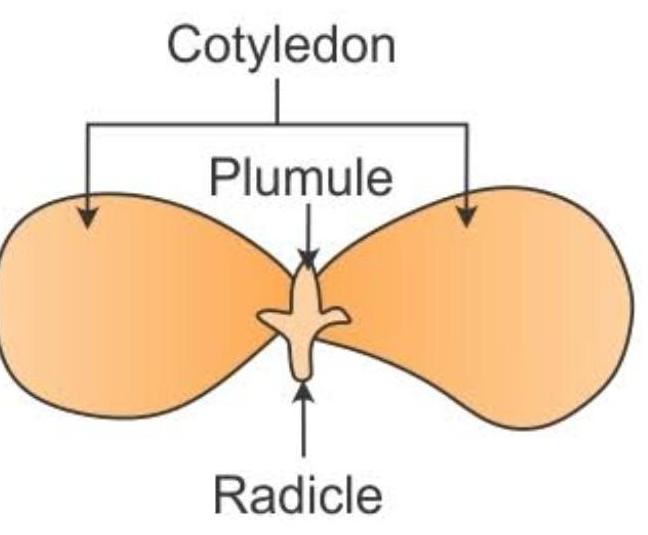
In Figure, the parts $A, B$ and $C$ are $....... , ........$ and $.........$
- A
Cotyledon, plumule and radicle.
- B
Plumule, radicle and cotyledon.
- ✓
Plumule, cotyledon and radicle.
- D
Radicle, cotyledon and plumule.
AnswerCorrect option: C. Plumule, cotyledon and radicle.
View full question & answer→MCQ 501 Mark
When stamens are superior, the flower is:
MCQ 511 Mark
Grafting is not possible in monocots because they:
- A
Have scattered vascular bundles
- B
- C
- ✓
View full question & answer→MCQ 521 Mark
The asexual process replaced by the sexual method is known as:
MCQ 531 Mark
Which part of the embroyo sac receive the male gamete?
MCQ 541 Mark
Which of the following represents the female gametophyte in angiosperms?
MCQ 551 Mark
Germ pores can be traced in $................$
View full question & answer→MCQ 561 Mark
A dicotyledonous plant bears flowers but never produces fruits and seeds. The most probable cause for the above situation is:
- A
Plant is dioecious and bears only pistillate flowers.
- B
Plant is dioecious and bears both pistillate and staminate flowers.
- C
- ✓
Plant is dioecious and bears only staminate flowers.
AnswerCorrect option: D. Plant is dioecious and bears only staminate flowers.
View full question & answer→MCQ 571 Mark
If the haploid number of chromosomes in Pinus is $12,$ the number in its endosperm cells will be:
AnswerBecause endosperms of p!nus are always haploid and is formed before fertilization in ovules.
View full question & answer→MCQ 581 Mark
View full question & answer→MCQ 591 Mark
Top$-$shaped multiciliate male gametes and the mature seed which bears only one embryo with two cotyledons, are characteristic features of?
- A
- ✓
- C
Polypetalous angiosperms.
- D
Gamopetalous angiosperms.
View full question & answer→MCQ 601 Mark
- A
Shedding of pollen from anther.
- B
Similar to fertilization of animals.
- ✓
Transfer of pollen from anther to stigma.
- D
Transfer of pollen from anther to ovule.
AnswerCorrect option: C. Transfer of pollen from anther to stigma.
View full question & answer→MCQ 611 Mark
When the pollen of a flower is transferred to the stigma of another flower on the same plant, the process is known as:
MCQ 621 Mark
The development of fruits without fertilisation of the ovary, is called:
MCQ 631 Mark
- A
In dioecious plant, male and female flowers are seen in different plants.
- B
- C
Tapeworm, leech, earthworm and sponges are hermaphrodites.
- ✓
Marchantia and chara are dioecious.
AnswerCorrect option: D. Marchantia and chara are dioecious.
View full question & answer→MCQ 641 Mark
From the statements given below choose the option that are true for a typical female gametophyte of a flowering plant:
- It is $8-$nucleate and $7-$celled at maturity.
- It is free$-$nuclear during the development.
- It is situated inside the integument but outside the nucellus.
- It has an egg apparatus situated at the chalazal end.
- A
$i$ and $iv.$
- B
$ii$ and $iii.$
- ✓
$i$ and $ii.$
- D
$ii$ and $iv.$
AnswerCorrect option: C. $i$ and $ii.$
View full question & answer→MCQ 651 Mark
Both chasmogamous and cleistogamous flowers are present in
MCQ 661 Mark
Leeuwenhoek discovered $............$
- A
Double fertilization in angiosperms
- ✓
- C
- D
View full question & answer→MCQ 671 Mark
The polyembryony commonly occurs in.
MCQ 681 Mark
Exine of pollen grain is formed of:
- A
- B
Pecto$-$cellulose.
- C
Ligno$-$cellulose.
- ✓
View full question & answer→MCQ 691 Mark
In following plants, the unisexual female flower is:
MCQ 701 Mark
Parthenocarpic tomato fruits can be produced by:
- A
Removing androecium of flowers before pollen grains are released.
- ✓
Treating the plants with low concentrations of gibberellic acid and auxins.
- C
Raising the plants from vernalized seeds.
- D
Treating the plants with phenylmercuric acetate.
AnswerCorrect option: B. Treating the plants with low concentrations of gibberellic acid and auxins.
View full question & answer→MCQ 711 Mark
What is meant by emasculation?
- A
Pollination between flowers of same plant.
- B
Pollination between flowers of different plants.
- ✓
- D
View full question & answer→MCQ 721 Mark
A particular species of plant produces light, non$-$sticky pollen in large numbers and its stigmas are long and feathery. These modifications facilitate pollination by:
View full question & answer→MCQ 731 Mark
Water is not required in the fertilization of:
AnswerCorrect option: D. Pisum$/$ Maize
View full question & answer→MCQ 741 Mark
In plants, in nature, autogamy is avoided since the seeds produced:
- A
- B
Do not germinate successfully
- C
Do not produce healthy plants
- ✓
View full question & answer→MCQ 751 Mark
$.............$ favours autogamy.
View full question & answer→MCQ 761 Mark
AnswerSeeds develop from the ovules in the ovary after they have been fertilized by the male gametes from the pollen
View full question & answer→MCQ 771 Mark
A botanist collected some fruits with hook$-$like spines and when the seeds of the same have been germinated they turned out to be asteraceous taxa, bearing asepalous and wind pollinated flowers. The fruit he collected were of $.............$
View full question & answer→MCQ 781 Mark
Assured seed set is possible even in absence of pollinators, when pollination is:
MCQ 791 Mark
Which one of the following represents an ovule, where the embryo sac becomes horseshoe shaped and the funiculus and micropyle are close to each other?
MCQ 801 Mark
Route used by pollen tube for entering ovule is:
MCQ 811 Mark
Pollination occurs when a pollen grain $..........$
- A
Matures and has three nuclei
- ✓
- C
Releases its sperm nuclei
- D
Releases its pollen tube nucleus
View full question & answer→MCQ 821 Mark
Masses of pollen grains $i.e.$ pollinia is found in:
View full question & answer→MCQ 831 Mark
In a fertilised embryo sac, the haploid, diploid and triploid structures are
- ✓
Synergid, zygote and primary endosperm nucleus.
- B
Synergid, antipodal and polar nuclei.
- C
Antipodal, synergid and primary endosperm nucleus.
- D
Synergid, polar nuclei and zygote.
AnswerCorrect option: A. Synergid, zygote and primary endosperm nucleus.
View full question & answer→MCQ 841 Mark
Which of the following represents the female gametophyte in angiosperms?
MCQ 851 Mark
Unisexuality of flowers prevents:
- A
Geitonogamy, but not xenogamy.
- B
Autogamy and geitonogamy.
- ✓
Autogamy, but not geitonogamy.
- D
Both geitonogamy and xenogamy.
AnswerCorrect option: C. Autogamy, but not geitonogamy.
View full question & answer→MCQ 861 Mark
Through which cell of the embryo sac, does the pollen tube enter the embryo sac?
MCQ 871 Mark
Future shoot hidden in a seed is called as:
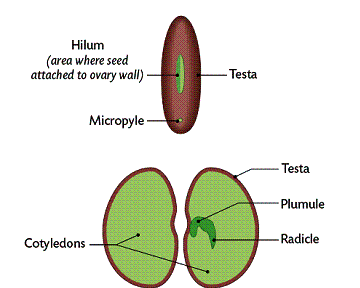
AnswerThe young shoot of a plant embryo above the cotyledons, consisting of the epicotyl and often immature leaves is the plumule. It is the future shoot.
Part of a seed embryo that develops into the shoot, bearing the first true leaves of a plant.
In most seeds, for example, the sunflower, the plumule is a small conical structure without any leaf structure.
The growth of the plumule does not occur until the cotyledons have grown above ground.
View full question & answer→MCQ 881 Mark
Apomixis is a type of reproduction that results is the development of $a/an:$
- A
New organism from fusion products of gametes.
- ✓
New organism without fusion of gametes.
- C
- D
AnswerCorrect option: B. New organism without fusion of gametes.
View full question & answer→MCQ 891 Mark
An example of a seed with endosperm, perisperm and car uncle is:
MCQ 901 Mark
Number of meiotic divisions required to produce $200/400$ seeds of pea would be:
- A
$200/400.$
- B
$400/800.$
- C
$300/600.$
- ✓
$250/500.$
AnswerCorrect option: D. $250/500.$
View full question & answer→MCQ 911 Mark
Identify the true statement from the following:
- ✓
Stamen consist of anther and filament.
- B
Anther consists of stamen and filament.
- C
Anther is generally monothecous.
- D
Dithecous anther consists of two pollen sacs.
AnswerCorrect option: A. Stamen consist of anther and filament.
View full question & answer→MCQ 921 Mark
Nucellar polyembryony is reported in species of:
AnswerCitrus exhibits polyembryonic seed development, an apomictic process in which many maternally derived embryos arise from the nucellus surrounding the developing zygotic embryo.
View full question & answer→MCQ 931 Mark
If any following part of flower, is involved in the formation of fruit is called as false fruit. Such part is:
MCQ 941 Mark
Generative cell was destroyed by laser but a normal pollen tube was still formed because:
- A
Contents of killed generative cell stimulate pollen growth.
- ✓
Vegetative cell is not damaged.
- C
Laser beam stimulates growth of pollen tube.
- D
The region of emergence of pollen tube is not harmed.
AnswerCorrect option: B. Vegetative cell is not damaged.
View full question & answer→MCQ 951 Mark
Mustard oil is obtained from:
MCQ 961 Mark
What is common between vegetative reproduction and Apomixis?
- A
Both occur round the year.
- ✓
Both produces progeny identical to the parent.
- C
Both are applicable to only dicot plants.
- D
Both bypass the flowering phase.
AnswerCorrect option: B. Both produces progeny identical to the parent.
View full question & answer→MCQ 971 Mark
In ginger vegetative propagation occurs through:
MCQ 981 Mark
Cleistogamous flowers are.
- ✓
Cleistogamous flowers are.
- B
- C
- D
AnswerCorrect option: A. Cleistogamous flowers are.
View full question & answer→MCQ 991 Mark
What would be the number of chromosomes of the aleurone cells of a plant with $42$ chromosomes in its roots tip cells?
View full question & answer→MCQ 1001 Mark
In which of the following plant, the fruit is a drupe, seed coat is thin, embryo is inconspicuous and endosperm is edible?
MCQ 1011 Mark
Starting from the innermost part, the correct sequence of parts in an ovule are:
- A
Egg, nucellus, embryo sac, integument.
- ✓
Egg, embryo sac, nucellus, integument.
- C
Embryo sac, nucellus, integument, egg.
- D
Egg, integument, embryo sac, nucellus.
AnswerCorrect option: B. Egg, embryo sac, nucellus, integument.
View full question & answer→MCQ 1021 Mark
In Figure, the parts $A, B$ and $C$ are sequentially $....$
- A
Cotyledon, plumule and radicle.
- B
Plumule, radicle and cotyledon.
- ✓
Plumule, cotyledon and radicle.
- D
Radicle, cotyledon and plumule.
AnswerCorrect option: C. Plumule, cotyledon and radicle.
View full question & answer→MCQ 1031 Mark
In the young cob of maize, numerous filamentous hair like structures protruding from its tip are.
- A
- ✓
- C
- D
Hairy projections from the bracts.
View full question & answer→MCQ 1041 Mark
View full question & answer→MCQ 1051 Mark
In angiosperms, triple fusion is required for the formation of:
MCQ 1061 Mark
During microsporogenesis, meiosis occurs in:
MCQ 1071 Mark
Plants with spikelet inflorescence are well adapted for $...........$
View full question & answer→MCQ 1081 Mark
View full question & answer→MCQ 1091 Mark
In $..........$ flowers, the stigma is always branched rough and sticky.
View full question & answer→MCQ 1101 Mark
Pollination by insects is called:
MCQ 1111 Mark
View full question & answer→MCQ 1121 Mark
View full question & answer→MCQ 1131 Mark
When a diploid female plant is crossed with a tetraploid male, the ploidy of endosperm cells in the resulting seed is:
MCQ 1141 Mark
If an angiospermic male plant is diploid and female plant tetraploid, the ploidy level of endosperm will be.
MCQ 1151 Mark
In a flower, if the megaspore mother cell forms megaspores without undergoing meiosis and if one of the megaspores develops into an embryo sac, its nuclei would be:
- A
- ✓
- C
A few haploid and a few diploid.
- D
AnswerIn a flower, if the megaspore mother cell forms megaspores without undergoing meiosis and if one of the megaspores develops into an embryo sac, its nuclei would be diploid.
View full question & answer→MCQ 1161 Mark
The migration of pollen grains to stigma is called as$.........$
AnswerPollination is the process by which pollen is transferred from the anther or the male part to the stigma or the female part of the plant thereby enabling fertilization and reproduction.
Fertilization is the fusion of male and female gametes.
Reproduction is the biological process by which an individual organism is produced from their parents.
View full question & answer→MCQ 1171 Mark
Apomixis term was given by $..........$
View full question & answer→MCQ 1181 Mark
Entry of pollen tube through micropyle is.
MCQ 1191 Mark
Diadelphous stamens are the characteristic feature of:
MCQ 1201 Mark
In which one of the following, would you expect to find glyoxysomes?
AnswerGlyoxysomes are microbodies.
These microbodies occur only in fat rich plant cells like castor seeds where they take part in $\beta-$oxidation of fats and perform glyoxylate cycle.
Glyoxysomes possess catalase enzyme.
View full question & answer→MCQ 1211 Mark
In Maize, the type of pollination is:
AnswerMaize plant use air for its pollination and this is the reason its pollens are light and non$-$sticky, stigma are hairy, long and free to capture pollens.
View full question & answer→MCQ 1221 Mark
Biologically most resistant plant material is:
MCQ 1231 Mark
Ovules are attached to a parenchymatous cushion called:
MCQ 1241 Mark
Which of the following floral parts forms the pericarp after fertilisation?
MCQ 1251 Mark
Cleistogamous flowers are:
- A
- ✓
Self$-$pollinated.
- C
Cross$-$pollinated.
- D
AnswerCorrect option: B. Self$-$pollinated.
View full question & answer→MCQ 1261 Mark
Flowers showing ornithophily show few characteristic like:
- A
Blue flower with nectaries at base of corolla.
- B
Bright red flower into thick inflorescence.
- ✓
Red sweet scented flower with nectaries.
- D
White flowers with fragrance.
AnswerCorrect option: C. Red sweet scented flower with nectaries.
View full question & answer→MCQ 1271 Mark
In monocots, male gametophyte is:
AnswerMicrospores are land plant spores that develop into male gametophytes.
Microspores are structures that are part of the alternation of generations in many seedless vascular cryptogams, all gymnosperms and all angiosperms.
Microspores are halpoid and are produced from diploid microsporocytes by meiosis.
View full question & answer→MCQ 1281 Mark
Transfer of pollen grains from the anther to the stigma of another flower of the same plant is called:
MCQ 1291 Mark
Double fertilization is characteristic of:
MCQ 1301 Mark
Pine apple fruit develops from:
- A
A unilocular polycarpellary flower.
- B
A multipistillate syncarpous flower.
- ✓
A cluster of compactly borne flowers on a common axis.
- D
A multilocular monocarpellary flower.
AnswerCorrect option: C. A cluster of compactly borne flowers on a common axis.
View full question & answer→MCQ 1311 Mark
Double fertilization leading to initiation of endosperm in angiosperms require.
- A
Fusion of one polar nucleus and the second male gamete only.
- ✓
Fusion of two polar nuclei and the second male gamete.
- C
Fusion of four or more polar nuclei and the second male gamete only.
- D
All of the above kinds of fusion in different angiosperms.
AnswerCorrect option: B. Fusion of two polar nuclei and the second male gamete.
View full question & answer→MCQ 1321 Mark
An ovule which becomes curved so that the nucellus and embryo sac lie at right angles to the funicle is.
MCQ 1331 Mark
Eight nucleate embryo sacs are.
- A
- B
- C
- ✓
Sometimes monosporic, sometimes bisporic and sometimes tetrasporic.
AnswerCorrect option: D. Sometimes monosporic, sometimes bisporic and sometimes tetrasporic.
View full question & answer→MCQ 1341 Mark
In which of the following, the seed germinates and still attached with the main plant?
MCQ 1351 Mark
In which of the following is translator apparatus present?
MCQ 1361 Mark
In many cultivated ornamental flowers, number of petal whorls is higher than the one in wild type. Extra petals are generally modified:
AnswerThe extra petals $($petaloids$)$ are stamens with extra tissue along their sides.
Flowers may add tissue to only one side of the stamen $($resemble stamen$)$ or to both sides of the stamen $($resemble true petal$).$
View full question & answer→MCQ 1371 Mark
Which of the following pair has haploid structures?
- A
Nucellus and antipodal cells.
- ✓
Antipodal cells and egg cell.
- C
Antipodal cells and megaspore mother cell.
- D
Nucellus and primary endosperm nucleus.
AnswerCorrect option: B. Antipodal cells and egg cell.
View full question & answer→MCQ 1381 Mark
A triglyceride molecule has:
- ✓
Three fatty acids with one glycerol molecule.
- B
Three fatty acids with two glycerol molecule.
- C
Two fatty acids with two glycerol molecules.
- D
One fatty acid with one glycerol molecule.
AnswerCorrect option: A. Three fatty acids with one glycerol molecule.
Triglyceride consist of a glycerol molecule bound to three fatty acid molecules.
Triglycerides are esters. These are main components of body fat.
View full question & answer→MCQ 1391 Mark
Endogamy in plants is the term, where:
- A
Actual fusion never occur.
- B
Gametes tend to fuse but fusion product never survives.
- ✓
Pollination between two flowers on the same plant.
- D
Such term is never known in fungi..
AnswerCorrect option: C. Pollination between two flowers on the same plant.
Endogamy is the type of pollination in which the pollen from the anthers of a flower reaches the stigma of another flower of the same plant.
View full question & answer→MCQ 1401 Mark
The point at which funiculus touches the ovule is:
MCQ 1411 Mark
Female gametophyte of angiosperms is represented by:
MCQ 1421 Mark
In angiosperms pollen tubes liberate their male gametes into the.
MCQ 1431 Mark
AnswerCloves represent the flower bud. They are aromatic.
They are flower buds of a tree Syzygium aromaticum belonging to the family Myrtaceae.
View full question & answer→MCQ 1441 Mark
Embryo sac is called monosporic when it develops from:
- A
One of the megaspores out of the four megaspores which are derived from division of megaspore mother cell.
- B
- ✓
Only from two functional megaspores.
- D
AnswerCorrect option: C. Only from two functional megaspores.
View full question & answer→MCQ 1451 Mark
The scutellum observed in a gram of wheat or maize is comparable to which part of the seed in other monocotyledons?
MCQ 1461 Mark
Transfer of pollen from anthers of one flower to the stigma of another flower of the same plant is called:
AnswerThe transfer of pollen grain from the anther to the stigma of a pistil is called pollination.
It is a mechanism by which non$-$motile male and female gametes are brought together for the fertilization.
Self$-$Pollination is of two types: Autogamy and geitonogamy.
The transfer of pollen grains from the anther of one flower to the stigma of another flower of the same plant is called geitonogamy.
This transfer involves a pollinating agent. Genetically, it is similar to autogamy since the pollen grains come from the same plant.
View full question & answer→MCQ 1471 Mark
During microsporogenesis, meiosis occurs in:
AnswerMicrospore mother cell undergoes meiosis to produce haploid pollen grains.
View full question & answer→MCQ 1481 Mark
Which of the following is the correct sequence of the events of sexual reproduction in a flower?
- ✓
Pollination, Fertilisation, Embryo, Seed.
- B
Pollination, Fertilisation, Seed, Embryo.
- C
Seed, Embryo, Fertilisation, Pollination.
- D
Embryo, Seed, Fertilisation, Pollination.
AnswerCorrect option: A. Pollination, Fertilisation, Embryo, Seed.
The sequence of sexual reproduction in a flower is as follows:
- Pollination is the process of transfer of pollen grains from the anther to the stigma of the flower.
- Fertilisation is the fusion of male and female gametes which leads to the formation of the embryo.
- The embryo is the developmental stage of a zygote which further develops into a seed.
- The embryo develops a tough coating around it and forms seed.
View full question & answer→MCQ 1491 Mark
Ovule is straight with funiculus, embryo sac, chalaza and micropyle lying on one straight line. It is
MCQ 1501 Mark
The fruit is chambered, developed from inferior ovary and has seeds with succulent testa in:
AnswerThe pomegranate fruit is a berry which develops from an inferior ovary.
Each seed has a surrounding water$-$laden pulp known as the edible sarcotesta that forms from the seed coat.
The seeds have no arils $($exarillate$).$
View full question & answer→MCQ 1511 Mark
The plant, whose seeds are known to have longest viability period is:
AnswerWater lotus $($Nelumbo nucifera$)$ have an unusually long period of viable germination.
Even if, a seed is in the ideal condition of germination, it might remain dormant for decades.
They show self$-$preservation and resistance to germination.
View full question & answer→MCQ 1521 Mark
A dioecious flowering plant prevents both.
- A
Geitonogamy and xenogamy.
- B
- ✓
Autogamy and geitonogamy.
- D
Cleistogamy and xenogamy.
AnswerCorrect option: C. Autogamy and geitonogamy.
View full question & answer→MCQ 1531 Mark
Adventitive polyembryony$/$ from nucellar cells occur in.
AnswerPolyembryony is the occurrence of more than one embryo in a single seed.
In adventive polyembryony, there is the formation of extra embryos due to sporophytic budding.
One or more sporophytic cells, either nucellus or integuments undergo stages of embryogeny and eventually develop into mature embryos.
This kind of polyembryony is found in citrus fruits.
View full question & answer→MCQ 1541 Mark
Double fertilization and triple fusion were discovered by.
MCQ 1551 Mark
Embryo sac is also known as:
MCQ 1561 Mark
One advantage of cleistogamy is:
- A
It leads to greater genetic diversity.
- B
Seed dispersal is more efficient and widespread.
- ✓
Seed set is not dependent on pollinators.
- D
Each visit of a pollinator results in transfer of hundreds of pollen grains.
AnswerCorrect option: C. Seed set is not dependent on pollinators.
Cleistogamy is a type of self $-$ pollination that is seen in permanently closed Self $-$ pollinating flowers.
These flowers are called as cleistogamous flowers.
Self $-$ pollination leads to lesser genetic diversity.
Seed dispersal does not takes place in it due to closed flowers.
Seed set is not dependent on pollinators as they are self fertilized.
View full question & answer→MCQ 1571 Mark
The entry of pollen tube into ovule through the micropyle is called:
MCQ 1581 Mark
The process whereby a perfect flower is pollinated by its own pollen is called as $.........$
AnswerAutogamy is otherwise called as self fertilization.
The term autogamy is also used for pollination and describes self pollination within the same flower, distinguished from geitonogamy, transfer of pollen to a different flower on the same flowering plant, or within a single monoecious gymnospermous plant.
View full question & answer→MCQ 1591 Mark
Mark the incorrect statement.
- A
- B
Banana is a parthenocarpic fruit
- C
Accesory fruit is also called as false fruit.
- ✓
View full question & answer→MCQ 1601 Mark
Anemophily type of pollination is found in
MCQ 1611 Mark
In a fertilised embryo sac, the haploid, diploid and triploid structures are:
- ✓
Synergid, zygote and primary endosperm nucleus.
- B
Synergid, antipodal and polar nuclei.
- C
Antipodal, synergid and primary endosperm nucleus.
- D
Synergid, polar nuclei and zygote.
AnswerCorrect option: A. Synergid, zygote and primary endosperm nucleus.
In a fertilised embryo sac, the haploid, diploid and triploid structures are synergid, zygote and primary endosperm nucleus.
View full question & answer→MCQ 1621 Mark
Transfer of pollen to the stigma of another flower of the same plant is:
MCQ 1631 Mark
Embryo sac is to ovule as $........$ is to an anther.
AnswerEmbryo sac is present in ovule, while pollen grains are present in anther.
View full question & answer→MCQ 1641 Mark
Chief pollinators of agricultural crops are:
MCQ 1651 Mark
Which of the following statements are true for flowers?
- A
They are the sexual reproductive organs.
- B
They are produced in all groups of plants.
- C
After fertilisation they give rise to fruits.
- ✓
AnswerExplanation: (D) Both B and D.
Flowers are sexual reproductive organ of plant because they contain male and female reproductive organ - stamen and pistil which form male and female gametes (pollen,ovule).
Flowers can be unisexual (having only stamen or pistil) or bisexual (contain both stamen and pistil).
After fertilization male and female gametes fuse to form zygote and ovary develops into fruit.
Some plants do not produce flower like-moss, fern etc. These plant reproduce by spores.
View full question & answer→MCQ 1661 Mark
One of the most resistant biological material is.
MCQ 1671 Mark
Haploid plant cultures are got from.
MCQ 1681 Mark
Sage flower is pollinated by:
MCQ 1691 Mark
When the gametophyte is not formed by spores but by any other part of sporophyte, it is known as:
AnswerApospory is the formation of gametophyte directly from sporophyte without the meiotic formation of spores.
View full question & answer→MCQ 1701 Mark
Which of the following plant seeds are used as "jeweller's weight"
MCQ 1711 Mark
Which of the following plant product is the hardest.
AnswerSporopollenin is a polymer, tougher than lignin but with similar properties, composed cheifly of carotenoids makes spores and pollen grains of plants resistant to biodegradation.
It is the hardest plant product.
View full question & answer→MCQ 1721 Mark
Development of an organism from female gamete$/$egg without involving fertilization is:
View full question & answer→MCQ 1731 Mark
In angiosperms all the four microspores of tetrad are covered by a layer which is formed by.
MCQ 1741 Mark
Which of the following is a drupe?
AnswerA drupe $($stone fruit$)$ is an indehiscent fruit in which the exocarp $($skin$)$ and mesocarp $($flesh$)$ surrounds the hardened endocarp with a seed $($kernel$)$ inside$, e.g.,$ mango.
View full question & answer→MCQ 1751 Mark
Which of the following floral parts forms the pericarp after fertilisation?
MCQ 1761 Mark
In Potato, self pollination is performed in:
- A
- B
- C
Bending of filaments to bring anthers in contact with stigma.
- ✓
Style bends to bring stigma in contact with anthers.
AnswerCorrect option: D. Style bends to bring stigma in contact with anthers.
In potato, male and female flowers mature at the same time $i.e$ it exhibits homogamy.
Pollination in potato flowers takes place by curling of style.
The style bends to bring the stigma in contact with the anthers and thus, pollens are deposited on the surface of the stigma.
Thus, self pollination occurs.
View full question & answer→MCQ 1771 Mark
Apomixis in plant means development of new plant.
- A
- ✓
Without fusion of gametes
- C
- D
AnswerCorrect option: B. Without fusion of gametes
Apomixis in plant means development of new plant without fusion of gametes.
Although seeds, in general, are the products of fertilization, a few flowering plants such as Asteraceae and grasses, have evolved this special mechanism.
Apomixis is a form of asexual reproduction that mimics sexual reproduction. But, it does not involve meiosis and fertilisation.
View full question & answer→MCQ 1781 Mark
The endosperm of gymnosperms is.
MCQ 1791 Mark
Pollen grains can be stored in liquid nitrogen at:
- A
$70^\circ C.$
- B
$100^\circ C.$
- ✓
$–196^\circ C.$
- D
$0^\circ C.$
AnswerCorrect option: C. $–196^\circ C.$
View full question & answer→MCQ 1801 Mark
In a typical complete, bisexual and hypogynous flower the arrangement of floral whorls on the thalamus from the outermost to the innermost is:
- A
Androecium, gynoecium, corolla and calyx.
- B
Calyx, corolla, gynoecium and androecium.
- C
Gynoecium, androecium, corolla and calyx.
- ✓
Calyx, corolla, androecium and gynoecium.
AnswerCorrect option: D. Calyx, corolla, androecium and gynoecium.
View full question & answer→MCQ 1811 Mark
A dicot plant lacking cotyledons is:
AnswerCuscuta is a dicot plant but has no cotyledons because they are converted into a thread like hypocotyls, so they must find suitable hosts within a few days to survive.
View full question & answer→MCQ 1821 Mark
How many microspore mother cells are required to produce $1000$ microspores$/$ pollen grains?
View full question & answer→MCQ 1831 Mark
Pollen grains are produced by:
AnswerStamens are the male reproductive structure of the plant.
They produce pollen grain by the process of microsporogenesis.
Leaves are the vegetative part of plants.
The gynoecium is the female reproductive part of the plant that produces the ovum.
The pistil is synonymous with gynoecium.
Hence, pollen grains are produced by "stamens".
View full question & answer→MCQ 1841 Mark
Autogamy can occur in a chasmogamous flower if:
- ✓
Both pollen and ovules mature simultaneously.
- B
Both anther and stigma are of equal lengths.
- C
Ovules mature before maturity of pollen.
- D
AnswerCorrect option: A. Both pollen and ovules mature simultaneously.
View full question & answer→MCQ 1851 Mark
Gloriosa superba exhibits:
MCQ 1861 Mark
AnswerA staminate flower is the flower having only stamen.
It is also known as male flower.
View full question & answer→MCQ 1871 Mark
In a type of apomixis known as adventive embryony, embryos develop directly from the$-$
- A
Synergids or antipodals in an embryo sac
- ✓
- C
- D
Accessory embryo sacs in the ovule
AnswerApomixis does not involve gamete formation and fertilization as found in amphimixis.
Adventive embryo formation is a type of apomixis in which embryos are formed from diploid integumental or nucellar cells.
View full question & answer→MCQ 1881 Mark
AnswerThe pericarp of the maize is fused with the seed coat known caryopsis.
The entire kernel is referred to as the seed.
View full question & answer→MCQ 1891 Mark
In non $-$ endospermic seeds, food is stored in:
AnswerIn the non $-$ endospermic or exalbuminous seeds, the endosperm is completely consumed by the developing embryo and the mature seeds are without endosperm. The food is stored in cotyledons. For example, gram, pea, bean etc.
View full question & answer→MCQ 1901 Mark
From the statements given below choose the option that are true for a typical female gametophyte of a flowering plant?
AnswerCorrect option: A. It is $8-$nucleate and $7-$celled at maturity.
View full question & answer→MCQ 1911 Mark
Starting from the innermost part, the correct sequence of parts in an ovule are:
- A
Embryo sac, nucellus, integument, egg.
- ✓
Egg, embryo sac, nucellus, integument.
- C
Egg, integument, embryo sac, nucellus.
- D
Egg, nucellus, embryo sac, integument.
AnswerCorrect option: B. Egg, embryo sac, nucellus, integument.
View full question & answer→MCQ 1921 Mark
Egg apparatus consists of:
- A
Egg cell and antipodal cells.
- B
Egg cell and central cell.
- ✓
Egg cell and two synergids.
- D
Egg cell and one synergid
AnswerCorrect option: C. Egg cell and two synergids.
View full question & answer→MCQ 1931 Mark
'Gynoecium is apocarpous' means that:
- A
Gynoecium comprises of only one pistil which is fused with stamen.
- ✓
Gynoecium comprises of more than one carpel, all of which are free.
- C
Gynoecium comprises of only one carpel which is free.
- D
Gynoecium comprises of more than one carpel, which are fused.
AnswerCorrect option: B. Gynoecium comprises of more than one carpel, all of which are free.
Apocarpous gynoecium means the presence of more than one carpel and the carpels are separate or unfused.
It is a primitive condition.
Examples of apocarpous gynoecium include strawberries and buttercup.
View full question & answer→MCQ 1941 Mark
Which of the following is not found in maize seed?
AnswerIn some seeds, Perisperm is a mass of nutritive material outside the embryo sac.
It is derived from the nucellus and deposited externally to the embryo sac.
For example, seeds of coffee, black pepper.
In maize seeds the perisperm is absent.
As maize is a monocot Coleorhiza, Coleoptile and Scutellum are found in maize.
Hence perisperm is not found in maize seed
View full question & answer→MCQ 1951 Mark
AnswerThe stamen are male reproductive organs.
They contain anther which is the site of pollen development.
Inside anther male sporogenous cell differentiates and undergoes meiosis to produce microspores that develop into pollen grains.
View full question & answer→MCQ 1961 Mark
The pro$-$ubisch bodies are converted to ubisch bodies when they become coated by $..............$
View full question & answer→MCQ 1971 Mark
AnswerMonocot seed are the type of seed that have one cotyledon called scutellum.
For example, Maize.
Dicot means seed posses two cotyledons.
For example, Mango.
Wind dispersed seed are those that use wind as a medium to move from one place to another.
For example, Xanthium
View full question & answer→MCQ 1981 Mark
Sperm and egg nuclei fuse due to.
AnswerCorrect option: D. Attraction of their protoplasts.
View full question & answer→MCQ 1991 Mark
Among the terms listed below, those that of are not technically correct names for a floral whorl are:
- Androecium.
- Carpel.
- Corolla.
- Sepal.
- A
$i$ and $iv.$
- B
$iii$ and $iv.$
- ✓
$ii$ and $iv$
- D
$i$ and $ii.$
AnswerCorrect option: C. $ii$ and $iv$
View full question & answer→MCQ 2001 Mark
Among the terms listed below, those that of are not technically correct names for a floral whorl are:
MCQ 2011 Mark
How many pollen grains will be formed after meiotic division in $10$ microspore mother cells?
View full question & answer→MCQ 2021 Mark
The functions of tapetum is to:
- A
- B
- ✓
Provide nourishment to the developing pollen grains.
- D
Store and protect pollen grains.
AnswerCorrect option: C. Provide nourishment to the developing pollen grains.
View full question & answer→MCQ 2031 Mark
Pineapple $($Ananas$)$ fruit develops from:
- ✓
A cluster of compactly borne flowers on a common axis.
- B
A multilocular monocarpellary flower.
- C
A unilocular polycarpellary flower.
- D
A multipistillate synchronous flower.
AnswerCorrect option: A. A cluster of compactly borne flowers on a common axis.
View full question & answer→MCQ 2041 Mark
The outermost and innermost wall layers of microsporangium in an anther are respectively:
- A
Epidermis and middle layer.
- ✓
- C
Epidermis and endodermis.
- D
View full question & answer→MCQ 2051 Mark
In a bisexual flower inspite of the young stamens being removed artificially, the flower produces fruit. Choose a suitable explanation for the above situation.
- ✓
Stamens removed but pistil is intact.
- B
Stamens removed but androecium is intact.
- C
Stamens removed but sepal is intact.
- D
AnswerCorrect option: A. Stamens removed but pistil is intact.
View full question & answer→MCQ 2061 Mark
The hard outer layer of pollens, named exine, is made of:
MCQ 2071 Mark
View full question & answer→MCQ 2081 Mark
Male gametophyte of angiosperms$/$monocots is.
View full question & answer→MCQ 2091 Mark
In a breeding experiment, the selected male parent is diploid and the female parent is tetraploid. What will be the ploidy level of the endosperm that will develop after double fertilisation?
MCQ 2101 Mark
The pollination with the help of wind is termed as $...........$
AnswerAnemophily or wind pollination is a form of pollination whereby pollen is distributed by wind.
Almost all gymnosperms are anemophilous, as are many plants in the order Poales, including grasses, sedges and rushes.
View full question & answer→MCQ 2111 Mark
While planning for an artificial hybridization programme involving dioecious plants, which of the following steps would not be relevant:
- A
Bagging of female flower.
- B
Dusting of pollen on stigma.
- ✓
- D
AnswerIn case of dioecious plant, male and female flowers are not usually on a single plant. Hence, emasculation may not be necessary in certain cases.
View full question & answer→MCQ 2121 Mark
The phenomenon wherein, the ovary develops into a fruit without fertilisation is called:
AnswerIf a fruit is formed without fertilisation of ovary, it is called a parthenocarpic fruit$, e.g.,$ banana and grape.
View full question & answer→MCQ 2131 Mark
In a flowering plant, archesporium gives rise to.
- A
Only tapetum and sporogenous cells.
- B
Only the wall of the sporangium.
- ✓
Both wall and the sporogenous cells.
- D
AnswerCorrect option: C. Both wall and the sporogenous cells.
View full question & answer→MCQ 2141 Mark
AnswerHybridization is a technique of artificial pollination in which by spreading the stamens on female stigma the process of breeding completed.
This technique is used for developing desirable traits in different species.
View full question & answer→MCQ 2151 Mark
In a type of apomixis known as adventive embryony, embryos develop directly from the $...........$
- ✓
- B
Synergids or antipodals in an embryo sac.
- C
Accessory embryo sacs in ovule.
- D
AnswerApomixis is also called as adventive embryony is the method of fertilization from cells other than egg cells.
Adventive embryony is possible when the embryo develops from the integuments or nucellus.
View full question & answer→MCQ 2161 Mark
The primitive type of stamens are found in which of the following family?
- A
- B
- C
- ✓
Degeneriaceae or Magnoliaceae
AnswerCorrect option: D. Degeneriaceae or Magnoliaceae
The Magnolia family has the following primitive characteristics:
- Large flowers with numerous petals and sepals $($tepals$).$
- Numerous spirally arranged stamens at the base of a cone like receptacle bearing numerous spirally arranged carpels.
- Each seed has a fleshy red outer layer $($aril$)$ and hangs from its follicle by a threadlike stalk.
- Radial symmetry or actinomorphic and floral axis $($receptacle$)$ elongated.
View full question & answer→MCQ 2171 Mark
From among the sets of terms given below, identify those that are associated with the gynoecium.
- ✓
Stigma, ovule, embryo sac, placenta.
- B
Thalamus, pistil, style, ovule.
- C
Ovule, ovary, embryo sac, tapetum.
- D
Ovule, stamen, ovary, embryo sac.
AnswerCorrect option: A. Stigma, ovule, embryo sac, placenta.
Stigma, ovule, embryo sac and placenta are associated with the gynoecium.
View full question & answer→MCQ 2181 Mark
When the pollen of a flower is transferred to the stigma of another flower on the same plant, the process is known as:
MCQ 2191 Mark
Epipetalous and syngenesious stamens occur in:
MCQ 2201 Mark
Microsporogenesis occurs:
- A
- B
- ✓
- D
In essential floral organs.
View full question & answer→MCQ 2211 Mark
Which of the following is the correct sequence of events of sexual reproduction in a flower?
- A
Pollination, fertilisation, seedling, embryo.
- B
Seedling, embryo, fertilisation, pollination.
- ✓
Pollination, fertilisation, embryo, seedling.
- D
Embryo, seedling, pollination, fertilisation.
AnswerCorrect option: C. Pollination, fertilisation, embryo, seedling.
View full question & answer→MCQ 2221 Mark
AnswerAnemophily is the type of pollination in which wind is the pollinating agent.
The pollen grains are light and non $-$ sticky so that they can easily be carried by air currents.
The flowers have well $-$ exposed stamens so that the pollens are easily dispersed into wind currents.
Flowers have a large feathery stigma to easily trap the airborne pollen grains.
It occurs in grasses, maize, wheat, etc.
View full question & answer→MCQ 2231 Mark
From among the sets of terms given below, identify those that are associated with the gynoecium:
- A
Ovule, stamen, ovary, embryo sac.
- B
Thalamus, pistil, style, ovule.
- C
Ovule, ovary, embryo sac, tapetum.
- ✓
Stigma, ovule, embryo sac, placenta.
AnswerCorrect option: D. Stigma, ovule, embryo sac, placenta.
View full question & answer→MCQ 2241 Mark
If the haploid number of chromosomes in Pinus is $12,$ the number in its endosperm cells will be
AnswerBecause endosperms of p!nus are always haploid and is formed before fertilization in ovules.
View full question & answer→MCQ 2251 Mark
From among the situations given below, choose the one that prevents both autogamy and geitonogamy:
- A
Monoecious plant bearing unisexual flowers.
- ✓
Dioecious plant bearing only male or female flowers.
- C
Monoecious plant with bisexual flowers.
- D
Dioecious plant with bisexual flowers.
AnswerCorrect option: B. Dioecious plant bearing only male or female flowers.
View full question & answer→MCQ 2261 Mark
From among the situations given below, choose the one that prevents both autogamy and geitonogamy:
- A
Dioecious plant with bisexual flowers.
- B
Monoecious plant with bisexual flowers.
- ✓
Dioecious plant bearing only male or female flowers.
- D
AnswerCorrect option: C. Dioecious plant bearing only male or female flowers.
View full question & answer→MCQ 2271 Mark
The outermost and innermost wall layers of microsporangium in an anther are respectively:
- A
- B
Epidermis and endodermis.
- C
Epidermis and middle layer.
- ✓
View full question & answer→MCQ 2281 Mark
A diploid female plant and a tetraploid male plant are crossed. The ploidy of endosperm shall be.
MCQ 2291 Mark
Double fertilization is fusion of.
- A
- B
Two eggs and polar nuclei with pollen nuclei.
- C
One male gamete with egg and other with synergid.
- ✓
One male gamete with egg and other with secondary nucleus.
AnswerCorrect option: D. One male gamete with egg and other with secondary nucleus.
View full question & answer→MCQ 2301 Mark
In a typical complete, bisexual and hypogynous flower the arrangement of floral whorls on the thalamus from the outermost to the innermost is:
- ✓
Calyx, corolla, androecium and gynoecium.
- B
Calyx, corolla, gynoecium and androecium.
- C
Gynoecium, androecium, corolla and calyx.
- D
Androecium, gynoecium, corolla and calyx.
AnswerCorrect option: A. Calyx, corolla, androecium and gynoecium.
Arrangement of floral whorls on the thalamus from the outermost to the innermost is Calyx, corolla, androecium and gynoecium.
View full question & answer→MCQ 2311 Mark
Emasculation is a part of:
AnswerRemoval of stamens from a bisexual flower before anthesis $($anthesis is the period during which a flower is fully open and functional$)$ is called as emasculation.
Emasculation is useful for preventing the self pollination in female parent which is concerned with hybridization.
View full question & answer→MCQ 2321 Mark
A particular species of plant produces light, non$-$sticky pollen in large numbers and its stigmas are long and feathery. These modifications facilitate pollination by:
View full question & answer→MCQ 2331 Mark
What is the direction of micropyle in anatropous ovule?
MCQ 2341 Mark
Flowers and stamens of compositae are:
- A
- ✓
- C
- D
Epigynous and superior ovary
AnswerEpigynous flower: Thalamus is hollowed out and fused with ovary.
Other floral organs appear at the top of ovary.
Gynoecium is inferior while other parts are superior.
View full question & answer→MCQ 2351 Mark
Pollen grain is liberated at:
- A
- B
- C
- ✓
Two or three celled stage.
AnswerCorrect option: D. Two or three celled stage.
View full question & answer→MCQ 2361 Mark
Flowers are highly modified $.........$
View full question & answer→MCQ 2371 Mark
Gynoecium with fused carpels is called:
MCQ 2381 Mark
Which of the following defines the characteristics of family Asclepiadaceae?
MCQ 2391 Mark
Male reproductive organ of a flower:
AnswerStamen is the male reproductive organ.
It consists of filament and anther.
Pollination is a phenomenon that transfers of pollen grains from anther to stigma of carpel.
View full question & answer→MCQ 2401 Mark
In a breeding experiment, the selected male parent is diploid and the female parent is tetraploid. What will be the ploidy level of the endosperm that will develop after double fertilisation?
MCQ 2411 Mark
View full question & answer→MCQ 2421 Mark
Cotyledons and testa respectively are edible parts in:
- ✓
Groundnut and pomegranate
- B
- C
- D
AnswerCorrect option: A. Groundnut and pomegranate
View full question & answer→MCQ 2431 Mark
In a type of apomixis known as adventive embryony, embryos develop directly from the.
- A
- ✓
- C
Synergids or antipodals in an embryo sac.
- D
Accessory embryo sac in the ovule.
View full question & answer→MCQ 2441 Mark
The number of meiotic divisions, required to produce $400$ seeds in a pea plant, is:
View full question & answer→MCQ 2451 Mark
Seed formation without fertilization in flowering plants involves the process of
MCQ 2461 Mark
The phenomenon observed in some plants wherein parts of the sexual apparatus is used for forming embryos without fertilisation is called:
AnswerWhen seeds are produced without fertilization, this phenomenon is called apomixes. In parthenocarpy, seeds are not produced which means embryos are not produced. Hence, option $'b\ ’$ is the correct answer.
View full question & answer→MCQ 2471 Mark
Which one produce androgenic haploids in anther cultures?
- A
- B
Tapetal layer of anther wall.
- ✓
- D
View full question & answer→MCQ 2481 Mark
Study of formation, growth and development of new individual from an egg is.
MCQ 2491 Mark
Which statement is correct for compositae?
AnswerCorrect option: A. $5 -$ lobed stamens
View full question & answer→MCQ 2501 Mark
While planning for an artificial hybridization programme involving dioecious plants, which of the following steps would not be relevant?
- A
- ✓
- C
Dusting of pollen on stigma.
- D
Bagging of female flower.
View full question & answer→