Question 11 Mark
Cyclohexanamine
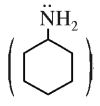
is more basic than benzenamine
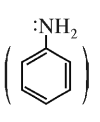
why?
AnswerIn cyclohexanamine, the lone electron pair of nitrogen is easily available because there is no resonance in it, whereas in benzenamine (aniline), the lone electrons pair of nitrogen is not easily available due to resonance, hence cyclohexanamine is more basic than aniline.
View full question & answer→Question 21 Mark
How is phenyl isocyanide prepared from benzene? Write the required reaction sequence.
Question 31 Mark
Convert nitrobenzene into benzene.
Question 41 Mark
Ethanamine is completely soluble in water, whereas benzenamine (aniline) is almost insoluble in water, why?
AnswerEthanamine easily forms inter molecular hydrogen bonds with water, hence it is completely soluble in water. Due to the large, size of the phenyl group in aniline, it is unable to form hydrogen bonds with water, hence it is almost insoluble in water.
View full question & answer→Question 51 Mark
Write the reaction sequence required to convert methanamine into ethane nitrile.
Question 61 Mark
Give the equation of reaction of aniline with Benzaldehyde.
Question 71 Mark
How to differentiate between $2^{\circ}$ and $3^{\circ}$ amines using Hinsberg reagent?
Answer$2^{\circ}$ amine reacts with Hinsberg reagent but $3^{\circ}$ amine does not react with Hinsberg reagent.
View full question & answer→Question 81 Mark
A primary amine $($molecular weight $31)$ reacts with carbon disulphide in the presence of $\ce{HgCl_2}$ to form a compound which smells like mustard oil. Give the formula and chemical equation of primary amine.
View full question & answer→Question 91 Mark
Write a reaction showing the acidic nature of methyl amine.
Question 101 Mark
Name the simplest primary amine which shows optical isomerism?
Question 111 Mark
What type of amine is tertiary butyl amine?
Question 121 Mark
Mention one use of quaternary ammonium salt.
Question 131 Mark
Mention the use of Benadryl. Also tell the functional group present in it.
AnswerBenadryl is used as an antihistamine an tertiary amine group is present in it.
View full question & answer→Question 141 Mark
Name two bioactive amines which are used in increasing blood pressure.
AnswerAdrenaline and Ephedrine. These are secondary amines.
View full question & answer→Question 151 Mark
Mention the natural sources of amines.
AnswerIn nature, amines are found in proteins, vitamins, alkaloids and hormones.
View full question & answer→Question 161 Mark
Write the formula and IUPAC name of sulphanilic acid.
Question 171 Mark
Which amines are insoluble in water?
Question 181 Mark
Write the order of boiling point of primary secondary and tertiary amines of equal molecular masses.
AnswerPrimary amine $>$ Secondary amine $>$ Tertiary amine.
View full question & answer→Question 191 Mark
What will be the main product obtained when alkyl halide is treated with excesss ammonia?
Question 201 Mark
Which isomerism is present in the following pair of compounds?

Question 211 Mark
Give the structure of A, B and C in the reaction :

Question 221 Mark
Give the structure of A, B and C in the reaction :

Question 231 Mark
Give the structure of A, B and C in the reaction :

Question 241 Mark
Give the structure of A, B and C in the reaction :

Question 251 Mark
Give the structure of A, B and C in the reaction :

Question 261 Mark
Give the structure of A, B and C in the reaction :

Question 271 Mark
Accomplish the conversion :
Benzamide to toluene
Question 281 Mark
Accomplish the conversion :
Aniline to p-bromo aniline
Question 291 Mark
Accomplish the conversion :
Chlorobenzene to p-chloroamine
Question 301 Mark
Accomplish the conversion :
Benzyl chloride to 9-phenyl ethanomine
Question 311 Mark
Accomplish the conversion :
Aniline to benzyl alcohol.
Question 321 Mark
Accomplish the conversion :
Aniline to 2,4,5-tribromo fluoro beznene
Question 331 Mark
Accomplish the conversion :
Benzoic acid to aniline
Question 341 Mark
Accomplish the conversion :
Benzene to m-bromo phenol
Question 351 Mark
Accomplish the conversion :
Nitrobenezene to benzoic acid
Question 361 Mark
Write short notes :
Hoffmann's bromamide reaction
AnswerHoffmann Bromamide Reaction : In this reaction a amide is treated in an aqueous or ethanoic solution of NaOH or KOH , with bromine then primary amine is formed.

View full question & answer→Question 371 Mark
How will you convert :
Propanoic acid into ethanoic acid?
Question 381 Mark
How will you convert :
Nitromethane into dimethyl amine
Question 391 Mark
How will you convert :
Methanamine into ethanamine
Question 401 Mark
How will you convert :
Ethanoic acid into propanoic acid
Question 411 Mark
How will you convert :
Ethanamine into methanamine
Question 421 Mark
How will you convert :
Methanol to ethanoic acid
Question 431 Mark
How will you convert :
Hexane nitrile into 1 -amino pentane
Question 441 Mark
How will you convert :
Ethanoic acid into methanamine
Question 451 Mark
Arrange the following :
In increasing order of solubility in water :
$C_6 H_5 NH_2,\left(C_2 H_5\right)_2 NH, C_2 H_5 NH_2$
View full question & answer→Question 461 Mark
Arrange the following :
In increasing order of boiling point :
$C_2 H_5 OH,\left(CH_3\right)_2 NH, C_2 H_5 NH_2$
View full question & answer→Question 471 Mark
Arrange the following :
In decreasing order of basic strength in gas phase
$C_2 H_5 NH_2,\left(C_2 H_5\right)_2 NH,\left(C_2 H_5\right)_3 N \text { and } NH_3$
Answer$\left(C_2 H_5\right)_3 N>\left(C_2 H_5\right)_2 NH>C_2 H_5 NH_2>NH_3$
(Decreasing order of basic strength in gas phase)
View full question & answer→Question 481 Mark
Arrange the following :
In incresing order of basic strength :
(a) Aniline, p-nitroaniline and p-toluidine
(b) $C _6 H _5 NH _2, C _6 H _5 NHCH _3, C _6 H _5 CH _2 NH _2$
Answer
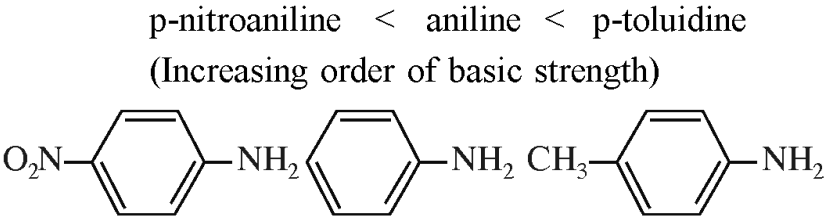
(b) $C _6 H _5 NH _2< C _6 H _5 NHCH _3< C _6 H _5 CH _2 NH _2$ View full question & answer→Question 491 Mark
Arrange the following :
In increasing order of basic strength :
$C _6 H _5 NH _2, C _6 H _5 N\left( CH _3\right)_2,\left( C _2 H _5\right)_2 NH$ and $CH _3 NH _2$
Answer$C _6 H _5 NH _2< C _6 H _5 N\left( CH _3\right)_2< CH _3- NH _2<$ $\left( C _2 H _5\right)_2 H$ (Increasing order of basic strength)
View full question & answer→Question 501 Mark
Arrange the following :
In decreasing order of the $pK _{ b }$ values :
$C _2 H _5 NH _2, C _6 H _5 NHCH _3,\left( C _2 H _5\right)_2 NH$ and $C _6 H _5 NH _2$
Answer$C _6 H _5 NH _2> C _6 H _5 NHCH _3> C _2 H _5 NH _2>$ $\left( C _2 H _5\right)_2 NH$ (Decreasing order of $pK _{ b }$ value means increasing order of basic strength)
View full question & answer→Question 511 Mark
Account for the following :
Gabriel phthalimide synthesis is preferred for synthesising primary amines.
AnswerIn Garbriel phthalimide synthesis $RNH _2$ is formed from R-X in which pure primary amine is formed and no other side products are formed. Because phthallic acid obtained is used again while in other reactions mixture of products is formed. So Gabriel phthallimide synthesis is preferred for synthesising primary amines.
View full question & answer→Question 521 Mark
Account for the following :
Diazonium salts of aromatic amines are more stable than those of aliphatic amines.
AnswerDiazonium salts of aromatic amines are more stable than diazonium salts of aliphatic amines because due to resonance they attains stability. Resonating structures of $C _6 H _5 N_2^{+}$are as under :
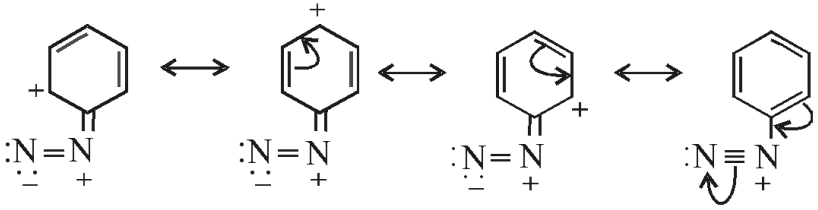
Arene diazonium salts are stable for some time in solution at low temperature (273-278 K). View full question & answer→Question 531 Mark
Account for the following :
Aniline does not undergo Friedel-Crafts reaction.
AnswerAniline does not show Friedel-Craft reaction because in this reaction $AlCl _3$ is used as catalyst which is Lewis acid which form salt with aniline (Lewis base). Due to salt formation nitrogen of aniline attains + ve charge which is strong deactivating group so reactivity of this decreases.

View full question & answer→Question 541 Mark
Account for the following :
Ethyl amine is soluble in water whereas aniline is not.
AnswerEthyl amine $\left( C _2 H _5- NH _2\right)$ forms hydrogen bond with water while aniline does not have tendency to form hydrogen bond with water due to large size non-polar $C _6 H _5-$ group so ethyl amine is soluble in water whereas aniline is not.
View full question & answer→Question 551 Mark
Give one chemical test to distinguish between the pair of compound :
Aniline and N-methyl aniline
AnswerAniline $\left(1^{\circ}\right)$. Gives carbyl amine test with $CHCl _3$ and alkali while N -methyl aniline $\left(2^{\circ}\right)$ do not give carbyl amine test.
View full question & answer→Question 561 Mark
Give one chemical test to distinguish between the pair of compound :
Aniline and benzyl amine
AnswerAniline form azo dye by the reaction with benzene diazonium chloride $\left( C _6 H _5 \stackrel{+}{ N }_2 \overline{ C } l \right)$ while in benzyl amine this does not occurs.
View full question & answer→Question 571 Mark
Give one chemical test to distinguish between the pair of compound :
Ethyl amine and aniline
AnswerEthyl amine does not form azo dye by the reaction with benzene diazonium chloride while aniline forms azo dye (yellow) by the reaction with benzene diazonium chloride.
View full question & answer→Question 581 Mark
Give one chemical test to distinguish between the pair of compound :
Secondary and tertiary amines
AnswerSecondary amine $\left( R _2 NH \right)$ reacts with Hinsberg reagent in a product formed insoluble in alkali while tertiary amine $\left( R _3 N\right)$ does not react with Hinsberg reagent.
View full question & answer→Question 591 Mark
Give one chemical test to distinguish between the pair of compound :
Methylamine and dimethyl amine
AnswerMethylamine $CH _3- NH _2\left(1^{\circ}\right)$ reacts $\left( C _6 H _5 SO _2 Cl \right)$ and product formed is soluble in alkali while product formed by the reaction of dimethyl amine $CH _3- NH -$ $CH _3\left(2^{\circ}\right)$ with Hinsberg reagent (benzene sulphonyl chloride) is insoluble in alkali.
View full question & answer→Question 601 Mark
Write IUPAC name of the compound and classify them into primary, secondary and tertiary amine :
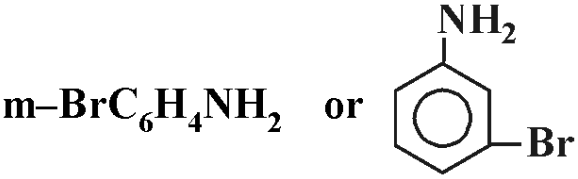
Answer3-bromoaniline or 3-bromobenzenamine $\left(1^{\circ}\right)$
View full question & answer→Question 611 Mark
Write IUPAC name of the compound and classify them into primary, secondary and tertiary amine :
$\left( CH _3 CH _2\right)_2 NCH _3$
AnswerN-ethyl-N-methyl ethanamine $\left(3^{\circ}\right)$
View full question & answer→Question 621 Mark
Write IUPAC name of the compound and classify them into primary, secondary and tertiary amine :
$C _6 H _5 NHCH _3$
AnswerN -methyl benzeneamine or N -methylaniline $\left(2^{\circ}\right)$
View full question & answer→Question 631 Mark
Write IUPAC name of the compound and classify them into primary, secondary and tertiary amine :
$\left( CH _3\right)_3 CNH _2$
Answer2-methyl propan-2-amine $\left(1^{\circ}\right)$
View full question & answer→Question 641 Mark
Write IUPAC name of the compound and classify them into primary, secondary and tertiary amine :
$CH _3 NHCH \left( CH _3\right)_2$
AnswerN -methyl propan-2-amine $\left(2^{\circ}\right)$
View full question & answer→Question 651 Mark
Write IUPAC name of the compound and classify them into primary, secondary and tertiary amine :
$CH _3\left( CH _2\right)_2 NH _2$
AnswerPropan-1-amine $\left(1^{\circ}\right)$
View full question & answer→Question 661 Mark
Write IUPAC name of the compound and classify them into primary, secondary and tertiary amine :
$\left( CH _3\right)_2 CHNH _2$
AnswerPropan-2-amine $\left(1^{\circ}\right)$
View full question & answer→Question 671 Mark
Give plausible explanation of :
Why are amines less acidic than alcohols of comparable molecular masses?
AnswerAmines are less acidic than alcohols of comparable molecular masses because in amines polarity of $N - H$ bond is less than $- O - H$ bond of alcohols due to more electronegativity of oxygen than nitrogen. So amines have less tendency to denote $H ^{+}$in comparison alcohols.
View full question & answer→Question 681 Mark
Why cannot aromatic primary amines be prepared by Gabriel phthalimide synthesis ?
AnswerAromatic primary amines cannot be prepared by Gabriel phthalimide synthesis because in aryl halide double bond character is attained in carbon halogen bond due to resonance ( + M effect) so bond becomes strong due to which aryl halide do not undergo nucleophilic substitution with the anion formed by phthalimide.
View full question & answer→Question 691 Mark
Complete the reaction :
$C _6 H _5 N_2 Cl \xrightarrow[\text { (ii) } NaNO _2 / Cu , \Delta]{\text { (i) } HBF _4}$
View full question & answer→Question 701 Mark
Complete the reaction :
$C _6 H _5 NH _2+\left( CH _3 CO \right)_2 O \rightarrow$
View full question & answer→Question 711 Mark
Complete the reaction :
$C _6 H _5 NH _2+ Br _2$ (aq.) $\rightarrow$
View full question & answer→Question 721 Mark
Complete the reaction :
$C _6 H _5 N_2 Cl + C _2 H _5 OH \rightarrow$
View full question & answer→Question 731 Mark
Complete the reaction :
$C _6 H _5 NH _2+ H _2 SO _4$ conc. $\rightarrow$
View full question & answer→Question 741 Mark
Complete the reaction :
$C _6 H _5 N_2 Cl + H _3 PO _2+ H _2 O \rightarrow$
View full question & answer→Question 751 Mark
Complete the reaction :
$C _6 H _5 NH _2+ CHCl _3+$ (alcoholic) $KOH \rightarrow$
View full question & answer→Question 761 Mark
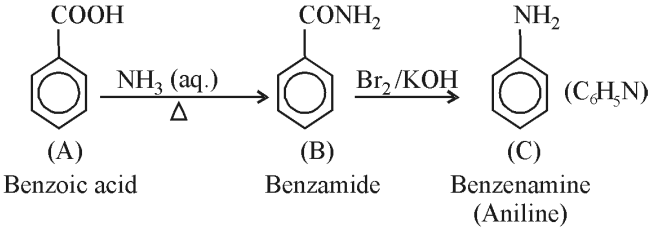
An aromatic compound 'A' on treatment with aqueous ammonia and heating forms compound 'B' which on heating with $Br _2$ and KOH forms a compound ' C ' of molecular formula $C _6 H _7 N$. Write the structures and IUPAC names of compounds $A, B$ and $C$.
AnswerReaction and $A , B , C$ and their names are as follows :
View full question & answer→