Question 14 Marks
What happens when D-glucose is treated with the following reagents?
(i) HI , (ii) Bromine water, (iii) $HNO _3$.
(i) HI , (ii) Bromine water, (iii) $HNO _3$.
Answer
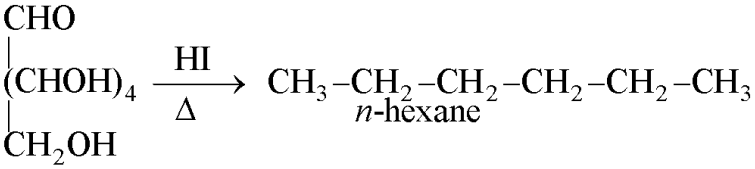
View full question & answer→(i) Reaction with HI : On long time heating with HI, it gets reduced to give n-hexane. This proves that all the six carbon atoms are linked in a straight chain.
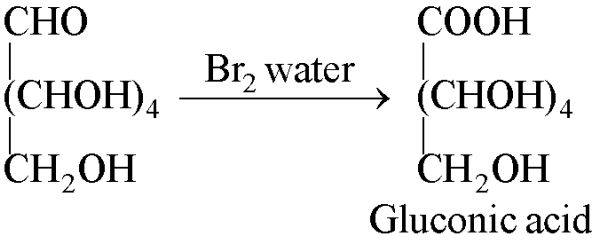
(ii) Reaction with bromine water : Glucose gets oxidised by bromine water to form gluconic acid. This proves that the carboxyl group is present as an aldehydic group.
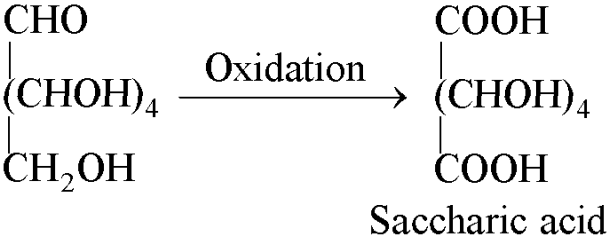
(iii) Reaction with $HNO _3$ : On oxidation with nitric acid, glucose gives dicarboxylic acid, saccharic acid. This indicates the presence of a primary alcoholic group in glucose.
(ii) Reaction with bromine water : Glucose gets oxidised by bromine water to form gluconic acid. This proves that the carboxyl group is present as an aldehydic group.
(iii) Reaction with $HNO _3$ : On oxidation with nitric acid, glucose gives dicarboxylic acid, saccharic acid. This indicates the presence of a primary alcoholic group in glucose.