Questions

1 Marks Question

Take a timed test

9 questions · self-marked practice — reveal the answer and mark yourself.

Question 11 Mark
(i) Write one reaction of D-glucose which cannot be explained by its open chain structure.
(ii) What type of linkage is present in nucleic acids?
Answer
(i) Glucose does not give 2, 4-DNP test and Schiff's test.
(ii) Phosphodiaester linkage is present in the nucleic acids.
View full question & answer
Question 31 Mark
Write the name of two Vitamins and name the diseases caused by deficiency of vitamins.
Answer
(i) Vitamin A - Night blindness
(ii) Vitamin C - Scurvy
View full question & answer
Question 41 Mark
What type of bonding occurs in globular proteins?
Answer
Hydrophobic interactions, disulphide bridges, ionic interactions and H-bonding.
View full question & answer
Question 51 Mark
Why cellulose cannot be used as the food for human beings?
Answer
Cellulose cannot be hydrolysed in human body because of the absence of that particular enzyme in the body, hence it cannot be digested in human body.
View full question & answer
Question 61 Mark
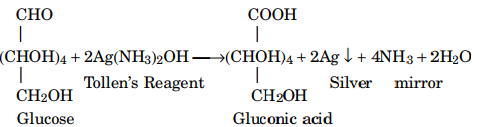
How will you show that D-glucose is a reducing sugar?
Answer
D-Glucose forms silver mirror with Tollen's reagent and give a red ppt with Fehlings solution. This show that D-glucose is a reducing sugar.
Image
View full question & answer
Question 71 Mark
What is mutarotation?
Answer
When an optically active compound show change in specific rotation with time up to an equilibrium value the phenomena is mutarotation.
View full question & answer
Question 81 Mark
What is the source of pectin? What is its use ?
Answer
The source of pectin is fruit skin. They are used in drug preparation, where they are used as inert agents to suspend as active drug.
View full question & answer
Question 91 Mark
What are reducing sugars ?
Answer
Carbohydrates which reduce Tollen's reagent and give red ppt with Fehling's solution are called reducing sugars. All monosaccharides (both aldoses and ketoses) and disaccharides except sucrose are reducing sugars.
View full question & answer