Questions

M.C.Q (1 Marks)

Take a timed test

39 questions · self-marked practice — reveal the answer and mark yourself.

Question 51 Mark
What is the order of integral rate reaction with expression $k =\frac{2.303}{t} \log \frac{[ R ]_0}{[ R ]}$ ?
Answer
b
View full question & answer
Question 61 Mark
For the reaction $2 A \rightarrow 3 B$, what is the reaction rate $-\frac{ d ( A )}{ dt }$ is equal to ?
Answer
b
View full question & answer
Question 101 Mark
The order and molecular number of reaction of $CH _3 COOC _2 H _5+ H _2 O \xrightarrow{ H ^{+}} CH _3 COOH +$ $C _2 H _5 OH$ are respectively
Answer
b
View full question & answer
Question 111 Mark
For the reaction $A + B =2 C$, the speed of extinction of A is $10^{-2}$ mole litre 'second', then what will be the speed of formation of C ?
Answer
d
View full question & answer
Question 131 Mark
The expression $k =\frac{2.303}{ t } \log \frac{[ R ]_0}{[ R ]}$ is the integral velocity equation of the order of reaction :
Answer
b
View full question & answer
Question 141 Mark
Find two third $\left( t \frac{2}{3}\right)$ life span for first order reaction (Given : $k =5.48 \times 10^{-14}$ second) :
Answer
a
View full question & answer
Question 151 Mark
If a and $t \frac{1}{2}$ is the initial concentration of the reactants and the half-life of the zero order reaction respectively, then which of the following is the correct relationship?
Answer
b
View full question & answer
Question 161 Mark
By doubling the initial concentration of a reagent, its $t \frac{1}{2}$ becomes half. The order of this reaction will be :
Answer
c
View full question & answer
Question 181 Mark
The reaction speed rule is given $\frac{d P}{d t}=K[A][B]$ for $2 A+ B \longrightarrow$ Product $( P )$ when $[ B ] \gg[ A ]$, then order of reaction is this situation will be :
Answer
b
View full question & answer
Question 231 Mark
The temperature dependence of the rate constant of a reaction is given by which of the following equation?
Answer
a
View full question & answer
Question 241 Mark
By doubling the initial concentration of reactant in a reaction, the half-life of that reaction also doubles as compared to before, then the order of this reaction will be :
Answer
c
View full question & answer
Question 281 Mark
The half-life of $C _{14}$ is 5760 years. After how many years will a 100 mg sample of ${ }^6 C _{14}$ be reduced to 25 mg ?
Answer
c
View full question & answer
Question 301 Mark
For the reaction $2 A+ B \longrightarrow 3 C + D$, which of the following expressions does not represent the rate of the reaction :
Answer
c
View full question & answer
Question 331 Mark
If the velocity of a reaction does not depend on the concentration of the reactants, then what will be the order of that reaction?
Answer
b
View full question & answer
Question 371 Mark
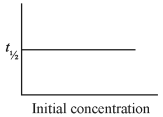
The speed of reaction between x and y becomes 100 times. When the concentration of x is increased 10 times, then the order of the reaction with respect to x will be :
Answer
b
View full question & answer
Question 391 Mark
For the reaction $X + Y \longrightarrow$ Product, the velocity of the reaction $= K [ X ]^{ a }[ Y ]^{ b }$, then the order of the reaction will be :
Answer
c
View full question & answer