MCQ 11 Mark
Two statements are given$-$ one labelled Assertion $(A)$ and the other labelled Reason $(R).$ Select the correct answer to these questions from the codes $(a), (b), (c)$ and $(d)$ as given below: Assertion $(A):$ Linkage isomerism arises in coordination compounds because of ambidentate ligand.
Reason $(R):$ Ambidentate ligand like $NO_2$ has two different donor atoms i.e., $N$ and $O.$
- ✓
Both Assertion $(A)$ and Reason $(R)$ are correct statements, and Reason $(R)$ is the correct explanation of the Assertion $(A).$
- B
Both Assertion $(A)$ and Reason $(R)$ are correct statements, but Reason $(R)$ is not the correct explanation of the Assertion $(A).$
- C
Assertion $(A)$ is correct, but Reason $(R)$ is incorrect statement.
- D
Assertion $(A)$ is incorrect, but Reason $(R)$ is correct statement.
AnswerCorrect option: A. Both Assertion $(A)$ and Reason $(R)$ are correct statements, and Reason $(R)$ is the correct explanation of the Assertion $(A).$
Both Assertion $(A)$ and Reason $(R)$ are correct statements, and Reason $(R)$ is the correct explanation of the Assertion $(A).$
View full question & answer→MCQ 21 Mark
Two statements are given$-$ one labelled Assertion $(A)$ and the other labelled Reason $(R)$. Select the correct answer to these questions from the codes $(a), (b), (c)$ and $(d)$ as given below:
Assertion $(A)$ : Linkage isomerism arises in coordination compounds because of ambidentate ligand.
Reason $(R)$ : Ambidentate ligand like $NO_2$ has two different donor atoms i.e., $N$ and $O$.
- ✓
Both Assertion $(A)$ and Reason $(R)$ are correct statements, and Reason $(R)$ is the correct explanation of the Assertion $(A)$.
- B
Both Assertion $(A)$ and Reason $(R)$ are correct statements, but Reason $(R)$ is not the correct explanation of the Assertion $(A).$
- C
Assertion $(A)$ is correct, but Reason $(R)$ is incorrect statement.
- D
Assertion $(A)$ is incorrect, but Reason $(R)$ is correct statement.
AnswerCorrect option: A. Both Assertion $(A)$ and Reason $(R)$ are correct statements, and Reason $(R)$ is the correct explanation of the Assertion $(A)$.
Both Assertion $(A)$ and Reason $(R)$ are correct statements, and Reason $(R)$ is the correct explanation of the Assertion $(A)$.
View full question & answer→MCQ 31 Mark
In these questions, a statement of assertion followed by a statement of reason is given. Choose the correct answer out of the following choices.
Assertion: $\ce{[Cu(NH_3)_4]^{2+}}$ is coloured while $\ce{[Cu(CN)_4]^{3-}}$ ion is colourless.
Reason: $\ce{[Cu(NH_3)_4]^{2+}}$ has $dsp^2$ hybridisation.
- A
Assertion and reason both are correct statements and reason is correct explanation for assertion.
- ✓
Assertion and reason both are correct statements but reason is not correct explanation for assertion.
- C
Assertion is correct statement but reason is wrong statement.
- D
Assertion is wrong statement but reason is correct statement.
AnswerCorrect option: B. Assertion and reason both are correct statements but reason is not correct explanation for assertion.
$\ce{[Cu(NH_3)_4]^{2+}}$ is coloured due to the presence of unpaired electron whereas $\ce{[Cu(CN)_4]^{3-}}$ has no unpaired electron.
View full question & answer→Question 41 Mark
In these questions, a statement of assertion followed by a statement of reason is given. Choose the correct answer out of the following choices.
- Assertion and reason both are correct statements and reason is correct explanation for assertion.
- Assertion and reason both are correct statements but reason is not correct explanation for assertion.
- Assertion is correct statement but reason is wrong statement.
- Assertion is wrong statement but reason is correct statement.
Assertion: The ligands nitro and nitrito are called ambidentate ligands.
Reason: An ambidentate ligand can attach to metal through two different atoms.
Answer
- Assertion and reason both are correct statements and reason is correct explanation for assertion.
Explanation:
When a monodentate ligand has two possible donor atoms and attached in two ways to the central metal atom then that ligand is called ambidentate ligand. This leads to linkage isomerism.
View full question & answer→MCQ 51 Mark
In these questions, a statement of assertion followed by a statement of reason is given. Choose the correct answer out of the following choices.
Assertion: $\ce{[Pt(NH_3)_2Cl_2]}$ is square planar.
Reason: The oxidation state of platinum is $+2.$
- ✓
Assertion and reason both are correct statements and reason is correct explanation for assertion.
- B
Assertion and reason both are correct statements but reason is not correct explanation for assertion.
- C
Assertion is correct statement but reason is wrong statement.
- D
Assertion is wrong statement but reason is correct statement.
AnswerCorrect option: A. Assertion and reason both are correct statements and reason is correct explanation for assertion.
The outer electronic configuration of platinum in ground state is $Sd^96s^1.$
The $pt^{2+}$ ion formed by the loss of two electrons has outer electronic configuration of $5d^8.$
In the presence of strong ligands $(NH_3$ molecules$)$ two unpaired electrons in the $Sd-$subshell pair up.
This is followed by $dsp^2$ hybridisation resulting in the formation of four hybridised vacant orbitals which accommodate four pairs of electrons from four ligands $($two from ammonia and two from $Cl^-).$
As such the resulting complex is square planar.
View full question & answer→MCQ 61 Mark
In these questions, a statement of assertion followed by a statement of reason is given. Choose the correct answer out of the following choices.
Assertion: $\ce{[Fe(CN)_6]^{3-}}$ is weakly paramagnetic while $\ce{[Fe(CN)_6]^{4-}}$ is diamagnetic.
Reason: $\ce{[Fe(CN)_6]^{3-}}$ has $+3$ oxidation state while $\ce{[Fe(CN)_6]^{4- }}$ has $+2$ oxidation state.
- ✓
Assertion and reason both are correct statements and reason is correct explanation for assertion.
- B
Assertion and reason both are correct statements but reason is not correct explanation for assertion.
- C
Assertion is correct statement but reason is wrong statement.
- D
Assertion is wrong statement but reason is correct statement.
AnswerCorrect option: A. Assertion and reason both are correct statements and reason is correct explanation for assertion.
$\ce{[Fe(CN)_6]^{3-}}$ has one unpaired electron, hence it shows paramagnetic nature while $\ce{[Fe(CN)_6]^{4-}}$ possesses no unpaired electron and thus shows diamagnetic nature.
View full question & answer→MCQ 71 Mark
In these questions, a statement of assertion followed by a statement of reason is given. Choose the correct answer out of the following choices.
Assertion: $\ce{[CrCl_2(H_2O)_4]NO_3}$ is dichlorotetraaquachromium $(III)$ nitrate.
Reason: In writing the name of the complex cation is written first followed by the anion.
- A
Assertion and reason both are correct statements and reason is correct explanation for assertion.
- B
Assertion and reason both are correct statements but reason is not correct explanation for assertion.
- ✓
Assertion is correct statement but reason is wrong statement.
- D
Assertion is wrong statement but reason is correct statement.
AnswerCorrect option: C. Assertion is correct statement but reason is wrong statement.
Assertion is correct statement but reason is wrong statement.
View full question & answer→Question 81 Mark
In these questions, a statement of assertion followed by a statement of reason is given. Choose the correct answer out of the following choices.
- Assertion and reason both are correct statements and reason is correct explanation for assertion.
- Assertion and reason both are correct statements but reason is not correct explanation for assertion.
- Assertion is correct statement but reason is wrong statement.
- Assertion is wrong statement but reason is correct statement.
Assertion: Ethylenediaminetetraacetate ion forms an octahedral complex with the metal ion
Reason: It has six donor atoms which coordinate simultaneously to the metal ion.
Answer
- Assertion and reason both are correct statements and reason is correct explanation for assertion.
View full question & answer→MCQ 91 Mark
In these questions, a statement of assertion followed by a statement of reason is given. Choose the correct answer out of the following choices.
Assertion: All the octahedral complexes of $Ni^{2+}$ must be outer orbital complexes.
Reason: Outer orbital octahedral complexes are given by weak ligands
- A
Assertion and reason both are correct statements and reason is correct explanation for assertion.
- B
Assertion and reason both are correct statements but reason is not correct explanation for assertion.
- C
Assertion is correct statement but reason is wrong statement.
- ✓
Assertion is wrong statement but reason is correct statement.
AnswerCorrect option: D. Assertion is wrong statement but reason is correct statement.
$Ni^{2+}$ configuration,
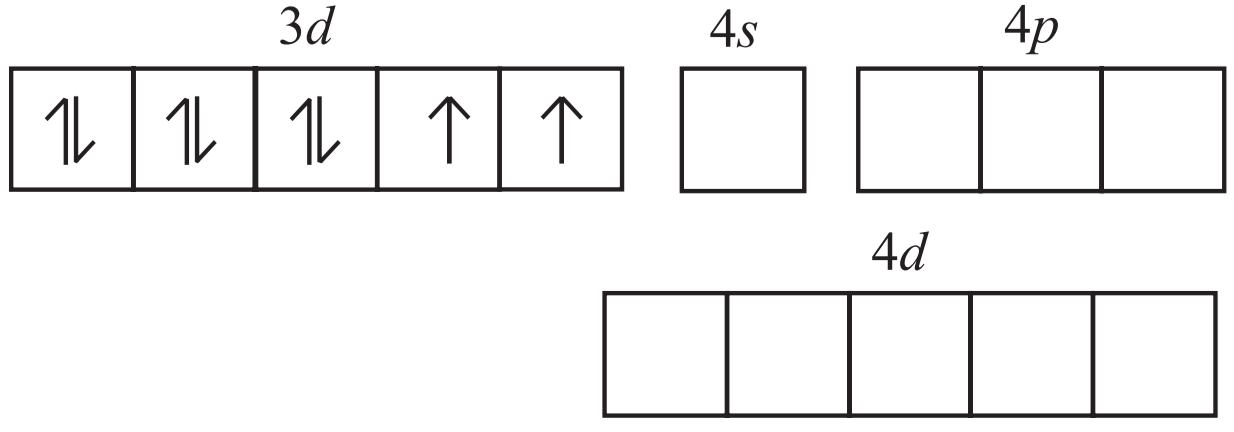
During rearrangement only one $3d-$orbital may be made available by pairing the electrons.
Thus, inner $d^2sp^3$ hybridisation is not possible.
So, only $sp^3d^2 ($outer$)$ hybridisation can occur. View full question & answer→Question 101 Mark
In these questions, a statement of assertion followed by a statement of reason is given. Choose the correct answer out of the following choices.
- Assertion and reason both are correct statements and reason is correct explanation for assertion.
- Assertion and reason both are correct statements but reason is not correct explanation for assertion.
- Assertion is correct statement but reason is wrong statement.
- Assertion is wrong statement but reason is correct statement.
Assertion: Thiocarbonyl is a neutral ligand.
Reason: Thiocarbonyl has three donor atoms but behaves as a bidentate ligand.
Answer
- Assertion is correct statement but reason is wrong statement.
Explanation:
Thiocarbonyl (CS) has one donor atoms.
View full question & answer→MCQ 111 Mark
In these questions, a statement of assertion followed by a statement of reason is given. Choose the correct answer out of the following choices.
Assertion: $\ce{[Ni(CN)_4]^{2-}}$ has square planar and $\ce{[NiCl_4]^{2-}}$ has tetrahedral shape.
Reason: $\ce{[Ni(CN)_4]^{2-}}$ is diamagnetic while $\ce{[NiCl_4]^{2-}}$ is paramagnetic.
- ✓
Assertion and reason both are correct statements and reason is correct explanation for assertion.
- B
Assertion and reason both are correct statements but reason is not correct explanation for assertion.
- C
Assertion is correct statement but reason is wrong statement.
- D
Assertion is wrong statement but reason is correct statement.
AnswerCorrect option: A. Assertion and reason both are correct statements and reason is correct explanation for assertion.
In $\ce{[NiCl_4]^{2-}},$ the $Cl^-$ ligands present in the complex ion are less basic than $CN^-,$ as such no pairing of electrons in the $3d-$subshell takes place.
This results in $sp^3$ hybridisation and the complex so formed is tetrahedral.
On the other hand, in case of $\ce{[Ni(CN)_4]^{2-}},$ the $CN^-$ ligands present in the complex ion are more basic than $Cl^-.$
as such pairing of electrons can take place in the $3d-$subshell.
Due to pairing of electrons in $3d-$subshell, one of the $d-$orbital becomes vacant.
This results in $dsp^2$ hybridisation and the complex so formed is square planar and diamagnetic.
View full question & answer→MCQ 121 Mark
In these questions, a statement of assertion followed by a statement of reason is given. Choose the correct answer out of the following choices.
Assertion: $\ce{[Al(NH_3)_6]^{3+}}$ does not exist in aqueous solution.
Reason: $\ce{NH_3}$ is a neutral ligand.
- A
Assertion and reason both are correct statements and reason is correct explanation for assertion.
- ✓
Assertion and reason both are correct statements but reason is not correct explanation for assertion.
- C
Assertion is correct statement but reason is wrong statement.
- D
Assertion is wrong statement but reason is correct statement.
AnswerCorrect option: B. Assertion and reason both are correct statements but reason is not correct explanation for assertion.
The complex ion $\ce{[Al(NH_3)_6]^{3+}}$ undergoes the change into new complex ion $\ce{[Al(H_2O)_6]^{3+}}$ in aqueous medium due to higher heat of hydration of aluminium ion on account of its small size.
$\ce{[Al(NH_3)_6]^{3+} + 6H_2O \rightarrow [Al(H_2O)_6]^{3+} + 6NH_3}$
View full question & answer→MCQ 131 Mark
In these questions, a statement of assertion followed by a statement of reason is given. Choose the correct answer out of the following choices.
Assertion: $\ce{Cu(OH)_2}$ is soluble in $\ce{NH_4OH}$ but not in $\ce{NaOH}.$
Reason: $\ce{Cu(OH)_2}$ forms a soluble complex with $NH_3.$
- ✓
Assertion and reason both are correct statements and reason is correct explanation for assertion.
- B
Assertion and reason both are correct statements but reason is not correct explanation for assertion.
- C
Assertion is correct statement but reason is wrong statement.
- D
Assertion is wrong statement but reason is correct statement.
AnswerCorrect option: A. Assertion and reason both are correct statements and reason is correct explanation for assertion.
Assertion and reason both are correct statements and reason is correct explanation for assertion.
View full question & answer→Question 141 Mark
In these questions, a statement of assertion followed by a statement of reason is given. Choose the correct answer out of the following choices.
- Assertion and reason both are correct statements and reason is correct explanation for assertion.
- Assertion and reason both are correct statements but reason is not correct explanation for assertion.
- Assertion is correct statement but reason is wrong statement.
- Assertion is wrong statement but reason is correct statement.
Assertion: Zeise's salt is a $\pi$-bonded organometallic compound.
Reason: The oxidation number of platinum in Zeise's salt is +2. Answer
- Assertion and reason both are correct statements but reason is not correct explanation for assertion.
Explanation:
In these complexes, the metal and ligand fonn a bond that involves the $\pi$-electrons of the ligand and so it is a $\pi$-bonded organometallic compound. View full question & answer→MCQ 151 Mark
In these questions, a statement of assertion followed by a statement of reason is given. Choose the correct answer out of the following choices.
Assertion: $\ce{[Cr(NH_3)_6]^{3+}}$ is paramagnetic.
Reason: $\ce{[Cr(NH_3)_6]^{3+}}$ shows $d^2sp^3$ hybridisation.
- A
Assertion and reason both are correct statements and reason is correct explanation for assertion.
- ✓
Assertion and reason both are correct statements but reason is not correct explanation for assertion.
- C
Assertion is correct statement but reason is wrong statement.
- D
Assertion is wrong statement but reason is correct statement.
AnswerCorrect option: B. Assertion and reason both are correct statements but reason is not correct explanation for assertion.
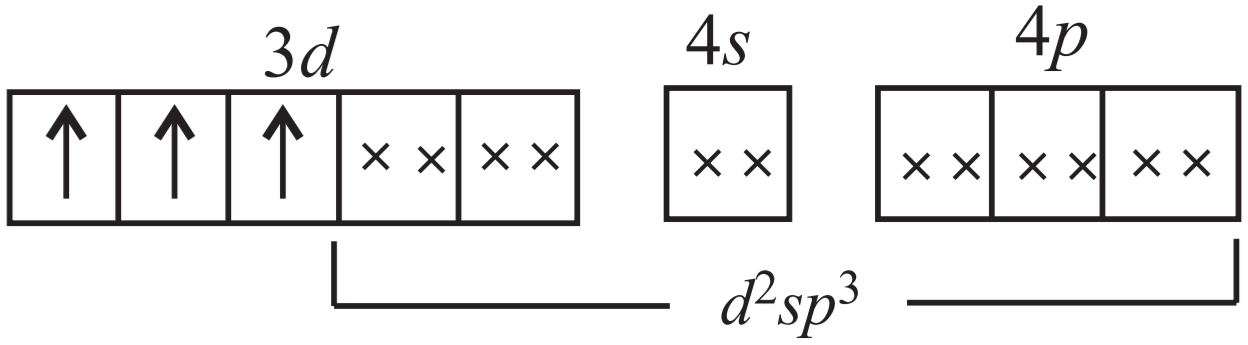
The $Cr^{3+}$ ion has three unpaired electrons. It has $d^2 sp^3$ hybridisation and it is paramagnetic. $Cr^{3+}: 3d^3$
View full question & answer→MCQ 161 Mark
In these questions, a statement of assertion followed by a statement of reason is given. Choose the correct answer out of the following choices.
Assertion: Low spin complexes have less number of unpaired electrons.
Reason: $\ce{[FeF_6]^{3-}}$ is a low spin complex.
- A
Assertion and reason both are correct statements and reason is correct explanation for assertion.
- B
Assertion and reason both are correct statements but reason is not correct explanation for assertion.
- ✓
Assertion is correct statement but reason is wrong statement.
- D
Assertion is wrong statement but reason is correct statement.
AnswerCorrect option: C. Assertion is correct statement but reason is wrong statement.
$\ce{[FeF_6]^{3-}}$ is a high spin complex since $F^-$ is a weak field ligand.
View full question & answer→MCQ 171 Mark
In these questions, a statement of assertion followed by a statement of reason is given. Choose the correct answer out of the following choices.
Assertion: The ligand $\text{N}_3^-$ is named as nitride.
Reason: $\text{N}_3^-$ is derived from $\ce{HN_3}.$
- A
Assertion and reason both are correct statements and reason is correct explanation for assertion.
- B
Assertion and reason both are correct statements but reason is not correct explanation for assertion.
- ✓
Assertion is correct statement but reason is wrong statement.
- D
Assertion is wrong statement but reason is correct statement.
AnswerCorrect option: C. Assertion is correct statement but reason is wrong statement.
$\text{N}_3^-$ is named as azido. It is derived from $HN_3.$
View full question & answer→MCQ 181 Mark
In these questions, a statement of assertion followed by a statement of reason is given. Choose the correct answer out of the following choices.
Assertion: The $\ce{[Ni(en)_3]Cl_2 }(En =$ ethylenediamine$)$ has lower stability than $\ce{[Ni(NH_3)_6]Cl_2}.$
Reason: In $\ce{[Ni(en)_3]Cl_2}$ the geometry of $Ni$ is octahedral.
- A
Assertion and reason both are correct statements and reason is correct explanation for assertion.
- B
Assertion and reason both are correct statements but reason is not correct explanation for assertion.
- C
Assertion is correct statement but reason is wrong statement.
- ✓
Assertion is wrong statement but reason is correct statement.
AnswerCorrect option: D. Assertion is wrong statement but reason is correct statement.
$\ce{[Ni(en)_3]Cl_2}$ is a chelating compound and chelated complexes are more stable than similar complexes with unidentate ligands as dissociation of the complex involves breaking of two bonds rather than one.
In $\ce{[Ni(en)_3]Cl_2, Ni}$ with $d^8$ configuration shows octahedral geometry.
View full question & answer→MCQ 191 Mark
In these questions, a statement of assertion followed by a statement of reason is given. Choose the correct answer out of the following choices.
Assertion: The second and third transition series elements have lesser tendency to fonn low spin complex as compared to the first transition series.
Reason: The $\ce{CFSE} (\Delta_0)$ is more for $5d$ and $4d.$
- A
Assertion and reason both are correct statements and reason is correct explanation for assertion.
- ✓
Assertion and reason both are correct statements but reason is not correct explanation for assertion.
- C
Assertion is correct statement but reason is wrong statement.
- D
Assertion is wrong statement but reason is correct statement.
AnswerCorrect option: B. Assertion and reason both are correct statements but reason is not correct explanation for assertion.
$4d$ and $5d$ elements have greater tendency to form low spin complex $($allows better pairing of electrons$)$ in comparison to $3d$ because the difference in energy of $t_{2g }$ and $e_g (\ce{CFSE}, \Delta_0)$ increases in $4d$ and $5d.$
View full question & answer→MCQ 201 Mark
In these questions, a statement of assertion followed by a statement of reason is given. Choose the correct answer out of the following choices.
Assertion: $\ce{[Ti(H_2O)_6]^{3+}}$ is coloured while $\ce{[Sc(H_2O)_6]^{3+}}$ is colourless.
Reason: $d - d$ transition is not possible in $\ce{[Sc(H_2O)_6]^{3+}}.$
- ✓
Assertion and reason both are correct statements and reason is correct explanation for assertion.
- B
Assertion and reason both are correct statements but reason is not correct explanation for assertion.
- C
Assertion is correct statement but reason is wrong statement.
- D
Assertion is wrong statement but reason is correct statement.
AnswerCorrect option: A. Assertion and reason both are correct statements and reason is correct explanation for assertion.
$\ce{[Sc(H_2O)_6]^{3+}}$ has no unpaired electron in its d subshell and thus $d - d$ transition is not possible whereas $\ce{[Ti(H_2O)_6]^{3+}}$ has one unpaired electron in its d-subshell which gives rise to $d - d $ transition to impart colour.
View full question & answer→MCQ 211 Mark
In these questions, a statement of assertion followed by a statement of reason is given. Choose the correct answer out of the following choices.
Assertion: $\ce{[Fe(CN)_6]^{3-}}$ has $d^2sp^3$ type hybridisation.
Reason: $\ce{[Fe(CN)_6]^{3-}}$ ion shows magnetic moment corresponding to two unpaired electrons.
- A
Assertion and reason both are correct statements and reason is correct explanation for assertion.
- B
Assertion and reason both are correct statements but reason is not correct explanation for assertion.
- C
Assertion is correct statement but reason is wrong statement.
- ✓
Assertion is wrong statement but reason is correct statement.
AnswerCorrect option: D. Assertion is wrong statement but reason is correct statement.
$\ce{[Fe(CN)_6]^{3-}}$ ion shows magnetic moment corresponding to one unpaired electron.
View full question & answer→MCQ 221 Mark
In these questions, a statement of assertion followed by a statement of reason is given. Choose the correct answer out of the following choices.
Assertion: Aqueous solution of potassium ferrocyanide does not give the test of iron $(II).$
Reason: Potassium ferrocyanide is not poisonous like potassium cyanide.
- A
Assertion and reason both are correct statements and reason is correct explanation for assertion.
- ✓
Assertion and reason both are correct statements but reason is not correct explanation for assertion.
- C
Assertion is correct statement but reason is wrong statement.
- D
Assertion is wrong statement but reason is correct statement.
AnswerCorrect option: B. Assertion and reason both are correct statements but reason is not correct explanation for assertion.
Being a complex salt, potassium ferrocyanide ionises to $4K^+$ and $\ce{[Fe(CN)_6]^{4-}}$ ions. Absence of $Fe (II)$ does not give the test of iron.
View full question & answer→