Questions

2 Marks Questions

Take a timed test

18 questions · self-marked practice — reveal the answer and mark yourself.

Question 12 Marks
Write the IUPAC name of the following :
(i) $\left[ Cu \left( H _2 O \right)_4\right]^{+2}$
(ii) $\left[ Co \left( NH _3\right)_6\right] Br _3$
(iii) $\left[ Fe ( CN )_6\right]^{3-}$
Answer
(i) Tetra aqua copper (II) ion
(ii) Hexa amine cobalt (III) bromide
(iii) Hexa cyano ferrate (III) ion.
View full question & answer
Question 22 Marks
Draw the geometry and write the configuration of the geometric iosmers of $\left[ Pt \left( H _2 O \right)_2 Br _2\right]$.
View full question & answer
Question 32 Marks
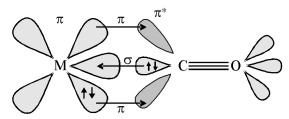
Draw the energy bond present in the carbonyl complex ?
Answer
The synergic bond in carbonyl complex is depicted as follows:
Image
View full question & answer
Question 42 Marks
(a) Examples of neutral ligands with special names.
(b) How are positive ligands named? Explain.
Answer
(a) Neutral ligands with special names are as follows $- H _2 O =$ aqua, $CS =$ thiocarbonyl, $NH _3=$ Ammine, NO $=$ Nitrosyl, CO = Carbonyl, NS = Thionitrosyl.
(b) Suffix (ium) attached at the end of the name of positive ligands.
$
\text { Example }-\stackrel{+}{N} O=\text { Nitrosilium, } \quad NH_2-\stackrel{+}{N} H_3=
$
Hydrazinium and $\stackrel{+}{ N } O _2=$ nitronium.
View full question & answer
Question 52 Marks
What is coordination isomerism? Explain.
Answer
Coordination isomerism : This isomerism occurs when there is an interchange of ligands between the cationic and anionic coordination powers of different metals present. Complex $\left[ Co \left( NH _3\right)_6\right]\left[ Cr ( CN )_6\right]$ in which $NH _3$ is bonded to $Co ^{2+}$ and $CN ^{-}$ $CN ^{-}$is bonded to $Cr ^{3+}$ whereas in its coordination isomer $\left[ Cr \left( NH _3\right)_6\right]\left[ Co \left( CN _6\right)\right], NH _3$ is bonded to $Cr ^{3+}$ and $CN ^{-}$is bonded to $Co ^{3+}$.
View full question & answer
Question 62 Marks
Explanation of ionization isomerism with example.
Answer
Ionization isomerism: When the cation present in a complex is itself a possible ligand and it forms another complex by replacing a ligand, then the complex obtained is called ionization isomerism and this property is called ionization isomerism.
Example : (i) $\left[ Co \left( NH _3\right)_5 SO _4\right] Br$ and
(ii) $\left[ Co \left( NH _3\right)_5 Br \right] SO _4$
$Br ^{-}$is obtained by absorption of (i) whereas by ionization
(ii) $SO _4{ }^{2-}$ is obtained.
View full question & answer
Question 72 Marks
Give examples and IUPAC names of the following types of complexes :
(i) Neutral complex
(ii) Negative complex
(iii) Positive complex.
Answer
(i) $Fe ( CO )_3$, Penta carbonyl iron (O).
(ii) $\left[ Co \left( NO _3\right)_6\right]^{3-}$, hexa nitrato cobaltate (III) ion.
(iii) $\left[ Pt \left( NH _3\right)_4 Cl _2\right]^{2+}$, tetra ammine dichlorido platinum
(IV) ion.
View full question & answer
Question 122 Marks
What will be the correct order for the wavelength of absorption in the visible region for the following :
$\left[ Ni \left( NO _2\right)_6\right]^{4-},\left[ Ni \left( NH _3\right)_6\right]^{2+},\left[ Ni \left( H _2 O \right)_6\right]^{2+} ?$
Answer
The order of strength in the spectrochemical series for the ligands used in the given complexes is as follows :
$H _2 O < NH _3< NO _2^{-}$
Hence, the order of absorbed light (energy) for excitation will be as follows :
$\left[ Ni \left( H _2 O \right)_6\right]^{2+}<\left[ Ni \left( NH _3\right)_6\right]^{2+}<\left[ Ni \left( NO _2\right)_6\right]^{4-}$
Hence, the order of absorbed wavelength will be the opposite of the above order because $( E = hc / \lambda)$.
$\left[ Ni \left( NO _2\right)_6\right]^{4-}<\left[ Ni \left( NH _3\right)_6\right]^{2+}<\left[ Ni \left( H _2 O \right)_6\right]^{2+}$
View full question & answer
Question 132 Marks
A solution of [Ni(H2O)6]2+ is green but a solution of [Ni(CN)4]2- is colourless. Explain.
Answer
The unpaired electrons are present in 3d8 configuration of Ni2+ present in [Ni(H2O)6]2+. H2O is a weak ligand, due to which there is no pairing of electrons and has sp3d2 hybridization.
Due to unpaired electrons, d-d transition occurs easily in this complex due to which it is coloured (green) but in [Ni(CN)4]2-, CN-- is a strong ligand due to which electrons get paired in the 3d8, configuration of Ni2+, Hence, there is no unpaired electrons in this complex due to dsp2 hybridization, hence d-d transition is not possible in it. For this reason, it is colourless.
View full question & answer
Question 142 Marks
FeSO4 solution mixed with (NH4)2SO4 solution in 1:1 molar ratio gives the test of Fe2+ ion but CuSO4 solution mixed with aqueous ammonia in 1:4 molar ratio does not give the test of Cu2+ ion. Explain why? 
Answer
By mixing FeSO4 and (NH4)2SO4 solution in 1:1 molar ratio, the binary salt $\left[ FeSO _4\left( NH _4\right)_2 SO _4 \cdot 6 H _2 O \right]$ (Moore salt) is formed which ionizes in the solution and gives Fe2+ ion. But the mixture of CuSO4 and aqueous NH3 in 1:4 molar ratio forms the complex salt  $\left[ Cu \left( NH _3\right)_4\right] SO _4$.The complex ion $\left[ Cu \left( NH _3\right)_4\right]^{2+}$ present in it is not ionized, hence it does not contain independent Cu2+ ions, and hence does not gives the test of Cu2+ ions.
View full question & answer
Question 152 Marks
$\left[ Cr \left( NH _3\right)_6\right]^{3+}$ is paramagnetic while [Ni(CN)4]2- is diamagnetic. Explain why?
Answer
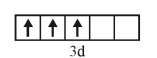
In [Cr(NH3)6]3+, Cr is in +3 oxidation state whose electronic configuration is 3d3, which has three unpaired electrons.
Image
These unpaired electrons remain present even after the hybridization (d2sp3) because only vacant d-orbitals are used in hybridization, hence [Cr(NH3)6]3+ is paramagnetic but in $\left[ Ni ( CN )_4\right]^{2-}, Ni$ is in $Ni ^{2+}$ state whose configuration is 3d8. Due to strong ligand CN-, its unpaired electrons becomes paired at the time of hybridization, hence it is diamagnetic.
View full question & answer
Question 172 Marks
What is the coordination entity formed when excess of aqueous KCN is added to an aqueous solution of copper sulphate? Why is it that no precipitate of copper sulphide is obtained when H2S(g) is passed through this solution?
Answer
Aqueous solution of copper sulphate is found in the form of [Cu(H2O)4)]2+ and on adding excess of aqueous KCN, the following complex ion is formed :
$
\left[Cu\left(H_2 O\right)_4\right]^{2+}+4 CN^{-} \rightarrow\left[Cu(CN)_4\right]^{2-}+4 H_2 O
$
$\qquad\qquad\qquad\qquad\qquad$Tetracyano cuprate (II) ion
$\qquad\qquad\qquad\qquad\qquad\qquad\qquad$ (solute)
Since, CN- is a strong ligand, it forms stable complex with Cu2+ ion. Cu2+ ion is not free in this. Therefore, when H2S gas is passed through it, CuS precipitate is not formed.
View full question & answer
Question 182 Marks
Write the geometrical isomers of [Pt(NH3)(Br)(Cl)(Py)] and how many of these will exhibit optical isomers?
Answer
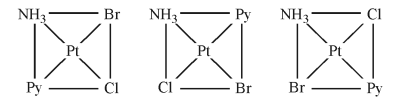
Three geometric isomers of the complex [Pt(NH3)(Br)(Cl)(Py)] are possible, out of which two are considered to be cis isomers and one is considered to be trans isomers. Their structures are as follows :
Image
This complex has a square planar geometry, hence there is no optical isomerism (polar isomerism) in it.
View full question & answer
2 Marks Questions - Chemistry STD 12 Science Questions - Vidyadip