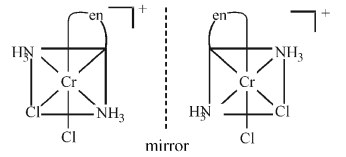
On the basis of crystal theory, octahedral in the presence of strong field ligand and weak field ligand. Explain the difference in crystal field splitting.
Explain with two examples each of the following coordination entity, ligand coordination number, coordination polyhedron, homoleptic and heteroleptic.
Answer
(i) Coordination Entity : The species in which a certain number of ions or molecules are attached to the central metal atom or ion by forming covalent bonds is called coordination entity. For example : $\left[ CoCl _3\left( NH _3\right)_3\right]$, the cobalt ion is surrounded by three NH3 molecules and three chloride ions. Other examples : $[Ni(CO)_4]$ and $\left[ Co \left( NH _3\right)_6\right]^{3+}$. (ii) Ligand : The molecules or ions attached to the central metal atom or ion in the coordination entity (complex species) are called ligands. They form covalent bonds by donating an electron pair to the metal. Example : $Cl , H _2 O$ and $NH _3$. (iii) Coordination Number (CN) : In a complex species, the number of donor atoms of the ligands bound to the metal which are directly attached to it is called the coordination number of the metal. Example : The coordination number of platinum Pt in the complex ion $\left[ PtCl _6\right]^{2-}$ is 6 and that of Ni in $\left[ Ni \left( NH _3\right)_4\right]^{2+}$ is 4. (iv) Coordination polyhedra or Coordination polyhedron : The specific arrangement in space of the ligands directly attached to the central atom in a complex species is called coordination polyhedra. Example : $\left[ Co \left( NH _3\right)_6\right]^{3+}$ is octahedral and $\left[ Ni ( CO )_4\right]$ is tetrahedral. (v) Homoleptic and heteroleptic complexes : Complexes in which the metal atom is attached only to one type of donor groups is called homoleptic complexes, and those complexes in which the metal atom is attached to more than one type of donor groups are called heteroleptic complexes. Example : $\left[ Co \left( NH _3\right)_4 Cl _2\right]^{+}$.
Write down the IUPAC name for each of the following complexes and indicate the oxidation state, electronic configuration and coordination number. Also give stereochemistry and magnetic moment of the complex : (i) $K \left[ Cr \left( H _2 O \right)_2\left( C _2 O _4\right)_2\right] \cdot 3 H _2 O$ (ii) $\left[ Co \left( NH _3\right)_5 Cl \right] Cl _2$ (iii) $\left[ CrCl _3( py )_3\right]$ (iv) $Cs \left[ FeCl _4\right]$ (v) $K _4\left[ Mn ( CN )_6\right]$
Answer
(i) $K \left[ Cr \left( H _2 O \right)_2\left( C _2 O _4\right)_2\right] \cdot 3 H _2 O$ : IUPAC name of the complex is - Potassium diaqua di-oxalate chromate (III) trihydrate. Oxidation state of metal = +3(3d3) Electronic configuration of Cr3+ = $t_{2 g}^3 e_g^0$ Coordination number of metal = 6 Geometry of the complex = Octahedral
This complex has geometric and optical isomerism. Magnetic moment $(\mu)=\sqrt{n(n+2)}$ B.M. Cr3+ = 3d3 , no. of unpaired electrons, n = 3 $\mu=\sqrt{3(3+2)}=\sqrt{15}$ B.M. $=3.87$ B.M. (ii)$\left[ CrCl _3( py )_3\right]:$ IUPAC name of the complex is-Trichloridotrispyridine chromium (III) Oxidation state of metal = +3(3d3) Electronic configuration of Cr3+= $t_{2 g}^3 e_g^0$ Coordination number of metal = 6 Geometry of the complex = Octahedral It has special type of geometric isomerism (fac and mer). $\begin{array}{r}\text {Magnetic moment} (\mu)=\sqrt{3(3+2)}=\sqrt{15}=3.87 B . M . \\ ( n =3)\end{array}$ (iii) $\left[ Co \left( NH _3\right)_5 Cl \right] Cl _2$ : IUPAC name of the complex is-Pentamine chlorido cobalt (III) chloride Oxidation state of metal = +3(3d6) Electronic configuration of Co3+$=t_{2 g}^6 e_g^0$ Coordination number of metal = 6 Geometry of the complex = Octahedral Magnetic moment $\mu$ = 0, because it has all paired electrons. (iv)$Cs \left[ FeCl _4\right]:$ IUPAC name of the complex is-Cesium tetrachlorido ferrate (III) Oxidation state of metal =
+3(3d5) Electronic configuration of $Fe ^{3+}= e _{ g }^2 t _{2 g}^3$ Coordination number of metal = 4 Geometry of the complex = Tetrahedral Magnetic moment $(\mu)=\sqrt{5(5+2)}$ $=\sqrt{35}=5.91$ B.M. $( n =5)$ (v)$K _4\left[ Mn ( CN )_6\right]:$ IUPAC name of the complex is-Potassium hexacyano manganate (II) Oxidation state of metal = +2(3d5) Electronic configuration of $Mn ^{2+}= t _{2 g}^5 e _{ g }^0$ Coordination number of metal = 6 Geometry of the complex = Octahedral Magnetic Magnetic $(\mu)=\sqrt{1(1+2)}=\sqrt{3}=1.73 BM$
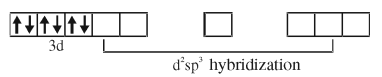
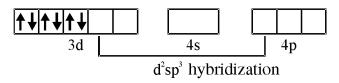
Discuss the nature of bonding in the following coordination entities on the basis of valence bond theory : (i) $\left[ Fe ( CN )_6\right]^{4-}$ (ii) $\left[ FeF _6\right]^{3-}$ (iii) $\left[ Co \left( C _2 O _4\right)_3\right]^{3-}$ (iv) $\left[ CoF _6\right]^{3-}$
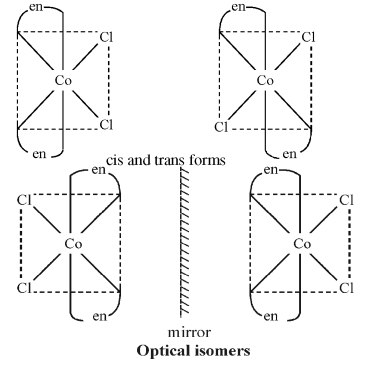
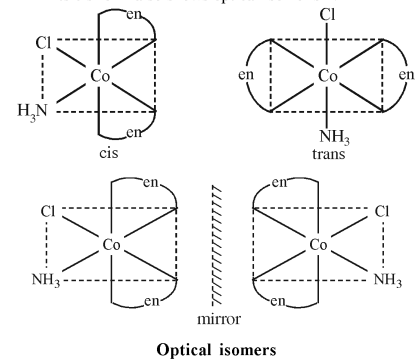
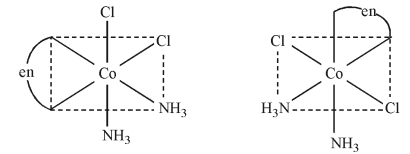
Draw all the isomers (geometrical and optical) of : (i) $\left[ CoCl _2( en )_2\right]^{+}$ (ii) $\left[ Co \left( NH _3\right) Cl ( en )_2\right]^{2+}$ (iii) $\left[ Co \left( NH _3\right)_2 Cl _2( en )\right]^{+}$
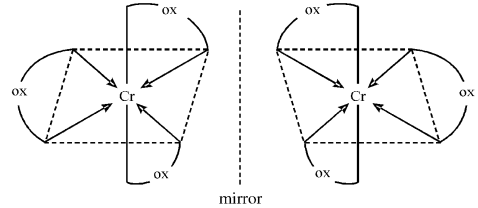
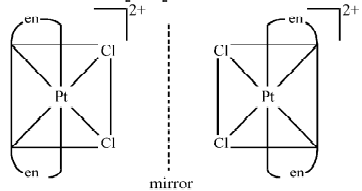
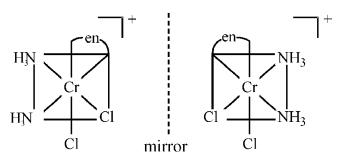
Draw the structures of optical isomers of : (i) $\left[ Cr \left( C _2 O _4\right)_3\right]^{3-}$ (ii) $\left[ PtCl _2( en )_2\right]^{2+}$ (iii) $\left[ Cr \left( NH _3\right)_2 Cl _2( en )\right]^{+}$