Question 11 Mark
A compound which liberates reddish brown gas around the anode during electrolysis in its molten state is$-$
AnswerWe know that Bromine gas is reddish brown in colour and which can only liberates during electrolysis of Lead $(II)$ bromide $(PbBr_2)$ During electrolysis of Lead $(II)$ bromide , Positive lead ions $($cations$)$ move to the cathode and gain electrons to become lead metal and negative bromide ions $($anions$)$ move to the anode and loose an electron to make chlorine atoms. Two bromine atoms then combine and the diatomic bromine gas $(Br_{2})$ is released at the anode.
View full question & answer→Question 21 Mark
How much charge in Faraday is required for the reduction of $1$ mole of $Ag^+$ to $Ag$?
AnswerAccording to the problem$:$
Let the formula required charge $n \times F$
$n =$ difference of charge on ions
$F$ is constant $= 96487C$
Here $n = 1$
Hence required charge $= 1 \times 96487C$
$= 96487C.$
View full question & answer→Question 31 Mark
A photo-cell employs photoelectric effect to convert:
Answer
- Change in the intensity of illumination into a change in photoelectric current.
Explanation:
In photoelectric effect when monochromatic radiations of suitable frequency fall on the photo-sensitive plate called cathode, the photoelectrons are emitted which get accelerated towards the anode. These electrons flow in the outer circuit resulting in the photoelectric current.
Using the incident radiations of a fixed frequency, it is found that the photoelectric current increases linearly with the intensity of incident light.
View full question & answer→Question 41 Mark
The EMF of a galvanic cell is determined by using a:
Answer
- Voltmeter.
Explanation:
EMF is measured by using a voltmeter while standard EMF by a potentiometer.
View full question & answer→Question 51 Mark
On heating, sodium and sulphur can be melted. Molten sodium and molten sulphur are used ?
Answer
- As electrodes in a modern kind of battery.
Explanation:
Molten sodium and molten sulphur are used as electrodes in modern kind of battery because of high capacity and stable cyclic performance and stability.]
They have highly active molten electrode.
Cathode typically made of molten sulphur and anode is sodium.
View full question & answer→Question 61 Mark
An apparatus used for the measurement of the quantity of electricity passed is known as a:
Answer
- Coulometer.
Explanation:
Coulometry is the technique that determines the amount of matter transformed during an electrolysis reaction, by measuring the amount of electricity (in coulombs) consumed or produced.
View full question & answer→Question 71 Mark
In a galvanic cell energy changes occur like:
Answer
- Chemical energy → electrical energy.
Explanation:
The energy conversion that takes place in a galvanic cell is an chemical to electrical change. Galvanic cells are cells that consist of two dissimilar metals in common contact with an electrolyte.
View full question & answer→Question 81 Mark
The active materials used in lead$-$acid battery are$:$
AnswerSpongy lead and lead oxide $(PbO_{2})$
View full question & answer→Question 91 Mark
Resistivity is reciprocal of ______ of an electrolyte.
Answer
- Specific conductance.
Explanation:
Resistivity is reciprocal of specific conductance (k).
View full question & answer→Question 101 Mark
The weights of various ions liberated by passing the same current through different electrolytes are in the ratio of their:
Answer
- Equivalent weights.
Explanation:
The weights of various ions liberated by passing the same current through different electrolytes are in the ratio of their Equivalent weights.
View full question & answer→Question 111 Mark
The electric charge for electrode deposition of 1g equivalent of a substance is:
Answer
- The charge on one mole of electrons.
Explanation:
The quantity of electricity required to deposit or librate 1g equivalent of any substance by the passage of electric current.
It is equal to the charge present on 1 mol of electrons. One faraday is equivalent to 96500 C.
View full question & answer→Question 121 Mark
In the electrolysis of aqueous sodium chloride solution which of the half cell reaction will occur at anode?
AnswerAt the anode, the following oxidation reactions are possible.
$\text{Cl}^-\xrightarrow{\ \ \ \ \ \ \ \ \ \ \ \ \ \ \ \ }\frac{1}{2}\text{Cl}_2(\text{g})+\text{e}^-;\ \ \ \ \text{E}^{\ominus}_{\text{Cell}}=1.36\text{V}$
$2\text{H}_2\text{O}\xrightarrow{\ \ \ \ \ \ \ \ \ \ \ \ \ \ \ \ }\text{O}_2+4\text{H}^++4\text{e}^{-};\ \ \ \ \text{E}^{\ominus}_{\text{Cell}}=1.23\text{V}$
lower value of $E^0$ is preferred and therefore, water should get oxidised in preference to $Cl^-(aq).$
However, on account of overpotential of oxygen,
reaction $\text{Cl}^-\xrightarrow{\ \ \ \ \ \ \ \ \ \ \ \ \ }\frac{1}{2}\text{Cl}_2+\text{e}^-$ is preferred.
View full question & answer→Question 131 Mark
One Faraday is equal to ___________.
Answer
- 96500 coulombs
Explanation:
The Faraday constant (named after Michael Faraday) is the magnitude of electric charge per mole of electrons. It is equal to 96500 coulombs.
View full question & answer→Question 141 Mark
What happens when an electrolysis experiment is stopped and the battery terminals are reversed?
Answer
- The electrolysis proceeds and the rate of liberation remains the same.
Explanation:
Eectrolysis chemical decomposition produced by passing an electric current through a liquid or solution containing ions.The electrolysis proceeds and the rate of liberation remains the same happens when an electrolysis experiment is stopped and the battery terminals are reversed
View full question & answer→Question 151 Mark
Rusting of iron involves:
Answer
- Oxidation
Explanation:
Rusting of iron involves oxidation.
View full question & answer→Question 161 Mark
In an electrolyte solution, current is maintained by the flow of:
Answer
- Negative and positive ions both.
Explanation:
A electrolytic solution allows the flow of ions to maintain a balance in charge between the oxidation and reduction vessels while keeping the contents of each separate. With the charge difference balanced, electrons can flow once again, and the reduction and oxidation reactions can proceed.
View full question & answer→Question 171 Mark
Lead pipes are readily corroded by:
Answer
- Acetic acid.
Explanation:
Corrosion of lead is strongly accelerated by traces of acetic acid. Acetic acid in the presence of oxygen rapidly attacks lead and produces very soluble lead(II) acetate which precludes the use of lead to process or store wine or fruit juice.
View full question & answer→Question 181 Mark
How much electricity must pass through acidulated water to release $22,400\ cm^3$ of hydrogen at $\text{N.T.P.}$?
AnswerWe know that $22,400\ cm^3$ of $H_{2}$ means $1$ mole of $H_2.$
Now, we know that $2H^++ 2e^{− }\rightarrow H_2$
Hence, for production of $1$ mole of $H_2,$ two moles of $e^−$ are required.
And, one mole of $e^−$ constitutes $96500 C$
Hence, charge or electricity required $= 96500 \times 2 = 193000 C$
View full question & answer→Question 191 Mark
An article made of an ordinary metal is desired to be coated with gold by electroplating, then gold has to be:
Answer
- Made as the anode of an electrolytic cell.
Explanation:
Electroplating is a process for coating a conductive object with a thin layer of a material, such as a metal. An electrical current is used to reduce cations of a desired material from a solution onto the object. Electroplating is primarily used for depositing a layer of material to bestow a desired property (e.g., abrasion , wear resistance, corrosion protection, lubricity, aesthetic qualities, etc.) to a surface that otherwise lacks that property. Another application uses electroplating to build up thickness on undersized parts.An article made of an ordinary metal is desired to be coated with gold by electroplating, then gold has to be made as the anode of an electrolytic cell.
View full question & answer→Question 201 Mark
Answer
- All of the above takes place.
Explanation:
The corrosion of iron is an electrochemical process. The anode region and cathode region are present in iron. Iron(II) is oxidized to Iron(III) by oxygen and is then converted to rust. At the cathode, oxygen is reduced. The electron flow is from anode to cathode through metal. This is accompanied by the flow of ions through water droplets.
View full question & answer→Question 211 Mark
In an electrochemical cell, cathode is:
Answer
- The electrode at which reduction takes place.
Explanation:
In an electrochemical cell, cathode is the electrode, at which reduction takes place and electrons are gained by some species.
Anode is the electrode, at which oxidation takes place and the electrons are lost by some species.
View full question & answer→Question 221 Mark
Electrons are getting added to an element Y. Which electrode will Y migrate to during electrolysis?
Answer
- Anode.
Explanation:
On adding electrons to Y, it will get negatively charged and hence will migrate to positive electrode that is anode.
View full question & answer→Question 231 Mark
The capacity of cell is measured in:
Answer
- Ampere-hour
Explanation:
The capacity of a cell is measured by the discharging at a constant electric current until it fully drains out for that particular time. Hence, the capacity of the cell/battery is measured by the ampere-hour rating.
View full question & answer→Question 241 Mark
Number of Faradays involved in the net reaction of Lead accumulator is __________.
Answer
- 2
Explanation:
For lead accumulator battery, the oxidation reaction at anode requires two moles of electrons. Similarly, the reduction reaction at cathode requires two moles of electrons.
View full question & answer→Question 251 Mark
Answer
- 96500 C
Explanation:
Charge of one mole of electrons is known as one faraday which is equal to 96,500 coulombs.
View full question & answer→Question 261 Mark
_________ is an application of electrolysis.
Answer
- Electrotyping.
Explanation:
Electrotyping is one of application of electrolysis, and is used for the reproduction of some craft work e.g., art work on metals, woodcarving and gramophone records etc.
An impression of the object is taken on a wax block. The wax blocks impression is then coated (sprayed) with a fine power of graphite and is made cathode in an electrolytic bath containing solution of a suitable salt e.g., copper sulfate.
The anode is made of a thin sheet of pure metal e.g., copper metal. The passage of electric current results in the deposition of copper on the wax block impression. After a reasonably thick layer of metal is obtained, the wax is removed by melting.
View full question & answer→Question 271 Mark
The secondary battery is such a battery:
Answer
- Which can be recharged.
Explanation:
A secondary battery cell is one in which chemical energy is converted into electrical energy, but they work only when they are charged by passing electric current through them by some source.
View full question & answer→Question 281 Mark
Rusting of iron is catalysed by which of the following$:$
AnswerThe rusting or iron occurs in acidic medium. Hence it is catalyzed by $H^+$ ions.
View full question & answer→Question 291 Mark
Which is not true for electrolysis:
Answer
- Electrolysis is used for manufacturing some gases and compounds.
Explanation:
Electrolysis has wide applications in industries. Some of the important applications are, as follows.
- Production of hydrogen by electrolysis of water.
- Manufacture of heavy water.
- The metals like K, Mg, Al, etc., are obtained by electrolysis of fused electrolytes.
- Non-metals like hydrogen, fluorine, chlorine are obtained by electrolysis.
- In this method pure metal is deposited at cathode from a solution containing the metal ions, etc.
- Compounds like NaOH, KOH, white lead, etc. are synthesised by electrosynthesis method.
- Electroplating: The process of coating an inferior metal with a superior metal by electrolysis is known as electroplating.
View full question & answer→Question 301 Mark
Name the gas released at the cathode when acidulated water is electrolysed.
AnswerAcidulated water is a mixture of cold water and small amount if vinegar, lemon juice or lime juice. it's just used as a soak to prevent discoloration of some fruits and vegetables that darken quikly when their cut surfaces are exposed to air. During electrolysis of acidulated water, hydrogen gas $(H_2)$ is liberated at cathode.
View full question & answer→Question 311 Mark
Answer
- Chemical energy into electrical energy.
Explanation:
A voltaic cell also known as galvanic cell is an electrochemical cell that uses spontaneous redox reactions to generate electricity. It consists of two separate half cells. Chemical energy is converted to electrical energy.
View full question & answer→Question 321 Mark
The quantity of electricity needed to liberate 0.5gram equivalent of an element is:
Answer
- 48250 coulomb
Explanation:
Electricity required, Q = No. of equiv. × 96500 coulombs
= 0.5 × 96500 = 48250 C
View full question & answer→Question 331 Mark
Which molecule electrolysis temperature is maximum?
AnswerDepend on size of element so sb is bigger size then other and $D$ is currect option.
View full question & answer→Question 341 Mark
The presence of $CO_2$ in the atmosphere results in$:$
AnswerThe presence of $CO_2$ in the atmosphere will do iron oxide rusting. When a drop of water hits an iron object, two things begin to happen almost immediately. First, the water, a good electrolyte, combines with carbon dioxide in the air to form a weak carbonic acid, an even better electrolyte. As the acid is formed and the iron dissolved, some of the water will begin to break down into its component pieces $-$ hydrogen and oxygen. The free oxygen and dissolved iron bond into iron oxide, in the process freeing electrons.
View full question & answer→Question 351 Mark
The process of lead action in a simple voltaic cell:
Answer
- Decreases the efficiency of the cell.
Explanation:
The process of lead action in a simple voltaic cell is a chemical action that occurs while the current is flowing and causes hydrogen bubbles to form on the surface of anode. The action is called polarization. Some hydrogen bubbles rise to the surface of the electrolyte and escape into the air and some remain on the surface of the anode. If enough bubbles remain around the anode, the bubbles form a barrier that increases internal resistance. When the internal resistance of the cell increases, the output current is decreased and the voltage of the cell also decreases.
View full question & answer→Question 361 Mark
One faraday of electricity will liberate one gram mole of the metal from the solution of$:$
AnswerAs only in $\ce{NaCl} \ 1e^−$ is involved.
View full question & answer→Question 371 Mark
As dilution of the solution increases then the conductivity of solution ___________.
Answer
- Increases.
Explanation:
The conductivity of a weak electrolyte increases with an increase dilution. As the dilution increases the number of ion increases and they get free from their co-ions and can move independently from each other. So by increasing dilution the rate of conductivity increases as more ions are available for conductance.
View full question & answer→Question 381 Mark
$6.24 \times 10^{19}$ electrons is equal approximately to$:$
AnswerSince $ 6.24 \times 10^{18}$ electrons $= 1$ coulomb
$\therefore 6.24 \times 10^{19}$ electrons $= 10$ coulomb
$\Big(\frac{6.24\times10^{19}}{6.24\times10^{18}}\Big)$
View full question & answer→Question 391 Mark
The tarnishing of silver ornaments in the atmosphere is due to the formation of$:$
AnswerIn the air, a silver object tarnishes owing to the reaction of silver with hydrogen sulfide and oxygen.Reaction$:$
$\ce{Ag +}$ air$\ce{(O_2 + H_2S) \rightarrow Ag_2O + Ag_2S}$
View full question & answer→Question 401 Mark
Answer
- The magnitude of the charge of 1 mole of electrons.
Explanation:
The Faraday constant represents the amount of electric charge carried by one mole, or Avogadro's number, of electrons.
View full question & answer→Question 411 Mark
Which of these metals do not corrode?
Answer
- Platinum
Explanation:
Corrosion is a process through which metals in manufactured states return to their natural oxidation states. This process is a reduction-oxidation reaction in which the metal is being oxidized by its surroundings, often the oxygen in air. As platinum is least reactive so it will not corrode.
View full question & answer→Question 421 Mark
Corrosion can not be prevented by which of the following method?
Answer
- Exposing it to sunlight.
Explanation:
Corrosion can be prevented by creating a barrier between the object and oxygen. Galvanisation is a process to prevent corrosion and so is painting. However, exposing to sunlight is not a method to prevent corrosion.
View full question & answer→Question 431 Mark
In a galvanic cell, the reactions taking place in the anodic half cell and the cathodic half cell will be$:$
AnswerIn a galvanic cell in anode half cell, oxidation of $Zn$ takes place and in cathodic half cell $Cu^{2t}$ gets reduced.
View full question & answer→Question 441 Mark
Corrosion is $a/ an:$
AnswerHint$:$ Corrosion is the oxidation of metal by moist air, often unwanted.
Corrosion is an electrochemical change. A highly reactive metal $($easily oxidisable$)$ is oxidised in the anodic reaction $M^{x+}+ xe^{− }\rightarrow M.$
Highly reactive metals are more easily corroded unless they form a protective oxide layer around them on oxidation which prevents further oxidation. Noble metals like $Pt$ are not easily corroded.
View full question & answer→Question 451 Mark
________ can be obtained from bauxite by ______.
Answer
- Aluminium, Electrolysis.
Explanation:
Aluminium can be obtained from bauxite by Electrolysis. Bauxite is ore of Aluminium and Electrolysis is done to purify aluminium.
View full question & answer→Question 461 Mark
The amount of ions discharged during electrolysis is directly proportional to:
Answer
- Chemical equivalent of ion.
Explanation:
According to Faraday's first law of electrolysis, the amount (W) of an ion discharged i.e., (oxidized or reduced) at either electrode during electrolysis is directly proportional to the quantity of charge passed through the electrolyte. i.e,
W α Q
W α i t
W = z. i. t
Here Q = total charge (electricity) passed through the solution.
i = current in ampere.
t = time for which current flows in seconds.
z = electrochemical equivalent of ion.
View full question & answer→Question 471 Mark
An acid is a substance that produces ............. ions in a water solution:
Answer
- Hydrogen.
Explanation:
Solutions of acids and bases produce some ions that can carry electric current, so they are said to be electrolytes. Acids contain at least one hydrogen atom that can be removed when the acid is dissolved in water. An acid is a substance that produces hydrogen ions in a water solution. When an acid dissolves in water, hydrogen ions interact with water to form hydronium ions.
The strength of an acid or base depends on how many acid or base particles dissociate into ions in water. When a strong acid dissolves in water all molecules ionize into ions. When a weak acid dissolves in water a small fraction dissolve in water.
View full question & answer→Question 481 Mark
The magnitude of charge present on one azide ion in coulombs is$:$
AnswerThe charge of one electron is $-1.602 \times 10^{−19} C.$
The azide ion $\text{N}^-_3$ has unit negative charge which is equal to the charge on one electron.
Hence, the magnitude of charge on one azide ion is equal to $1.602 \times 10^{−19} C.$
View full question & answer→Question 491 Mark
What transformation of energy takes place when current is drawn from a cell ?
Answer
- Chemical energy changes to electrical energy.
Explanation:
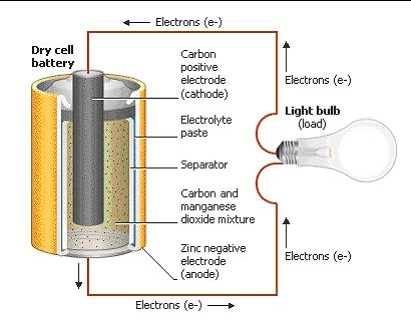
An electric battery is a device consisting of one or more electrochemical cells that convert stored chemical energy into electrical energy. Each cell contains a positive terminal, or cathode, and a negative terminal, or anode. Electrolytes allow ions to move between the electrodes and terminals, which allows current to flow out of the battery to perform work.
Cell convert chemical energy directly to electrical energy. Redox reactions power the battery. Cations are reduced (electrons are added) at the cathode during charging, while anions are oxidized (electrons are removed) at the anode during discharge. The electrodes do not touch each other, but are electrically connected by the electrolyte.
A separator allows ions to flow between electrodes, but prevents mixing of the electrolytes.
The voltage developed across a cell's terminals depends on the energy release of the chemical reactions of its electrodes and electrolyte.
View full question & answer→Question 501 Mark
While charging the lead storage battery $........$
AnswerWhile charging the lead storage battery the reaction occurring on cell is reversed and $\ce{PbSO_4(s)}$ on anode and cathode is converted into $Pb$ and $Pb0_2$ respectively.
Hence, option $(i)$ is the correct choice The electrode reactions are as follows$:$
At cathode $\text{PbSO}_4(\text{s})+2\text{e}^{-}\xrightarrow{\ \ \ \ \ \ \ \ \ \ \ \ \ }\text{Pb}(\text{s})+\text{SO}^{2-}_4(\text{aq})(\text{Reduction})$
At anode $\text{PbSO}_4(\text{s})+2\text{H}_2\text{O}\xrightarrow{\ \ \ \ \ \ \ \ \ \ \ \ \ \ }\text{PbO}_2(\text{s})+\text{SO}^{2-}_4+4\text{H}^{+}+2\text{e}^{-}(\text{Oxidation})$
Overall reaction $2\text{PbSO}_4(\text{s})+2\text{H}_2\text{O}\xrightarrow{\ \ \ \ \ \ \ \ \ \ \ \ \ \ }\text{Pb}(\text{s})+\text{PbO}_2(\text{s})+4\text{H}^+(\text{aq.})+2\text{SO}^{2-}_4(\text{aq.})$
View full question & answer→Question 511 Mark
Ammonium chloride used in dry cell acts as
Answer
- Electrolyte
Explanation:
A dry cell is a type of battery, commonly used for portable electrical devices.A standard dry cell comprises a zinc anode, usually in the form of a cylindrical pot, with a carbon cathode in the form of a central rod. The electrolyte is ammonium chloride in the form of a paste next to the zinc anode.Ammonium chloride is a strong electrolyte. In dry cell, the electrolyte ammonium chloride forms ammonium ion and chloride ions.
View full question & answer→Question 521 Mark
What will happen during the electrolysis of aqueous solution of $CuSO_4$ by using platinum electrodes?
AnswerDuring electrolysis following reaction takes place at cathode,
$\text{Cu}^{2+}+2\text{e}^-\xrightarrow{\ \ \ \ \ \ \ \ \ \ }\text{Cu}$
$\text{H}^++\text{e}^-\xrightarrow{\ \ \ \ \ \ \ \ \ \ \ }\frac{1}{2}\text{H}_2$
Standard electrode potential of $Cu^{2+}/Cu$ is greater than $\text{H}^{+}/\frac{1}{2}\text{H}_2$
therefore $Cu$ will deposite at cathode.
View full question & answer→Question 531 Mark
A half cell reaction is one which:
Answer
- Takes place at one electrode.
Explanation:
In an electrochemical cell, a redox reaction occurs. Oxidation occurs at one electrode and reduction occurs at another electrode. The reaction occuring at each electrode is known as half cell reaction.
View full question & answer→Question 541 Mark
______ ionizes in fused or in aqueous solution state and furnish ions in solution.
Answer
- Bases.
Explanation:
Bases ionizes in fused or in aqueous solution state and furnish ions in solution.
View full question & answer→Question 551 Mark
Identify the false statement among the following:
Answer
- Deposition of metals takes place in both electrolytic cell and galvanic cell.
Explanation:
Oxidation takes place at anode and reduction at cathode. In electrolytic cell anode is positive and anode positive. In voltaic cell, anode is negative.
Metal deposition takes place in electrolytic cell only.
Direction of current is always cathode to anode in electrolytic cell.
View full question & answer→Question 561 Mark
During the process of electrolysis of water, dilute sulphuric acid splits into:
Answer
- None of these.
Explanation:
During the process of electrolysis of water, dilute sulphuric acid splits into when electricity is passed through the dilute sulfuric acid solution. The electrolyte is dilute sulfuric acid (= acidified water) which, during electrolysis is split into hydrogen and oxygen gases.
View full question & answer→Question 571 Mark
In which of the following the corrosion of iron will be most rapid?
Answer
- In air and saline water.
Explanation:
The corrosion of iron indicates a chemical change in the metal. Rust (hydrous oxide) is an example of this change that results when the iron is exposed to water or damp air. A thin film of oxide forms on the iron; this actually protects the metal from further corrosion by slowing the rate of oxidation. Where salt is present, electrochemical corrosion occurs, and the protective oxide film does not form, thus the corrosion (buildup of rust) continues unchecked. Hence corrosion is faster in saline water.
View full question & answer→Question 581 Mark
Using the data given below find out the strongest reducing agent.
$\text{E}^\ominus_{\text{cr}_2\text{O}^{2-}_7/\text{cr}^{3+}}=1.33\text{V}\ \ \ \text{E}^\ominus_{\text{Cl}_2/\text{Cl}^-}=1.36\text{V}$
$\text{E}^\ominus_{\text{MnO}^-_4/\text{Mn}^{2+}}=1.51\text{V}\ \ \ \ \text{E}^\ominus_{\text{Cr}^{3+}/\text{Cr}}=-0.74\text{V}$
AnswerA negative value of standard reduction potential for $Cr^{3+}$ to $Cr$ means that the redox couple is a stronger reducing agent.
View full question & answer→Question 591 Mark
The compounds which decompose on passage of an electric current through them are known as:
Answer
- Electrolytes.
Explanation:
The compounds which decompose on passage of an electric current through them are known as electrolytes. e.g water, strong acids, strong bases.
View full question & answer→Question 601 Mark
The quantity of charge required to obtain one mole of aluminium from $\ce{Al_2O_3}$ is $.........$
Answer$\text{Al}_2\text{O}_3\xrightarrow{\ \ \ \ \ \ \ \ \ }2\text{Al}^{3+}+3\text{O}^{2-}$
$\text{Al}^{3-}+3\text{e}^{-}\xrightarrow{\ \ \ \ \ \ \ \ \ }\text{Al}(\text{for 1 mole})$
$3F$ charge is required to obtain $1$ mole $Al$ from $\ce{Al_2O_{3.}}$
View full question & answer→Question 611 Mark
What will happen during the electrolysis of aqueous solution of $CuSO_4$ in the presence of $Cu$ electrodes?
AnswerElectrolysis of $CuSO_4$ can be represented by two half$-$cell reactions these occurring at cathode and anode respectively as,
At cathode$: \text{Cu}^{2+}+2\text{e}^-\xrightarrow{\ \ \ \ \ \ \ \ \ \ }\text{Cu(s)}$
At anode$: \text{Cu(s)}\xrightarrow{\ \ \ \ \ \ \ \ \ \ }\text{Cu}^{2+}+2\text{e}^-$
Here, $Cu$ will deposit at cathode while copper will dissolved at anode.
Hence, options $(i)$ and $(ii)$ are the correct choices.
View full question & answer→Question 621 Mark
Selenium has the unusual property of being a good conductor in light but a poor conductor in the dark. It was, therefore, used in making.
Answer
- Photo-electric cells.
Explanation:
Since, selenium is a good conductor of electricity in light, but poor conductor in dark.
It is used in photo- electric cells.
Since, photocell is an electronic device which works on the principle of photo electric effect and convert light energy into electrical energy.
View full question & answer→Question 631 Mark
Use the data given in and find out the most stable ion in its reduced form.
$\text{E}^\ominus_{\text{cr}_2\text{O}^{2-}_7/\text{cr}^{3+}}=1.33\text{V}\ \ \ \text{E}^\ominus_{\text{Cl}_2/\text{Cl}^-}=1.36\text{V}$
$\text{E}^\ominus_{\text{MnO}^-_4/\text{Mn}^{2+}}=1.51\text{V}\ \ \ \ \text{E}^\ominus_{\text{Cr}^{3+}/\text{Cr}}=-0.74\text{V}$
Answer$Mn^{2+}$ is most stale in its reduced form due to highest $E^0$ value.
View full question & answer→Question 641 Mark
The current inside a copper voltameter?
Answer
- Is the same as the outside value.
Explanation:
The current inside a copper voltameter is the same as the outside value.An electric current is a flow of electric charge. In electric circuits this charge is often carried by moving electrons in a wire. It can also be carried by ions in an electrolyte, or by both ions and electrons such as in an ionised gas (plasma).Electric current is measured using a device called an ammeter.
View full question & answer→Question 651 Mark
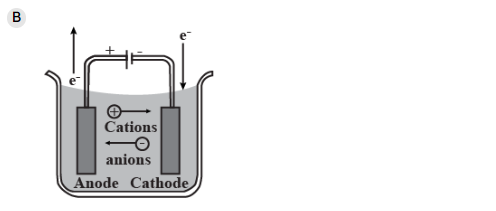
Schematic diagram of an electrolytic-cell is:
Answer
Explanation:
In an electrolytic cell cations move towards cathode and anions move towards anode. In the external circuit, current flows from anode to cathode.
View full question & answer→Question 661 Mark
The ZnCl used in a dry cell is which helps to maintain the moistness of paste contained in the cell between anode and cathode is:
Answer
- Highly hydroscopic.
Explanation:
The Zinc used in dry cell is which helps to maintain the moistness of paste contained in the cell between anode and cathode is highly hygroscopic.
View full question & answer→Question 671 Mark
In the rusting of iron, iron has been$:$
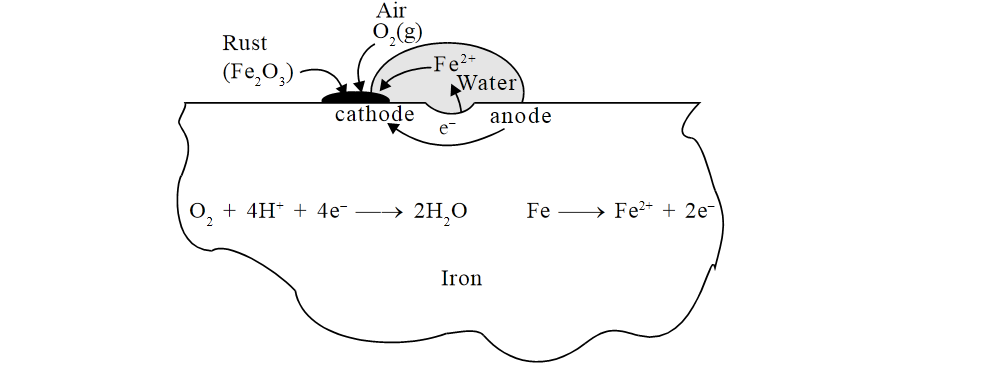
AnswerIn corrosion, metal is oxidised by loss of electrons to oxygen to form metal oxide. In rusting of iron, at one spot of the iron object oxidation occurs and that spot behaves as an anode.
Anode$:Fe(s) \rightarrow Fe^{2+ }(aq) + 2e^−$
Cathode$: 4e^{- }+ 4H^+(aq) + O_2(aq) \rightarrow 2H_2O(l)$
View full question & answer→Question 681 Mark
In a dry cell $.........$ containing a moist paste of plaster of Paris, $\ce{NH_{4}Cl}$ and $\ce{ZnCl}$ acts as
AnswerDry$-$cell batteries consist of a zinc chloride paste which allow a dry$-$cell to$ ... $with moist paste of ammonium chloride $(NH_{4}Cl)$ where $ZnCl_2$ acts as Zinc vessel, Cathode. an electrolyte.
A dry cell is a type of battery, commonly used for portable electrical devices.
A standard dry cell comprises a zinc anode, usually in the form of a cylindrical pot, with a carbon cathode in the form of a central rod.
The electrolyte is ammonium chloride in the form of a paste next to the zinc anode.
View full question & answer→Question 691 Mark
$\text{E}^{\ominus}_{\text{Cell}}$ for some half cell reactions are given below. On the basis of these mark the correct answer.
- $\text{H}^+(\text{aq})+\text{e}^-\xrightarrow{\ \ \ \ \ \ \ \ \ \ \ \ \ }\frac{1}{2}\text{H}_2(\text{g});\ \ \ \ \ \text{E}^\ominus_{\text{Cell}}=0.00\text{V}$
- $2\text{H}_2\text{O}_{(\text{l})}\xrightarrow{\ \ \ \ \ \ \ \ \ \ \ \ \ \ }\text{O}_{2(\text{g})}+4\text{H}^{+}_{(\text{aq})}+4\text{e}^-;\ \ \ \ \ \text{E}^0_{\text{Cell}}=1.23\text{V}$
- $2\text{SO}^{2-}_{4(\text{aq})}\xrightarrow{\ \ \ \ \ \ \ \ \ \ \ \ \ }\text{S}_2\text{O}^{2-}_{8(\text{aq})}+2\text{e}^-;\ \ \ \ \ \text{E}^0_{\text{cell}}=1.96\text{V}$
AnswerIn dilute sulphuric acid solution, hydrogen will be reduced at cathode,
$\text{H}^++\text{e}^-\xrightarrow{\ \ \ \ \ \ \ \ \ }\frac{1}{2}\text{H}_2$
and $H_2O$ is oxidized at anode.
$2\text{H}_2\text{O}\xrightarrow{\ \ \ \ \ \ \ \ \ }\text{O}_2+4\text{H}^++4\text{e}^-$
While in concentrated solution of sulphuric acid, $SO^{-2}$ ions are oxidized to tetrathionate $(SO_2)$ ions.
View full question & answer→Question 701 Mark
The process in which chemical change occurs on passing electricity is termed as __________.
Answer
- Electrolysis.
Explanation:
Electrolysis is a process by which electric current is passed through a substance to effect a chemical change i.e oxidation or reduction of a substance.
View full question & answer→Question 711 Mark
Corrosion of metals can be prevented when contact between metal and .......... is cut off.
Answer
- Oxygen
Explanation:
Corrosion of the metal can be prevented if the contact between metal and air is cut of.
View full question & answer→Question 721 Mark
The following factors play vital role in corrosion process:
Question 731 Mark
The cell constant of a conductivity cell ___________.
Answer
- Remains constant for a cell.
Explanation:
The cell constant of a conductivity cell (i) remains constant for a cell.
View full question & answer→Question 741 Mark
Answer
- Positive ions move toward the negative electrode and negative ions toward the positive electrode.
Explanation:
The process in which electrical current is passed through a substance to effect a chemical change. The chemical change is one in which the substance loses or gains an electron (oxidation or reduction) is called electrolysis.
The process is carried out in an electrolytic cell, an apparatus consisting of positive and negative electrodes held apart and dipped into a solution containing positively and negatively charged ions. In this process, positive ions move toward the negative electrode and negative ions toward the positive electrode.
View full question & answer→Question 751 Mark
In an electrolytic cell cathode acts as:
Answer
- Reducing agent.
Explanation:
At cathode reduction occurs, therefore, cathode acts as a reducing agent by supplying electrons.
View full question & answer→Question 761 Mark
Which cell will measure standard electrode potential of copper electrode?
AnswerWhen copper electrode is connected to standard hydrogen electrode, it acts as cathode and its standard electrode potential can be measured.
$\text{E}^0=\text{E}^0_\text{R}-\text{E}^0_\text{L}=\text{E}^0_\text{R}-0=\text{E}^0_\text{R}$
$\text{Pt}(\text{s})\big|\text{H}_2(\text{g},1\text{ bar})\big|\text{H}^+(\text{aq}.1\text{M})\big|\big|\text{Cu}^{2+}(\text{aq.1})\text{M}\big|\text{Cu}$ will measure standard electrode potential of copper electrode.
To calculate the standard electrode potential of the given cell it is coupled with the standard hydrogen electrode in which pressure of hydrogen gas is one bar and the cone, of $H^+$ ion in the solution is one molar and also the concentrations of the oxidized and the reduced forms of the species in the right hand half-cell are unity.
View full question & answer→Question 771 Mark
Zinc corrodes in ____________________.
Answer
- 2M acid solution.
Explanation:
Corrosion requires an acidic medium. Hence zinc corrodes in 2M acid solution.
View full question & answer→Question 781 Mark
The most common industrial application of chemical effects of electric current is:
Answer
- Electroplating.
Explanation:
The process of depositing a layer of any desired metal on another material by means of electricity is called electroplating. It is one of the most common applications of chemical effects of electric current.
Electroplating is a very useful process. It is widely used in industry for coating metal objects with a thin layer of a different metal.
View full question & answer→Question 791 Mark
In the atmosphere of industrial smog, copper corrodes to form:
Answer
- Basic copper carbonate and sulphate.
Explanation:
Architectural structures built with copper corrode to give green verdigris (copper carbonate). It can be a mixture of carbonate and sulfate compounds in various amounts, depending upon environmental conditions such as sulfur-containing acid rain.
View full question & answer→Question 801 Mark
$\wedge^{{\circ}}_{\text{m}(\text{NH}_4\text{OH})}$ is equal to $........$
AnswerSince we require only sum of molar conductivity of $NH_4^{+}$ and $OH^-$
View full question & answer→Question 811 Mark
On electrolysis, water splits into$:$
AnswerElectrolysis of water$: \ce{H_2O \rightarrow 2H^{+ } + O^{−2}}$
On electrolysis, water splits up into its constituent ions as positively charged $H^{+ }$ ions and negatively charged $O^{−2}$ ions.
View full question & answer→Question 821 Mark
The internal resistance of a lead acid battery can be reduced by:
Question 831 Mark
When a corroded metal object is rubbed by a sand paper then:
Answer
- Outer corroded layer will be removed.
Explanation:
The metals lose their shine and become dull when exposed to air for a long time. Due to the formation of oxides, when the surface is rubbed by a sand paper, then the outer corroded layer is removed.
View full question & answer→Question 841 Mark
The amount of charge carried by $M^{3−}$ ion is$:$
AnswerCharge of $e^{− }= 1.60 \times 10^{−19}C$
Charge on $M^{3− }= 3 \times 1.6 \times 10^{−19}C$
$ = 4.8 \times 10^{−19}C$
View full question & answer→Question 851 Mark
In the electrolytic cell, flow of electrons is from:
Answer
- Cathode to anode through internal supply.
Explanation:
Hint: Electrons flow from the negative to a positive end.
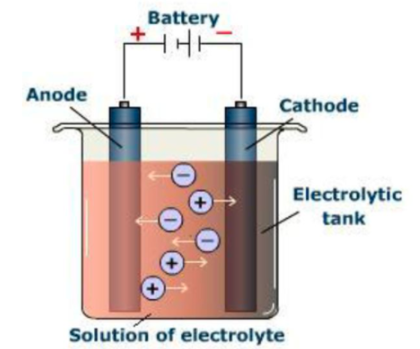
Step 1: A cell in which Electrical energy is used to cause a non-spontaneous oxidation and reduction reaction is called an Electrolytic cell.
The electrolytic cell requires an energy input to proceed.
Step 2: Electrolytic cell contains three parts Cathode, Anode, and electrolyte.
Positive electrode is called anode.
Negative electrode is called Cathode.
An electrolyte is a substance in an aqueous or molten form that dissociates into ions and conducts electricity.
In a electrolytic cell, electrons are transferred from cathode to anode through internal supply.
View full question & answer→Question 861 Mark
The decomposition of chemical compound in the aqueous or fused state by passing direct electric current is known as:
Answer
- Electrolysis
Explanation:
The decomposition of chemical compound in the aqueous or fused state by passing direct electric current is known as electrolysis.
View full question & answer→Question 871 Mark
Lead acid cell and alkalic cells are:
Question 881 Mark
1In electro-chemical corrosion of metals, the metal undergoing corrosion:
Answer
- Becomes anode.
Explanation:
During corrosion, the oxidation of metal to metal ions occur. Hence the metal undergoing corrosion acts as anode.
View full question & answer→Question 891 Mark
Negative terminal of a dry cell is formed by:
Answer
- Zinc container.
Explanation:
The dry cell consists of Zinc container which acts as anode and the cathode is a carbon (graphite) rod.
View full question & answer→Question 901 Mark
The process used to decompose compounds using electric current is called :
Answer
- Electrolysis.
Explanation:
The process used to decompose compounds using electric current is called electrolysis.
View full question & answer→Question 911 Mark
Which of the following is not true?
Answer
- Effect of dilution on conductance of strong electrolyte can be explained by Arrhenius theory.
View full question & answer→Question 921 Mark
Tin cans, used for storing food are made by electroplating:
Answer
- Tin onto iron.
Explanation:
Tin cans, used for storing food, are made by electroplating tin onto iron. Tin is less reactive than iron. Thus, food does not come into contact with iron and
is protected from getting spoilt.
View full question & answer→Question 931 Mark
$\wedge^{{\circ}}_\text{m}\text{H}_2\text{O}$ is equal to $.......$
Answer$\wedge^{{\circ}}_{\text{m}(\text{H}_2\text{O)}}=\wedge^{{\circ}}_{\text{m}(\text{HCl})}+\wedge^{{\circ}}_{\text{m}(\text{NaOH})}-\wedge^{{\circ}}_{\text{m}(\text{NaCl})}$
$\wedge^{{\circ}}_{\text{m}(\text{H}^+)}+\wedge^{{\circ}}_{\text{m}(\text{OH}^-)}=\wedge^{{\circ}}_{\text{m}(\text{H}^+)}+\wedge^{{\circ}}_{\text{m}(\text{cl}^-)}+\wedge^{{\circ}}_{\text{m}(\text{Na}^+)}+\wedge^{{\circ}}_{\text{m}(\text{OH}^-)}-\wedge^{{\circ}}_{\text{m}(\text{Na}^+)}-\wedge^{{\circ}}_{\text{m}(\text{cl}^-)}$
$\wedge^{{\circ}}_{\text{m}(\text{HNO}_3)}+\wedge^{{\circ}}_{\text{m}(\text{NaOH})}-\wedge^{{\circ}}_{\text{m}(\text{NaNO}_3)}=\wedge^{{\circ}}_{\text{m}(\text{H}_2\text{O})}$
$\wedge^{{\circ}}_{\text{m}(\text{H}^+)}+\wedge^{{\circ}}_{\text{m}(\text{NO}^-_3)}+\wedge^{{\circ}}_{\text{m}(\text{Na}^+)}+\wedge^{{\circ}}_{\text{m}(0\text{H}^-)}-\wedge^{{\circ}}_{\text{m}(\text{Na}^+)}-\wedge^{{\circ}}_{\text{m}(\text{NO}^-_3)}=\wedge^{{\circ}}_{\text{m}(\text{H}^+)}+\wedge^{{\circ}}_{\text{m}(\text{OH}^-)}$
$\wedge^{{\circ}}_{\text{m}(\text{NH}_4\text{OH})}+\wedge^{{\circ}}_{\text{m}(\text{HCl})}-\wedge^{{\circ}}_{\text{m}(\text{NH}_4\text{Cl})}=\wedge^{{\circ}}_{\text{m}(\text{H}_2\text{0})}$
However, the sum of molar conductivities of constituent ions gives the molar conductivity of water but here $\ce{NH_4OH}$ is a weak electrolyte of which complete decomposition is not possible.
View full question & answer→Question 941 Mark
An electrochemical cell can behave like an electrolytic cell when ____________.
Answer
- $\text{E}_\text{ext}>\text{E}_{\text{Cell}}$
Explanation:
If an external opposite potential is applied on the galvanic cell and increased reaction continues to take place till the opposing voltage reaches the value 1.1V.
At this stage no current flow through the cell and if there is any further increase in the external potential then reaction starts functioning in opposite direction.
Hence, this works as an electrolytic cell. View full question & answer→Question 951 Mark
Internal resistance of a battery cell increases with:
Answer
- Increase in distance between two electrodes.
Explanation:
Internal resistance of a battery cell:
- increases with increase in distance between two electrodes.
- decreases with increase in concentration of electrolyte.
- decreases with increase in area of the plate inside the electrolyte.
- decreases with increase in size of the electrodes.
View full question & answer→Question 961 Mark
The electric charge for electrode deposition of 1g equivalent of a substance is:
Answer
- charge on 1 mole of electrons.
Explanation:
Charge on one mole of electrons is equal to one Faraday, so one gram equivalent of a substance will be deposited by one mole of electrons. 1g equivalent of a substance means one equivalent of substance which have total charge of one mole of electron.
View full question & answer→Question 971 Mark
Which of the following statement is not correct about an inert electrode in a cell?
Answer
- It provides surface for redox reaction.
Explanation:
Inert electrode does not participate in redox reaction and acts only as source or sink for electrons. It provides surface either for oxidation or for reduction reaction.
View full question & answer→Question 981 Mark
Rusting of iron is a chemical reaction. The reaction can be termed as$:$
AnswerRusting of iron is a combination reaction. It occurs as follows$-$
$\ce{Fe + H_2O + O_2 \rightarrow Fe_2O_{3 }\times H_2O}$
View full question & answer→Question 991 Mark
A metal is released in the electrolysis of a salt. It gets deposited on the $:$
AnswerThe metal which is released in the electrolysis is of simple salt, so it would generally be deposited on the cathode.
For example, suppose we take sodium chloride $\ce{(NaCl)}$ then on breaking this into simpler form we get,
$\ce{NaCl \rightarrow Na^+ + Cl^-}$
This can be said that as Na acquires positive charge, it shall move to negative electrode $($or negative terminal$)$ i.e. cathode.
View full question & answer→Question 1001 Mark
Maintenance-free batteries, now in use, in place of common batteries, have:
Answer
- Electrodes made of calcium-containing lead alloy.
Explanation:
Calcium-tin-lead alloys are used for making grids for maintenance-free batteries. The calcium content in such alloys for positive grids has varied generally from about 0.06 to about 0.1% by weight of the alloy while the tin has generally ranged from about 0.1 up to 0.8% and even more. More typically, the calcium content in such alloys when used for making maintenance-free battery grids has been at least about 0.08% by weight or more.
View full question & answer→Question 1011 Mark
The process of breaking down of a compound by passing electric current through it is called:
Answer
- Electrolysis
Explanation:
Electrolysis is chemical decomposition produced by passing electric current through a liquid or solution containing ions.
View full question & answer→Question 1021 Mark
The factors that promote electro chemical corrosion are _____________.
Answer
- All the above.
Explanation:
Pure metals are resistive to corrosion. If there are impurities in a metal, a local galvanic cell is created with the metal as an anode and the impurity as a cathode. The result is the corrosion of the metal. And in the presence of a high concentration of oxygen, corrosion will be faster. Also when the conductivity of solutions is higher, the corrosion will be faster.
View full question & answer→Question 1031 Mark
An example of secondary battery cell is:
Answer
- Edison Alkaline cell.
Explanation:
Voltiac cell, daniel cell, Lachanche cell, Bunsen cell, fuel are some well known example of primary battery cells. Whereas, lead acid cell and edison alkaline cell are two well known example of secondary cells.
View full question & answer→Question 1041 Mark
Answer
- Positively charged electrode.
Explanation:
An Anode is a positively charged electrode through which conventional current flows in a circuit.
View full question & answer→Question 1051 Mark
The passage of electricity in the Daniell cell when Zn and Cu electrodes are connected:
Answer
- From Cu to Zn outside the cell.
View full question & answer→Question 1061 Mark
When copper rod donates electrons to hydrogen ions, it gains ................. charge.
Answer
- Positie.
Explanation:
We know that when an atom donates electrons, the atom becomes positive charge and when the atom receives the electrons, it becomes negative charge.
View full question & answer→Question 1071 Mark
The difference between the electrode potentials of two electrodes when no current is drawn through the cell is called ___________.
Answer
- Cell emf.
Explanation:
EMF is the difference between the electrode potentials of two electrodes. when no current is drawn through the cell.
View full question & answer→Question 1081 Mark
Molar conductivity of ionic solution depends on ___________.
Answer
- Temperature.
- Concentration of electrolytes in solution.
Explanation:
Molar conductivity of ionic solution depends on temperature and concentration of electrolytes in solution.
View full question & answer→Question 1091 Mark
Primary battery is a battery:
Answer
- which cannot be recharged.
Explanation:
It is an electrochemical cell which acts as a source of electrical energy without being previously charged up by an electric current from an external source of current.
In which electrode reactions cannot be reversed by an external source.
These are not chargeable.
View full question & answer→Question 1101 Mark
According to the electrochemical concept, corrosion occurs at$:$
AnswerCorrosion can be defined as the deterioration of materials by chemical processes. Of these, the most important by far is electrochemical corrosion of metals in which the oxidation process $\ce{M \rightarrow M^{+ } + e^−}$ is facilitated by the presence of a suitable electron acceptor. This is possible because metals are conductive and so, the electrons can flow through the metal from the anodic to the cathodic regions.
Metallic corrosion occurs when metal atoms are oxidized and subsequently leave the metal lattice as ions. The oxidation reaction of the metal is referred to as the anodic half$-$reaction. The areas on a metal surface where oxidation occurs are referred to as anodes.
View full question & answer→Question 1111 Mark
Aluminium is more reactive than iron. But aluminium is less easily corroded than iron because:
Answer
- Oxygen forms a protective oxide layer on aluminium surface.
Explanation:
Corrosion resistance of aluminium is due to formation of thin layer of aluminium oxide that forms when metal is exposed to air and prevents further oxidation. It is called as protective passivation.
View full question & answer→Question 1121 Mark
During electroplating by electrolysis, the article to be electroplated is:
Answer
- Made the cathode of an electrolytic cell.
Explanation:
During electroplating by electrolysis, the article to be electroplated as made the cathode of an electrolytic cell.
View full question & answer→Question 1131 Mark
When iron is rusted, it is:
Answer
- Oxidised.
Explanation:
View full question & answer→Question 1141 Mark
The internal resistance of a dry cell is of the order of:
Answer
- 0.2 to 0.4 Ohm.
Explanation:
In dry-cell battery, the electrolyte is in the form of a paste. And there is no presence of nickel and iron material. Due to that, the internal resistance of the dry is very less. The value is approximately in between 0.2 to 0.4 Ω.
View full question & answer→Question 1151 Mark
When the lead accumulator is charged, it acts as:
Answer
- An electrolytic cell.
Explanation:
During the charging of a lead accumulator cell, the electical energy is stored in the form of chemical energy. Thus, the electrical energy derives non-spontaneous chemical reactions.
View full question & answer→Question 1161 Mark
When current is passed through molten sodium chloride:
Answer
- Sodium is deposited at the negative electrode and the chlorine gas is formed at the positive electrode.
View full question & answer→Question 1171 Mark
_____ refers to amount of electricity while _____ refers to rate at which it flows.
Answer
- Coloumb, ampere
Explanation:
Coulomb refers to amount of electricity while ampere refers to rate at which it flows. Coulomb is the quantity of lctricity passed through a conductor/ electrolyte when a current of 1A strength flows for 1 second. In other words, coulomb = amperes × second.
View full question & answer→Question 1181 Mark
Which of the following methods is suitable for preventing an iron frying pan from rusting?
Answer
- Applying a coating of zinc.
Explanation:
Applying paint and grease are not suitable solutions to prevent an iron frying pan from rusting as the paint can melt by flame and can be destroyed in repeated use.
Applying a coating of zinc is a better option as it forms a coating of corrosion-resistant zinc which prevents corrosive substances from reaching the more delicate part of the metal.
View full question & answer→Question 1191 Mark
The charge carriers in metallic conductors and in electrolytes are respectively:
Answer
- Electrons and ions.
Explanation:
Electrolysis is the passing of a direct electric current through an ionic substance that is either molten or dissolved in a suitable solvent, producing chemical reactions at the electrodes and separation of materials. In metallic conductors, electrons carry the current and the material is unaffected by this flow for small currents.
View full question & answer→Question 1201 Mark
Which of the following is true about Corrosion?
AnswerIron combines with oxygen in presence of water to form hydrated iron $(III)$ oxide. i.e. $\ce{Fe_2O_3⋅xH_2O}.$
View full question & answer→Question 1211 Mark
Current in an electrolyte is carried by:
Answer
- Both + ve and - ve ions.
Explanation:
In electrolytes, the charge carriers are ions, atoms that have gained electrons so they are negatively charged are called anions, atoms that have lost electrons so they are positively charged are called cations. Thus, ions are charged particles (e.g. Na+ sodium ion or Cl- chloride ion in NaCl solution) and their movement or flow constitutes an electric current, i.e. the electrolyte consists of a stream of moving charged particles.
View full question & answer→Question 1221 Mark
Water is decomposed into hydrogen and oxygen by means of electric current by the process$:$
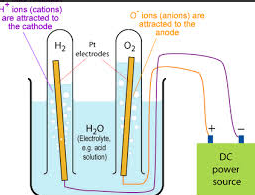
AnswerElectrolysis of water is the decomposition of water $(H_2O)$ into oxygen $(O_2)$ and hydrogen gas $(H_2)$ due to an electric current being passed through the water. An electrical power source is connected to two electrodes, or two plates $($typically made from some inert metal such as platinum, stainless steel or iridium$)$ which are placed in the water. Hydrogen will appear at the cathode $($the negatively charged electrode, where electrons enter the water$),$ and oxygen will appear at the anode $($the positively charged electrode$).$ Assuming ideal faradaic efficiency, the amount of hydrogen generated is twice the amount of oxygen, and both are proportional to the total electrical charge conducted by the solution. Above is the simple setup for electrolysis of water.
View full question & answer→Question 1231 Mark
Electrolysis is due to the ______ effect of electric current.
Answer
- Chemical.
Explanation:
Electrolysis is an electro-chemical process in which current is passed between two electrodes through an ionized solution (electrolyte) to deposit positive ions (anions) on the negative electrode (cathode) and negative ions (cations) on the positive electrode (anode).
So we can say that electrolysis is due to the chemical effect of electric current.
View full question & answer→Question 1241 Mark
In electrochemical corrosion. the metal undergoing corrosion:
Answer
- Acts as anode.
Explanation:
In electrochemical corrosion. the metal undergoing corrosion acts as an anode.
In anode region, the metal is oxidized to metal cation and in cathode region, oxygen is reduced to water.
View full question & answer→Question 1251 Mark
The electric current in a chemical cell is due to movement of:
Answer
- Positive and negative ions.
Explanation:
An electrolyte solution is formed by mixing an electrolyte in a solvent. The electrolyte on dissolution furnishes ions. The preferred movement of ions under the influence of the electric field is responsible for electric current. Hence, the electric current in a chemical cell is due to the movement of positive and negative ions.
View full question & answer→Question 1261 Mark
Which of the following statement is correct?
Answer
- $\text{E}_{\text{Cell}}$ is an intensive property while $\Delta_\text{r}\text{G}$ of cell reaction is an extensive property.
Explanation:
$\text{E}_{\text{Cell}}$ is an intensive property as it does not depend upon mass of species (number of particles) but $\Delta_\text{r}\text{G}$ of the cell reaction is an extensive property because this depends upon mass of species (number of particles). View full question & answer→Question 1271 Mark
Splitting a compound using electricity is called:
Answer
- Electrolysis.
Explanation:
Ionic substances can be broken down into the elements they are made from by passing electricity through them. The process is called electrolysis.
View full question & answer→Question 1281 Mark
Answer
- in all concentrations
Explanation:
Faradays laws are independent of temperature, or concentration Faradays laws are applicable at all concentrations.
View full question & answer→Question 1291 Mark
In an electrolytic cell, the current flows from:
Answer
- Cathode to anode in outer circuit.
Explanation:
In the electrolytic cell, the current flows from the cathode to anode in the outer circuit.
In the electrolytic cell, electrical energy is converted to chemical energy.
View full question & answer→Question 1301 Mark
Electric energy is produced by the:
Answer
- Separation of charges.
Explanation:
Electric energy is a form of energy, which is created by the movement of electrons. Generally electrons are bound to an atom by the positive force of protons. When for some reason these electrons get detached from their atoms electric energy is produced.
View full question & answer→Question 1311 Mark
Use the data given in and find out which of the following is the strongest oxidising agent$:$
$\text{E}^\ominus_{\text{cr}_2\text{O}^{2-}_7/\text{cr}^{3+}}=1.33\text{V}\ \ \ \text{E}^\ominus_{\text{Cl}_2/\text{Cl}^-}=1.36\text{V}$
$\text{E}^\ominus_{\text{MnO}^-_4/\text{Mn}^{2+}}=1.51\text{V}\ \ \ \ \text{E}^\ominus_{\text{Cr}^{3+}/\text{Cr}}=-0.74\text{V}$
AnswerHighest positive value of standard reduction potential means strongest oxidising agent. Hence, $\ce{MnO^-_4^{ }}$ is the strongest oxidising agent.
View full question & answer→Question 1321 Mark
What should be the state of compounds which decompose on passing electric current?
Answer
- Molten or aqueous
Explanation:
Compounds should be aqueous or molten so that they can be easily dissociated into ions.
View full question & answer→Question 1331 Mark
Effect of temperature on internal resistance of a battery is:
Answer
- Inversely proportional.
Explanation:
In the presence of electrolyte, internal resistance, Ri is inversely proportional to temperature T. It is because, as we increase the temperature, more electrolyte dissociates and resistance decreases.
View full question & answer→Question 1341 Mark
Using the data given in find out in which option the order of reducing power is correct.
$\text{E}^\ominus_{\text{cr}_2\text{O}^{2-}_7/\text{cr}^{3+}}=1.33\text{V}\ \ \ \text{E}^\ominus_{\text{Cl}_2/\text{Cl}^-}=1.36\text{V}$
$\text{E}^\ominus_{\text{MnO}^-_4/\text{Mn}^{2+}}=1.51\text{V}\ \ \ \ \text{E}^\ominus_{\text{Cr}^{3+}/\text{Cr}}=-0.74\text{V}$
Answer
- $\text{Mn}^{2+}<\text{Cl}^-<\text{Cr}^{3+}<\text{Cr}$
Explanation:
Lower the value of standard reduction potential greater will be the reducing power. View full question & answer→Question 1351 Mark
Fill in the blanks:
The filament resistance of bulb is ......, to its resistance when it is not glowing.
Answer
- Greater.
Explanation:
When the bulb is glowing, heat generates. Because of heat resistance of the filament increases. That is why the filament resistance of glowing bulb is greater than its resistance when it is not glowing.
View full question & answer→Question 1361 Mark
The process of depositing a thin layer of desired metal over another metal by passing an electric current through some electrolyte is called as ?
Answer
- Electroplating.
Explanation:
lectroplating is the process of coating a metal object with a thin layer of another metal by means of process which is known as Electrolysis. The electroplated coating is usually no more than .002 inch (.05mm) thick.
View full question & answer→Question 1371 Mark
Among Na, Hg, S, Pt and graphite, which can be used as electrodes in electrolytic cells having aqueous solutions?
Answer
- Hg, Pt and graphite
Explanation:
Sodium and sulphur reacts with water whereas Hg, Pt and graphite donot, hence can be used as electodes.
View full question & answer→Question 1381 Mark
Any article of iron if left in open for some time, acquires a film of brownish substance $($rust$)$ having chemical formula$:$
AnswerIron reacts with air to form iron oxide $(III)$ which is known by the name rust or rusting of iron. Rust is an iron oxide or red oxide formed by the redox reaction of iron and oxygen in the presence of water or air moisture. Rust consist of hydrated iron oxide.
View full question & answer→Question 1391 Mark
Which of the following statements is true ?
Answer
- Electrolysis is one of the applications of chemical effects of current.
Explanation:
Electrolysis is a method of using direct electric current to drive a chemical reaction. It involves the interchange of atoms and ions by the removal or addition of electrons.
View full question & answer→Question 1401 Mark
The more negative the standard potential, the .............. is its ability to displace hydrogen from acids.
Answer
- Greater.
Explanation:
As we know, More negative is the standard potential, higher is the probability to oxidise and because of that it has high ability to displace hydrogen from acids.
View full question & answer→Question 1411 Mark
Carbon dioxide is a __________.
Answer
- Weak electrophile.
Explanation:
Carbon dioxide is a weak electrophile. It possess very less partial positive charge which are attracted towards electrons.
View full question & answer→Question 1421 Mark
A reversible galvanic cell is connected to an external battery. If the EMF of the battery is less than the EMF of the galvanic cell, then the current:
Answer
- Will flow from the galvanic cell to the battery.
Explanation:
If the EMF of a battery is less than the EMF of an electro-chemical cell, then the current will flow from the electro-chemical cell to the battery. As, the current always flows from a higher potential to a lower potential.
View full question & answer→Question 1431 Mark
For purification of impure metals by the process of electrolysis:
Answer
- Salt solution of that metal in pure form is taken as an electrolyte.
Explanation:
When an impure metal is purified using electrolytic refining impure metal is used as anode and pure metal is used as cathode and the salt solution of same metal in pure form that is being purified is taken as electrolyte.
View full question & answer→Question 1441 Mark
In electrolysis, mass of the substance liberated at cathode is proportional to:
Answer
- Quantity of electricity passed.
Explanation:
According to the first law of electrolysis the mass of of substance liberated at cathode is proportional to the quantity of electric charge passed through it or indirectly it's proportional to the quantity of electricity passed.
$\because \text{m}=\text{k×q}$ View full question & answer→Question 1451 Mark
A dry cell converts chemical energy into:
Answer
- Electrical energy
Explanation:
A dry cell converts chemical energy into electrical energy.
View full question & answer→Question 1461 Mark
In a galvanic cell, electrons flow through connecting wires from:
Answer
- Anode to cathode.
Explanation:
In a galvanic cell, oxidation occurs at anode and reduction occurs at the cathode i.e., electrons are released from anode and they are accepted at the cathode. Hence, electrons flow from anode to cathode in a galvanic cell.
View full question & answer→Question 1471 Mark
In electrochemical cell, oxidation and reduction occurs at:
Answer
- Anode and cathode respectively.
Explanation:
Oxidation occurs at the electrode termed the anode and reduction occurs at the electrode called the cathode. In both galvanic and electrolytic cells, oxidation takes place at the anode and electrons flow from the anode to the cathode. and reduction takes place at cathode. The anode of an electrolytic cell is positive (cathode is negative), since the anode attracts anions from the solution.
View full question & answer→Question 1481 Mark
The presence of electrolytes ................ the rate of corrosion.
Answer
- Increases.
Explanation:
The presence of electrolyte increase the concentration of electron and thus increasing the mobility of electron due to which rate of corrosion increases.
View full question & answer→Question 1491 Mark
Which metals does not corrode easily?
Answer
- Gold
Explanation:
In the activity series, metals are on the top of the series react and corrode easily as these metals are highly reactive like iron corrodes easily in the presence of water and air forming its oxide layer while metals present at the bottom are least reactive and do not corrode easily like gold, silver and platinum are some of them.
View full question & answer→Question 1501 Mark
Which of the following is true for electrolytic refining?
Answer
- Pure metal is used at cathode and impure metal at anode.
Explanation:
Impure metal will release electron hence form anode electrode and pure metal will absorb electron hence it will be posses as cathode electrode. Pure metal is used as the cathode and impure metal as anode.
View full question & answer→Question 1511 Mark
Answer
- Donates electrons to hydrogen ions.
Explanation:
According electron configuration of copper atom, there is one electron in the outermost shell. For becoming a stable atom, the copper electrode will donate electrons to hydrogen atom.
View full question & answer→Question 1521 Mark
Which of the following statements is incorrect?
Answer
- Conductance of an electrolytic solution decreases with dilution.
View full question & answer→Question 1531 Mark
Electrolytes which allow large current to pass through them are known as:
Answer
- Strong electrolytes.
Explanation:
Electrolytes which allow large current to pass through them are known as strong electrolytes.
View full question & answer→Question 1541 Mark
In a galvanic cell electron flow will be from:
Answer
- Negative electrode to positive electrode.
Explanation:
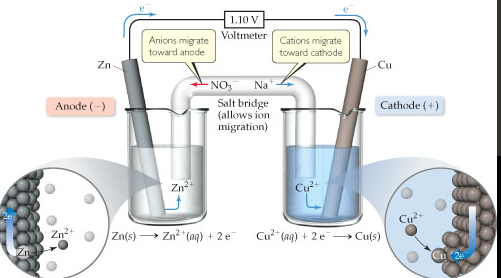
Electron flows opposite to the direction of current, i.e. from low to high voltage.
$\therefore$ Electron flows from negative to the positive electrode.
View full question & answer→Question 1551 Mark
Use the data and find out the most stable oxidised species.
$\text{E}^\ominus_{\text{cr}_2\text{O}^{2-}_7/\text{cr}^{3+}}=1.33\text{V}\ \ \ \text{E}^\ominus_{\text{Cl}_2/\text{Cl}^-}=1.36\text{V}$
$\text{E}^\ominus_{\text{MnO}^-_4/\text{Mn}^{2+}}=1.51\text{V}\ \ \ \ \text{E}^\ominus_{\text{Cr}^{3+}/\text{Cr}}=-0.74\text{V}$
Answer$Cr^{3+}/Cr$ has most negative value of standard reduction potential.
Hence, $Cr^{3+}$ is the most oxidized species.
View full question & answer→Question 1561 Mark
Select incorrect statement$:$
AnswerCalomel eletrode contains calomel paste $\ce{(H_{g2}Cl_2)}$ in contact with $Hg(l)$ and $(aq) \ \text{KCl}$ solution. $Pt$ electrode is dipped to make contact.
View full question & answer→Question 1571 Mark
The hydrogen formed by the action of zinc on sulphuric acid forms a layer of gas on the surface of copper plate in a simple voltaic cell, because of which:
Answer
- All of the above.
Explanation:
The hydrogen formed by the action of zinc on sulphuric acid forms a layer of gas on the surface of a copper plate in a simple voltaic cell, because of which:-
→ Internal resistance of cell increases
→ Hydrogen ions are unable to reach the anode
→ polarisation takes place at an anode.
View full question & answer→Question 1581 Mark
Conductivity of an electrolytic solution depends on $........$
AnswerConductivity or specific conductance $k \ ($kappa$).$ It is the conductance of solution kept between two electrodes with $1m^2$ area of cross section and distance of $1m.$ It is the reciprocal of resistivity $(p).$
$\text{K}=\frac{1}{\text{p}}$
$\text{S.I unit of k}=\text{sm}^{-1}$
It depends on the nature of the electrolyte and concentration of the electrolyte.
View full question & answer→Question 1591 Mark
For the given cell, $\text{Mg}|\text{Mg}^{2+}||\text{Cu}^{2+}|\text{Cu}:$
Answer
- Cu is cathode.
- The cell reaction is $\text{Mg}+\text{Cu}^{2+}\xrightarrow{\ \ \ \ \ \ \ \ \ \ \ }\text{Mg}^{2+}+\text{Cu}$
Explanation:
Left side of the cell represent oxidation half-cell and right side represent reduction half-cell. View full question & answer→Question 1601 Mark
Chemical compounds which conduct electricity in the fused or in aqueous solution state and undergo chemical decomposition due to the flow of current through it are known as:
Answer
- Electrolytes.
Explanation:
Chemical compounds which conduct electricity in the fused or in aqueous solution state and undergo chemical decomposition due to the flow of current through it are known as electrolytes. e.g NaCl
View full question & answer→Question 1611 Mark
Conductivity k, is equal to ____________.
Answer
- $\frac{1}{\text{R}}\frac{1}{\text{A}}$
- $\frac{\text{G}^*}{\text{R}}$
Explanation:
$\text{R}=\frac{\rho\text{L}}{\frac{\text{Al}}{\rho}}=\frac{1}{\text{R}}\frac{1}{\text{A}}$
Conductivity k = Conductance (G) × Cell constant (G*) View full question & answer→Question 1621 Mark
Electrolytes which allow small amount of electricity to pass through them are known as:
Answer
- Weak electrolytes.
Explanation:
Electrolytes which allow small amount of electricity to pass through them are known as weak electrolytes.
View full question & answer→Question 1631 Mark
The cathode in the central compartment of Castner Kellner cell used for the manufacture of NaOH is:
Answer
- Mercury
Explanation:
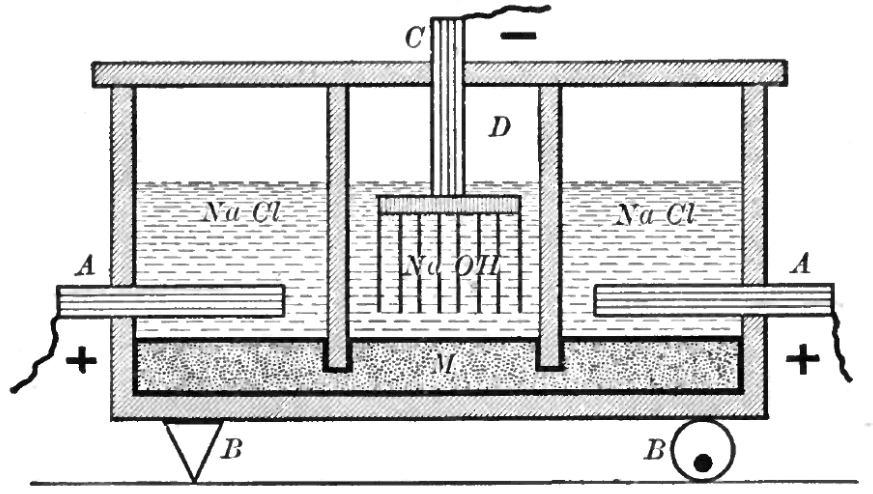
The apparatus shown is divided into two types of cells separated by slate walls. The first type, shown on the right and left of the diagram, uses an electrolyte of sodium chloride solution, a graphite anode (A), and a mercury cathode (M). The other type of cell, shown in the center of the diagram, uses an electrolyte of sodium hydroxide solution, a mercury.
View full question & answer→Question 1641 Mark
Metals react differently with water. The more vigorous is the reaction, the more is the bubble formation. The following diagram illustrates the reaction of sodium, magnesium and copper with water.
What can be concluded from this diagram?

Answer
- Sodium reacts more vigorously with water than magnesium and copper.
Explanation:
Sodium reacts more vigorously with water than magnesium and copper.
View full question & answer→Question 1651 Mark
In hydrogen evolution type of corrosion with respect to hydrogen electrode which of the following is correct ?
AnswerAny metal lying below hydrogen electrode will reduce $H^+$ ions to give $H^2$ gas, while any metal lying above hydrogen will not reduce $H^{+}$ ions. Thus metals like $Fe, Zn, Cd$ etc lying below hydrogen with more negative $\text{SRP}$ capable of reacting with dilute acids while metals like $Ag, Cu$ etc which lie above hydrogen electrode, can not evolve hydrogen with dilute acids.
View full question & answer→Question 1661 Mark
The electric charge for electrode deposition of one gram equivalent of a substance is$:$
AnswerOne gram equivalent of a substance requires $96500$ coulombs $s^{−1}$ of electricity.
View full question & answer→Question 1671 Mark
Anode in the galvanic cell is:
Answer
- Negative electrode.
Explanation:
Electrochemical cells or galvanic cells are same thing. Anode in galvanic cells is negative electrode where oxidation takes place.
View full question & answer→Question 1681 Mark
$\text{E}^\ominus_{\text{Cell}}=1.1\text{V}$ for Daniell cell. Which of the following expressions are correct description of state of equilibrium in this cell?
Answer
- $\frac{2.303\text{RT}}{2\text{F}}\log\text{K}_{\text{c}}=1.1$
- $\log\text{K}_\text{c}=\frac{2.2}{0.059}$
Explanation:
$\text{E}^0_\text{cell}=\frac{2.303\text{RT}}{\text{n}\text{F}}\log\text{K}_{\text{c}}$
$\text{Or}\ \ \ \ \text{E}^0_{\text{cell}}=\frac{0.059}{2}\log\text{K}_\text{c}\ \ \text{or}\ \ \ 1.1=\frac{0.059}{2}\log\text{K}_\text{c}$
$\text{Or}\ \ \ \log\text{K}_\text{c}=\frac{2.2}{0.059}$ View full question & answer→MCQ 1691 Mark
The electrode potential of standard hydrogen electrode is -