Questions

3 Marks Question

Take a timed test

48 questions · self-marked practice — reveal the answer and mark yourself.

Question 13 Marks
How do you convert:
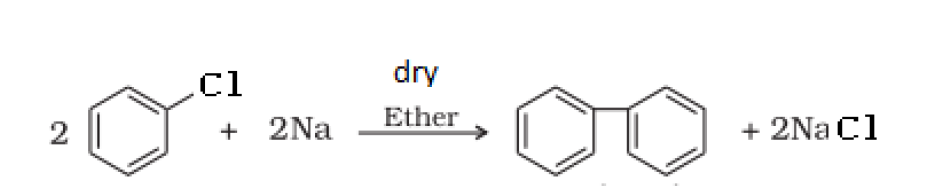
  1. Chlorobenzene to biphenyl.
  2. Propene to I-iodopropane.
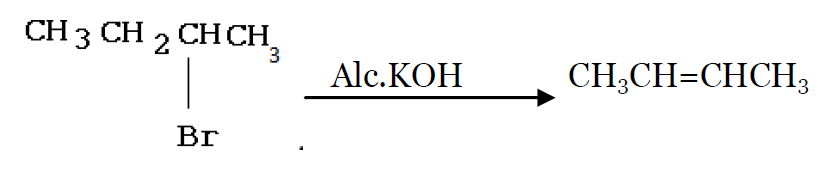
  3. 2-bromobutane to but-2-ene.
Answer
  1.  
  1.  
  1.  
View full question & answer
Question 23 Marks
Complete the following giving the structures of major organic products.
$(\text{CH}_3)_3-\text{C}-\text{CH}_2-\text{Br}\xrightarrow[\Delta]{\text{C}_2\text{H}_5\text{ONa}/\text{C}_2\text{H}_5\text{OH}}\ ........$
Answer
$\ \ \ \ \ \ \ \ \ \ \ \ \text{CH}_3\\ \ \ \ \ \ \ \ \ \ \ \ \ \ |\\\text{CH}_3-\text{C}-\text{CH}_2-\text{Br}\xrightarrow[\Delta]{\text{C}_2\text{H}_5\text{ONa}/\text{C}_2\text{H}_5\text{OH}}\\ \ \ _\text{neo-pentyl bromide}$$\ \ \ \ \ \ \ \ \ \ \ \ \text{CH}_3\\ \ \ \ \ \ \ \ \ \ \ \ \ \ |\\\text{CH}_3-\text{C}-\text{CH}_2-\text{O}-\text{CH}_2-\text{CH}_3\\ \ \ \ \ \ \ \ \ \ \ \ \ \ |\\ \ \ \ \ \ \ \ \ \ \ \ \ \text{CH}_3\\ \ \ \ \ \ \ \ \ _\text{Ethyl neo-pentyl ether}$
View full question & answer
Question 33 Marks
Give reasons:
  1. n-Butyl bromide has higher boiling point than t-butyl bromide.
  2. Racemic mixture is optically inactive.
  3. The presence of nitro group $(–NO_2)$ at o/p positions increases the reactivity of haloarenes towards nucleophilic substitution reactions.
Answer
  1. Larger surface area, higher van der Waals' forces, higher the boiling point.
  2. Rotation due to one enantiomer is cancelled by another enantiomer.
  3. $-NO_2$ acts as Electron withdrawing group or –I effect.
View full question & answer
Question 43 Marks
Complete the following reactions:
  1. $\text{CH}_{3}\text{CH}_{2}\text{NH}_{2}+\text{CHCl}_{3}+\text{alc. KOH}\rightarrow$
  2. $\text{C}_{6}\text{H}_{5}\text{N}_{2}^{+}\text{Cl}^{-}\xrightarrow[\text{(Room}\text{ temp.)}]{H_2O}$
Answer
  1. $CH_3CH_2NH_2 + CHCl_3 + alc 3KOH\rightarrow CH_3CH_2NC + 3KCl + 3H_2O$
  2. $\text{C}_{6}\text{H}_{5}\text{N}_{2}^{+}\text{Cl}^{-}\xrightarrow{\text{H}_{2}\text{O}\text{; Room}\text{ temp.}}\text{C}_{6}\text{H}_{5}\text{OH}+\text{N}_{2}+\text{HCl}$
View full question & answer
Question 53 Marks
How would you achieve the following conversions:
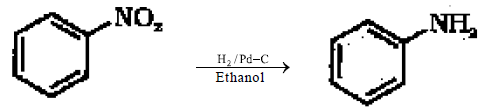
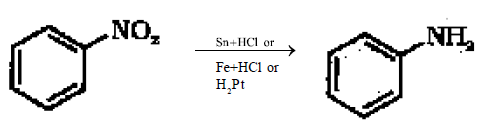
  1. Nitrobenzene to aniline.
  2. An alkyl halide to a quaternary ammonium salt.
  3. Aniline to benzonitrile.
Write the chemical equation with reaction conditions in each case.
Answer
  1.  

Alternate answer
  1. $\text{RX}+\text{NH}_{3}\xrightarrow{OH^{-}}\text{RNH}_{2}.$
$\text{RNH}_{2}\xrightarrow{RX}\text{R}_{2}\text{NH}\xrightarrow{RX}\text{R}_{3}\text{N}\xrightarrow{RX}\text{R}_{4}\text{N}^{+}\text{X}^{-}.$
  1. $\text{ArNH}_{2}+\text{NaNO}_{2}+\text{HCl}\xrightarrow{273-278}\text{ArN}_{2}^{+}\text{Cl}^{-}\xrightarrow{CuCN}\text{ArCN}.$
View full question & answer
Question 63 Marks
Write the structure of the product when chlorobenzene is treated with methyl chloride in the presence of sodium metal and dry ether.
Answer

When a mixture of chlorobenzene and methyl chloride is treated with sodium metal in the presence of dry ether, toluene is obtained.
View full question & answer
Question 73 Marks
Give reasons for the following:
  1. Ethyl iodide undergoes $S_N2$ reaction faster than ethyl bromide.
  2. $(\pm)$ 2-Butanol is optically inactive.
  3. C-X bond length in halobenzene is smaller than C-X bond length in $CH_3-X$.
Answer
  1. I, is better leaving group/C-I bond is weeker then C-Br bond.
  2. Because it is a racemic mixture/equal & opposite rotation of two enantiomers cancel each other.
  3. Due to resonance in $halobenzene/sp^2$ hybridization of C-atom in halobenzene & $sp^3$ hybridization of C-atom in $CH_3X$.
View full question & answer
Question 83 Marks
How will you distinguish between the following pairs of compounds:
Chloroform and carbon tetrachloride.
Answer
On heating chloroform and carbon tetrachloride with aniline and ethanolic potassium hydroxide separately chloroform forms pungent smelling isocyanide but carbon tetrachloride does not form this compound.
$\text{C}_6\text{H}_5\text{NH}_2+\text{CHCl}_3+3\text{KOH (ethanolic)}\xrightarrow{\Delta}$ $\text{C}_6\text{H}_5\text{NC}+3\text{KCl}+3\text{H}_2\text{O}\\ ^\text{Phenyl isocyanide}$
View full question & answer
Question 93 Marks
Answer the following questions:
  1. What is meant by chirality of a compound? Give an example.
  2. Which one of the following compounds is more easily hydrolyzed by KOH and why?
$CH_3CHClCH_2CH_3 or CH_3CH_2CH_2Cl.$
  1. Which one undergoes $S_N2$ substitution reaction faster and why?
Answer
  1. The objects which are non-superimposable on their mirror image are said to be chiral and this property is known as chirality eg. Butan-2-ol.
  2. $CH_3CHClCH_2CH_3$. Because it will form secondary carbocation which is more stable ($S_N1$ mechanism) or $CH_3CH_2CH_2CH_2C$l is easily hydrolyzed as it is primary alkyl halide ($S_N2$ mechanism).

Because Iodine has larger size and therefore good leaving group.
View full question & answer
Question 103 Marks
Rearrange the compounds of each of the following sets in order of reactivity towards $S_N2$ displacement:
  1. 2-Bromo-2-methylbutane, 1-Bromopentane, 2-Bromopentane.
  2. 1-Bromo-3-methylbutane, 2-Bromo-2-methylbutane, 3-Bromo-2-methylbutane.
  3. 1-Bromobutane, 1-Bromo-2, 2-dimethylpropane, 1-Bromo-2-methylbutane.
Answer
  1. 1-Bromopentane > 2-Bromopentane > 2-Bromo -2-methyle butane.
  2. 1- Bromo-2 -methyl butane > 3-Bromo- 2-methyl butane> 2-Bromo-2-methyl butane.
  3. 1- Bromobutane > 1-Bromo- 2-methyl butane > 1-Bromo-2, 2-dimethyl propane.
View full question & answer
Question 113 Marks
Predict the order of reactivity of the four isomeric bromobutanes in $S_N1$ and $S_N2$ reactions.
Answer
$\mathrm{CH}_3 \mathrm{CH}_2 \mathrm{CH}_2 \mathrm{CH}_2 \mathrm{Br}<\left(\mathrm{CH}_3\right)_2 \mathrm{CHCH}_2 \mathrm{Br}<\mathrm{CH}_3 \mathrm{CH}_2 \mathrm{CH}(\mathrm{Br}) \mathrm{CH}_3<\left(\mathrm{CH}_3\right)_3 \mathrm{CBr}\left(\mathrm{~S}_{\mathrm{N}} 1\right) \mathrm{CH}_3 \mathrm{CH}_2 \mathrm{CH}_2 \mathrm{CH}_2 \mathrm{Br}>\left(\mathrm{CH}_3\right)_2 \mathrm{CHCH}_2 \mathrm{Br}>$
$\mathrm{CH}_3 \mathrm{CH}_2 \mathrm{CH}(\mathrm{Br}) \mathrm{CH}_3>\left(\mathrm{CH}_3\right)_3 \mathrm{CBr}\left(\mathrm{~S}_{\mathrm{N}} 2\right)$
Of the two primary bromides, the carbocation intermediate derived from $\left(\mathrm{CH}_3\right)_2 \mathrm{CHCH}_2 \mathrm{Br}$ is more stable than that derived from $\mathrm{CH}_3 \mathrm{CH}_2 \mathrm{CH}_2 \mathrm{CH}_2 \mathrm{Br}$ because of greater electron donating inductive effect of $\left(\mathrm{CH}_3\right)_2 \mathrm{CH}$ group. So, $\left(\mathrm{CH}_3\right)_2 \mathrm{CHCH}_2 \mathrm{Br}$ is more reactive than $\mathrm{CH}_3 \mathrm{CH}_2 \mathrm{CH}_2 \mathrm{CH}_2 \mathrm{Br}$ in $\mathrm{S}_{\mathrm{N}} 1$ reactions. $\mathrm{CH}_3 \mathrm{CH}_2 \mathrm{CH}(\mathrm{Br}) \mathrm{CH}_3$ is a secondary bromide and $\left(\mathrm{CH}_3\right)_3 \mathrm{CBr}$ is a tertiary bromide. Thus, the above order is followed in $\mathrm{S}_{\mathrm{N}} 1$. The reactivity in $\mathrm{S}_{\mathrm{N}} 2$ reactions follows the reverse order as the steric hindrance around the electrophilic carbon increases in that order.
View full question & answer
Question 123 Marks
Explain the following:
Haloalkanes react with KCN to form alkyl cyanides as main product while AgCN forms isocyanides as the major product.
Answer
KCN is predominantly ionic and provides cyanide ions in solution. The attack takes place mainly through carbon atom and not through nitrogen atom as C-C bond is more stable than C-N bond. In contrast, AgCN is mainly covalent in nature and nitrogen is free to donate electron pair forming isocyanide as the major product.
View full question & answer
Question 133 Marks
Giving an example for each describe the following reactions:
  1. Hofmann’s bromamide reaction.
  2. Gatterman reaction.
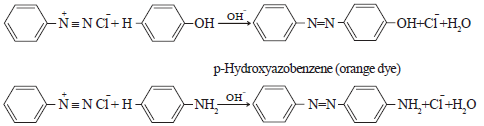
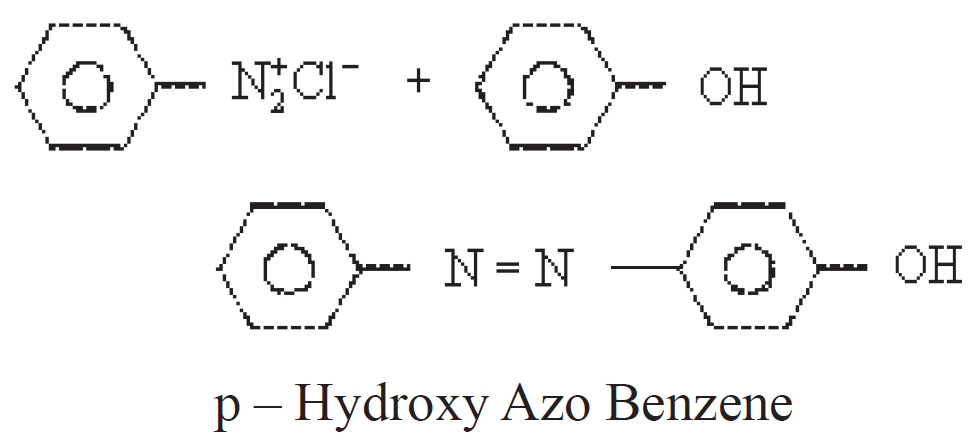
  3. A coupling reaction.
Answer
  1. Hoffmann Bromamide Reaction:
$\text{R-CONH}_{2}+\text{Br}_{2}+\text{4NaOH}\rightarrow\text{R-NH}_{2}+\text{Na}_{2}\text{CO}_{3}+\text{2NaBr+2NaBr}+\text{2H}_{2}\text{O}$
  1. Gatterman reaction:
  1. Coupling reaction:

p-Aminoazobenzene (yellow dye)
View full question & answer
Question 143 Marks
Answer the following questions:
In the following pairs of halogen compounds, which would undergo $S_N1$ reaction faster? Explain.
Answer

because of greater stability of secondary carbocation than primary.
View full question & answer
Question 153 Marks
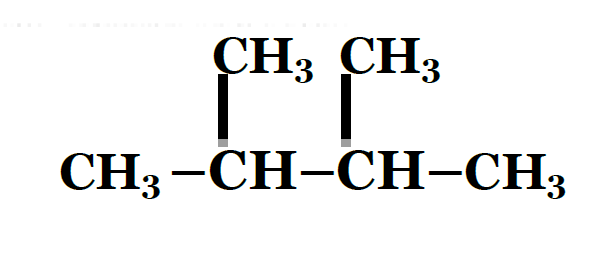
Among the isomeric alkanes of molecular formula $C_5H_{12}$, identify the one that on photochemical chlorination yields,
  1. A single monochloride.
  2. Three isomeric monochlorides.
  3. Four isomeric monochlorides.
Answer
  1. Neopentene $\ \ \ \ \ \ \ \ \ \ \ \text{CH}_3\\\ \ \ \ \ \ \ \ \ \ \ \ \mid\\\text{H}_3\text{C}-\text{C}-\text{CH}_3.\\\ \ \ \ \ \ \ \ \ \ \ \ \mid\\\ \ \ \ \ \ \ \ \ \ \ \text{CH}_3$ As all the H-atomsare equivalent, the replacement of any one of them gives the same product.
  2. $\ \ \text{a}\ \ \ \ \ \ \text{b}\ \ \ \ \ \text{c}\ \ \ \ \ \ \text{b}\ \ \ \ \ \text{a}\\\text{CH}_3\text{CH}_2\text{CH}_2\text{CH}_2\text{CH}_3$ n-pentene. a, b, c are the three sets of equivalent hydrogens. Therefore, three isomaric monochlorides are possible.
  3. $\ \ \text{a}\ \ \ \ \ \ \ \ \ \ \text{b}\ \ \ \ \ \ \ \ \ \text{c}\ \ \ \ \ \ \ \ \ \ \ \text{d}\\\text{CH}_3-\text{CH}-\text{CH}_2-\text{CH}_3\\\ \ \ \ \ \ \ \ \ \ \ \ \ \ \ \mid\\\ \ \ \ \ \ \ \ \ \ \ \ \ \text{CH}_3$ iso-pentene. There are four sets of equivalent hydrogens Designated as a, b, c, d. Thus, four isomeric monochlorides are possible.
View full question & answer
Question 163 Marks
What happens when bromine reacts with $\text{CH}_3-\text{C}\equiv\text{CH}?$ How would you justify this reaction?
Answer
When bromine reacts with propyne, the reddish brown colour of bromine is discharged as long as propyne is present in excess.
$\\\text{CH}_3-\text{C}\equiv\equiv\text{CH}+\text{Br}_2\\ \ \ \ \ \ \ \ \ \ \ ^\text{Propyne}\ \ \ \ \ \ \ \ \ ^{(\text{Reddish }}\\ \ \ \ \ \ \ \ \ \ \ \ \ \ \ \ \ \ \ \ \ \ \ \ \ \ \ \ \ \ \ \ \ ^\text{brown)}$
$\ \ \ \ \ \ \ \ \ \ \ \ \ \ \ \ \ \ \ \ \ \ \text{Br}\ \ \ \ \ \ \ \ \ \ \ \ \ \ \ \ \ \ \ \ \ \ \ \ \ \ \ \ \ \ \ \ \ \ \ \ \ \ \ \ \ \text{Br}\ \ \ \ \text{Br}\\\ \ \ \ \ \ \ \ \ \ \ \ \ \ \ \ \ \ \ \ \ \ \ |\ \ \ \ \ \ \ \ \ \ \ \ \ \ \ \ \ \ \ \ \ \ \ \ \ \ \ \ \ \ \ \ \ \ \ \ \ \ \ \ \ \ \ \ |\ \ \ \ \ \ \ |\\\xrightarrow{\text{CCl}_4}\text{CH}_3-\text{C}==\text{C}-\text{H}\xrightarrow{\text{+Br}_2}\text{CH}_3-\text{C}-\text{C}-\text{H}\\\ \ \ \ \ \ \ \ \ \ \ \ \ \ \ \ \ \ \ \ \ \ \ |\ \ \ \ \ \ \ \ \ \ \ \ \ \ \ \ \ \ \ \ \ \ \ \ \ \ \ \ \ \ \ \ \ \ \ \ \ \ \ \ \ \ \ \ \ |\ \ \ \ \ \ |\\\ \ \ \ \ \ \ \ \ \ \ \ \ \ \ \ \ \ \ \ \ \ \text{Br}\ \ \ \ \ \ \ \ \ \ \ \ \ \ \ \ \ \ \ \ \ \ \ \ \ \ \ \ \ \ \ \ \ \ \ \ \ \ \ \ \ \ \text{Br}\ \ \ \text{Br}\\ \ \ \ \ \ \ \ \ \ \ \ \ \ \ \ \ \ \ \ \ \ \ \ \ \ \ \ \ \ \ \ \ \ \ \ \ \ \ \ \ \ \ \ \ \ \ \ \ \ \ \ \ \ \ \ \ ^\text{1, 1, 2, 2-Tetrabromopropane}\\ \ \ \ \ \ \ \ \ \ \ \ \ \ \ \ \ \ \ \ \ \ \ \ \ \ \ \ \ \ \ \ \ \ \ \ \ \ \ \ \ \ \ \ \ \ \ \ \ \ \ \ \ \ \ \ \ \ \ \ \ \ \ \ \ \ \ \ \ ^\text{(colourless)}$
This is due to the formation of 1, 1, 2, 2-tetrabromopropane which is colourless.
View full question & answer
Question 173 Marks
  1. State one use each of DDT and iodoform.
  2. Which compound in the following couples will react faster in $S_N2$ displacement and why?
  1. 1-Bromopentane or 2-bromopentane.
  2. 1-Bromo-2-methylbutane or 2-bromo-2-methylbutane.
Answer
  1. DDT is used as an insecticide and Iodoform is used as a mild antiseptic.
  2.  
  1. 1-Bromo pentane, as it is a primary alkyl halide.
  2. 1-Bromo-2-methyl butane, as it is a primary alkyl halide.
View full question & answer
Question 183 Marks
Write the structures of main products when benzene diazonium chloride reacts with the following reagents:
  1. $CuCN$
  2. $CH_3CH_2OH$
  3. $KI$
View full question & answer
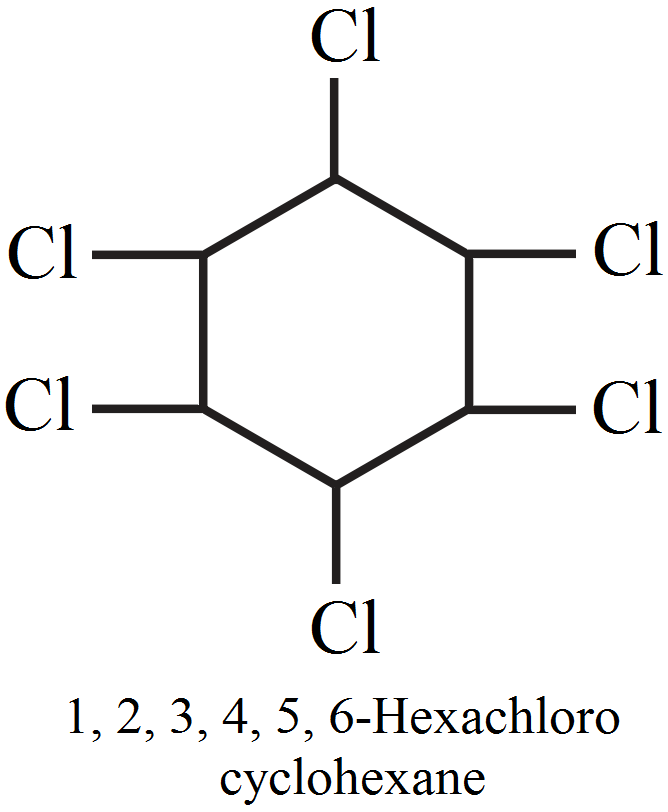
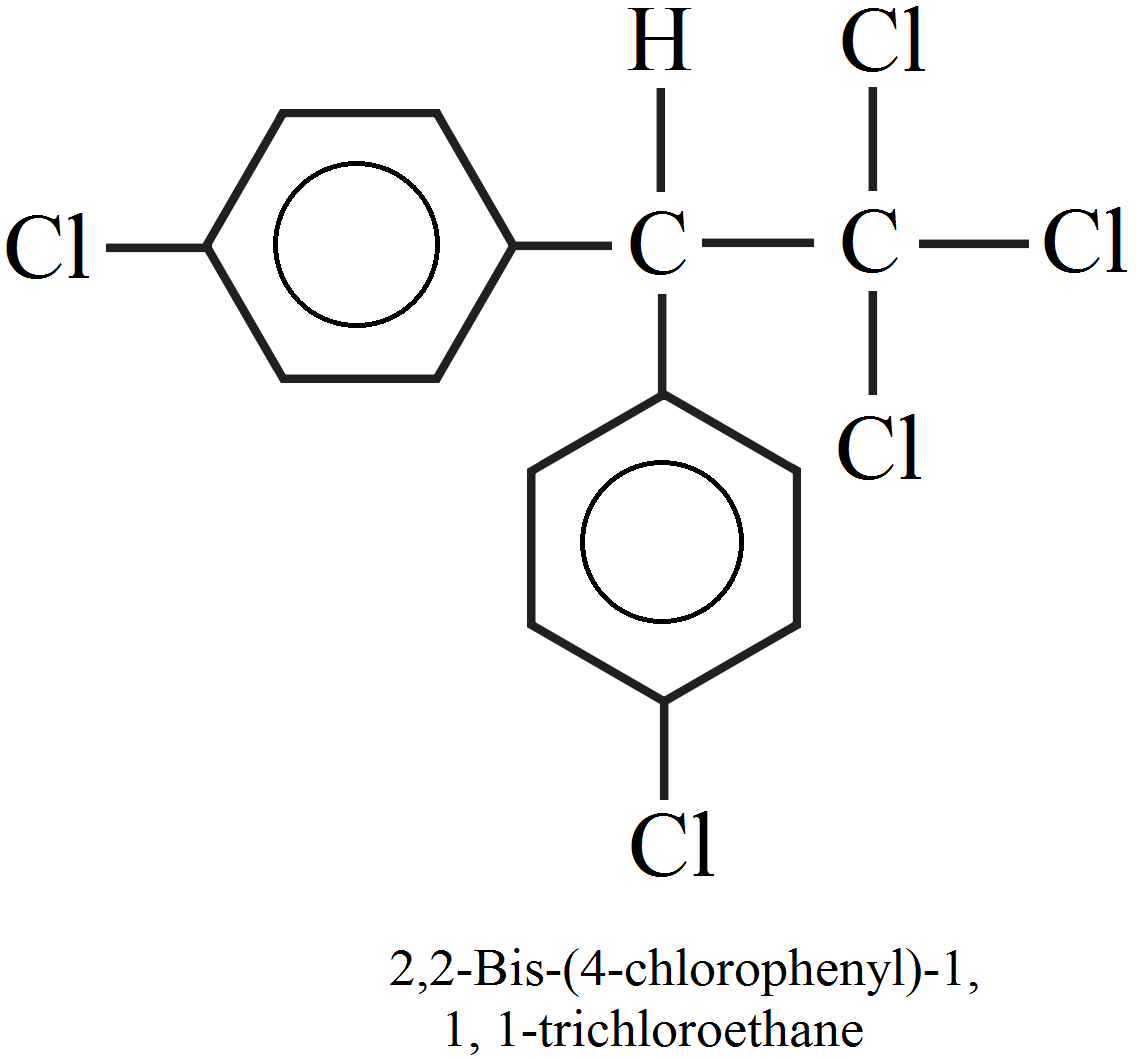
Question 193 Marks
Give the structural formula and IUPAC name of the following compounds:
  1. BHC
  2. DDT
Answer
  1. BHC
  1. DDT
​​​​​​​
View full question & answer
Question 203 Marks
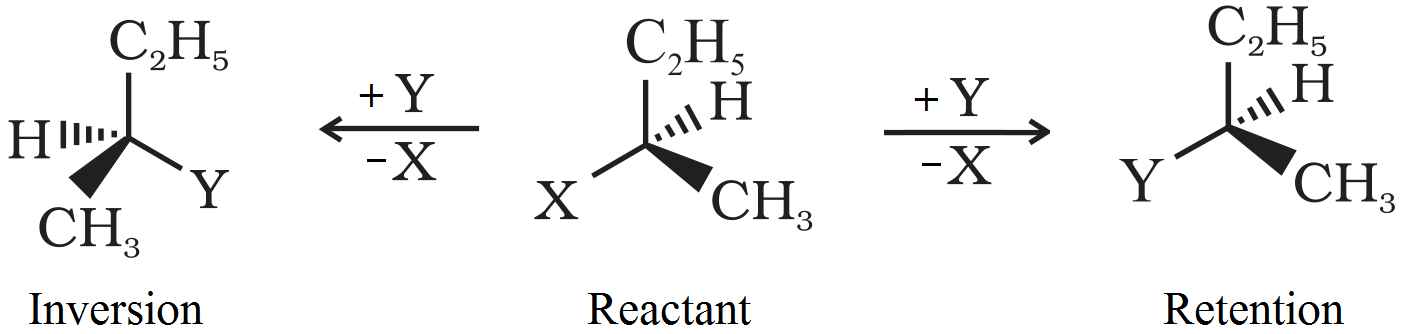
Differentiate between retention and inversion.
Answer

If the relative configuration of the atoms/ groups around a chiral centre in an optically active molecule remains the same before and after the reaction, the reaction is said to proceed with retention of configuration. On the other hand, if the relative configuration of the atoms/ groups around a stereocentre in the product is opposite to that in the reactant, the reaction is said to proceed with inversion of configuration.
For example,
View full question & answer
Question 213 Marks
  1. Out of $(CH_3)_3C–Br$ and $(CH_3)_3C–I$, which one is more reactive towards $S_N1$ and why?
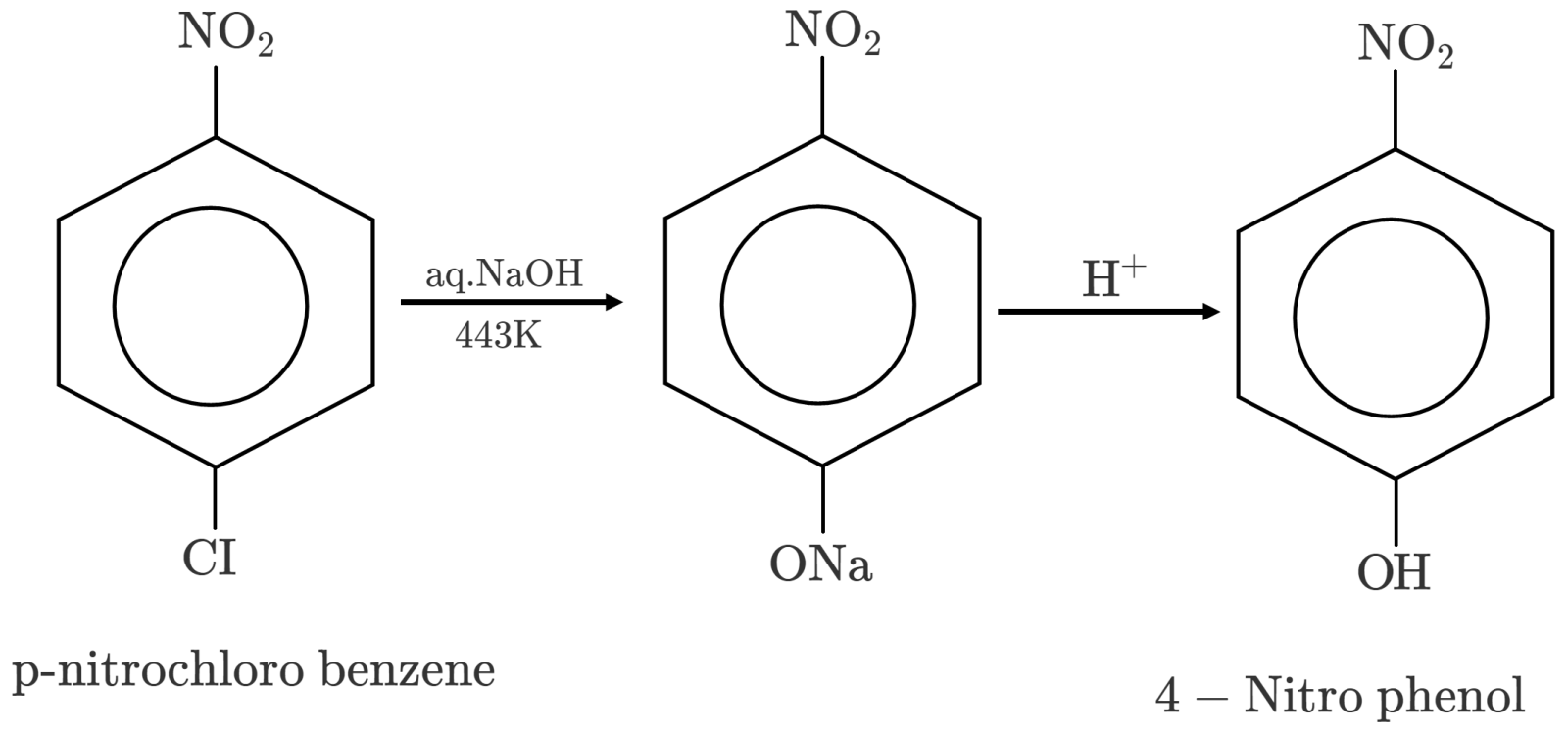
  2. Write the product formed when p-nitrochlorobenzene is heated with aqueous NaOH at $443K$ followed by acidification.
  3. Why dextro and laevo–rotatory isomers of Butan-2-ol are difficult to separate by fractional distillation?
Answer
  1. In $S_N1$ reactions, reactivity depends on the stability of carbocation after removing the leaving group form the reactant. Since the carbocation is same here, so, we will see the tendency of leaving group. As we can see in the following reactions $Br^-$ and $I^-$ are the leaving groups, out of them $I^-$ is a better leaving group. Hence $S_N1$ reaction will be faster in $(CH_3)_3–I$
  2.  
  1. Dextro and laevo rotatory isomers of butane-2-ol are difficult to separate by fractional distillation because of no difference in boiling points of these two rotatory isomers.
$\ \ \ \ \ \ \ \ \ \ \ \ \ \ \ \ \ \ \ \ \ \ \ \ \ \text{OH}\\\ \ \ \ \ \ \ \ \ \ \ \ \ \ \ \ \ \ \ \ \ \ \ \ \ \ \ |\\\text{CH}_3-\text{CH}_2-\text{CH}-\text{CH}_3\\ \ \ \ \ \ \ \ \ \ \ \text{Butan-2}-\text{ol}$
View full question & answer
Question 223 Marks
Vinyl chloride is hydrolysed more slowly than ethyl chloride.
Answer

Vinyl chloride may be represented as a resonance hybrid of the following two structures:

As a result of resonance, the carbon–chlorine bond acquires some double bond character in vinyl chloride. On the other hand, in ethyl chloride, the carbon–chlorine bond is a pure single bond. Thus, vinyl chloride undergoes hydrolysis more slowly than ethyl chloride.
View full question & answer
Question 233 Marks
How the following conversions can be carried out?
Ethanol to But-2-yne.
Answer
$\text{CH}_3\text{CH}_2\text{OH}\xrightarrow[-\text{SO}_2,\text{ -HCl}]{\text{SOCl}_2,\text{ Pyridine}}\text{CH}_3\text{CH}_2\text{Cl}\\ \ \ \ \ ^\text{(ethanol)}\ \ \ \ \ \ \ \ \ \ \ \ \ \ \ \ \ \ \ \ \ \ \ \ \ \ \ \ \ \ \ ^\text{(chlroethane)}$$\text{CH}\equiv\text{CH}+\text{NaNH}_2\xrightarrow[196\text{K}]{\text{liq. NH}_3}\text{HC}\equiv\text{C}^-\text{Na}^+\\ \ \ \ \ \ \ \ \ \ \ \ \ \ \ \ \ \ \ \ \ \ \ \ \ \ \ \ \ \ \ \ \ \ \ \ \ \ \ \ \ \ \ \ \ \ \ \ \ \ ^{(\text{sodium acetylide})}$
$\text{CH}_3\text{CH}_2-\text{Cl}+\text{HC}\equiv\text{C}^-\text{Na}^+\rightarrow\text{CH}_3\text{CH}_2-\text{C}\equiv\text{CH}\\ \ \ \ \ ^{(\text{chloroethane})}\ \ \ \ \ \ ^{\text{(sodium }}\ \ \ \ \ \ \ \ \ \ \ \ \ \ \ \ \ \ \ \ \ \ \ \ \ \ ^{(\text{But-1-yne})+\text{NaCl}}\\ \ \ \ \ \ \ \ \ \ \ \ \ \ \ \ \ \ \ \ \ \ \ \ \ \ \ \ \ ^{\text{acetylide)}}$
View full question & answer
Question 243 Marks
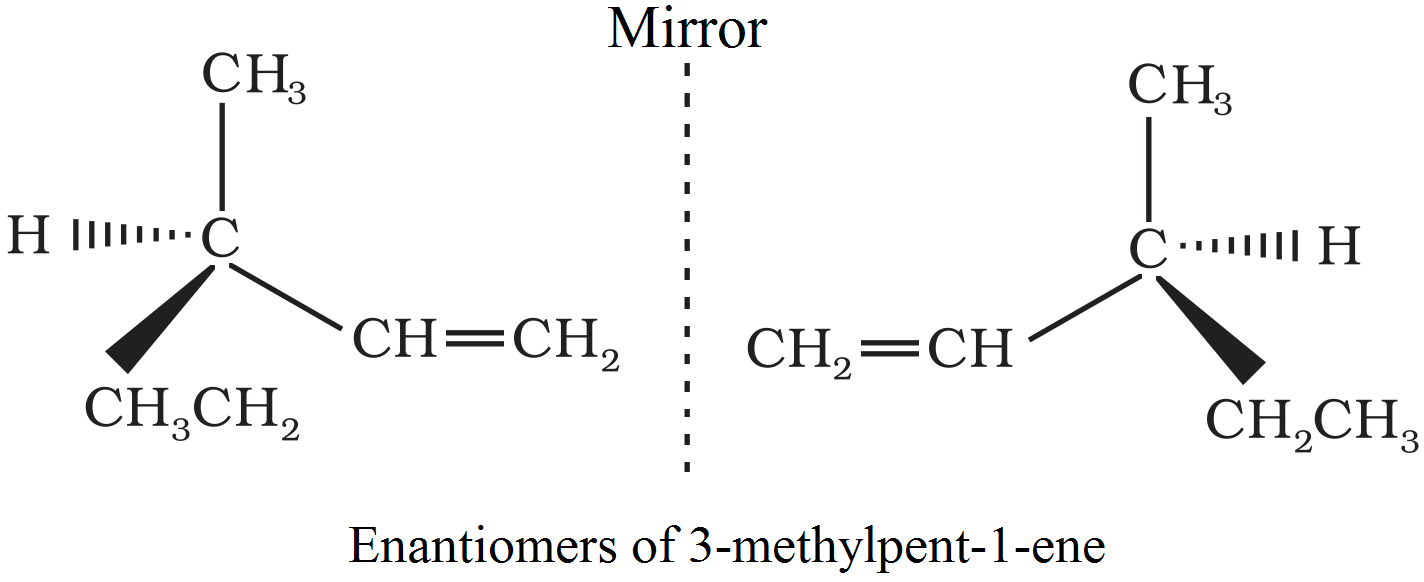
What are enantiomers? Draw the structures of the possible enantiomers of 3-methylpent-1-ene.
Answer

Stereoisomers which are non-superimposable mirror images of each other are called enantiomers.
View full question & answer
Question 253 Marks
How will you bring about the following conversions?
n-Propyl chloride to iso-propyl chloride.
Answer
$\text{CH}_3-\text{CH}_2-\text{CH}_2-\text{Cl}\xrightarrow[\Delta]{\text{alc. KOH}}\text{CH}_3-\text{CH}==\text{CH}_2\xrightarrow{\text{HCl}}\text{CH}_3-\text{CH}-\text{CH}_3\\\ \ \ \ _\text{n-Propyl}\ \ \ \ \ \ \ \ _\text{chloride}\ \ \ \ \ \ \ \ \ \ \ \ \ \ \ \ \ \ \ \ \ \ \ \ \ \ \ \ \ \ \ \ \ \ \ \ \ \ \ \ \ \ \ \ \ \ \ \ \ \ \ \ \ \ \ \ \ \ \ \ \ \ \ \ \ \ \ \ \ \ \ \ \ \ \ \ \ \ \ \ \ \ |\ \\\ \ \ \ \ \ \ \ \ \ \ \ \ \ \ \ \ \ \ \ \ \ \ \ \ \ \ \ \ \ \ \ \ \ \ \ \ \ \ \ \ \ \ \ \ \ \ \ \ \ \ \ \ \ \ \ \ \ \ \ \ \ \ \ \ \ \ \ \ \ \ \ \ \ \ \ \ \ \ \ \ \ \ \ \ \ \ \ \ \ \ \ \ \ \ \ \ \ \ \ \ \ \ \ \ \ \ \ \ \ \ \ \ \ \text{Cl}\\ \ \ \ \ \ \ \ \ \ \ \ \ \ \ \ \ \ \ \ \ \ \ \ \ \ \ \ \ \ \ \ \ \ \ \ \ \ \ \ \ \ \ \ \ \ \ \ \ \ \ \ \ \ \ \ \ \ \ \ \ \ \ \ \ \ \ \ \ \ \ \ \ \ \ \ \ \ \ \ \ \ \ \ \ \ \ \ \ \ \ \ \ \ \ \ \ \ \ \ \ \ \ \ \ \ _{\text{Iso-Propyl chloride}}$
View full question & answer
Question 263 Marks
Explain the following in one or two sentences:
Allyl chloride is hydrolysed more readily than n-propyl chloride.
Answer
Allyl chloride shows high reactivity as the carbocation formed by hydrolysis is stabilised by resonance while no such stabilisation of carbocation exists in the case of n-propyl chloride.
$\text{CH}_2==\text{CH}-\text{CH}_2-\text{Cl}\xrightarrow[\text{slow}]{\text{Ioazation}}\text{CH}_2==\text{CH}-\stackrel{{+\ \ \ \ \ }}{\hbox{CH}_2}+\text{Cl}^-\\\ \ \ \ \ \ \ \ \ \ \ \ \ \ ^\text{Allyl chloride}$
$\text{CH}_2==\text{CH}-\text{CH}_2\text{OH}\xleftarrow[\text{Fast}]{\text{OH}^-}\stackrel{{+\ \ \ \ \ }}{\hbox{CH}_2}\text{CH}_2-\text{CH}==\text{CH}_2\\ \ \ \ \ \ \ \ \ \ \ \ \ \ \ \ ^\text{Allyl alcohol}$
On the other hand, n-propyl chloride does not undergo ionisation to produce n-propyl carbocation and hence allyl chloride is hydrolysed more readily than n-propyl chloride.
View full question & answer
Question 273 Marks
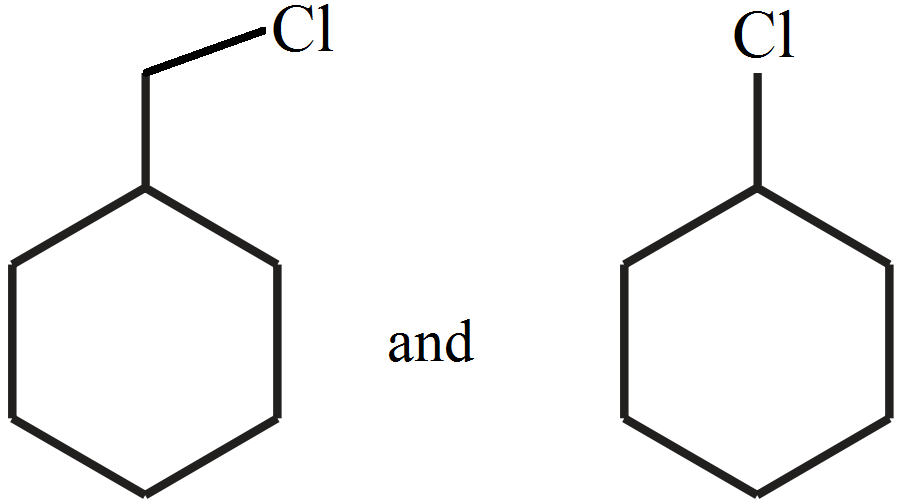
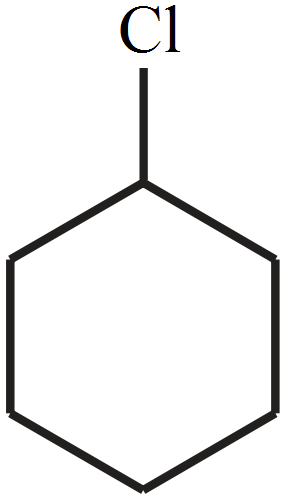
Answer the following questions: Explain why the dipole moment of chlorobenzene is lower than that of cyclohexyl chloride.
Answer

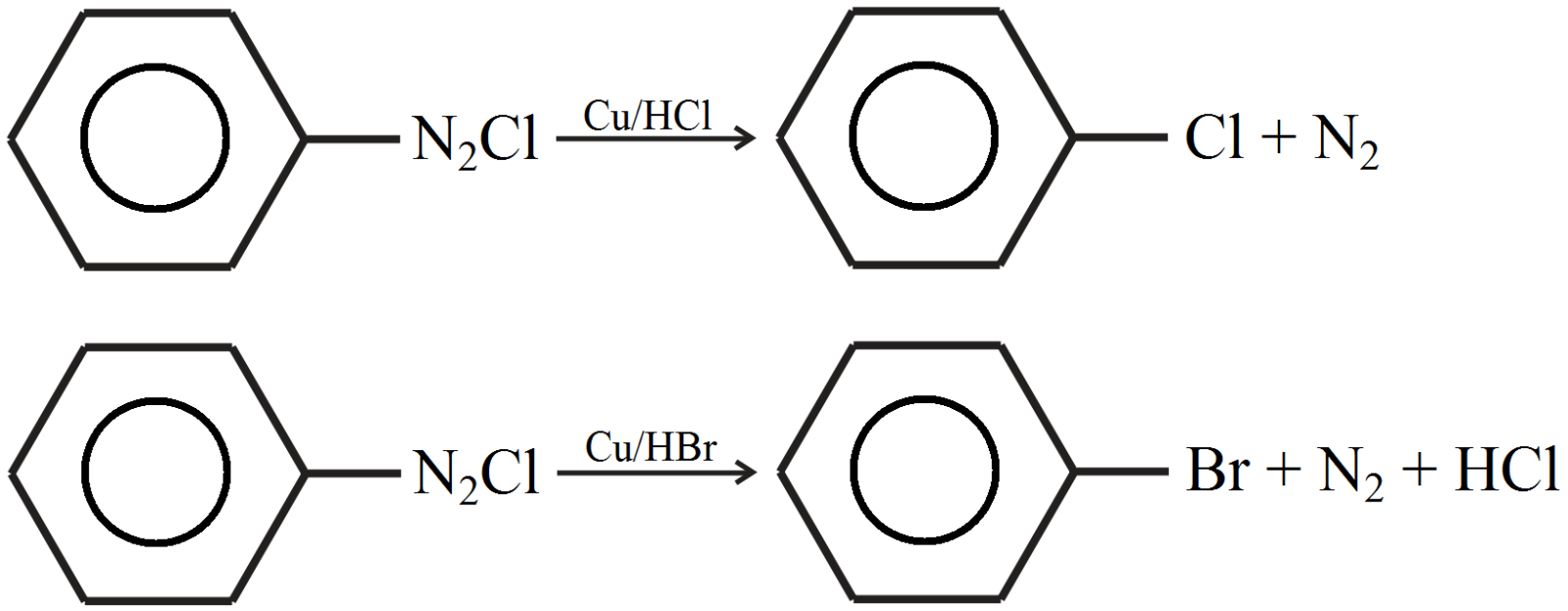
Gatterman’s Reaction: The reaction of diazonium salts with ‘Cu’ powder in the presence of corresponding halogen acids is known as Gatterman’s reaction.
View full question & answer
Question 283 Marks
Answer thefollowing:
  1. Haloalkanes easily dissolve in organic solvents,why?
  2. What is known as a racemic mixture? Give an example.
  3. Of the two bromoderivatives, $C_6H_5CH(CH_3)Br$ and $C_6H_5CH(C_6H_5) Br$, which one ismore reactive in $S_N1$ substitution reaction and why?
Answer
  1. Because the new intermolecular attractions between haloalkanes and solvent molecules have about the same strength or stronger than the existing ones in themolecules.
  2. Amixture containing two enantiomers in equal proportions is known as a racemic mixture. e.g. (+) butan-2-ol.
  3. $C_6H_5CH(C_6H_5)$ Br, because it forms more stable carbocation.
View full question & answer
Question 293 Marks
Following compounds are given to you:
2-Bromopentane, 2-Bromo-2-methylbutane, 1-Bromopentane
  1. Write the compound which is most reactive towards $S_N2$ reaction.
  2. Write the compound which is optically active.
  3. Write the compound which is most reactive towards $\beta$-elimination reaction.
Answer
  1. 1-Bromopentane.
  2. 2-Bromopentane.
  3. 2-Bromo-2-methylbutane.
View full question & answer
Question 303 Marks
Complete the following giving the structures of major organic products.
$(\text{CH}_3)_3-\text{C}-\text{Br}\xrightarrow{\text{Mg}}\ .......\ \xrightarrow{\text{H}_2\text{O}}\ ......$
Answer
$\ \ \ \ \ \ \ \ \ \ \ \ \text{CH}_3\ \ \ \ \ \ \ \ \ \ \ \ \ \ \ \ \ \ \ \ \ \ \ \ \ \ \ \ \ \ \ \ \ \ \text{CH}_3\\ \ \ \ \ \ \ \ \ \ \ \ \ \ | \ \ \ \ \ \ \ \ \ \ \ \ \ \ \ \ \ \ \ \ \ \ \ \ \ \ \ \ \ \ \ \ \ \ \ \ \ \ \ \ |\ \\\text{CH}_3-\text{C}-\text{Br}\xrightarrow[\text{Dry ether}]{+\text{Mg}}\text{CH}_3-\text{C}-\text{MgBr}\\ \ \ \ \ \ \ \ \ \ \ \ \ \ |\ \ \ \ \ \ \ \ \ \ \ \ \ \ \ \ \ \ \ \ \ \ \ \ \ \ \ \ \ \ \ \ \ \ \ \ \ \ \ \ |\\ \ \ \ \ \ \ \ \ \ \ \ \ \text{CH}_3\ \ \ \ \ \ \ \ \ \ \ \ \ \ \ \ \ \ \ \ \ \ \ \ \ \ \ \ \ \ \ \ \ \ \text{CH}_3\\ _\text{2-Bromo-2methyl propane}\ \ \ \ \ \ \ _\text{tert-Butyl magnesium bromide}$$ \ \ \ \ \ \ \ \ \ \ \ \ \ \ \ \ \ \ \ \ \ \text{CH}_3\\ \ \ \ \ \ \ \ \ \ \ \ \ \ \ \ \ \ \ \ \ \ \ | \\ \xrightarrow[]{\text{H}_2\text{O}}\text{CH}_3-\text{CH}-\text{CH}_3\\ \ \ \ \ \ \ \ \ \ \ \ _\text{2-Methyl propane}$
View full question & answer
Question 313 Marks
  1.  
  1.  
  1. $\text{CH}_{3}-\text{CH}_{2}-\text{ Br}\xrightarrow{\text{AgCN } } ?$
Answer
  1.  
  1.  
  1. $CH_3CH_2NC$.
View full question & answer
Question 333 Marks
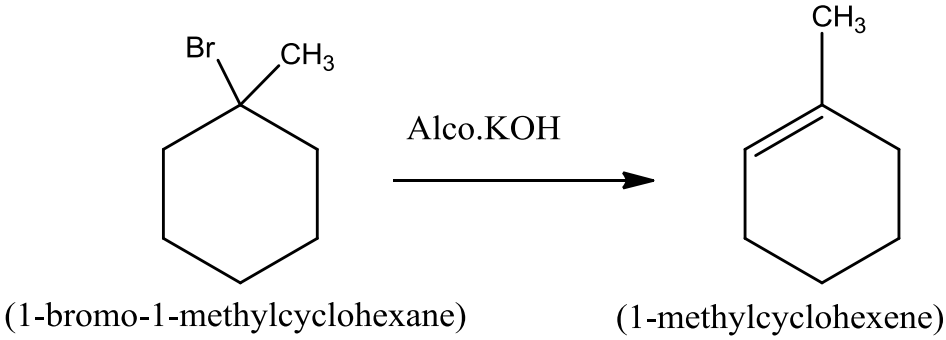
Write the structure of the alkene formed by dehydrohalogenation of 1-bromo-1-methylcyclohexane with alcoholic KOH.
Answer

The elimination reaction can be represented as.
View full question & answer
Question 343 Marks
Predict the major product formed when HCl is added to isobutylene. Explain the mechanism involved.
Answer
The major product is 2-Chloro-2-methyl propane
$ \ \ \ \ \ \ \ \ \ \ \ \ \ \ \ \ \ \ \ \ \ \ \ \ \ \ \ \ \ \ \ \ \ \ \ \ \ \ \ \ \ \ \ \ \ \ \ \ \ \ \ \ \ \ \ \ \ \ \ \ \ \ \text{Cl}\\ \ \ \ \ \ \ \ \ \ \ \ \ \ \ \ \ \ \ \ \ \ \ \ \ \ \ \ \ \ \ \ \ \ \ \ \ \ \ \ \ \ \ \ \ \ \ \ \ \ \ \ \ \ \ \ \ \ \ \ \ \ \ \ |\\\text{CH}_3-\text{C}=\text{CH}_2+\text{HCl}\xrightarrow{ \ \ \ \ \ \ \ \ }\text{CH}_3-\text{C}-\text{CH}_3\\ \ \ \ \ \ \ \ \ \ \ \ \ \ | \ \ \ \ \ \ \ \ \ \ \ \ \ \ \ \ \ \ \ \ \ \ \ \ \ \ \ \ \ \ \ \ \ \ \ \ \ \ \ \ \ \ \ \ \ \ \ \ \ |\\ \ \ \ \ \ \ \ \ \ \ \ \ \text{CH}_3 \ \ \ \ \ \ \ \ \ \ \ \ \ \ \ \ \ \ \ \ \ \ \ \ \ \ \ \ \ \ \ \ \ \ \ \ \ \ \ \ \ \ \ \text{CH}_3\\ \ \ \ \ \ \ \text{(Isobutylene)} \ \ \ \ \ \ \ \ \ \ (2-\text{Chloro-2-methylpropane})$
The mechanism involved in this reaction is:
Step 1 $\\\text{CH}_3-\text{C}=\text{CH}_2\xrightarrow{ \ \ \ \ \text{H}^+ \ \ \ \ }\text{CH}_3-+\text{C}-\text{CH}_3+\text{CH}_3-\text{CH}-+\text{CH}_3\\ \ \ \ \ \ \ \ \ \ \ \ \ \ | \ \ \ \ \ \ \ \ \ \ \ \ \ \ \ \ \ \ \ \ \ \ \ \ \ \ \ \ \ \ \ \ \ \ \ \ \ \ \ \ \ \ \ \ | \ \ \ \ \ \ \ \ \ \ \ \ \ \ \ \ \ \ \ \ \ \ \ \ \ \ \ \ \ \ \ \ |\\ \ \ \ \ \ \ \ \ \ \ \ \ \text{CH}_3 \ \ \ \ \ \ \ \ \ \ \ \ \ \ \ \ \ \ \ \ \ \ \ \ \ \ \ \ \ \ \ \ \ \ \ \ \ \text{CH}_3 \ \ \ \ \ \ \ \ \ \ \ \ \ \ \ \ \ \ \ \ \ \ \ \ \ \ \text{CH}_3\\ \ \ \ \ \ \ \text{Isobutylene} \ \ \ \ \ \ \ \ \ \ \ \ \ \ \ \ \ \ \ \ 3^\circ\text{carbocation} \ \ \ \ \ \ \ \ \ \ \ \ 1^\circ\text{carbocation}\\ \ \ \ \ \ \ \ \ \ \ \ \ \ \ \ \ \ \ \ \ \ \ \ \ \ \ \ \ \ \ \ \ \ \ \ \ \ \ \ \ \ \ \ \ \ \ (\text{more stable}) \ \ \ \ \ \ \ \ \ \ \ \ \ \ \ (\text{less stable})$
Step 2 $\ \ \ \ \ \ \ \ \ \ \ \ \ \ \ \ \ \ \ \ \ \ \ \ \ \ \ \ \ \ \ \ \ \ \ \ \ \ \ \ \ \ \ \ \ \ \ \ \ \ \ \ \ \ \ \ \ \text{Cl}\\ \ \ \ \ \ \ \ \ \ \ \ \ \ \ \ \ \ \ \ \ \ \ \ \ \ \ \ \ \ \ \ \ \ \ \ \ \ \ \ \ \ \ \ \ \ \ \ \ \ \ \ \ \ \ \ \ \ \ |\\\text{CH}_3-+\text{C}-\text{CH}_3\xrightarrow{ \ \ \ \ \text{Cl}^- \ \ \ \ }\text{CH}_3-\text{C}-\text{CH}_3 \\\ \ \ \ \ \ \ \ \ \ \ \ \ \ \ \ |\ \ \ \ \ \ \ \ \ \ \ \ \ \ \ \ \ \ \ \ \ \ \ \ \ \ \ \ \ \ \ \ \ \ \ \ \ \ \ \ \ |\\ \ \ \ \ \ \ \ \ \ \ \ \ \ \ \ \text{CH}_3 \ \ \ \ \ \ \ \ \ \ \ \ \ \ \ \ \ \ \ \ \ \ \ \ \ \ \ \ \ \ \ \ \ \ \ \text{CH}_3$
View full question & answer
Question 353 Marks
tert-Butylbromide reacts with aq.$ NaOH$ by $S_N1$ mechanism while n-butylbromide reacts by $S_N2$ mechanism. Why$?$
Answer
In general, the $S_N1$ reaction proceeds through the formation of carbocation. The tert-butylbromide readily loses Br ion to form stable $3^\circ$ carbocation. Therefore, it reacts with aqueous $KOH$ by $S_N1$ mechanism as:
$ \ \ \ \ \ \ \ \ \ \ \ \ \text{CH}_3 \ \ \ \ \ \ \ \ \ \ \ \ \ \ \ \ \ \ \ \ \ \ \ \ \ \ \ \ \ \ \ \ \ \ \text{CH}_3\\ \ \ \ \ \ \ \ \ \ \ \ \ \ | \ \ \ \ \ \ \ \ \ \ \ \ \ \ \ \ \ \ \ \ \ \ \ \ \ \ \ \ \ \ \ \ \ \ \ \ \ \ \ \ |\\\text{CH}_3-\text{C}-\text{Br}\xrightarrow[\text{Br}^-]{\text{Ionization}}\text{CH}_3-\text{C}^+\\ \ \ \ \ \ \ \ \ \ \ \ \ \ | \ \ \ \ \ \ \ \ \ \ \ \ \ \ \ \text{slow} \ \ \ \ \ \ \ \ \ \ \ \ \ \ \ \ \ \ |\\ \ \ \ \ \ \ \ \ \ \ \\ \ \ \ \ \ \ \ \ \ \ \ \text{CH}_3 \ \ \ \ \ \ \ \ \ \ \ \ \ \ \ \ \ \ \ \ \ \ \ \ \ \ \ \ \ \ \ \ \ \ \ \ \text{CH}_3\\ \ \ \ \ \ \ \ \ \ \ \ \ \ \ \ \ \ \ \ \ \ \ \ \ \ \ \ \ \ \ \ \ \ \ \ \ \ \ \ \ \text{tert-butyl carbocation}$
$ \ \ \ \ \ \ \ \ \ \ \ \ \text{CH}_3 \ \ \ \ \ \ \ \ \ \ \ \ \ \ \ \ \ \ \ \ \ \ \ \ \text{CH}_3\\ \ \ \ \ \ \ \ \ \ \ \ \ \ | \ \ \ \ \ \ \ \ \ \ \ \ \ \ \ \ \ \ \ \ \ \ \ \ \ \ \ \ \ \ |\\\text{CH}_3-\text{C}^+\xrightarrow[\text{fast}]{ \ \ \ \text{OH} \ \ \ }\text{CH}_3-\text{C}-\text{OH}\\ \ \ \ \ \ \ \ \ \ \ \ \ \ | \ \ \ \ \ \ \ \ \ \ \ \ \ \ \ \ \ \ \ \ \ \ \ \ \ \ \ \ \ |\\ \ \ \ \ \ \ \ \ \ \ \\ \ \ \ \ \ \ \ \ \ \ \ \text{CH}_3 \ \ \ \ \ \ \ \ \ \ \ \ \ \ \ \ \ \ \ \ \ \ \ \ \text{CH}_3\\ \ \ \ \ \ \ \ \ \ \ \ \ \ \ \ \ \ \ \ \ \ \ \ \ \ \ \ \ \ \ \ \ \text{tert-Butyl alcohol}$
On the other hand, $n-$Butyl bromide does not undergo ionization to form n-Butyl carbocation $(1^\circ )$ because it is not stable. Therefore, it prefers to undergo reaction by $S_N2$ mechanism, which occurs, is one step through a transition state involving nucleophilic attack of $OH^–$ ion from the back side with simultaneous expulsion of $Br^–$ ion from the front side.

$S_N1$ mechanism follows the reactivity order as $3^\circ > 2^\circ > 1^\circ$ while $S_N2$ machanism follows the reactivity order as $1^\circ < 2^\circ < 3^\circ$
Therefore, tert-butylbromide $(3^\circ )$ reacts by $S_N1$ mechanism while n-Butylbromide $(1^\circ )$ reacts by $S_N2$ mechanism.
View full question & answer
Question 363 Marks
  1. Explain the following giving suitable examples:
  1. Sandmeyer’s reaction.
  2. Coupling reaction of a diazonium salt.
  1. Explain the observed $K_b$ order:
$Et_2NH>Et_3N>EtNH_2$ in aqueous solution.
Answer
  1.  
  1. Sandmeyer’s Reaction:
$\text{C}_{6}\text{H}_{5}\text{N}_{2}^{+}\text{Cl}^{-}\xrightarrow{CuCl/HCl}\text{C}_{6}\text{H}_{5}\text{Cl}+\text{N}_{2}.$
  1. Coupling reaction:
  1. Due to combined effect of steric hinderance, hydration & inductive effects.
View full question & answer
Question 373 Marks
How will you bring about the following conversions?
Iso-propyl chloride to n-propyl chloride.
Answer
$\text{CH}_3-\text{CH}-\text{CH}_3\xrightarrow[\Delta]{\text{alc. KOH}}\text{CH}_3-\text{CH}==\text{CH}_2\xrightarrow[\text{H}_2\text{O}_2/\text{OH}^-]{+\text{H}_2\text{H}_6}\\\ \ \ \ \ \ \ \ \ \ \ \ \ |\\ \ \ \ \ \ \ \ \ \ \ \ \ \text{Cl}\\ \ _\text{Iso-propyl chloride}$$\text{CH}_3-\text{CH}_2-\text{CH}_2-\text{OH}\xrightarrow{+80\text{Cl}_2}\text{CH}_3-\text{CH}_2-\text{CH}_2\text{Cl}\\ \ \ \ \ \ \ \ \ \ \ \ \ \ \ \ \ \ \ \ \ \ \ \ \ \ \ \ \ \ \ \ \ \ \ \ \ \ \ \ \ \ \ \ \ \ \ \ \ \ \ \ \ \ \ \ \ \ \ \ \ \ \ \ \ _\text{n-Propyl cholride}$
View full question & answer
Question 383 Marks
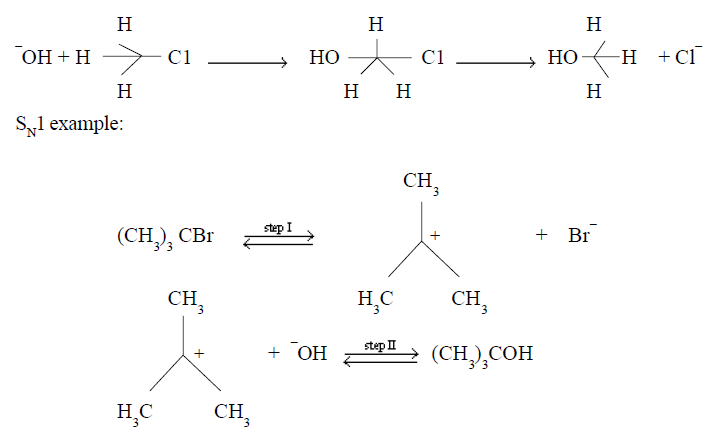
How would you differentiate between $S_N1$ and $S_N2$ mechanisms of substitution reactions? Give one example of each.
Answer
In $S_N1$ it occurs in two steps and the reaction is of first order whereas in $S_N2$ it occurs in one step and the reaction is of second order.
Alternate answer
In $S_N1$ reaction, retention of configuration takes place whereas in $S_N2$ inversion of configuration occurs.
$S_N2$ example:
View full question & answer
Question 393 Marks
Give reasons:
  1. $C–Cl$ bond length in chlorobenzene is shorter than $C–Cl$ bond length in $CH_3–Cl.$
  2. The dipole moment of chlorobenzene is lower than that of cyclohexyl chloride.
  3. $S_N1$ reactions are accompanied by racemization in optically active alkyl halides.
Answer
  1. In chlorobenzene, each carbon atom is $sp^2$ hybridised/resonating structures/partial double bond character.
  2. Due to $+R$ effect in chlorobenzene/difference in hybridization i.e. $sp^2$ and $sp^3$ respectively/$-I$ and $+R$ effect oppose each other while $–I$ effect is the only contributing factor in cyclohexane.
  3. Due to formation of planar carbocation/Carbon in carbocation formed is $sp^2$ hybridised.
View full question & answer
Question 403 Marks
Account for the following observations:
  1. $pK_b$ for aniline is more than that for methylamine.
  2. Methylamine solution in water reacts with ferric chloride solution to give a precipitate of ferric hydroxide.
  3. Aniline does not undergo Friedel-Crafts reaction.
Answer
  1. It is because in aniline the $–NH_2$ group is attached directly to the benzene ring. It results in the unshared electron pair on nitrogen atom to be in conjugation with the benzene ring and thus making it less available for protonation.
  2. Methyl amine in water gives $OH^-$ ions which react with $FeCl_3​​​​​​​$ to give precipitate of ferric hydroxide/or
$\text{CH}_{3}\text{NH}_{2}+\text{H}_{2}\text{O}\rightarrow\text{CH}_{3}\text{NH}_{3}^{+}\text{OH}^{-}\rightarrow\text{CH}_{3}\text{NH}_{3}^{+}+\text{OH}^{-}$

$Fe^{3+} + 3OH^-→ Fe(OH)_3$.
  1. Aniline does not undergo Friedel-Crafts reaction due to salt formation with aluminium chloride, the Lewis acid.
View full question & answer
Question 413 Marks
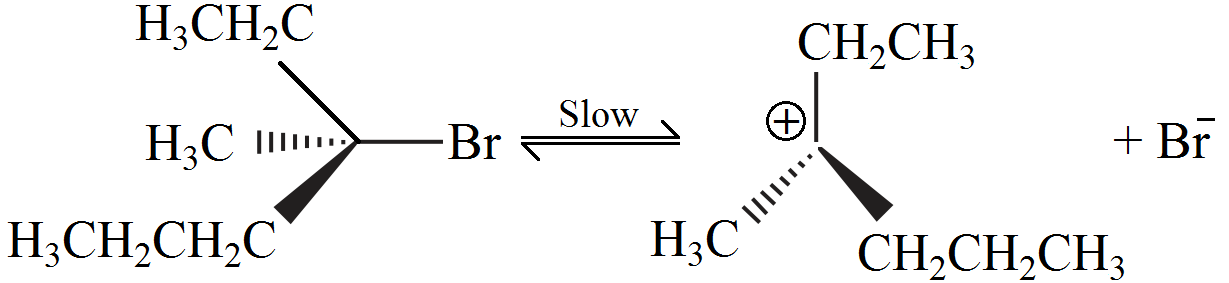
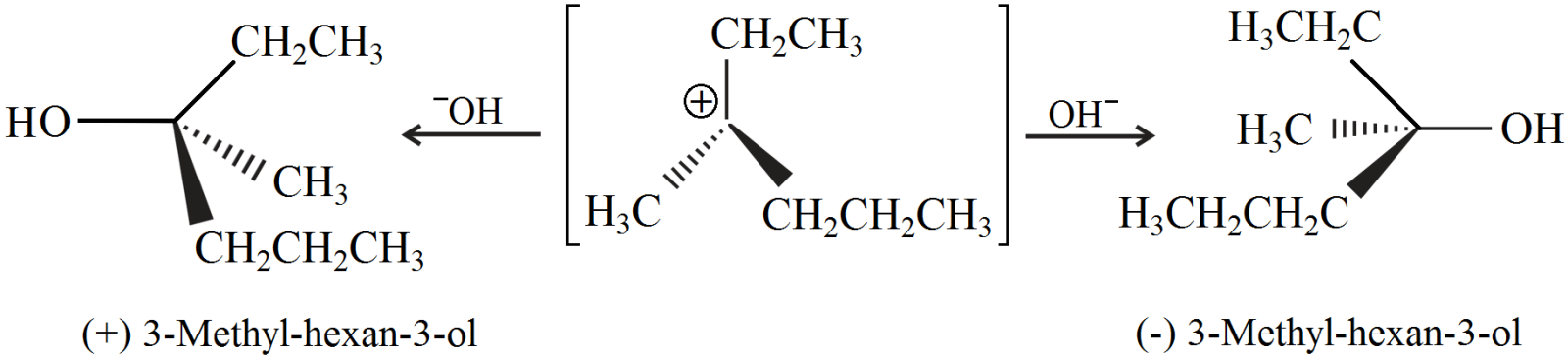
Answer the following questions: An optically active compound having molecular formula $C_7H_{15}Br$ reacts with aqueous KOH to give a racemic mixture of products. Write the mechanism involved in this reaction.
Answer

Since the optically active compound, $C_7H_{15}Br$ reacts with KOH forms a racemic mixture, therefore it must be tertiary alkyl halide and the reaction will follow $S_N1$ mechanism.
$\ \ \ \ \ \ \ \ \ \ \ \ \ \ \ \ \ \ \ \ \ \ \ \ \ \ \ \ \ \ \ \ \ \ \ \ \ \text{CH}_3\\ \ \ \ \ \ \ \ \ \ \ \ \ \ \ \ \ \ \ \ \ \ \ \ \ \ \ \ \ \ \ \ \ \ \ \ \ \ \ |\\\text{CH}_3-\text{CH}_2-\text{CH}_2-\text{C}-\text{CH}_2-\text{CH}_3+\text{OH}^-\rightarrow\\\ \ \ \ \ \ \ \ \ \ \ \ \ \ \ \ \ \ \ \ \ \ \ \ \ \ \ \ \ \ \ \ \ \ \ \ \ \ |\\ \ \ \ \ \ \ \ \ \ \ \ \ \ \ \ \ \ \ \ \ \ \ \ \ \ \ \ \ \ \ \ \ \ \ \ \ \ \text{Br}$
$\ \ \ \ \ \ \ \ \ \ \ \ \ \ \ \ \ \ \ \ \ \ \ \ \ \ \ \ \ \ \ \ \ \ \ \ \ \ \text{CH}_3\\ \ \ \ \ \ \ \ \ \ \ \ \ \ \ \ \ \ \ \ \ \ \ \ \ \ \ \ \ \ \ \ \ \ \ \ \ \ \ \ |\\\text{CH}_3-\text{CH}_2-\text{CH}_2-\text{C}-\text{CH}_2-\text{CH}_3+\text{Br}\\ \ \ \ \ \ \ \ \ \ \ \ \ \ \ \ \ \ \ \ \ \ \ \ \ \ \ \ \ \ \ \ \ \ \ \ \ \ \ |\\ \ \ \ \ \ \ \ \ \ \ \ \ \ \ \ \ \ \ \ \ \ \ \ \ \ \ \ \ \ \ \ \ \ \ \ \ \ \text{OH}\\\ \ \ \ \ \ \ \ \ \ \ \ \ \ \ \ \ \ \ \ \ _{(\pm)\text{3-Methyl-hexam-3-ol}}$
Mechansim:
  1.  
  1.  
View full question & answer
Question 433 Marks
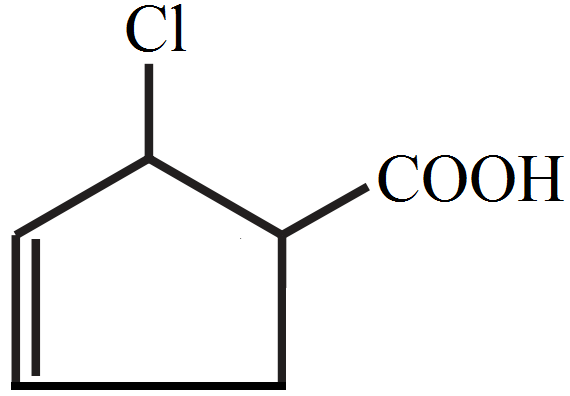
Give the IUPAC name of the following organic compounds:
  1. $(\text{CH}_3)_3\text{CCH}_2\text{Br}$
  2. $\text{CH}_3\text{CH}==\text{C}-\text{CH}-\text{CH}_3\\ \ \ \ \ \ \ \ \ \ \ \ \ \ \ \ \ \ \ \ \ \ \ \ |\ \ \ \ \ \ |\\ \ \ \ \ \ \ \ \ \ \ \ \ \ \ \ \ \ \ \ \ \ \ \text{CH}_3 \text{Br}$
  3.  
Answer
  1. 1-Bromo-2, 2-dimethyl propane.
  2. 4-Bromo-3-methyl pent-2-ene.
  3. 2-Chloro-cyclopent-3-ene carboxylic acid.
View full question & answer
Question 443 Marks
How will you bring about the following conversions?
Methyl bromide to acetone.
Answer
$\text{CH}_3-\text{Br}\xrightarrow{\text{CH}\equiv\text{C}^-\text{Na}^+}\text{CH}_3-\text{C}\equiv\text{CH}\\_\text{Methyl bromide}$$\ \ \ \ \ \ \ \ \ \ \ \ \ \ \ \ \ \ \ \ \ \ \ \ \ \text{O}\\ \ \ \ \ \ \ \ \ \ \ \ \ \ \ \ \ \ \ \ \ \ \ \ \ \ ||\\\xrightarrow[\text{HgSO}_4]{\text{H}_2\text{SO}_4}\text{CH}_3-\text{C}-\text{CH}_3\\\ \ \ \ \ \ \ \ \ \ \ \ \ \ \ \ \ \ \ \ \ \ _\text{Acetone}$
View full question & answer
Question 453 Marks
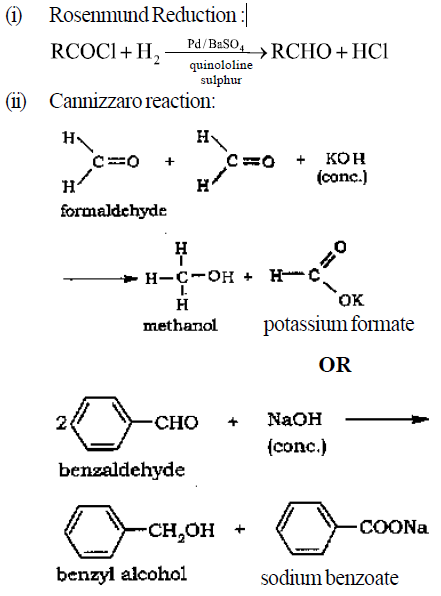
Write one chemical equation for each, to illustrate the following reactions:
  1. Rosenmund reduction.
  2. Cannizzaro reaction.
  3. Fischer esterification.
Answer

  1. Fischer esterification
$RCOCH + ROH \xrightarrow{\text{H}^{+}} RCOOR + H_2O$.
View full question & answer
Question 463 Marks
Predict the order of reactivity of the following compounds in $S_N1$ and $S_N2$ reactions:
$C_6H_5CH_2Br, C_6H_5CH(C_6H_5)Br, C_6H_5CH(CH_3)Br, C_6H_5C(CH_3)(C_6H_5)Br.$
Answer
$C_6H_5C(CH_3)(C_6H_5)Br > C_6H_5CH(C_6H_5)Br > C_6H_5CH(CH_3)Br > C_6H_5CH_2Br (S_N1).$$C_6H_5C(CH_3)(C_6H_5)Br < C_6H_5CH(C_6H_5)Br < C_6H_5CH(CH_3)Br < C_6H_5CH_2Br (S_N2).$
Of the two secondary bromides, the carbocation intermediate obtained from $C_6H_5CH(C_6H_5)B$r is more stable than that obtained from $C_6H_5CH(CH_3)Br$ because it is stabilised by two phenyl groups due to resonance. Hence, the former bromide is more reactive than the latter in $S_N1$  reaction. Phenyl group is bulkier than a methyl group. Thus, $C_6H_5CH(C_6H_5)Br$ is less reactive than $C_6H_5CH(CH_3)Br$ in $S_N2$  reactions.
View full question & answer
Question 473 Marks
How will you distinguish between the following pairs of compounds:
Benzyl chloride and chlorobenzene.
Answer
On adding sodium hydroxide and silver nitrate to both the compounds benzyl chloride forms white precipitate but chlorobenzene does not form white precipitate.
$\text{C}_6\text{H}_5\text{CH}_2\text{Cl}+\text{NaOH}\rightarrow\text{C}_6\text{H}_5\text{CH}_2\text{OH}+\text{NaCl}$
$\text{NaCl}+\text{AgNO}_3\rightarrow\text{AgCl(s)}+\text{NaNO}_3\\ \ \ \ \ \ \ \ \ \ \ \ \ \ \ \ \ \ \ \ \ \ \ \ \ \ \ \ \ \ \ \ \ \ ^{\text{White ppt.}}$
View full question & answer
Question 483 Marks
Give reasons for the following: p-nitrochlorobenzene undergoes nucleophilic substitution faster than chlorobenzene. Explain giving the resonating structures as well.
Answer

In p-nitrochlorobenzene a carbanion intermediate is formed. This is stabilised by resonance as shown below.

The -I effect of nitro group further stabilises the intermediate. Hence, p-nitrochlorobenzene reacts faster than chlorobenzene.
View full question & answer