Questions

2 Marks Questions

Take a timed test

6 questions · self-marked practice — reveal the answer and mark yourself.

Question 12 Marks
Based on solute$-$solvent interactions, arrange the following in order of increasing solubility in $n-$octane and explain. Cyclohexane, $\ce{KCl, CH_3OH, CH_3CN}.$
Answer
$n-$octane is a non$-$polar solvent.
Therefore, the solubility of a non$-$polar solute is more than that of a polar solute in the $n-$octane.
The order of increasing polarity is:
Cyclohexane $\ce{< CH_3CN < CH_3OH < KCl}$
Therefore, the order of increasing solubility is:
$\ce{KCl < CH_3OH
View full question & answer
Question 22 Marks
Transition elements show high melting points. Why?
Answer
The high melting points of transition metals are due to strong metallic bonds between the atoms of these elements This is because of involvements of a greater number of electrons in the interatomic metallic bonding from (n-1)d orbitals in addition to ns electrons in the interatomic molecular bonding.
View full question & answer
Question 32 Marks
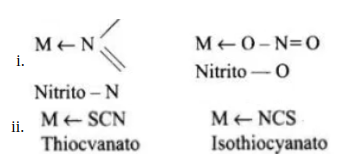
Name the type of isomerism when ambidentate ligands are attached to the central metal ion. Give two examples of ambidentate ligands.
Answer
Linkage isomerism- arises in a coordinated compound containing ambidentate ligand
Examples.
Image
View full question & answer
Question 42 Marks
Answer the following:
(a) A reaction is 50% complete in 2 hours and 75% complete in 4 hours. What is the order of the reaction?
(b) For which type of reactions, order and molecularity have the same value?
Answer
Answer the following:
(i) First order.
(ii) Elementary reactions have the same value of order and molecularity because the elementary reaction proceeds in a single step.
View full question & answer
Question 52 Marks
What happens when
i. a pressure greater than osmotic pressure is applied on the solution side separated from solvent by a semipermeable membrane?
ii. acetone is added to pure ethanol?
Answer
i. Reverse osmosis (direction of osmosis is reversed) occurs i.e. net flow of the solvent is from solution to solvent. Hence greater pressure is applied to the solvent molecules from the solution side would move into the pure solvent through a semipermeable membrane.
ii. When acetone is added to the ethanol, molecules of acetone get in between the molecules of ethanol and break some of the hydrogen bond, which weakens the intermolecular attractive forces resulting in an increase in vapor pressure of the mixture than ethanol in a pure state.
View full question & answer