Questions

3 Marks Question

Take a timed test

8 questions · self-marked practice — reveal the answer and mark yourself.

Question 13 Marks
Zinc rod is dipped in $0.1 M$ solution of $ZnSO _4$
The salt is $95 \%$ dissociated at is dilution at $298 K$ . Calculate the electrode potential. Given
$E ^0\left( Zn ^{2+} / Zn \right)=-0.76$
Answer
${\left[Z n^{2+}\right]=0.1 \times \frac{95}{100}=0.095 M}$
$Z n^{2+}+2 e^{-} \rightarrow Z n$
$E_{\left(Z n^{+} / Z n\right)}=E_{\left(Z n^{+} / Z n\right)}^0-\frac{0.0591}{2} \log \frac{1}{\left[Z n^{2+}\right]}$
$=-0.76 V-\frac{0.0591}{2} \log \frac{1}{0.095}$
$=-0.76 V-\frac{0.0591}{2}[\log 1000-\log 95]$
$=-0.76-\frac{0.0591}{2}[3.000-1.9777]$
$=-0.76 V-\frac{0.0591}{2} \times 1.0223$
$=-0.76 V-\frac{0.0604}{2}=0.76-0.0302$
$=-0.7902 V$
View full question & answer
Question 23 Marks
Give structures of the products you would except when each of the following alcohols
$i.$ Butan$-1-ol$
$ii.\ 2-$Methylbutan$-2-ol$ react with
$a.\ HCI - ZnCl_2$
$b.\ HBr$ and
$c.\ SOCI_2$​​​​​​​
Answer
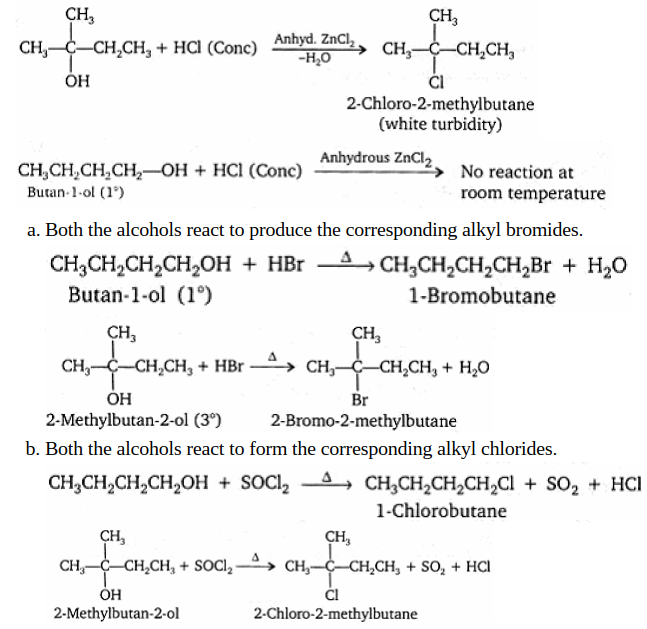
$i.\ a.$ With $HCl - ZnCl_2 ($lucas reagent$)\ 2-$Methylbutane$-2-ol$
$ii.$ Being a $3^\circ$ alcohol, reacts with Lucas reagent to produce turbidity immediately due to the formation of insoluble tert-alkyl chloride while butane-l-ol $(i)$ being a $1^\circ$ alcohol does not react with Lucas reagent at room temperature.
Image
View full question & answer
Question 33 Marks
Image
Image
Image
Answer
Image
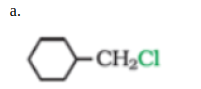
is more reactive towards $S_N2$ because it is a primary halide.
Image
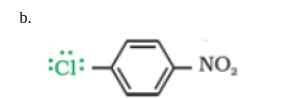
is more reactive towards nucleophilic substitution reaction because it is more reactive due to the presence of electron with drawing $-$ $NO_2$ group.
Image
View full question & answer
Question 43 Marks
The following results have been obtained during the kinetic studies of the reaction.
$2A + BC \rightarrow D$
Experiment $[A]/mol L^{-1}$ $[B]/mol L^{-1}$ Initial rate of formation of $D/mol L^{-1} \min^{-1}$
$I$ $0.1$ $0.1$ $6.0 x 10^{-3}$
$II$ $0.3$ $0.2$ $7.2 x 10^{-2}$
$III$ $0.3$ $0.4$ $2.88 \times 10^{-1}$
$IV$ $0.4$ $0.1$ $2.40 x 10^{-2}$

Determine the rate law and the rate constant for the reaction.
Answer
From experiments $I$ and $IV,$ it may be noted that $[B]$ is same but $[A]$ has been made four times, the rate of reaction has also becomes four times. This means $\text{w.r.t A}$
$\text { Rate } \propto[A]$
From experiments $II$ and $III$ it may be noted that $[A]$ is kept same an $[B]$ has been doubled, the rate of reaction has become four times. This means $\text{w.r.t B},$
$\text { Rate } \propto[B]^2$
Combining $(i)$ and $(ii),$ we get the rate law for the given reaction as:
$\text { Rate }=k[A][B]^2$
Thus order $ \text{w.r.t A =1}$
Order $\text{w.r.t B} =2$
The overall order of the reaction
$=1+2=3$
The rate constant and its units can be calculated from the data of each experiment using the expression. $k=\frac{\text { rate }}{[A][B]^2}$
$=\frac{mol L^{-1} \min ^{-1}}{\left(mol L^{-1}\right)\left(mol L^{-1}\right)^2}$
$=mol^{-2} L^{-2} \min ^{-1}$
Expt. $k=$ mol $^{-2} L^{-2} \min ^{-1}$
i. $\frac{6.0 \times 10^{-3}}{0.1 \times(0.1)^2}=6.0$
ii. $\frac{7.2 \times 10^{-2}}{0.3 \times(0.2)^2}=6.0$
iii. $\frac{2.88 \times 10^{-1}}{0.3 \times(0.4)^2}=6.0$
iv. $\frac{2.4 \times 10^{-2}}{0.4 \times(0.1)^2}=6.0$
Rate constant $k=6.0 mol^{-2} L^{-2} \min ^{-1}$
View full question & answer
Question 53 Marks
Calculate the emf of the following cell at $298 K$ .
$2 Cr(s)+3 Fe^{2+}(0.1 M) \rightarrow 2 Cr^{3+}(0.01 M)+3 Fe(s)$
Given, $E_{c r^{3+} / c r}^o=-0.74 V, E_{F e^{2+} / F e}^o=-0.44 V$
Answer
Since oxidation of $Cr$ is taking place in the given reaction, the chromium electrode is anode and as $Fe$ is reduced in the reaction, $Fe$ electrode is the cathode.
The half$-$cell reactions are as follows.
At anode $\left.Cr \rightarrow Cr ^{3+}+3 e ^{-}\right] \times 2$
At cathode $\left.Fe ^{2+}+2 e ^{-} \rightarrow Fe \right] \times 3$
Overall reaction
$2 Cr+3 Fe^{2+} \rightarrow 2 Cr^{3+}+3 Fe$
$\text { Eo }=E_{\text {cathode }}-E_{\text {anode }}=-0.44-(-0.74)=0.3 V$
$E=E^{o}-\frac{0.0591}{n} \log \frac{\left[Cr^{3+}\right]^2}{\left[Fe^{2+}\right]^3}$
Here, $n =$ number of electrons transferred, i.e. equal to $6$ .
$=0.3-\frac{0.0591}{6} \log \frac{[0.01]^2}{[0.1]^3}$
$=0.309 \approx 0.31$
View full question & answer
Question 63 Marks
Calculate the e.m.f at $25^{\circ} c$ for the following cell:
$N i(s)\left|N i^{2+}(0.01 M) \| C u^{2+}(0.1 M)\right| C u(s)$
Given: $E ^0 Ni ^{+2} / Ni =-0.25 V$
$E_{C u^{2+} / C u}^0=+0.34 V$
$\left[1 F=96,500 Cmol ^{-1}\right]$. Calculate the maximum work that can be accomplished by the operation of this cell
Answer
Cell reaction is
$N i(s)\left|N i^{2+}(0.01 M)\right|\left|C u^{2+}(0.1 M)\right| C u(s)$
At anode : $N i(s) \rightarrow N i^{2+}(a q)+2 e^{-}$
At cathode: $Cu ^{2+}(a q)+2 e \rightarrow Cu (s)$
Net cell reaction
$Ni(s)+Cu^{2+}(a q) \rightarrow N i^{2+}(a q)+Cu(s)$
$E_{\text {cell }}=E_{\text {cell }}^0-\frac{0.0591}{2} \log \frac{\left[Ni^{2+}\right]}{\left[Cu^{2+}\right]}$
$=[+0.34 V-(-0.25 V)]-\frac{0.0591}{2} \log \frac{1}{10}$
$=0.59 V-\frac{0.0591}{2} \times-1$
$=0.59+0.0295$
$=0.6195 V$
$\Delta G=-n E F$
$=-2 \times 0.6195 V \times 96500 C / mol$
$=-119563.5 J / mol$
$\Delta G=-119.5635 KJ / mol$
$-\Delta G=W_{\max }=119.5635 KJ / mol$
View full question & answer
Question 73 Marks
Draw structures of the following derivatives:
i. 2,4-Dinitrophenylhydrazone of benzaldehyde
ii. Cyclopropanone oxime
iii. Acetaldehydedimethylacetal
View full question & answer
Question 83 Marks
Explain how does the - OH group attached to a carbon of benzene ring activate it towards electrophilic substitution?
Answer
The -OH group is an electron-donating group. Thus, it increases the electron density in the benzene ring as shown in the given resonance structure of phenol.
Image
As a result, the benzene ring is activated towards electrophilic substitution.
View full question & answer