Questions

M.C.Q (1 Marks)

Take a timed test

12 questions · self-marked practice — reveal the answer and mark yourself.

Question 11 Mark
Aniline does not undergo Friedel - Crafts reaction because:
Answer
(b) Aluminium chloride reacts with Aniline
Explanation: $AlCl _3$ being a lewis acid reacts with the lone pair of $- NH _2$ group of aniline forming an adduct $\left( C _6 H _5 NH _2{ }^{+} AlCl _3\right)$ which deactivates the benzene system hence no friedal craft reaction occurs.
View full question & answer
Question 21 Mark
Williamson's synthesis is used for the preparation of
Answer
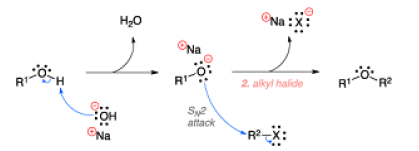
The Williamson ether synthesis is an organic reaction, forming an ether from an organohalide and deprotonated alcohol $($alkoxide$).$ This reaction was developed by Alexander Williamson in $1850.$ Typically it involves the reaction of an alkoxide ion with a primary alkyl halide via an $S_N2$ reaction.
Image
View full question & answer
Question 31 Mark
The reduction of ethanenitrile with sodium and alcohol gives:
Answer
(a) 1-aminoethane
Explanation: 1-aminoethane
View full question & answer
Question 41 Mark
The reaction $A \rightarrow B$ is a second order process when the initial concentration of $A$ is $0.50 M$, the half life is $8.0$ minutes. What is the half life if the initial concentration of $A$ is $0.10 M?$
Answer
$(a) 40.0$ minutes
Explanation: For second$-$order reaction:
$t_{1 / 2}=\frac{2 k}{[R]}$
$\Rightarrow k=\frac{t_{1 / 2}[R]}{2}$
Applying this equation,
$\frac{t_{1 / 2}[R]}{2}=\frac{t_{1_{1 / 2}}\left[R^{\prime}\right]}{2}$
$\frac{8.0 \times 0.50}{2}=\frac{t_{1 / 2}^{\prime} \times 0.10}{2}$
$t_{1 / 2}^{\prime}=\frac{8 \times 0.50}{0.10}=40$
View full question & answer
Question 51 Mark
The compound which forms acetaldehyde when heated with dilute NaOH is:
Answer
(d) 1, 1 dichloroethane
Explanation: $CH _3 CHCl _2+ OH ^{-} \rightarrow CH _3 CH ( OH )_2 \rightarrow CH _3 CHO + H _2 O$
Gem diols like $\left( CH _3 CH ( OH )_2\right.$ ) are generally not stable. The $2- OH$ group attached to the same C removes $H _2 O$ and forms carbonyl compounds.
View full question & answer
Question 61 Mark
Silver ornaments turn black by the presence of which gas in the atmosphere?
Answer
Silver ornaments turns black coming in contact with $\ce{H_2S}$ due to formation of $\ce{Ag_{2}S}.$
The chemical equation for this change can be represented as given below: $\ce{2Ag(s) + H_2S(g) Ag_{2}S(s) + H_2(g)}$
View full question & answer
Question 71 Mark
$\ce{CH_3CONH_2}$ on reaction with $\ce{NaOH}$ and $Br_2$ in alcoholic medium gives$:$
Answer
Product formed is $\ce{CH_3NH_2}$
View full question & answer
Question 81 Mark
Image
Answer
(b) 1-Bromo-2-methylbutane
Explanation: First, we need to identify the longest carbon chain. Once we do that, the actual structure should read $CH _3- CH _2$ $- CH \left( CH _3\right)- CH _2- Br$. - Br , the functional halide group is attached to the first carbon atom (1- Bromo), so we start the numbering from that position. The methyl group branch is bond to the second carbon atom in the chain(2-methyl). The number of carbons in the unbranched parent chain is four, thus giving the name butane. The IUPAC is named 1-Bromo-2methylbutane.
View full question & answer
Question 91 Mark
Chlorobenzene is formed by the reaction of chlorine with benzene in the presence of $\ce{AlCl_3}.$ Which of the following species attacks the benzene ring in this reaction?
Answer
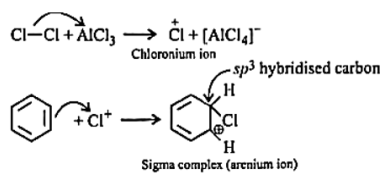
Aluminum chloride $\ce{( AlCl_3)}$ is a Lewis acid catalyst and works in the same way as $\ce{FeCl_3}$ does. Benzene $\ce{( C_6H_6)}$ is converted into chlorobenzene by chlorination of benzene in the presence of $\ce{AlCl_3}.$ The reaction occurs by an electrophilic substitution reaction. $\ce{Cl_2}$ forms a coordination complex with $\ce{AlCl_3}$, forming $\ce{Cl ^{+} AlCl_4^{-}}$ complex, which gives a slight positive charge to $Cl ,$ and $\ce{AlCl_4^{-}}$ is negatively charged. This $Cl ^{+}$ then reacts with the aromatic double bond of the benzene ring to form an additional product, followed by deprotonation to form chlorobenzene and $\ce{AlCl_3}$ and $\ce{HCl}$ as the side products.
Image
View full question & answer
Question 101 Mark
The following experimental rate data were obtained for a reaction carried out at $25^{\circ} C : A_{(g)}+B_{(g)} \rightarrow C_{(g)}+D_{(g)}$
Initial $[A_{(g)}] \ce{mol dm^{-3}}$ Initial $[B_{(g)}]\ce{mol dm^{-3}}$ Initial rate $\ce{mol dm^{-3}S^{-1}}$
$3.0 \times 10^{-2}$ $2.0 \times 10^{-2}$ $1.89 \times 10^{-4}$
$3.0 \times 10^{-2}$ $4.0 \times 10^{-2}$ $1.89 \times 10^{-4}$
$6.0 \times 10^{-2}$ $4.0 \times 10^{-2}$ $7.56 \times 10^{-4}$
Answer
Order with respect to $A_{(g)}$
Second Order with respect to $B_{(g)} -$ Zero
View full question & answer
Question 111 Mark
Match the items given in column $I$ with that in column $II:$
Column $I$ Column $II$
$(a)$ Urea $(i) i < 1$
$(b) \ce{FeCl_3}$ $(ii) i = 1$
$(c)$ Benzoic acid in Benzene $(iii) i = 2$
$(d) \ce{MgSO_4}$ $(iv) i = 4$
Answer
$(a)-(ii), (b)-(iv), (c) - (i), (d) - (iii)$
View full question & answer
Question 121 Mark
Which of the following reactions of glucose can be explained only by its cyclic structure?
Answer
(b) Pentaacetate of glucose does not react with hydroxylamine.
Explanation: The pentaacetate of glucose does not react with the hydroxylamine indicating the absence of free -CHO group. This property of the glucose can be explained only by its own cyclic structure.
View full question & answer