Questions

2 Marks Questions

Take a timed test

6 questions · self-marked practice — reveal the answer and mark yourself.

Question 12 Marks
The presence of Carbonyl group in glucose is confirmed by its reaction with hydroxylamine. Identify the type of carbonyl group present and its position. Give a chemical reaction in support of your answer.
Answer
The carbonyl group present in glucose is aldehyde and the $C_1$ atom.
Glucose gets oxidised to six $-$ carbon carboxylic acid $($gluconic acid$)$ with $\text{COOH}$ group at the $\ce{Cl}$ atom on reaction with a mild oxidising agent like bromine water.
This indicates that the carbonyl group is present as an aldehydic group
View full question & answer
Question 22 Marks
Complete the following reactions by writing the major and minor product in each
case $($any $2)$
a. $\ce{CH_3CH_2Br + KCN \rightarrow}$
b.$\ce{CH_3CH_2CH=CH_2 + HBr \rightarrow}$
c. $\ce{(CH_3)_2CHCHCICH_3 + alc KOH \rightarrow}$
Answer
$(a)\ \ce{CH_3CH_2CN (major), CH_3CH_2NC (minor)}$
$(b)\ \ce{CH_3CH_2CHBrCH_3 (major) CH_3CH_2CH_2CH_2Br (minor)}$
$(c)\ \ce{(CH_3)_2C=CHCH_3 (major) (CH_3)_2CHCHCH_2 (minor)}$
View full question & answer
Question 32 Marks
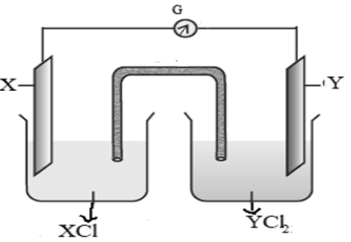
Observe the following cell and answer the questions that follow:
Image
a. Represent the cell shown in the figure.
b. Name the carriers of the current in the salt bridge
c. Write the reaction taking place at the anode.
Answer
$(a)\mathrm{Y}(\mathrm{s})\left|\mathrm{Y}^{2+}(\mathrm{aq})\right|\left|\mathrm{X}^{+}(\mathrm{aq})\right| X(\mathrm{~s})$
$(b)$ ions are carrier of current in salt bridge
$(c) \ce{Y(s)\rightarrow Y^{2+}(aq) + 2e}$
View full question & answer
Question 42 Marks
a. Write the $\text{IUPAC}$ name of the following complex : $\ce{K[Cr(H_2O)_2(C_2O_4)_2]H_2O}$
b. Name the metal present in the complex compound of $(i)$ Haemoglobin $(ii)$ Vitamin $B-12$
Answer
$(a)$ Potassium diaquadioxalatochromate $(III)$ hydrate
$(b) \ (i)$ Haemoglobin: Iron $(ii)$ Vitamin $B-12$ : Cobalt
View full question & answer
Question 52 Marks
a. A soda bottle will go flat (loose its fizz) faster in Srinagar than in Delhi. Is this statement correct? Why or why not?
b. How does sugar help in increasing the shelf life of the product?
Answer
(a) At higher altitudes i.e. in Srinagar the atmospheric pressure is lower. The solubility of a gas in a liquid is directly proportional to the partial pressure of the gas over the solution, therefore, the carbon dioxide dissolved in water will be lesser at Srinagar making the soda go flat faster.
(b)Preservation of fruits by adding sugar/salt protects against bacterial action. Through osmosis, a bacterium on canned fruit loses water, shrivels and dies.
View full question & answer
Question 62 Marks
a. Nitrogen gas is soluble in water. At temperature $293 K$, the value of $K_HiS 76.48$ kbar. How would the solubility of nitrogen vary $($increase, decrease or remain the same$)$ at a temperature above $293 K_H$ if the value of $K_1$ rises to 88.8 kbar.
b. Chloroform $(b.p. 61.2^\circ C)$ and acetone $(b.p. 56^\circ C)$ are mixed to form an azeotrope. The mole fraction of acetone in this mixture is $0.339$. Predict whether the boiling point of the azeotrope formed will be $(i) 60^\circ C (ii) 64.5^\circ C$ or $(iii)54 ^\circ C.$ Defend your answer with reason.
Answer
$(a)$ Solubility of gas is inversely proportional to the value of Henry's constant $K_{H-}$. On increasing temperature nitrogen gas becomes less soluble because its $K_H$ value increases.
$(b) \ (ii)64.5 ^\circ C$
Chloroform and acetone mixture show negative deviation from Raoult's law therefore, they form maximum boiling azeotrope at a specific composition. The boiling point of the mixture so obtained will be higher than the individual components.
View full question & answer