Questions

5 Marks Questions

Take a timed test

4 questions · self-marked practice — reveal the answer and mark yourself.

Question 15 Marks
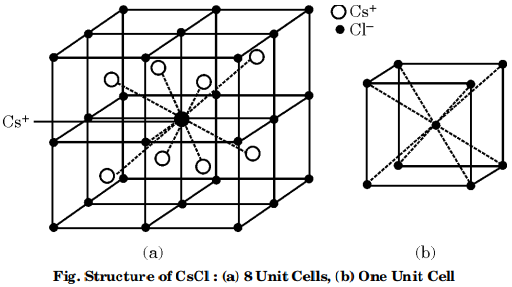
Describe the structure of CsCl.
Answer
CsCl (bcc) : $Cl ^{-}$in cubic arrangement $Cs ^{+}$ion occupy cubic voids.
Coordination No. $8: 8$
and $\frac{r_{+}}{r_{-}}=0.93$
Number of formula per unit cell $=1$
Image
View full question & answer
Question 25 Marks
What is packing efficiency? Determine the packing efficiency of hcp and ccp structure.
Answer
Packing Efficiency : Percentage of the avai-lable volume occupied by the ispheres (atoms) is called packing efficiency.
Packing Efficiency in hep and cep structures.
In cep and hep structures the packing efficiency is 74%. Let us calculate the packing efficiency in ccp structure.
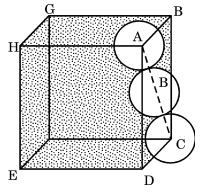
In figure, let the unit cell edge length by 'a' and face diagonal. AC = b.
In $\Delta ABC$,$\quad$$AC ^2= BC ^2+ AB ^2$
$b^2=a^2+a^2 \Rightarrow b=\sqrt{2} a$
If $r$ is the radius of sphere, then
$b=4 r=\sqrt{2} a \Rightarrow a=\frac{4 r}{\sqrt{2}}=2 \sqrt{2} r ; \therefore r=\frac{a}{2 \sqrt{2}}$
There are four spheres per unit cell in ccp structure.
Volume of four spheres $=4 \times \frac{4}{3} \pi r^3$, and
Volume of cubic is $a^3=(2 \sqrt{2} r)^3=16$
Image
Percentage of packing efficiency
$=\frac{\text { Volume occupied by four spheres of unit cell }}{\text { Total Volume of the Unit Cell }} \times 100 \%$
$=\frac{4 \times \frac{4}{3} \pi r^3 \times 100}{16 \sqrt{2} \pi^3} \%=\frac{\pi}{3 \sqrt{2}} \times 100 \%=74 \%$
View full question & answer
Question 35 Marks
(i) If NaCl is doped with $ 10^{-3} $ mol % $ SrCl_{2} $ then what is the concentration of cations vacancies?
(ii) Write the uses of amorphous solids.
Answer
(i) Doping of NaCl with $10^{-3} mol \%$ means that 100 moles of NaCl are doped with $10^{-3} mol$ of $SrCl _2$.
$\therefore 1$ mole of NaCl is doped with $SrCl _2=\frac{10^{-3}}{100}=10^{-5}$ mole.
As each $Sr ^{2+}$ ion creates one cation vacancy, therefore, concentration of cationic vacancies
$=10^{-5} mol / mol$ of NaCl
$=10^{-5} \times 6.023 \times 10^{23}=6.023 \times 10^{18} mol^{-1}$
(ii) Uses of Amorphous Solids:
(a) The most widely used amorphous solids are inorganic glasses which are used in construction, houseware, laboratoryware etc.
(b) Amorphous silica is the best material for converting the sunlight into electricity (in photovoltaic cells).
(c) Rubber is also an amorphous solid which is used in making tyres, shoe soles etc.
(d) A large number of plastics which are amorphous solids are used in making articles of daily use.
View full question & answer
Question 45 Marks
What is imperfections? How many types of its? Explain.
Answer
An ideal crystal is one which has the same unit cell containing the same lattice points throughout the whole of the crystal. At absolute zero (0 K) most of the ionic crystals are ideal but with rise in temperature, there is a chance of distortion. The defect may appear at a point, along a line or over a surface.
Generally imperfections are of two types :
1. Electronic Imperfections : In a pure covalent crystals (e.g., Si) or ionic crystals (e.g., NaCl) at absolute zero (0 K) electrons are present in lowest energy states. But, at higher temperatures, of the electrons may occupy higher energy states depending upon the temperature. For example, in crystals of pure silicon, some electrons are released from covalent bonds at temperature above 0 K. The bonds from which electrons have been removed become electron deficient and these are called holes. These electrons become mobile and are responsible for electrical conductivity. This is known as intrinsic condition.
The holes in an electric field move in opposite direction to that in which electron move. The electrons and holes in solids give rise to electronic imperfections.
2. Atomic or Point Imperfections -The defects or imperfections arise due to the irregularity in the arrangement of atoms or ions are known as point defects or atomic imperfections. These are produced when an equal number of cations and anions are missing from the regular lattice positions and thus an equal number of cations and anionic vacancies are produced or when an ion of an ionic crystal is missing and is shifted to a vacant interstitial site existing in the structure of the crystal.
Atomic or point defects may occur in stoichiometric as well as in non-stoichiometric crystals. The point defects found in stoichiometric crystals are called stoichiometric defects while the point defects found in non-stoichiometric crystals are known as non-stoichiometric defects.
View full question & answer