Questions

3 Marks Question

Take a timed test

3 questions · self-marked practice — reveal the answer and mark yourself.

Question 13 Marks
Write differences between adsorption and absorption.
Answer
AdsorptionAbsorption
1. The concentration of subtances takes place on the interface of two immiscible phases.1. The substance is distributed in the whole body of the adsorbent to form a solution of a compound.
2. It is a surface phenome-non.2. Absorption equilibrium is slow.
3. In it, the concentration of substance is always greater on the interface than in the bulk.3. It is a bulk phenonenon. In if molecules of adsorbate penetrate the whole body of adsorbent.
View full question & answer
Question 23 Marks
(i) What is the role of activated charcoal in gas mask?
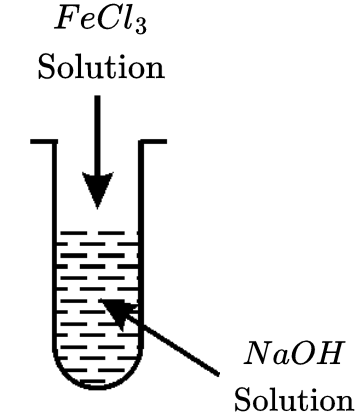
(ii) A colloidal sol is prepared by the given method in figure. What is the charge on hydrated ferric oxide colloidal particles formed in the test tube? How is the sol represented?
(iii) How does chemisorption vary with temperature ?
Image
Answer
(i) The activated charcoal adsorbs the poisonous gases rather than oxygen and provides fresh oxygen for inhaling.
(ii) When ferric chloride is added to NaOH, a negatively charged sol is formed with adsorption of $OH^{-}$ ions. The sol is represented as: $[Fe(OH)_{3}]OH^{-}$.
(iii) Adsorption is an exothermic process. According to Le Chatelier's at low temperature forward reaction is favourable. As temperature increases enough energy is being provided for the molecules to reach the activation energy. Therefore, initially as temperature increases, chemisorption increases. As the high temperature helps in bond breaking, after certain temperature, chemisorption decreases.
View full question & answer
Question 33 Marks
What are lyophobic and lyophilic sols ? Give their chief distinguishing characteristics.
Answer
Lyophobic sols : The colloidal solutions in which the dispersed phase has no attraction for dispersion medium. They are irreversible in nature and get precipitated on adding small amount of electrolyte. They do not get hydrated much as they have no affinity for the solvent. Examples : Metals and metal sulphides.
Lyophilic sols : They are the colloids in which particles of dispersed phase have a great affinity for the dispersion medium. They are reversible in nature for their precipitation large amount of electrolyte is required due to the attraction for solvent they are heavily hydrated. Examples : gum, gelatine.
View full question & answer