Questions

Answer the question [ 4 mark question ]

Take a timed test

10 questions · self-marked practice — reveal the answer and mark yourself.

Question 14 Marks
If function $f(x)=\frac{1-\cos (c x)}{x \sin x}, x \neq 0$ and $f(0)=\frac{1}{2}$ and $f(x)$ is continuous at $x=0$ then find value of $c$.
Answer
Given function
$
f(x)=\left\{\begin{array}{cc}
\frac{1-\cos c x}{x \sin x}, & x \neq 0 \\
\frac{1}{2}, & x=0
\end{array}\right.
$
is continuous at $x=0$.
value of function at $x=0$.
$
f(x)=\frac{1}{2} \quad \therefore f(0)=\frac{1}{2}
$
value of R.H.L.$
\begin{aligned}
\lim _{x \rightarrow 0^{+}} f(x) & =\lim _{h \rightarrow 0} f(0+h) \\
=\lim _{h \rightarrow 0} \frac{1-\cos c(0+h)}{(0+h) \sin (0+h)} & =\lim _{h \rightarrow 0} \frac{1-\cos c h}{h \sin h} \\
& =\lim _{h \rightarrow 0} \frac{2 \sin ^2\left(\frac{c h}{2}\right)}{h^2\left(\frac{\sin h}{h}\right)} \\
& =\lim _{h \rightarrow 0} \frac{2\left[\frac{\sin \left(\frac{c h}{2}\right)}{\left(\frac{c h}{2}\right)}\right]^2 \times\left(\frac{c h}{2}\right)^2}{h^2\left(\frac{\sin h}{h}\right)} \\
& =\frac{c^2}{2} \lim _{h \rightarrow 0} \frac{\left[\frac{\sin (c h / 2)}{(c h / 2)}\right]^2}{(\sin h / h)} \\
& =\frac{c^2}{2} \times 1 \\
& =\frac{c^2}{2}
\end{aligned}
$
function is continuous at $x=0$
$
\begin{array}{ll}
\therefore & f(0)=\text { R.H.L } \\
\Rightarrow & \frac{1}{2}=\frac{c^2}{2} \\
\therefore & c^2=1 \Rightarrow c= \pm 1
\end{array}
$
View full question & answer
Question 24 Marks
Find the value of $\frac{d y}{d x}$ at $\theta=\frac{\pi}{4}$ when :
$x=a e^\theta(\sin \theta-\cos \theta)$
$y=a e^\theta(\sin \theta+\cos \theta)$
Answer
$\frac{d x}{d \theta} =a\left[\frac{d}{d \theta}\left(e^\theta \sin \theta\right)-\frac{d}{d \theta}\left(e^\theta \cos \theta\right)\right]$
$ =a\left[e^\theta \cos \theta+e^\theta \sin \theta-e^\theta(-\sin \theta)-e^\theta \cos \theta\right]$
$ =a\left[e^\theta \cos \theta+e^\theta \sin \theta+e^\theta \sin \theta-e^\theta \cos \theta\right]$
$\Rightarrow \frac{d y}{d \theta} =2 a e^\theta \sin \theta$
and $y=a e^\theta(\sin \theta+\cos \theta)$
$\frac{d y}{d \theta} =a\left[\frac{d}{d \theta}\left(e^\theta \sin \theta\right)+\frac{d}{d \theta}\left(e^\theta \cos \theta\right)\right]$
$ =a\left[e^\theta \cos \theta+e^\theta \sin \theta+e^\theta(-\sin \theta)+e^\theta \cos \theta\right]$
$ =2 a e^\theta \cos \theta$
$\Rightarrow \frac{d y}{d x} =2 a e^\theta \cos \theta$
$\therefore \frac{d y}{d x}=\frac{\frac{d y}{d \theta}}{\frac{d x}{d \theta}}=\frac{2 a e^\theta \cos \theta}{2 a e^\theta \sin \theta}=\cot \theta$
At $\theta=\frac{\pi}{4}, \frac{d y}{d x}=\cot \frac{x}{4}=1$
View full question & answer
Question 34 Marks
Function $f(x)=\left\{\begin{array}{c}x^2+m, \text { when } x \neq 0 \\ -x^2-m, \text { when } x=2\end{array}\right.$, is continuous at $x=0$ then find value of $m$.
View full question & answer
Question 44 Marks
If given function is continuous at $x=2$. Find the value of $k$ :$
f(x)=\left\{\begin{array}{cc}
\frac{x^3+x^2-16 x+20}{(x-2)^2}, & \text { when } x \neq 2 \\
k, & \text { when } x=2
\end{array}\right.
$
Answer
Given function
$f(x)=\left\{\begin{array}{cc}
\frac{x^3+x^2-16 x+20}{(x-2)^2}, & \text { when } x \neq 2 \\
k, & \text { when } x=2
\end{array}\right.$
value of function at $x=2$
$f(2)=k$
value of R.H.L.
$\begin{aligned} \lim _{x \rightarrow 2^{+}} f(x) & =\lim _{h \rightarrow 0} f(2+h) \\ & =\lim _{h \rightarrow 0} \frac{(2+h)^3+(2+h)^2-16(2+h)+20}{(2+h-2)^2}\end{aligned}$
$\begin{array}{c}=\lim _{h \rightarrow 0} \frac{8+h^3+12 h+6 h^2+4+h^2+4 h-32-16 h+20}{h^2} \\ =\lim _{h \rightarrow 0} \frac{h^3+7 h^2}{h^2}=\lim _{h \rightarrow 0} \frac{h^2(h+7)}{h^2}=7\end{array}$
because function is continuous at $x=2$.
$\begin{aligned}
& \therefore & f(2) & =\lim _{h \rightarrow 0} f(2+h) \\
\Rightarrow & & k & =7
\end{aligned}$
View full question & answer
Question 54 Marks
$f(x)=\left\{\begin{array}{cl}\frac{x e^{\frac{1}{x}}}{1+e^{\frac{1}{x}}}, & x \neq 0 \\ 0, & x=0\end{array}, x=0\right.$ Examine the continuity at $x =0$.
Answer
Given function $f(x)=\left\{\begin{array}{cc}\frac{x e^{\frac{1}{x}}}{1+e^{\frac{1}{x}}}, & x \neq 0 \\ 0, & x=0\end{array}\right.$, is continuous at $x=0$
$\therefore$ Value of $\text{R.H.L.}$
$\lim _{x \rightarrow 0^{+}} f(x) =\lim _{h \rightarrow 0} f(0+h)=\lim _{h \rightarrow 0} \frac{(0+h) e^{\frac{1}{0+h}}}{1+e^{\frac{1}{0+h}}}$
$ =\lim _{h \rightarrow 0} \frac{h e^{\frac{1}{h}}}{e^{\frac{1}{h}}\left[\left(\frac{1}{e^{\frac{1}{h}}}+1\right)\right]}$
$ =\lim _{h \rightarrow 0} \frac{h}{\frac{1}{e^{1 / h}}+1}=\frac{0}{\frac{1}{\infty}+1}=\frac{0}{0+1}$
$ =\frac{0}{1}=0$
value of $\text{L.H.L.}$
$\lim _{x \rightarrow 0^{-}} f(x) =\lim _{h \rightarrow 0} f(0-h)=\lim _{h \rightarrow 0} \frac{(0-h) e^{\frac{1}{0-h}}}{1+e^{\frac{1}{0-h}}}$
$ =\lim _{h \rightarrow 0} \frac{-h e^{-1 / h}}{1+e^{-1 / h}}=\lim _{h \rightarrow 0}\left\{\frac{(-h) \frac{1}{e^{1 / h}}}{1+\frac{1}{e^{1 / h}}}\right.$
$\qquad \quad=\frac{0}{1}=0$
 value of $ f(0)=0$
$\because \lim _{h \rightarrow 0} f(0+h)=\lim _{h \rightarrow 0} f(0-h)=f(0)$
$\therefore $ hence function is continuous at $ x=0$
View full question & answer
Question 64 Marks
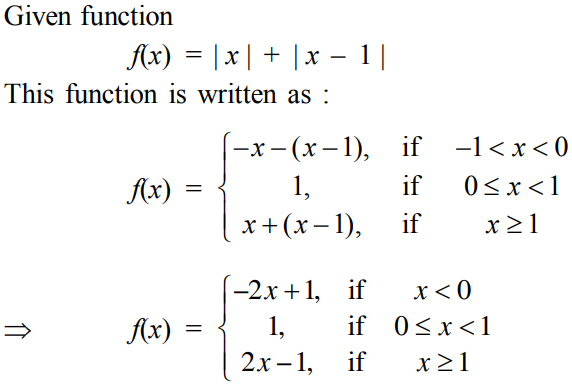
Examine the continuity and differentiability of function $f(x)=|x|+|x-1|$ in interval $(-1,2)$.
Answer
Image
at $x = 0 f(0)=1$
$f(0+h)=1$ and $f(0-h)=1-2(0-h)=1+ 2 h$
$\text{RHL} =\lim _{h \rightarrow 0} f(0+h)=\lim _{h \rightarrow 0} 1=1$
$LHL =\lim _{h \rightarrow 0} f(0-h)=\lim _{h \rightarrow 0}(1+2 h)=1$
$\because f(0)= \text{RHL} = LHL =1$ hence function is continuous at $x=0$.
$R f^{\prime}(0)=\lim _{h \rightarrow 0} \frac{f(0+h)-f(0)}{h}=\lim _{h \rightarrow 0}\left(\frac{1-1}{h}\right)=0$
$L f^{\prime}(0)=\lim _{h \rightarrow 0} \frac{f(0-h)-f(0)}{-h}=\lim _{h \rightarrow 0} \frac{(1+2 h-1)}{-h}=-2$
$\because R f^{\prime}(0) \neq L f^{\prime}(0)$, hence function is not differentiable at $x=0$
again at $x=1$
$f(1)=2-1=1$
$f(1+h)=2(1+h)-1=1+2 h \text { and } f(1-h)=1$
$\text { RHL }=\lim _{h \rightarrow 0} f(1+2 h)=\lim _{h \rightarrow 0}(1+2 h)=1$
$\text { LHL }=\lim _{h \rightarrow 0} f(1-h)=\lim _{h \rightarrow 0}(1)=1$
$\because f(1)= \text{RHL} = \text{LHL},$ hence function is continuous at $x=1$.
$R f^{\prime}(1) =\lim _{h \rightarrow 0} \frac{f(1+h)-f(1)}{h}$
$ =\lim _{h \rightarrow 0} \frac{(1+2 h-1)}{h}=2$
$L f^{\prime}(1) =\lim _{h \rightarrow 0} \frac{f(1-h)-f(1)}{-h}=\lim _{h \rightarrow 0} \frac{1-1}{-h}=0$
$R f^{\prime}(1) \neq L f^{\prime}(1)$, hence function is not differentiable at $x=1$.
View full question & answer
Question 74 Marks
If $y=\frac{\sin ^{-1} x}{x}$ then prove that :$
x\left(1-x^2\right) y_2+\left(2-3 x^2\right) y_1-x y=0
$
Answer
$
y=\frac{\sin ^{-1} x}{x} \text { or } x y=\sin ^{-1} x
$
differentiating w.r.t. $x$
$
x y_1+y \cdot 1=\frac{1}{\sqrt{1-x^2}}
$
or $\sqrt{\left(1-x^2\right)}\left[x y_1+y\right]=1$
Squaring on both sides
or $\quad\left(1-x^2\right)\left(x y_1+y\right)^2=1$
again differentiating w.r.t. $x$$
\begin{array}{r}
\therefore \quad\left(1-x^2\right) 2\left(x y_1+y\right) \times\left\{x y_2+y_1 \cdot 1+y_1\right\}+ \\
\left(x y_1+y\right)^2(-2 x)=0
\end{array}
$
or $2\left(x y_1+y\right)\left[\left(1-x^2\right)\left(x y_2+2 y_1\right)+\left(x y_1+y\right)\right.$$
(-x)]=0
$
or $\left(1-x^2\right)\left(x y_2+2 y_1\right)-x^2 y_1-x y=0$
$\therefore \quad\left(1-x^2\right) x y_2+2\left(1-x^2\right) y_1-x^2 y_1-x y=0$
or $\quad x\left(1-x^2\right) y_2+\left(2-3 x^2\right) y_1-x y=0$
View full question & answer
Question 84 Marks
If $y=\sin \left[2 \tan ^{-1}\left(\sqrt{\frac{1-x}{1+x}}\right)\right]$ then find $\frac{d y}{d x}$.
Answer
Suppose $x=\cos \theta$ or $\theta=\cos ^{-1} x$$
\begin{array}{ll}
\Rightarrow y=\sin \left[2 \tan ^{-1} \sqrt{\frac{1-\cos \theta}{1+\cos \theta}}\right] \\
\Rightarrow  y=\sin \left[2 \tan ^{-1} \sqrt{\frac{2 \sin ^2 \theta / 2}{2 \cos ^2 \theta / 2}}\right] \\
\Rightarrow  y=\sin \left[2 \tan ^{-1}\left(\tan \frac{\theta}{2}\right)\right] \\
\Rightarrow \quad y=\sin \left[2 \cdot \frac{\theta}{2}\right]=\sin \theta \\
\Rightarrow \quad y=\sqrt{1-\cos ^2 \theta}=\sqrt{1-x^2}
\end{array}
$
So, $\quad \frac{d y}{d x}=\frac{d}{d x} \sqrt{1-x^2}=\frac{1}{2 \sqrt{1-x^2}} \frac{d}{d x}\left(1-x^2\right)$$
\frac{d y}{d x}=\frac{-2 x}{2 \sqrt{1-x^2}}=\frac{-x}{\sqrt{1-x^2}}
$
View full question & answer
Question 94 Marks
If given function is continuous at $x =0$ then write the value of $k$.
$f(x)=\left\{\begin{array}{cl}\frac{\log (1+a x)-\log (1-b x)}{x}, & x \neq 0 \\ k, & x=0\end{array}\right.$
Answer
$\lim _{h \rightarrow 0} f(0+h)=\lim _{h \rightarrow 0} \frac{\log (1+a(0+h))-\log (1-b(0+h))}{(0+h)}$
$=\lim _{h \rightarrow 0} \frac{\log (1+a h)-\log (1-b h)}{h}$
$=\lim _{h \rightarrow 0} \frac{\left(a h-\frac{(a h)^2}{2}+\frac{(a h)^3}{3}-\ldots\right)-\left(-b h-\frac{(b h)^2}{2}-\frac{(b h)^3}{3}-\ldots\right)}{h}$
$ \text { value of R.H.L. at } x=0$
$ =\lim _{h \rightarrow 0}\left(\frac{(a+b) h-\frac{h^2}{2}\left(a^2-b^2\right)+\frac{h^3}{3}\left(a^3+b^3\right)-\ldots \ldots . .}{h}\right)$
$=\lim _{h \rightarrow 0}(a+b) h\left[\frac{1-\frac{h}{2}(a-b)+\frac{h^2}{3}\left(a^2-a b+b^2\right)-\ldots \ldots . .}{h}\right]$
$=a+b$ and $f(0)=k$
$\because \text { function is continuous at } x=0 \therefore f(0)=\lim _{h \rightarrow 0} f(0+h)$
$ \therefore k=a+b$
View full question & answer
Question 104 Marks
If function $f(x)=\frac{\sqrt{x}-\sqrt{a}}{x-a}$, is continuous at $x=a$, then find value of $f(a)$.
Answer
value of $\text{R.H.L.}$
$\lim _{h \rightarrow 0} f(a+0)=\lim _{h \rightarrow 0} \frac{a+h-a}{\sqrt{a+h}-\sqrt{a}}$
$=\lim _{h \rightarrow 0}\left[\frac{h}{\sqrt{a+h}-\sqrt{a}} \times \frac{\sqrt{a+h}+\sqrt{a}}{\sqrt{a+h}+\sqrt{a}}\right]$
$=\lim _{h \rightarrow 0} h \frac{(\sqrt{a+h}+\sqrt{a})}{a+h-a}$
$=\lim _{h \rightarrow 0} \frac{h(\sqrt{a+h}+\sqrt{a})}{h}=\sqrt{a}+\sqrt{a}$
$=2 \sqrt{a}$
$\because$function is continuous at $x=a$.
${rlrl}$
$\therefore f(a) =\lim _{h \rightarrow 0} f(a+h)$
$ \therefore f(a) =2 \sqrt{a}$
View full question & answer