If $\left|\begin{array}{ccc}5 & 3 & -1 \\ -7 & x & -3 \\ 9 & 6 & -2\end{array}\right|=0$, then the value of $x$ is
View full solution →Question types
Determinants question types
218 questions across 9 question groups — pick any mix to generate a MATHS paper with step-by-step answer keys.
218
Questions
9
Question groups
5
Question types
01
M.C.Q (1 Marks)
90 Q→02Assertion (A) & Reason (B) MCQ
10 Q→031 Marks Question
19 Q→042 Marks Questions
40 Q→053 Marks Question
18 Q→065 Marks Questions
17 Q→07Case study (4 Marks)
2 Q→08Fill In The Blanks[1 Marks ]
11 Q→09True False[1 Marks ]
11 Q→Sample Questions
Determinants questions
One sample from each question group in this chapter. Select any group above to see the full set with answer keys.
If $A=\left[\begin{array}{ll}\alpha & 2 \\ 2 & \alpha\end{array}\right]$ and $\left|A^3\right|=27$, then the value of $\alpha$ is
View full solution →If $\left[\begin{array}{cc}1 & -\tan \theta \\ \tan \theta & 1\end{array}\right]\left[\begin{array}{cc}1 & \tan \theta \\ -\tan \theta & 1\end{array}\right]^{-1}=\left[\begin{array}{cc}a & -b \\ b & a\end{array}\right]$, then
View full solution →The inverse of $\left[\begin{array}{cc}-4 & 3 \\ 7 & -5\end{array}\right]$ is
View full solution →If $A=\left[\begin{array}{ccc}1 & -2 & 4 \\ 2 & -1 & 3 \\ 4 & 2 & 0\end{array}\right]$ is the adjoint of a square matrix $B$, then $B^{-1}$ is equal to
View full solution →Assertion (A) : The inverse of a matrix $A=\left(\begin{array}{lll}43 & 1 & 6 \\ 35 & 7 & 4 \\ 17 & 3 & 2\end{array}\right)$ does not exist.
Reason (R) : The inverse of singular matrix is not possible.
View full solution →Reason (R) : The inverse of singular matrix is not possible.
Assertion (A) : The inverse of the matrix $A=\left(\begin{array}{ccc}4 & 2 & 3 \\ 8 & 5 & 2 \\ 12 & -4 & 5\end{array}\right)$ certainly exists.
Reason (R) : The matrix $A$ is non-singular and every non-singular matrix possesses its inverse.
View full solution →Reason (R) : The matrix $A$ is non-singular and every non-singular matrix possesses its inverse.
Assertion (A) : The inverse of $A=\left(\begin{array}{ll}3 & 4 \\ 3 & 5\end{array}\right)$ does not exist.
Reason (R) : The matrix $A$ is non-singular.
View full solution →Reason (R) : The matrix $A$ is non-singular.
Assertion (A) : The inverse of the matrix $\left[\begin{array}{ccc}1 & 3 & 5 \\ 2 & 6 & 10 \\ 9 & 8 & 7\end{array}\right]$ does not exist.
Reason (R) : The matrix $\left[\begin{array}{ccc}1 & 3 & 5 \\ 2 & 6 & 10 \\ 9 & 8 & 7\end{array}\right]$ is singular.
View full solution →Reason (R) : The matrix $\left[\begin{array}{ccc}1 & 3 & 5 \\ 2 & 6 & 10 \\ 9 & 8 & 7\end{array}\right]$ is singular.
Assertion (A) : If $A=\left(\begin{array}{ccc}l & 0 & 0 \\ 0 & m & 0 \\ 0 & 0 & n\end{array}\right)$, then
$
A^{-1}=\left(\begin{array}{ccc}
1 / l & 0 & 0 \\
0 & 1 / m & 0 \\
0 & 0 & 1 / n
\end{array}\right)
$
Reason $( R )$ : The inverse of a diagonal matrix is a diagonal matrix.
View full solution →$
A^{-1}=\left(\begin{array}{ccc}
1 / l & 0 & 0 \\
0 & 1 / m & 0 \\
0 & 0 & 1 / n
\end{array}\right)
$
Reason $( R )$ : The inverse of a diagonal matrix is a diagonal matrix.
Let $A = \left[\begin{array}{ccc} {1} & {\sin \theta} & {1} \\ {-\sin \theta} & {1} & {\sin \theta} \\ {-1} & {-\sin \theta} & {1} \end{array}\right]$ where $0 \leq \theta \leq 2 \pi$. Then
View full solution →If x, y, z are non-zero real numbers, then the inverse of matrix $A=\left[\begin{array}{lll} {x} & {0} & {0} \\ {0} & {y} & {0} \\ {0} & {0} & {z} \end{array}\right]$ is
View full solution →If $A$ is an invertible matrix of order $2,$ then det $(A^{–1})$ is equal to
View full solution →Let A be a non-singular square matrix of order 3 $\times$ 3. Then |adj A| is equal to
View full solution →Find adjoint of the matrix $\left|\begin{array}{ll}1 & 2 \\ 3 & 4\end{array}\right|$
View full solution →Evaluate : $\left|\begin{array}{ccc}1 & x & y \\ 1 & x+y & y \\ 1 & x & x+y\end{array}\right|$
View full solution →Let $A = \left[\begin{array}{ccc} {1} & {2} & {1} \\ {2} & {3} & {1} \\ {1} & {1} & {5} \end{array}\right]$. verify that $(A^{–1})^{–1} = A$
View full solution →Let $A = \left[\begin{array}{ccc} {1} & {2} & {1} \\ {2} & {3} & {1} \\ {1} & {1} & {5} \end{array}\right]$. verify that $[adj A]^{–1} = adj (A^{–1})$
View full solution →Prove that the determinant $\left|\begin{array}{ccc}x & \sin \theta & \cos \theta \\ -\sin \theta & -x & 1 \\ \cos \theta & 1 & x\end{array}\right|$ is independent of $\theta $.
View full solution →Examine the consistency of the system of equation $x + 3y = 5;\,\,2x + 6y = 8\,$
View full solution →Evaluate: $\left|\begin{array}{ccc}x & y & x+y \\ y & x+y & x \\ x+y & x & y\end{array}\right|$
View full solution →If $A^{-1}=\left[\begin{array}{ccc}3 & -1 & 1 \\ -15 & 6 & -5 \\ 5 & -2 & 2\end{array}\right]$ and $B=\left[\begin{array}{ccc}1 & 2 & -2 \\ -1 & 3 & 0 \\ 0 & -2 & 1\end{array}\right]$ find $( A B)^{-1}$
View full solution →Evaluate: $\left|\begin{array}{ccc}\cos \alpha \cos \beta & \cos \alpha \sin \beta & -\sin \alpha \\ -\sin \beta & \cos \beta & 0 \\ \sin \alpha \cos \beta & \sin \alpha \sin \beta & \cos \alpha\end{array}\right|$
View full solution →Solve the system of linear equation, using matrix method 4x - 3y = 3; 3x - 5y = 7
Solve the system of linear equation, using matrix method 2x - y = - 2; 3x + 4y = 3
Solve the system of equations
$ \frac{2}{x} + \frac{3}{y} + \frac{{10}}{z} = 4$
$ \frac{4}{x} - \frac{6}{y} + \frac{5}{z} = 1$
$ \frac{6}{x} + \frac{9}{y} - \frac{{ 20}}{z} = 2$
View full solution →$ \frac{2}{x} + \frac{3}{y} + \frac{{10}}{z} = 4$
$ \frac{4}{x} - \frac{6}{y} + \frac{5}{z} = 1$
$ \frac{6}{x} + \frac{9}{y} - \frac{{ 20}}{z} = 2$
Examine the consistency of the system of equation $3x - y - 2z = 2;\,\,2y - z = - 1;3x - 5y = 3$
View full solution →Examine the consistency of the system of equation x + y + z = 1; 2x + 3y + 2z = 2; ax + ay + 2az = 4
The cost of 4kg onion, 3kg wheat and 2kg rice is Rs. 60. The cost of 2kg onion, 4kg wheat and 6kg rice is Rs. 90. The cost of 6kg onion 2kg wheat and 3kg rice is Rs. 70. Find the cost of each item per kg by matrix method.
If $A=\left[\begin{array}{ccc}2 & -3 & 5 \\ 3 & 2 & -4 \\ 1 & 1 & -2\end{array}\right]$ find $A^{-1}$, using $A^{-1}$ solve the system of equations
$2 x-3 y+5 z=11$
$3 x+2 y-4 z=-5$
$x+y-2 z=-3$
View full solution →$2 x-3 y+5 z=11$
$3 x+2 y-4 z=-5$
$x+y-2 z=-3$
A trust fund has $₹ 35000$ that must be invested in two different types of bonds, say $\mathrm{X}$ and $\mathrm{Y}$. The first bond pays $10 \%$ interest p.a. which will be given to an old age home and second one pays $8 \%$ interest p.a. which will be given to WWA (Women Welfare Association). Let A be a $1 \times 2$ matrix and B be a $2 \times 1$ matrix, representing the investment and interest rate on each bond respectively.
View full solution →
(i) Represent the given information in matrix algebra.
(ii) If ₹ 15000 is invested in bond $\mathrm{X}$, then find total amount of interest received on both bonds?
(iii) If the trust fund obtains an annual total interest of ₹ 3200 , then find the investment in two bonds.
OR
If the amount of interest given to old age home is ₹500, then find the amount of investment in bond Y.
A tin can manufacturer designs a cylindrical tin can for a company making sanitizer and disinfectors. The tin can is made to hold 3 litres of sanitizer or disinfector. The cost of material used to manufacture the tin can is $₹ 100 / \mathrm{m}^2$.
View full solution →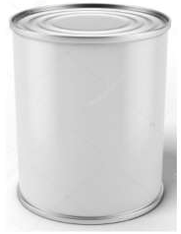
(i) If $\mathrm{r} \mathrm{cm}$ be the radius and $\mathrm{h} \mathrm{cm}$ be the height of the cylindrical tin can, then express the surface area as a function of radius (r)
(ii) Find the radius of the can that will minimize the cost of tin used for making can?
(iii) Find the height that will minimize the cost of tin used for making can ?
OR
Find the minimum cost of material used to manufacture the tin can.
Fill in the blanks:
If A is a matrix of order 3 × 3, then number of minors in determinant of A are ________.
If A is a matrix of order 3 × 3, then number of minors in determinant of A are ________.
Fill in the blanks:
The sum of the products of elements of any row with the co$-$factors of corresponding elements is equal to $..............$
View full solution →The sum of the products of elements of any row with the co$-$factors of corresponding elements is equal to $..............$
Fill in the blanks:
If $A$ is a matrix of order $3 \times 3,$ then $(A^2)^{-1} = ...............$.
View full solution →If $A$ is a matrix of order $3 \times 3,$ then $(A^2)^{-1} = ...............$.
Fill in the blanks:
If $\cos2\theta=0,$ then $\begin{vmatrix}0&\cos\theta&\sin\theta\\\cos\theta&\sin\theta&0\\\sin\theta&0&\cos\theta\end{vmatrix}^2=$ _________.
View full solution →If $\cos2\theta=0,$ then $\begin{vmatrix}0&\cos\theta&\sin\theta\\\cos\theta&\sin\theta&0\\\sin\theta&0&\cos\theta\end{vmatrix}^2=$ _________.
Fill in the blanks:
$\begin{vmatrix}0&\text{xyz}&\text{x}-\text{z}\\\text{y}-\text{x}&0&\text{y}-\text{z}\\\text{z}-\text{x}&\text{z}-\text{y}&0\end{vmatrix}=$ ________.
View full solution →$\begin{vmatrix}0&\text{xyz}&\text{x}-\text{z}\\\text{y}-\text{x}&0&\text{y}-\text{z}\\\text{z}-\text{x}&\text{z}-\text{y}&0\end{vmatrix}=$ ________.
State True or False for the statements of the following Exercise:
Let $ \begin{vmatrix}\text{a}&\text{p}&\text{x}\\\text{b}&\text{q}&\text{y}\\\text{c}&\text{r}&\text{z}\end{vmatrix}=16,$ then $\Delta_1=\begin{vmatrix}\text{p}+\text{x}&\text{a}+\text{x}&\text{a}+\text{p}\\\text{q}+\text{y}&\text{b} +\text{y}&\text{b}+\text{q}\\\text{r}+\text{z}&\text{c}+ \text{z}&\text{c}+\text{r}\end{vmatrix}=32.$
View full solution →Let $ \begin{vmatrix}\text{a}&\text{p}&\text{x}\\\text{b}&\text{q}&\text{y}\\\text{c}&\text{r}&\text{z}\end{vmatrix}=16,$ then $\Delta_1=\begin{vmatrix}\text{p}+\text{x}&\text{a}+\text{x}&\text{a}+\text{p}\\\text{q}+\text{y}&\text{b} +\text{y}&\text{b}+\text{q}\\\text{r}+\text{z}&\text{c}+ \text{z}&\text{c}+\text{r}\end{vmatrix}=32.$
State True or False for the statements of the following Exercise:
If the determinant $\begin{vmatrix}\text{x}+\text{a}&\text{p}+\text{u}&\text{l}+\text{f}\\\text{y}+\text{b}&\text{q}+\text{v}&\text{m}+\text{g}\\\text{z}+\text{c}&\text{r}+\text{w}&\text{n}+\text{h}\end{vmatrix}$ splits into exactly K determinants of order 3, each element of which contains only one term, then the value of K is 8.
View full solution →If the determinant $\begin{vmatrix}\text{x}+\text{a}&\text{p}+\text{u}&\text{l}+\text{f}\\\text{y}+\text{b}&\text{q}+\text{v}&\text{m}+\text{g}\\\text{z}+\text{c}&\text{r}+\text{w}&\text{n}+\text{h}\end{vmatrix}$ splits into exactly K determinants of order 3, each element of which contains only one term, then the value of K is 8.
State True or False for the statements of the following Exercise:
$\begin{vmatrix}\text{x}+1&\text{x}+2&\text{x}+\text{a}\\\text{x}+2&\text{x}+3&\text{x}+\text{b}\\\text{x}+3&\text{x}+4&\text{x}+\text{c}\end{vmatrix}=0,$ where a, b, c are in A.P.
View full solution →$\begin{vmatrix}\text{x}+1&\text{x}+2&\text{x}+\text{a}\\\text{x}+2&\text{x}+3&\text{x}+\text{b}\\\text{x}+3&\text{x}+4&\text{x}+\text{c}\end{vmatrix}=0,$ where a, b, c are in A.P.
State True or False for the statements of the following Exercise:
The determinant $\begin{vmatrix}\sin\text{A}&\cos\text{A}&\sin\text{A}+\cos\text{B}\\\sin\text{B}&\cos\text{A}&\sin\text{B}+\cos\text{B}\\\sin\text{C}&\cos\text{A}&\sin\text{C}+\cos\text{B}\end{vmatrix}$ is equal to zero.
View full solution →The determinant $\begin{vmatrix}\sin\text{A}&\cos\text{A}&\sin\text{A}+\cos\text{B}\\\sin\text{B}&\cos\text{A}&\sin\text{B}+\cos\text{B}\\\sin\text{C}&\cos\text{A}&\sin\text{C}+\cos\text{B}\end{vmatrix}$ is equal to zero.
State True or False for the statements of the following Exercise:
$\big(\text{aA})^{-1}-\frac{1}{\text{a}}\text{A}^{-1},$ where a is any real number and A is a square matrix.
View full solution →$\big(\text{aA})^{-1}-\frac{1}{\text{a}}\text{A}^{-1},$ where a is any real number and A is a square matrix.
Generate a Determinants paper free
Pick question groups from the list above, set marks and difficulty, and export a branded PDF with step-by-step answer keys. First 3 chapters free — no signup.