Questions · Page 2 of 2

1 Marks Question

Question 511 Mark
Determine the order and degree of the following differential equations. state also whether they are linear or non linear.
$\frac{\text{d}^2\text{y}}{\text{dx}^2}+3\Big(\frac{\text{dy}}{\text{dx}}\Big)^2=\text{x}^2\log\Big(\frac{\text{d}^2\text{y}}{\text{dx}^2}\Big)$
Answer
$\frac{\text{dy}}{\text{dx}}+\text{e}^\text{x}=0$
The highest order differential coefficient is $\frac{\text{dy}}{\text{dx}}$ and its power is 1.
So, it is a non linear differential equation of order 1 and degree 1.
View full question & answer
Question 521 Mark
Determine order and degree $($if defined$)$ of differential equations given in Exercise. $y\ ' + y = e^x$
Answer
The given differential equation is $y\ ' + y = e^x$
The highest order derivative present in the given differential equation is $y\ '$ and index of its highest power is $1.$
$\therefore$ the given differential equation is of order $1$ and degree $1.$
View full question & answer
Question 531 Mark
Determine the order and degree of the following differential equations. state also whether they are linear or non linear.
$\frac{\text{d}^3\text{y}}{\text{dx}^3}+\frac{\text{d}^2\text{y}}{\text{dx}^2}+\frac{\text{dy}}{\text{dx}}+\text{y}\sin\text{y}=0$
Answer
$\frac{\text{d}^3\text{y}}{\text{dx}^3}+\frac{\text{d}^2\text{y}}{\text{dx}^2}+\frac{\text{dy}}{\text{dx}}+\text{y}\sin\text{y}=0$The highest order differential coefficient is $\frac{\text{d}^2\text{y}}{\text{dx}^2}$ and its power is 1.
So, it is non linear differential equation with order 3 and degree 1.
View full question & answer
Question 541 Mark
Determine the order and degree of the following differential equations. state also whether they are linear or non linear. $\frac{\text{dy}}{\text{dx}}+\text{e}^\text{y}=0$
Answer
$\frac{\text{dy}}{\text{dx}}+\text{e}^\text{y}=0$ In this differential equation, the order of the highest order derivative is $1$ and its power is $1.$ So, it is a differential equation of order $1$ and degree $1.$
It is a non$-$linear differential equation, as the exponent of the dependent variable is not equal to $1($as per expansion series series of $e^y).$
View full question & answer
Question 551 Mark
Write the degree of the following differrntial equation $ \Big(\frac{\text{dy}}{\text{dx}}\Big)^{4}+3\text{x}\frac{\text{d}^{2}\text{y}}{\text{dx}^{2}}=0.$
Answer
$ \Big(\frac{\text{dy}}{\text{dx}}\Big)^{4}+3\text{x}\frac{\text{d}^{2}\text{y}}{\text{dx}^{2}}=0$
Here, we see that the highest order derivative is $\frac{\text{d}^{2}\text{y}}{\text{dx}^{2}}$ and its power is 1.
Therefore, the given differential equation is of first degree.
View full question & answer
Question 561 Mark
Write the differential equation representing the famliy of straight line y = Cx + 5, where C is an arbitrary constant.
Answer
We have,
$\text{y}=\text{Cx}+5\ ...(\text{i})$
$\Rightarrow \frac{\text{dy}}{\text{dx}}=\text{C}$
Substituting the value of C in (i),
$\text{y}=\frac{\text{dy}}{\text{dx}}\times\text{x}+5$
$\Rightarrow\text{x}\frac{\text{dy}}{\text{dx}}-\text{y}+5=0$
Hence, $\text{x}\frac{\text{dy}}{\text{dx}}-\text{y}+5=0$ is the differential equation tha famliy of lines $\text{y}=\text{Cx}+5$ When C is an arbita.
View full question & answer
Question 571 Mark
Determine the order and degree of the following differential equations. state also whether they are linear or non linear.
$\Big(\frac{\text{dy}}{\text{dx}}\Big)^3-4\Big(\frac{\text{dy}}{\text{dx}}\Big)^2+7\text{y}=\sin\text{x}$
Answer
$\Big(\frac{\text{dy}}{\text{dx}}\Big)^3-4\Big(\frac{\text{dy}}{\text{dx}}\Big)^2+7\text{y}=\sin\text{x}$The order of a differential equation is the order of the highest order derivative appearing in the equation. The degree of a differential equation is the degree of the highest order derivative. Consider the given differential equation
$\Big(\frac{\text{dy}}{\text{dx}}\Big)^3-4\Big(\frac{\text{dy}}{\text{dx}}\Big)^2+7\text{y}=\sin\text{x}$
In the above equation, the order of the highest order derivative is 1. So the differential equation is of order 1. In the above differential equation, the power of the highest order derivative is 3. Hence, it is a differential equation of degree 3. Since the degree of the above differential equation is 3, more than one, it is a non-linear differential equation.
View full question & answer
Question 581 Mark
Determine the order and degree of the following differential equations. state also whether they are linear or non linear.
$\text{x}^2\Big(\frac{\text{d}^2\text{y}}{\text{dx}}\Big)^3+\text{y}\Big(\frac{\text{dy}}{\text{dx}}\Big)^4+\text{y}^4=0$
Answer
$\text{x}^2\Big(\frac{\text{d}^2\text{y}}{\text{dx}}\Big)^3+\text{y}\Big(\frac{\text{dy}}{\text{dx}}\Big)^4+\text{y}^4=0$In this differential equation, the order of the highest order derivative is 2 and its power is 3. So, it is a differential equation of order 2 and degree 3.
It is a non linear differential equation, as its degree is more than 1.
View full question & answer
Question 591 Mark
Write the order of the differential equation  of the famliy of circles of radius r.
Answer
Given, the equation of famliy of circle,
$(\text{x}-\text{a}^{2})+(\text{y}-\text{b})^{2}=\text{r}^{2}\ ...(\text{i})$
Since, given equation have two arbiteary constant, so we differential the above equation two times wrt.x.
Differential equation (i) wrt.x. we get
  $2(\text{x}-\text{a})+2(\text{y}-\text{b})\frac{\text{}dy}{\text{dx}}=\text{r}^{2}=0$
$\Rightarrow (\text{x}-\text{a})+(\text{y}-\text{b})\frac{\text{dy}}{\text{dx}}=0\ ...(\text{ii})$
Differential equation (ii) wrt.x. we get,
$1+(\text{y}-\text{b})\frac{\text{d}^{2}\text{y}}{\text{dx}^{2}}+\big(\frac{\text{dy}}{\text{dx}}\big)=0$
$\Rightarrow(\text{y}-\text{b})=\frac{1+\big(\frac{\text{dy}}{\text{dx}}\Big)^{2}}{\frac{\text{d}^{2}\text{y}}{\text{dx}^{2}}}\ ...(\text{iii})$
Substitite value of (y - b) in equation (ii), we have,
$(\text{x}-\text{a})+\Bigg[\frac{1+\big(\frac{\text{dy}}{\text{dx}}\Big)^{2}}{\frac{\text{d}^{2}\text{y}}{\text{dx}^{2}}}\Bigg]\frac{\text{dy}}{\text{dx}}=0$
$(\text{x}+\text{a})+\frac{\Big[ 1+\big(\frac{\text{dy}}{\text{dx}}\Big)^{2}\Big]\frac{\text{dy}}{\text{dx}}}{\frac{\text{d}^{2}\text{y}}{\text{dx}^{2}}}\ ...(\text{iv})$
Substitite value of (x - a) (y - b) in equation (ii), we have,
$\Bigg[\frac{1+\big(\frac{\text{dy}}{\text{dx}}\Big)^{2}}{\frac{\text{d}^{2}\text{y}}{\text{dx}^{2}}}\Bigg]\frac{\text{dy}}{\text{dx}}+\Bigg[\frac{1+\big(\frac{\text{dy}}{\text{dx}}\Big)^{2}}{\frac{\text{d}^{2}\text{y}}{\text{dx}^{2}}}\Bigg]\frac{\text{dy}}{\text{dx}} =\text{r}^{2}$
$\Rightarrow \Big[1+\big(\frac{\text{dy}}{\text{dx}}\big)^{2}\Big] ^{3}=\text{r}^{2}\Big(\frac{\text{d}^{2}\text{y}}{\text{dx}^{2}}\Big)^{2}$
The order of the differential equation of the famliy of circle of redius r is 2.
View full question & answer
Question 601 Mark
Determine order and degree (if defined) of differential equations given in Exercise.
y''' + 2y" + y' = 0
Answer
The highest order derivative present in the given differential equation is y" and index of its highest power is 1.
$\therefore$ the given differential equation is of order 3 and degree 1.
View full question & answer
MCQ 611 Mark
Family $y = Ax + A^4$ of curves is represented by the differential equation of degree$:$
  • A
    $3$
  • B
    $2$
  • C
    $4$
  • $1$
Answer
Correct option: D.
$1$
$Y = Ax + A^4$
This equation is a linear Differential equation $=\frac{\text{dy}}{\text{dx}}=\text{A}$
Here the highest order Derivative is $y$
The Degree of this Derivative is $1$
View full question & answer
Question 621 Mark
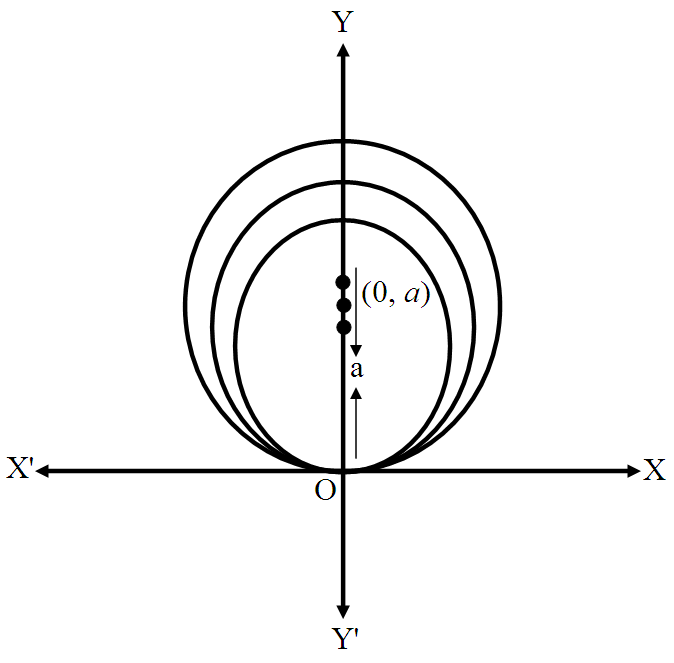
 Write the order of the differential equation of the family of circles touching X-axis at the origin.
Answer

The equation of the famliy of circles touching x-axis at the origin is 
$(\text{x}-0)^{2}+(\text{y}-\text{a})^{2}=\text{a}^{2}$
$\text{x}^{2}+\text{y}^{2}-2\text{ay}=0\ ...(\text{i})$
Here, a is the parameter.
Since, this equation contain only one conatant, we differentiate it only once.
 $2\text{x}+2\text{y}\frac{\text{dy}}{\text{dx}}-2\text{a}\frac{\text{dy}}{\text{dx}}=0$
$\text{a}=\frac{\text{x}+\text{y}(\frac{\text{dy}}{\text{dx}})}{\frac{\text{dy}}{\text{dx}}}\ ...(\text{ii})$
Putting the value of a from (i) in (i), we get
$\text{x}^{2}+\text{y}^{2}=2\text{y}\left\{\frac{\text{x}+\text{y}(\frac{\text{dy}}{\text{dx}})}{\frac{\text{dy}}{\text{dx}}}\right\}$
$(\text{x}^{2}+\text{y}^{2})\frac{\text{dy}}{\text{dx}}=2\text{xy}$
So, this is the differential equation.
Here, order of the diffrential equation is 1.
View full question & answer
Question 631 Mark
How many arbitray constants are there in the genral solution of the differential equation of orader 3.
Answer
The arbitrary constants in the general solution of the differential equation is equal to the order of the differntial equation.
Hence, the number of arbitrary constant in the general solution of the order 3 are 3.
View full question & answer
1 Marks Question - Page 2 - MATHS STD 12 Science Questions - Vidyadip