Question 15 Marks
$\text{If}\cos^{-1}\frac{x}{\text{a}} + \cos^{-1}\frac{y}{\text{b}} = \alpha, \text{Prove that}\frac{{x}^{2}}{\text{a}^{2}} - 2\frac{xy}{\text{ab}}\cos\alpha +\frac{{y}^{2}}{\text{b}^{2}} = \sin^{2}\alpha$
AnswerFrom the equation: $\cos^{-1}\frac{\text{x}}{\text{a}} = \alpha - \cos^{-1}\frac{\text{y}}{\text{b}}$
$\frac{\text{x}}{\text{a}} = \cos\bigg(\alpha-\cos^{-1}\frac{\text{y}}{\text{b}}\bigg)\Rightarrow\frac{\text{x}}{\text{a}} = \cos\alpha. \cos\bigg(\cos^{-1}\frac{\text{y}}{\text{b}}\bigg) + \sin\alpha.\sin\bigg(\cos^{-1}\frac{\text{y}}{\text{b}}\bigg)$
$\Rightarrow\frac{\text{x}}{\text{a}} = \frac{\text{y}.\cos\alpha}{\text{b}} + \sin\alpha\sqrt{1 - \frac{\text{y}^{2}}{\text{b}^{2}}} \Rightarrow\frac{\text{x}}{\text{a}}- \frac{\text{y}}{\text{b}}\cos\alpha = \sin \alpha \sqrt{1 - \frac{\text{y}^{2}}{\text{b}^{2}}} $
$\Rightarrow\bigg(\frac{\text{x}}{\text{a}} - \text{y}\frac{\cos\alpha}{\text{b}}\bigg)^{2} = \bigg(\sin\alpha\sqrt{1 - \frac{\text{y}^{2}}{\text{b}^{2}}}\bigg)$
$\Rightarrow\frac{\text{x}^{2}}{\text{a}^{2}}- \frac{\text{2xy}}{\text{ab}}.\cos\alpha + \frac{\text{y}^{2}}{\text{b}^{2}} = \sin^{2}\alpha$
View full question & answer→Question 25 Marks
Find the general solution of the differential equation $\frac{\text{dy}}{\text{dx}}-\text{y}=\sin\text{x}.$
AnswerGiven differential equation is $\frac{\text{dy}}{\text{dx}}-\text{y}=\sin\text{x}.$
$\Rightarrow$ Integrating factor $= \text{e}^{-\text{x}}$
$\therefore\ $ Solution is: $\lambda e^{–x} = \int\sin \text{e}^{-\text{x}}\text{dx}=\text{I}_1$
$\text{I}_1=-\sin \text{x}\text{e}^{-\text{x}}+\int\cos \text{x}\text{e}^{-\text{x}}\text{dx}$$=-\sin \text{x}\text{e}^{-\text{x}}+[-\cos \text{x}\text{e}^{-\text{x}}-\int+\sin\text{x}\text{e}^{-\text{x}}\text{dx}]$
$\text{I}_1=\frac{1}{2}[-\sin\text{x}-\cos\text{x}]\text{e}^{-\text{x}}$
$\therefore\ $ Solution is: $\lambda e^{–x }$ $=\frac{1}{2}(-\sin\text{x}-\cos\text{x})\text{e}^{-\text{x}}+\text{c} \text{or}\ \text{y}=-\frac{1}{2}(\sin\text{x}+\cos\text{x})+\text{ce}^\text{x}$
View full question & answer→Question 35 Marks
Find the particular solution of the differential equation $\text{(x - y)} \frac{\text{dy}}{\text{dx}} = \text{(x + 2y),}$ given that y = 0 when x = 1.
Answer$\frac{\text{dy}}{\text{dx}} = \frac{\text{x + 2y}}{\text{x - y}} = \frac{1 + \frac{\text{2y}}{\text{x}}}{1 - \frac{\text{y}}{\text{x}}}$
$\frac{\text{y}}{\text{x}} = \text{v} \Rightarrow \frac{\text{dy}}{\text{dx}} = \text{v + x} \frac{\text{dv}}{\text{dx}} \text{ }\text{ } \therefore \text{v + x} \frac{\text{dv}}{\text{dx}} = \frac{\text{1 + 2v}}{\text{1 -v}}$
$\Rightarrow \text{x} \frac{\text{dv}}{\text{dx}} = -\frac{\text{1 + 2v - v + v}^{2}}{\text{v - 1}} \Rightarrow \int \frac{\text{v - 1}}{\text{v}^{2} + \text{v + 1}} \text{dv} = - \frac{\text{dx}}{\text{x}}$
$\Rightarrow \int\frac{\text{2v + 1 - 3}}{\text{v}^{2} + \text{v + 1}} \text{dv} = \int - \frac{2}{\text{x}} \text{dx} \Rightarrow \int \frac{\text{2v + 1}}{\text{v}^{2} + \text{v + 1}} \text{dv - 3} \int \frac{1}{{\bigg(\text{v} + \frac{1}{2}\bigg)^{2} + \bigg(\frac{\sqrt{3}}{2}\bigg)^{2}}} = -\int \frac{2}{\text{x}} \text{dx}$
$\Rightarrow \log|\text{v}^{2} + \text{v} + 1| - 3. \frac{2}{\sqrt{3}} \tan^{-1} \bigg(\frac{\text{2v + 1}}{\sqrt{3}}\bigg) = \log |\text{x}|^{2} + \text{c}$
$\Rightarrow \log|\text{y}^{2} + \text{xy + x}^{2}| -2\sqrt{3}\tan^{-1} \bigg(\frac{\text{2y + x}}{\sqrt{3}\text{x}}\bigg) = \text{c}$
$\text{x = 1, y = 0} \Rightarrow \text{c} = -2\sqrt{3}. \frac{\pi}{6} = -\frac{\sqrt{3}}{3} \pi$
$\therefore \text{ } \log|\text{y}^{2} + \text{xy + x}^{2}| - 2\sqrt{3} \tan^{-1} \bigg(\frac{\text{2y + x}}{\sqrt{3x}}\bigg) + \frac{\sqrt{3}}{3} \pi = 0$
View full question & answer→Question 45 Marks
Find the equations of the tangent and normal to the curve$\frac{\text{x}^{2}}{\text{a}^{2}} - \frac{\text{y}^{2}}{\text{b}^{2}} = 1$ at the point ($\sqrt{2}$a, b).
Answer$\frac{\text{x}^{2}}{\text{a}^{2}} - \frac{\text{y}^{2}}{\text{b}^{2}} = 1 \Rightarrow\frac{2\text{x}}{\text{a}^{2}} - \frac{2\text{y}}{\text{b}^{2}}\frac{\text{dy}}{\text{dx}} = 0 \Rightarrow\frac{\text{dy}}{\text{dx}} =\frac{\text{b}^{2}\text{x}}{\text{a}^{2}\text{y}}$
slope of tangent at $(\sqrt{2}\text{ a, b }) = \frac{\sqrt{2}\text{b}}{\text{a}}$
slope of normal at $(\sqrt{2}\text{a , b }) = - \frac{\text{a}}{\sqrt{2}\text{b}}$
Equation of tangent is y – b $ = \frac{\sqrt{2}\text{b}}{\text{a}}(\text{x} - \sqrt{2}\text{a})$
i.e. $\sqrt{2}\text{ bx} - \text{ay} =\text{ab}$
and equation of normal is y – b = – $\frac{\text{a}}{\sqrt{2}\text{b}}(\text{x} - \sqrt{2}\text{ a})$
i.e. ax $ + \sqrt{2}\text{ by} = \sqrt{2}(\text{a}^{2} + \text{b}^{2}).$
View full question & answer→Question 55 Marks
If$ y = P e^{ax}+ Q e^{bx},$ show that
$\frac{\text{d}^2\text{y}}{\text{dx}^2}-(\text{a}+\text{b})\frac{\text{dy}}{\text{dx}}+\text{aby}=0$
Answer$y = P e^{ax} + Q e^{bx }$
$\Rightarrow\frac{\text{dy}}{\text{dx}}$
$= a P e^{ax} + b Q e^{bx}$
$\frac{\text{d}^2\text{y}}{\text{dx}^2}= a^2p e^{_{ax}} + b^{2 }Q e^{bx}$
$\therefore\ \text{LHS}=$$\frac{\text{d}^2\text{y}}{\text{dx}^2}$– (a + b)$\frac{\text{dy}}{\text{dx}}$ +aby
$= a^2 P e^{ax} + b^2 Q e^{bx} – (a + b) \{a P e^{ax} + b Q e^{bx}\}+ ab \{P e^{ax} + Q e^{bx}\}$
$= P e^{ax} \{a^2 – a^2 – ab + ab\}+ Q e^{bx} \{b^2 – ab – b^2 + ab\}$
$= 0 + 0 = 0. = R.H.S.$
View full question & answer→Question 65 Marks
Find the particular solution of the differential equation $\log\Big(\frac{\text{dy}}{\text{dx}}\Big)= 3x + 4y,$ given that $y = 0$ when $x = 0.$
AnswerGiven differential equation can be written as
$\frac{\text{dy}}{\text{dx}}=\text{e}^{3\text{x}+4\text{y}}=\text{e}^{3\text{x}}.\text{e}^{4\text{y}}$
$\therefore\ \int\text{e}^{-4\text{y}}\text{dy}=\int\text{e}^{3\text{x}}\text{dx}$
$\frac{\text{e}^{-4\text{y}}}{-4}=\frac{\text{e}^{3\text{x}}}{3}+\text{c}$
$\therefore\ 4\text{e}^{3\text{y}}+3\text{e}^{-4\text{y}}+12\ \text{c}=0$
taking $x = 0, y = 0$ we get $c = -\frac{7}{12}$
$\therefore$ The solution is $4 e^{3x} + 3 e^{– 4y} – 7 = 0$
View full question & answer→Question 75 Marks
From the differential equation of the family of circles in the second quadrant and touching the coordinate axes.
AnswerLet radius of any of the circle touching coordinate axes in the second quadrant be “a” then centre is (–a, a)
$\therefore$ Equation of the family of circles is:
$\text{(x + a}^{2}) + \text{(y - a)}^{2} = \text{a}^{2}, \text{a} \in \text{R}$
$\Rightarrow\text{x}^{2} + \text{y}^{2} + \text{2ax - 2ay + a}^{2} = 0$
Differentiate w.r.t. $\text{“x”, 2x + 2yy}' + \text{2a – 2ay}{' = 0} \Rightarrow\text{a} =\frac{\text{x + yy}'}{\text{y}'{ - 1}}$
$\therefore$The differential equation is:
$\bigg(\text{x} + \frac{\text{x + yy}{'}}{\text{y}{' - 1}}\bigg)^{2}\bigg(\text{y} - \frac{\text{x + yy'}}{\text{y}{' - 1}}\bigg)^{2} = \bigg( \frac{\text{x + yy}{'}}{\text{y}{' - 1}}\bigg)^{2}$
$\Rightarrow\bigg(\frac{\text{xy}'{\text{ + yy}{'}}}{\text{y}{' - 1}}\bigg)^{2} + \bigg(\frac{\text{x + y}}{\text{y}{' - 1}}\bigg)^{2} = \bigg(\frac{\text{x + yy}{'}}{\text{y}{' - 1}}\bigg)^{2}$
View full question & answer→Question 85 Marks
Find the general solution of the differential equation $y \ dx – (x + 2y^2) dy = 0.$
AnswerGiven differential equation can be written as $\text{y}\frac{\text{dx}}{\text{dy}}-\text{x}=2\text{y}^2\ \text{or}\ \frac{\text{dx}}{\text{dy}}-\frac{1}{\text{y}}.\text{x}=2\text{y}$
Integrating factor is ${\text{e}^{-\log \text{y}}}$= $\frac{1}{\text{y}}$
$\therefore\ \ \text{solution is}\ \text{x}.\frac{1}{\text{y}}=\int2\text{dy}=2\text{y}+\text{c}$
or $x = 2y^2 + cy.$
View full question & answer→Question 95 Marks
Find the particular solution of the differential equation $x (1 + y^2) dx – y (1 + x^2) dy = 0,$ given that $y = 1$ when $x = 0.$
AnswerGiven equation can be written as $\frac{\text{x}}{1+\text{x}^2}\text{dx}-\frac{\text{y}}{1+\text{y}^2}\text{dy}=0$
Integrating to get $\frac{1}{2}\log(1+\text{x}^2)-\frac1 2\log(1+\text{y}^2)=\log \text{c}_1$
$\Rightarrow\ \log(1+\text{x}^2)-\log(1+\text{y}^2)=\log \text{c}_1^2=\log\text{c}$
$\therefore\frac{(1+\text{x}^2)}{(1+\text{y}^2)}=\text{c} x = 0 y = 1$
$\Rightarrow\ \text{c}=\frac{1}{2}$
$\therefore\ 1+\text{y}^2=2(1+\text{x}^2)\ \ \ \text{or}\ \ \ \text{y}=\sqrt{2\text{x}^2+1}$
View full question & answer→Question 105 Marks
Solve the differential equation:
$y + x \frac{dy}{dx} = x - y \frac{dy}{dx}$
AnswerThe differential equation can be re-written as:
$\frac{\text{dy}}{\text{dx}} = \frac{\text{x -y}}{\text{x + y}}, \text{put y = vx,} \frac{\text{dy}}{\text{dx}} = \text{v + x} \frac{\text{dv}}{\text{dx}}$
$\Rightarrow\text{v + x}\frac{\text{dv}}{\text{dx}} = \frac{1 - \text{v}}{1 + \text{v}}\Rightarrow\frac{\text{1 + v}}{\text{1 - 2v - v}^{2}}\text{dv} = \frac{\text{1}}{\text{x}} \text{dx}$
integrating we get
$\Rightarrow\frac{1}{2}\int\frac{\text{2V + 2}}{\text{V}^{2} + \text{2V - 1}}\text{dv} = -\int\frac{1}{\text{x}} \text{dx}=\frac{1}{2}\log|\text{V}^{2} + \text{2V} - 1| = -\log\text{ x }+ \log \text{ C}$
$\therefore $ Solution of the differential equation is:
$\frac{1}{2}\log\bigg|\frac{\text{y}^{2}}{\text{x}^{2}} + \frac{\text{2y}}{\text{x}} - 1\bigg| = \log\text{C} - \log\text{x or,}\text{ y}^{2} + \text{2xy - x}^{2} = \text{C}^{2}$
View full question & answer→Question 115 Marks
$\text{If (ax + b)} \text{e}^{\text{y/x}} = \text{x},\text{then show that}$
$\text{x}^{3} \bigg(\frac{\text{d}^{2}\text{y}}{\text{dx}^{2}}\bigg) = \bigg(\text{x}\frac{\text{dy}}{\text{dx}}- \text{y}\bigg)^{2} $
Answer$\frac{\text{y}}{\text{x}} = \log\text{x} - \log (\text{ax + b)}$
differentiating w.r.t. x,
$=\frac {\text{x} {\frac{\text{dy}}{\text{dx}}- \text{y}}}{\text{x}^{2}} = \frac{1}{\text{x}}-\frac{\text{a}}{\text{ax + b}}=\frac{\text{b}}{\text{x ( ax + b)}}$
$= \text{x}. \frac{\text{dy}}{\text{dx}} - \text{y} = \frac{\text{bx}}{(\text{ax + b)}}\dots\dots\dots\dots\text{(1)} $
differentiating w.r.t. x, again
$\text{x} \frac{\text{d}^{2}\text{y}}{\text{dx}^{2}} + \frac{\text{dy}}{\text{dx}} -\frac{\text{dy}}{\text{dx}} = \frac{(\text{ax + b) b - abx}}{(\text{ax + b)}^{2}} $
$\text{x} \frac{\text{d}^{2}\text{y}}{\text{dx}^{2}} = \frac{\text{b}^{2}}{\text{(ax + b)}{2}}$
$\text{Writing}\Rightarrow \text{x}^{3}\ \frac{\text{d}^{2}\text{y}}{\text{dx}^{2}} = \bigg(\frac{\text{bx}}{\text{ax + b}} \bigg)^{2}\dots\dots\dots\text{(2)}$
From (1) and (2) $\Rightarrow$
$\text{x}^{3} \frac{\text{d}^{2}\text{y}}{\text{dx}^{2}} = \bigg(\text{x}. \frac{\text{dy}}{\text{dx}}- \text{y}\bigg)^{2}$
View full question & answer→Question 125 Marks
Find the differential equation of the family of curves $\text{(x- h)}^{2} + \text{(y - k)}^{2} = \text{r}^{2}, $ where h and k are arbitrary constants.
Answer$\text{(x - h ) + (y -k)} \frac{\text{dy}}{\text{dx}} = 0$
$\text{and 1 + (y - k)} \frac{\text{d}^{2}\text{y}}{\text{dx}^{2}} + \bigg(\frac{\text{dy}}{\text{dx}}\bigg)^{2} = 0$
$\Rightarrow \text{(y - k)} = \frac{-\Bigg[1 +\bigg(\frac{\text{dy}}{\text{dx}}\bigg)^{2}\Bigg]}{\frac{\text{d}^{2}{\text{y}}}{\text{dx}^{2}}} $
$\text{(1)} \Rightarrow \text{(x - h)} = -\frac{1 +\bigg(\frac{\text{dy}}{\text{dx}}\bigg)^{2}}{\frac{\text{d}^{2}{\text{y}}}{\text{dx}^{2}}}\frac{\text{dy}}{\text{dx}}$
Putting in the given eqn.
$-\frac{\Bigg(1 +\bigg(\frac{\text{dy}}{\text{dx}}\bigg)^{2}\Bigg)^{2}}{\bigg(\frac{\text{d}^{2}{\text{y}}}{\text{dx}^{2}}\bigg)^{2}}.\bigg(\frac{\text{dy}}{\text{dx}}\bigg)^{2} + \frac{\Bigg(1 +\bigg(\frac{\text{dy}}{\text{dx}}\bigg)^{2}\Bigg)^{2}}{\bigg(\frac{\text{d}^{2}{\text{y}}}{\text{dx}^{2}}\bigg)^{2}} = \text{r}^{2} $
$\text{or} \Bigg[1 +\bigg(\frac{\text{dy}}{\text{dx}}\bigg)^{2}\Bigg]^{3} = \text{r}^{2} \bigg(\frac{\text{d}^{2}\text{y}}{\text{dx}^{2}}\bigg)^{2}$
View full question & answer→Question 135 Marks
Show that the differential equation $\text{(x - y})\frac{\text{dy}}{\text{dx}} = \text{x + 2y}$ is homogeneous and solve it also.
Answer$\text{(x - y})\frac{\text{dy}}{\text{dx}} = \text{x + 2y}$
$\frac{\text{dy}}{\text{dx}} = \frac{\text{x } + 2\text{y}}{\text{x - y}}$
$\frac{\text{dy}}{\text{dx}} = \frac{1 + 2\frac{\text{y}}{\text{x}}}{1 - \frac{\text{y}}{\text{x}}} = \text{f}\bigg(\text{y}/\text{x}\bigg)\dots\dots\dots\dots\dots\dots\dots\dots\text{(1)}$
$\therefore$ differential equation is homogeneous Eqn.
$\text{y = vx to give}$
$\text{v + x}. \frac{\text{dv}}{\text{dx}} = \frac{1 + 2\text{v}}{1 - \text{v}}$
$\Rightarrow \int \frac{1 -\text{v}}{1 + \text{v + v}^{2}}\text{dv} = \int\frac{\text{dx}}{\text{x}}$
$\Rightarrow -\frac{1}{2}\int \frac{2 \text{v} + 1}{1 + \text{v + v}^{2}}\text{dv} + \frac{3}{2} \int\frac{\text{dv}}{\bigg(\text{v} +\frac{1}{2}\bigg)^{2} + \bigg(\frac{\sqrt{3}}{2}\bigg)^{2}} = \int\frac{\text{dx}}{\text{x}}$
$-\frac{1}{2}\log|1 +\text{ v + v}^{2}| + \sqrt{3}\tan^{-1}\bigg(\frac{2\text{v} + 1}{\sqrt{3}}\bigg) = \log|\text{x}| + \text{c}$
$- \frac{1}{2}\log\bigg|\frac{\text{x}^{2} + \text{xy + y}^{2}}{\text{x}^{2}}\bigg| + \sqrt{3}\tan^{-1} \bigg(\frac{2\text{y + x}}{x\sqrt{3}}\bigg)= \log|\text{|x| + c}$
View full question & answer→Question 145 Marks
Solve the differential equation $ (\tan^{–1} \text{x – y) dx = (1 + x}^{2}) \text{ dy}.$
AnswerGiven differential equation can be written as
$(1 + \text{x}^{2}) \frac{\text{dy}}{\text{dx}} + \text{y} = \tan^{-1} \text{x} \Rightarrow \frac{\text{dy}}{\text{dx}} + \frac{1} {1 + \text{x}^{2}} \text{y} = \frac{\tan^{-1} \text{x}}{\text{1 + x}^{2}}$
Integrating factor $ = \text{e}^{\tan^{-1}} \text{x}.$
$\therefore \text{Solution is y . e}^{\tan^{-1}}\text{x} = \int \tan^{-1} \text{x. e}^{\tan^{-1} \text{x}} \frac{1}{1 + \text{x}^{2}} \text{dx}$
$\Rightarrow \text{y. e}^{\tan^{-1}} \text{x} = \text{e}^{\tan^{-1}} \text{x} . (\tan^{-1}\text{x} - 1) + \text{c}$
$\text{ or } \text{ y} = (\tan^{-1} \text{x - 1)} + \text{c . e}^{-\tan^{-1_{\text{x}}}}$
View full question & answer→Question 155 Marks
If $y = P e^{ax} + Qe^{bx},$ show that $\frac{\text{d}^{2}\text{y}}{\text{dx}^{2}} - (\text{a + b })\frac{\text{dy}}{\text{dx}} + \text{aby} = 0 .$
Answer$y = P e^{ax}+ Qe^{bx}$
$\Rightarrow\frac{\text{dy}}{\text{dx}} = \text{a P e}^{ax} + \text{b Q e}^{bx}$
$\frac{\text{d}^{2}\text{y}}{\text{dx}^{2}} = \text{a}^{2}\text{P e}^{ax} + \text{b}^{2} \text{Q e}^{bx}$
$\therefore\text{ LHS } =\frac{\text{d}^{2}\text{y}}{\text{dx}^{2}} - (\text{a + b })\frac{\text{dy}}{\text{dx}} + \text{ aby}$
$ =\text{a}^{2}\text{P e}^{ax} + \text{b}^{2}\text{ Q e}^{bx} -(\text{a + b })\left\{\text{a P e}^{ax} + \text{b Q e}^{bx}\right\} + \text{ab}\left\{\text{P e}^{ax} + \text{Q e}^{bx}\right\}$
$ = \text{P e}^{ax}\left\{\text{a}^{2} - \text{a}^{2} - \text{ab} + \text{ab}\right\} + \text{ Q e}^{bx}\left\{\text{b}^{2} - \text{ab} - \text{b}^{2} + \text{ab}\right\}$
$= 0 + 0 = 0. = \text{R.H.S.}$
View full question & answer→Question 165 Marks
Solve the differential equation $(1 + x^2) \frac{\text{dy}}{\text{dx}} + \text{y} = \text{e}^{\tan^{-1}\text{x}.}$
AnswerGiven differential equation can be written as
$\frac{\text{dy}}{\text{dx}} + \frac{1}{1 + \text{x}^{2}}.\text{y} = \frac{1}{1 + \text{x}^{2}}.\text{e}^{\tan^{-1}\text{x}}$
Integrating factor $\text{e}^{\int\frac{1}{1 + \text{x}^{2}}\text{dx}} = \text{e}^{\tan^{-1}\text{x}}$
$\therefore\text{ solution is, y.}\text{e}^{\tan^{-1}\text{x}} = \int\frac{1}{1 + \text{x}^{2}}\text{e}^{2\tan^{-1}\text{x}}\text{dx}$
$\Rightarrow\text{y .e}^{\tan^{-1}\text{x}} = \frac{1}{2}\text{e}^{2\tan^{-1}\text{x}} + \text{c}$
$\text{or } \text{y} = \frac{1}{2}\text{e}^{\tan^{-1}\text{x}} + \text{c}\text{e}^{-\tan^{-1}\text{x}}.$
View full question & answer→Question 175 Marks
Find the particular solution of the differential equation$\frac{\text{ dy}}{\text{dx}} = 1 +\text{x + y +xy},\text{ given that }\text{y} = 0 \text{ when x } = 1.$
Answer$\frac{\text{dy}}{\text{dx}} = 1 + \text{x + y + xy} = (1 + \text{x})( 1 + \text{y})$
$\therefore\int\frac{\text{dy}}{1 + \text{y}} = \int(1 + \text{x})\text{dx}$
$\log|1 + \text{y}| = \text{x} + \frac{\text{x}^{2}}{2} + \text{c}$
$\text{x} = 1 ,\text{y} = 0 \Rightarrow\text{c} = - \frac{3}{2}$
$\therefore\text{ solution is } \log|1 + \text{y} | = \text{x} + \frac{\text{x}^{2}}{2} - \frac{3}{2}.$
View full question & answer→Question 185 Marks
If $y^x = e^{y–x},$ prove that $\frac{\text{dy}}{\text{dx}} = \frac{(1 + \log\text{y})^{2}}{\log\text{y}}.$
AnswerGiven $y^x = e^{y-x}$
Taking logarithm both sides we get
$\log y^x = \log e^{y-x}$
$\Rightarrow\text{x}.\log\text{y} = (\text{y} - \text{x}).\log e$
$\Rightarrow\text{x}.\log\text{y} = (\text{y} - \text{x})$
$\Rightarrow\text{x}(1 + \log\text{y}) = \text{y}$
$\Rightarrow\text{x} = \frac{\text{y}}{1 + \log\text{y}}$
Differentiating both sides $\text{w.r.t.y.}$ We get
$\frac{\text{dx}}{\text{dy}} = \frac{(1 + \log\text{y}).1 - \text{y}.\bigg(0 + \frac{1}{\text{y}}\bigg)}{(1 + \log\text{y})^{2}}$
$ = \frac{1 + \log\text{y} - 1 }{(1 + \log\text{y})^{2}} = \frac{\log\text{y}}{(1 + \log\text{y})^{2}}$
$\Rightarrow\frac{\text{dy}}{\text{dx}} = \frac{(1 + \log\text{y})^{2}}{\log\text{y}}$
$ \begin{bmatrix} \text{Note}:(i) \log_{e} \text{mn} = \log_{e}\text{m} + \log_{e}\text{n} \\ (ii)\log_{e}\frac{\text{m}}{\text{n}} = \log_{e}\text{m} - \log_{e}\text{n}\\ (iii)\log_{e } \text{ m}^{n} = \text{n}\log_{e}\text{m} \end{bmatrix}.$
View full question & answer→Question 195 Marks
If $x = a \cos^3 \theta$ and $y = a \sin^3 \theta$, then find the value of $\frac{\text{f}^{2}\text{y}}{\text{dx}}\text{at}\theta = \frac{\pi}{6}.$
AnswerGiven: $x = a \cos^3 \theta$
Differentiating both sides w.r.t. $\theta$ we get
$\frac{\text{dx}}{\text{d}\theta} = - 3 \text{a}\cos^{2}\theta.\sin\theta - - - - - - - -(i)$
Also $y = a \sin^3 \theta$
Differentiating both sides w.r.t. $\theta$ we get
$\frac{\text{dy}}{\text{d}\theta} = 3\text{a}\sin^{2}\theta.\cos\theta - - - - - - - - (ii)$
Now $\frac{\text{dy}}{\text{dx}} =\frac{\text{dy}/\text{d}\theta}{\text{dx}/\text{d}\theta} = \frac{3\text{a}\sin^{2}\theta.\cos\theta}{-3\text{a}\cos^{2}\theta.\sin\theta}$
$\Rightarrow\frac{\text{dy}}{\text{dx}} = - \tan\theta$
$\Rightarrow\frac{\text{d}^{2}\text{y}}{\text{dx}^{2}} = -\sec^{2}\theta.\frac{\text{d}\theta}{\text{dx}}$
$ = \frac{-\sec^{2}\theta}{-3\text{a}\cos^{2}\theta.\sin\theta} =\frac{1}{3\text{a}}\sec^{4}\theta.\text{cosec}\theta$
$\therefore\frac{\text{d}^{2}\text{y}}{\text{dx}^{2}}\bigg]_{\text{x} = \pi/6} = \frac{1}{3\text{a}}\sec^{4}\frac{\pi}{6}.\text{cosec}\frac{\pi}{6}$
$ = \frac{1}{3\text{a}}.\bigg(\frac{2}{\sqrt{3}}\bigg)^{4}\times2 =\frac{32}{27\text{a}}.$
View full question & answer→Question 205 Marks
Find the equations of tangents to the curve $3x^2 – y^2 = 8,$ which pass through the point $\bigg(\frac{4}{3} , 0 \bigg).$
AnswerLet the point of contact be $(x_0 , y_0 )$
Now given curve is $3x^2 - y^2 = 8$
Differentiating $w.r.t. x$ we get, $6x - 2y.\frac{\text{dy}}{\text{dx}} = 0 $
$\Rightarrow\frac{\text{dy}}{\text{dx}} = \frac{6\text{x}}{2\text{y}} = \frac{3\text{x}}{\text{y}}\Rightarrow\frac{\text{dy}}{\text{dx}}\bigg]_{(\text{x}_{0} ,\text{y}_{0})} = \frac{3\text{x}_{0}}{\text{y}_{0}}$
Now, equation of required tangent is
$(\text{y} - \text{y}_{0}) = \frac{3\text{x}_{0}}{\text{y}_{0}}(\text{x} - \text{x}_{0}) - - - - - -(i)$
$\because\text{ (i) passes through }\bigg(\frac{4}{3} , 0 \bigg)$
$\therefore(0 - \text{y}_{0}) = \frac{3\text{x}_{0}}{\text{y}_{0}}\bigg(\frac{4}{3} - \text{x}_{0}\bigg)$
$\Rightarrow - \text{y}_{0}^{2} = 4\text{x}_{0} - 3\text{x}_{0}^{2} - - - - - - - - -(ii)$
Also, $\therefore(x_0 , y_0 )$ lie on given curve $3x^2 - y^2 = 8$
$\Rightarrow3\text{x}_{0}^{2} - \text{y}_{0}^{2} = 8 $
$\Rightarrow\text{y}_{0}^{2} = 3 \text{x}_{0}^{2} - 8 $
Putting $y_0^2$ in $(ii)$ we get
$ -(3\text{x}_{0}^{2} - 8 ) = 4 \text{x}_{0} - 3\text{x}_{0}^{2}$
$\Rightarrow4\text{x}_{0} = 8$
$ \Rightarrow\text{x}_{0} = 2 $
$\therefore\text{y}_{0} = \sqrt{3\times2^{2} - 8} = \sqrt{4} = \pm2$
Therefore equations of required tangents are
$(\text{y} - 2 ) = \frac{3\times2}{2}(\text{x} - 2)$ and $(\text{y} + 2 ) = \frac{3 \times 2}{-2}(\text{x} - 2)$
$\Rightarrow\text{y} - 2 = 3\text{x} - 6 $ and $\text{y} + 2 = - 3\text{x} + 6 $
$\Rightarrow3\text{x} - \text{y} - 4 = 0$ and $ 3\text{x} + \text{y} - 4 = 0 .$
View full question & answer→Question 215 Marks
Find the particular solution of the differential equation $(\tan^{–1} y – x) dy =(1 + y^2 ) dx,$ given that when $x = 0, y = 0.$
Answer$(\tan^{-1}\text{y} - \text{x})\text{dy} = (1 + \text{y}^{2})\text{dx}$
$\Rightarrow\frac{\text{dx}}{\text{dy}} = \frac{(\tan^{-1}\text{y} - \text{x})}{(1 + \text{y}^{2})}$
$\Rightarrow\frac{\text{dx}}{\text{dy}} + \frac{\text{x}}{1 + \text{y}^{2}} = \frac{\tan^{-1}\text{y}}{1 + \text{y}^{2}}$
$\text{ Integrating Factor } = \text{e}^{\int\frac{\text{dy}}{1 + \text{y}^{2}}} = \text{e}^{\tan^{-1}\text{y}}$
$\Rightarrow(\text{ integrating Factor } ) \times\text{x} = \int(\text{ integrating Factor }) \times\frac{\tan^{-1}\text{y}}{1 + \text{y}^{2}}\text{dy}$
$\Rightarrow\text{xe}^{\tan^{-1}\text{y}} = \int\text{e}^{\tan^{-1}\text{y}}\frac{\tan^{-1}\text{y}}{1 + \text{y}^{2}}\text{dy} - - - - - - -(1)$
$\text{I} = \int\text{e}^{\tan^{-1}\text{y}}\frac{\tan^{-1}\text{y}}{1 + \text{y}^{2}}\text{dy}$
Let, $\tan^{-1}\text{y} = \text{t}\Rightarrow\frac{\text{dy}}{1 + \text{y}^{2}} = \text{dt}$
$\text{I} = \int\text{te}'\text{dt} = \text{t}(\text{e}') - \int\text{e}'\times\frac{\text{d}}{\text{dt}}(\text{t})\text{dt} = \text{te}' - \text{e}' =\text{e}'(\text{t} - 1) + \text{c} = \text{e}^{\tan^{-1}\text{y}}(\tan^{-1}\text{y} - 1 ) + \text{c} - - - - - - (2)$
Putting the value of $I$ from $(2)$ in $(1),$ we get:
$\text{xe}^{\tan^{-1}\text{y}} = \text{I} = \text{e}^{tan^{-1}\text{y}}(\tan^{-1}\text{y} - 1) + \text{c}$
$\Rightarrow\text{x} = (\tan^{-1}\text{y} - 1 ) + \text{ce}^{-\tan^{-1}\text{y}}$
$\text{ When}\text{ x} = 0,\text{y} = 0\Rightarrow0 = 0- 1 + \text{c}\Rightarrow\text{c} = 1 $
Therefore, Particular solution of the differential equation is $x = \tan^{-1} y - 1 + e \tan^{-1 y}.$
View full question & answer→Question 225 Marks
Find the particular solution of the differential equation $x (x^2 – 1) \frac{\text{dy}}{\text{dx}} = 1; y = 0$ when $x = 2.$
Answer$x (x^2 –1) \frac{\text{dy}}{\text{dx}} = 1$
$\Rightarrow\text{dy}=\frac{1}{\text{x(x}^{2}-1)}\text{dx}$
$\Rightarrow\int\text{dy}=\int\frac{1}{\Bigg(1-\frac{1}{\text{x}^{2}}\Bigg)}\frac{1}{\text{x}^{3}}\text{dx}$
$\Rightarrow\text{y}=\frac{1}{2}\log{\Bigg(1-\frac{1}{\text{x}^{2}}\Bigg)}+\text{C}$
$x = 2, y = 0$
$\Rightarrow\text{C}=-\frac{1}{2} \text{ }\log\text{ }\frac{3}{4}$
$\Rightarrow\text{y}=\frac{1}{2} \text{ }\log\text{ }\Bigg(1-\frac{1}{\text{x}^{2}}\Bigg)-\frac{1}{2}\text{ }\log\text{ }\frac{3}{4}$.
View full question & answer→Question 235 Marks
Solve the following differential equation: $(1 + x^2) dy + 2xy\ dx = \cot\ x\ dx; x \neq 0.$
AnswerThe given differential equation can be written as
$(1+\text{x}^2)\text{dy}+2\text{xy dx}=\cot\text{x dx}$
$(1+\text{x}^2)\frac{\text{dy}}{\text{dx}}+2\text{xy}=\cot\text{x}$
$\frac{\text{dy}}{\text{dx}}+\Big(\frac{2\text{x}}{1+\text{x}^2}\Big)\text{y}=\cot\text{x}$
$\text{here P}=\frac{2\text{x}}{1+\text{x}^2}$
$\text{I.F}=\text{e}^{\int\text{pdx}}$
$=\text{e}^{\int\frac{2\text{x}}{1+\text{x}^2}\text{dx}}$
$=\text{e}^{\log(1+\text{x}^2)}$
$\text{I.F}=1+\text{x}^2$
$\text{Y.I.F}=\int(1+\text{x}^2)\cdot\cot\text{x}\ \ \text{dx}$
$\text{y}.(1+\text{x}^2)=\log|\sin\text{x}|+\text{c}$
$\text{y}=(1+\text{x}^2)^{-1}\log|\sin\text{x}|+\text{c}(1+\text{x}^2)^{-1}$
View full question & answer→Question 245 Marks
Form the differential equation of the family of circles in the second quadrant and touching the coordinate axes.
Answer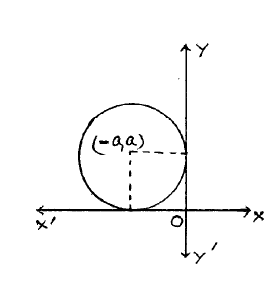
Equation of family of circle is $(x + a)^2 + (y – a)^2 = a^2$ or $x^2 + y^2 + 2ax – 2ay + a^2 = 0.....(i)$
Differentiating we get $2x + 2y \frac{\text{dy}}{\text{dx}} 2a – 2a \frac{\text{dy}}{\text{dx}}= 0$
$\Rightarrow\text{x+y }\frac{\text{dy}}{\text{dx}}=\text{a}\Bigg(\frac{\text{dy}}{\text{dx}}-1\Bigg)$
OR $\text{a}=\frac{\text{x+yy'}}{\text{y'-1}},\text{where y' }\frac{\text{dy}}{\text{dx}}$
substituting the value of a in $(i)$ and simplifying $(xy' – x + x + yy')^2 + (yy' – y – x – yy')^2 = (x + yy')^2$
OR $(x + y)^2 [(y')^2 +1]= (x + yy')^2.$ View full question & answer→Question 255 Marks
$\text{If x = }\sqrt{\text{a}^{\sin^{-1}t},}\text{ y}=\sqrt{\text{a}^{\text{cos}^{-1}}},\text{ show that }\frac{\text{dy}}{\text{dy}}=-\frac{\text{y}}{\text{x}}.$
Answer$\text{x}=\sqrt{\text{a}^{\text{sin}^{-1}t}}\Rightarrow\text{2 log x = sin}^{-1}\text{t }\text{log}\text{ a }\Rightarrow\frac{\text{dx}}{\text{dt}}=\frac{\text{x}}{2}\Bigg[\log \text{a}\frac{1}{\sqrt1-t^{2}}\Bigg]$
$\text{y}=\sqrt{\text{a}^{\text{cos}^{-1}t}}\Rightarrow\text{2}\log\text{y}=\log\text{a}\cos^{-1}\text{t}\Rightarrow\frac{\text{dy}}{\text{dt}}=-\frac{\text{y}}{2}\Bigg[\log\text{a}\cdot\frac{1}{\sqrt{\text{1-t}^{2}}}\Bigg]$
$\therefore\frac{\text{dy}}{\text{dx}}=-\frac{\text{y}}{2}\cdot\frac{2}{\text{x}}\frac{\sqrt{\text{1-t}^{2}}}{\sqrt{\text{1-t}^{2}}}=-\frac{\text{y}}{\text{x}}$.
View full question & answer→Question 265 Marks
Solve the following differential equation:$\text{(y + 3x}^{2})\frac{\text{dx}}{\text{dy}}=\text{x}$.
AnswerGiven equation can be written as $\text{x}\frac{\text{dy}}{\text{dx}}-\text{y}=\text{3x}^{2}$ OR $\frac{\text{dy}}{\text{dx}}-\frac{1}{\text{x}}\cdot\text{y}=\text{3x}$ $\text{I.F.}=\text{e}^{-\int\frac{1}{\text{x}}\text{dx}}=\text{e}^{-\log\text{x}}=\text{e}^{\log\frac{1}{\text{x}}}=\frac{1}{\text{x}}$ $\therefore\text{ solution is, y}\cdot\frac{1}{ \text{x}}=\int\text{3x}\cdot\frac{1}{\text{x}}\text{dx}=\text{3x + c}$$\Rightarrow\text{y}=\text{3x}^{2}+\text{cx}$.
View full question & answer→Question 275 Marks
If $x^y = e^{x –y},$ show that $\frac{\text{dy}}{\text{dx}}=\frac{\text{log x}}{\left\{\text{log(x e)}\right\}^{2}}.$
Answer$x^y = e^{x–y}$
$\Rightarrow y . \log x = (x – y) \log e = x – y$
$\text{y}=\frac{\text{x}}{\text{1 + log x}}$
$\frac{\text{dy}}{\text{dx}}=\frac{\text{(1 + log x)}\cdot\text{1 - x}\cdot\Big(\frac{1}{\text{x}}\Big)}{\text{(1 + log x)}^{2}}=\frac{\text{log x}}{\text{(1 + log x)}^{2}}$
$=\frac{\log\text{x}}{\text{(log e + log x)}^{2}}=\frac{\text{log x}}{\text{[log(xe)]}^{2}}$.
View full question & answer→Question 285 Marks
Solve the following differential equation:
x dy – y dx = $\sqrt{\text{x}^{2}+\text{y}^{2}}\text{ dx}$ .
AnswerGiven equation can be written as $\frac{\text{dy}}{\text{dx}}=\frac{\text{y}}{\text{x}}+\sqrt{1+\Big(\frac{\text{y}}{\text{x}}\Big)^{2}}$
$\Rightarrow\text{v + x }\frac{\text{dv}}{\text{dx}}=\text{v}+\sqrt{1+\text{v}^{2}}$ where $\frac{\text{y}}{\text{x}}=\text{v}$
$\Rightarrow\int\frac{\text{dv}}{\sqrt{1 + \text{v}^{2}}}=\int\frac{\text{dx}}{\text{x}}$
$\Rightarrow\log|\text{v}+\sqrt{1+\text{v}^{2}}|=\log\text{cx}$
$\Rightarrow\text{v}+\sqrt{1+\text{v}^{2}}=\text{cx}\therefore\text{y}+\sqrt{\text{x}^{2}+\text{y}^{2}}=\text{cx}^{2}$.
View full question & answer→Question 295 Marks
Solve the following differential equation:${(\text{x}^{2}-1)}\frac{\text{dy}}{\text{dx}}+\text{2xy}=\frac{1}{\text{x}^{2}-1};|\text{x}|\neq1$.
AnswerGiven differential equation can be written as$\frac{\text{dy}}{\text{dx}}+\frac{{\text{2x}}}{{\text{x}^{2}-1}}\cdot{\text{y}}=\frac{1}{(\text{x}^{2}-\text{1})^{2}}$
Which is of the form $\frac{\text{dy}}{\text{dx}}+\text{P(x)}\cdot\text{y = Q(x)}$
$\int\text{P(x) dx}=\int\frac{\text{2x}}{\text{x}^{2}-1}\text{dx}=\log|\text{x}^{2}-1|$
$\therefore$ Integrating factor = $\text{e}^{\int\text{p(x) dx}}=\text{(x}^{2}-1)$
$\therefore$ The solution is $(x^2 - 1)^{_.}Y = \int\frac{1}{\text{(x}^{2}-1)^{2}}\text{(x}^{2}-1)\text{ dx}$
$\text{(x}^{2}-1)\cdot\text{y}=\frac{1}{2}\log\Bigg|\frac{\text{x - 1}}{\text{x + 1}}\Bigg|+\text{c}$
View full question & answer→Question 305 Marks
Show that the differential equation (x – y) $\frac{\text{dy}}{\text{dx}}$ = x + 2y, is homogeneous and solve it.
AnswerGiven differential equation can be written as
$\frac{\text{dy}}{\text{dx}}=\frac{\text{x+2y}}{\text{x-y}}=\frac{1+2\ \text{y}/{\text{x}}}{1-\text{y}/\text{x}\ }=\text{f}(\text{y}/\text{x})$
hence, the differential equation is homogeneous.
$\text{Taking}\ \frac{\text{y}}{\text{x}}= \text{v}\ \text{OR}\ \text{y}=\ \text{vx}\Rightarrow \frac{\text{dy}}{\text{dx}}=\text{v+x}\frac{\text{dv}}{\text{dx}}$
$\therefore \text{v+x}\ \frac{\text{dv}}{\text{dx}}=\frac{1+2\text{v}}{1-\text{v}}\ \text{or}\ \text{x}\frac{\text{dv}}{\text{dx}}=\frac{1+2\text{v}}{1-\text{v}}-\text{v}=\frac{1+\text{v+v}^2}{1-\text{v}}$
$\Rightarrow\int\frac{\text{v}-1}{\text{v}^2+\text{v+1}}\text{dv}=-\int\frac{\text{dx}}{\text{x}}$
$\Rightarrow\frac{1}{2}\int\frac{2\text{v}+1-3}{\text{v}^2+\text{v}+1}\ \text{dv}=-\log |\text{x}|+\text{c}$
$\text{or}\ \frac{1}{2}\ \log\ |\text{v}^2+\text{v}+1|-\frac{3}{2}\int\frac{\text{dv}}{\bigg(\text{v}+\frac{1}{2}\bigg)^2+\bigg(\frac{\sqrt{3}}{2}\bigg)^2}= -\log |\text{x}|+\text{c}$
$\Rightarrow\log\ |\text{v}^2+\text{v}+1|+\log\text{x}^2=2\sqrt{3}\ \tan^{-1}\bigg(\frac{2\text{v}+1}{\sqrt{3}}\bigg)+\text{c}$
$\Rightarrow\log\ |\text{y}^2+\text{xy}+\text{x}^2|\ =2\sqrt{3}\ \tan^{-1}\bigg(\frac{2\text{y}+\text{x}}{\sqrt{3}\ \text{x}}\bigg)+\text{c}$
View full question & answer→Question 315 Marks
Solve the following differential equation:$\sqrt{\text{1 + x}^{2}+\text{y}^{2}+\text{x}^{2}\text{y}^{2}}+\text{xy}\frac{\text{dy}}{\text{dx}}=0.$
AnswerGiven differential equation can be written as
$\sqrt{\text{(1 + x}^{2})}\sqrt{(\text{1 + y}^{2})}+\text{xy}\frac{\text{dy}}{\text{dx}}=0$
$\Rightarrow\frac{\text{y}}{\sqrt{\text{1 + y}^{2}}}\text{ dy}=-\frac{\sqrt{\text{1 + x}^{2}}}{\text{x}}\text{dx}$
Integrating both sides, we get
$\sqrt{\text{1 + y}^{2}}=-\int\frac{\sqrt{\text{1 + x}^{2}}}{\text{x}^{2}}\cdot\text{x dx}=-\int\frac{\text{t}^{2}\text{ dt}}{\text{t}^{2}-1}\text{where }(1+\text{x}^{2})=\text{t}^{2}$
$\Rightarrow\sqrt{\text{1 + y}^{2}}=-\int\Bigg(1+\frac{1}{\text{t}^{2}-1}\Bigg)\text{dt}=-\text{t}-\frac{1}{2}\log\frac{\text{t - 1}}{\text{t + 1}}\text{c}$
$=-\sqrt{\text{1 + x}^{2}}-\frac{1}{2}\log\Bigg|\frac{\sqrt{\text{1 + x}^{2}}-1}{\sqrt{\text{1 + x}^{2}}+1}\Bigg|+\text{c}$
OR $\sqrt{\text{1 + y}^{2}}+\sqrt{\text{1 + x}^{2}}-\frac{1}{2}\log\Bigg|\frac{\sqrt{\text{1 + x}^{2}}-1}{\sqrt{\text{1 + x}^{2}}+1}\Bigg|=\text{c}$.
View full question & answer→Question 325 Marks
If $y = e^{a \sin–1} x, –1 < x < 1,$ then show that $\big(1-\text{x}^2\big)\frac{\text{d}^2\text{y}}{\text{dx}^2}-\text{a}^2\text{y}=0.$
Answer$\frac{\text{dy}}{\text{dx}}=\text{e}^\text{a}\;\sin^{-1}\text{x}\frac{a}{\sqrt{1-\text{x}^2}}=\frac{\text{ay}}{\sqrt{1-\text{x}^2}}$
$\Rightarrow\sqrt{1-\text{x}^2}\ \dot{}\ \frac{\text{dy}}{\text{dx}}=\text{ay}......(\text{i})$
$\Rightarrow\sqrt{1-\text{x}^2}\ \dot{}\ \frac{\text{d}^2\text{y}}{\text{dx}^2}-\frac{\text{x}}{\sqrt{1-\text{x}^2}} \dot{}\ \ \frac{\text{dy}}{\text{dx}}=\ \text{a} \frac{\text{dy}}{\text{dx}}$
$\Rightarrow\big(1-\text{x}^2\big)\frac{\text{d}^2\text{y}}{\text{dx}^2}-\text{x}\frac{\text{dy}}{\text{dx}}-\text{a}\sqrt{1-\text{x}^2}\frac{\text{dy}}{\text{dx}}=0$
$\Rightarrow\big(1-\text{x}^2\big)\frac{\text{d}^2\text{y}} {\text{dx}^2}-\text{x}\frac{\text{dy}}{\text{dx}}-\text{a}^2\text{y}=0 \ [\text{Using (i)}]$
View full question & answer→Question 335 Marks
Solve the following differential equation:$\text{x }\frac{\text{dy}}{\text{dx}}=\text{y - x}\tan\Bigg(\frac{\text{y}}{\text{ax}}\Bigg).$
Answer$\frac{\text{dy}}{\text{dx}}=\frac{\text{y}}{\text{x}}-\tan\Bigg(\frac{\text{y}}{\text{x}}\Bigg).........\text{(i)}$ Let y = vx $\Rightarrow$ $\frac{\text{dy}}{\text{dx}}=\text{v + x }\frac{\text{dv}}{\text{dx}}$ $\therefore\text{(i) becomes v + x }\frac{\text{dv}}{\text{dx}}=\text{v - tan v}$$\Rightarrow-\cot\text{v dv}=\frac{\text{dx}}{\text{x}}$
log | cosec v | = log | cx |
$\Rightarrow\text{ c x }=\text{cosec }\Bigg(\frac{\text{y}}{\text{x}}\Bigg)$
$\text{OR }\Bigg(\text{x sin}\Bigg(\frac{\text{y}}{\text{x}}\Bigg)=\text{c}\Bigg).$
View full question & answer→Question 345 Marks
Solve the following differential equation:$\text{x}^{2}\frac{\text{dy}}{\text{dx}}=\text{y}^{2}+\text{2xy}$
Given that y = 1, when x = 1.
Answer$\frac{\text{dy}}{\text{dx}}=\frac{\text{y}^{2}+\text{2xy}}{\text{x}^{2}}$
Let y = vx $\Rightarrow\frac{\text{dy}}{\text{dx}}=\text{v + x}\frac{\text{dv}}{\text{dx}}$
$\text{v + x}\frac{\text{dv}}{\text{dx}}=\text{v}^{2}+\text{2v}\Rightarrow\text{x}\frac{\text{dv}}{\text{dx}}=\text{v}^{2}+\text{v}$
$\Rightarrow\int\frac{\text{dv}}{\text{v(v+1)}}=\int\frac{\text{dx}}{\text{x}}$
$\Rightarrow\int\Bigg(\frac{1}{\text{v}}-\frac{1}{\text{v+1}}\Bigg)\text{dv}=\int\frac{\text{dx}}{\text{x}}$
$\log\frac{\text{v}}{\text{v+1}}=\log\text{cx}$
$\text{cx}=\frac{\frac{\text{y}}{\text{x}}}{\frac{\text{y}}{\text{x}}+1}=\frac{\text{y}}{\text{x+y}}$
When x = 1, y = 1, c = $\frac{1}{2}$
$\Rightarrow\frac{\text{x}}{2}=\frac{\text{y}}{\text{x+y}}\Rightarrow\text{x}^{2}+\text{xy - 2y}=0.$
View full question & answer→Question 355 Marks
Solve the following differential equation:$(\text{x}^{2}+1)\frac{\text{dy}}{\text{dx}}+\text{2xy}=\sqrt{\text{x}^{2}+4}$.
Answer$(\text{x}^{2}+1)\frac{\text{dy}}{\text{dx}}+\text{2xy}=\sqrt{\text{x}^{2}+4}$
$\frac{\text{dy}}{\text{dx}}+\frac{\text{2x}}{\text{x}^{2}+1}\text{y}=\frac{\sqrt{\text{x}^{2}+4}}{\text{x}^{2}+1}$
$\text{I.F.}=\text{e}^{\int\frac{\text{2x}}{\text{x}^{2}+1}\text{dx}}=(\text{x}^{2}+1)$
Solution is $y^{_.} (x^2 + 1) =\int\sqrt{\text{x}^{2}+4}\text{ dx + c}$
$y (x^2 + 1) = \frac{1}{2}\text{x}\sqrt{\text{x}^{2}+4}+2\log\Big(\text{x}+\sqrt{\text{x}^{2}+4}\Big)+\text{c.}$
View full question & answer→Question 365 Marks
Find the general solution of the differential equation $\text{x}\cos\Big(\frac{\text{y}}{\text{x}}\Big)\frac{\text{dy}}{\text{dx}}=\text{y}\cos\Big(\frac{\text{y}}{\text{x}}\Big)+\text{x}.$
AnswerGiven differential equation can be written as $\frac{\text{dy}}{\text{dx}} = \frac{\text{y}}{\text{x}} + \frac{1}{\cos\big(\frac{\text{y}}{\text{x}}\big)}$ $\text{put y = vx} \Rightarrow \frac{\text{dy}}{\text{dx}} = \text{v + x} \frac{\text{dv}}{\text{dx}}$ $\therefore \text{v + x} \frac{\text{dv}}{\text{dx}} = \text{v} + \frac{1}{\cos{\text{v}}}$ $\Rightarrow \int{\cos\text{v}}\ {\text{dv}} = \int \frac{\text{dx}}{\text{x}}$ $\Rightarrow \sin\text{v}=\log |\text{x}| +\text{c}$$\Rightarrow\ \sin\big(\frac{\text{y}}{\text{x}}\big)=\log|\text{x}|+\text{c}$
View full question & answer→Question 375 Marks
Find the particular solution of the differential equation $(1 + y^2) + (x – \text{e}^{\tan^{-1}}y)\frac{\text{dy}}{\text{dx}}=0$ given that $y = 0$ when $x=1.$
AnswerGiven differential equation can be written as
$\frac{\text{dx}}{\text{dy}}+\frac{\text{x}}{1+\text{y}^2}=\frac{\text{e}^{\tan^{-1}}\text{y}}{1+\text{y}^2}$
$\text{I.F.}=\text{e}^{\int\frac{\text{dy}}{1+\text{y}^2}}=\text{e}^{\tan^{-1}}\text{y}$
Solution is given by
$\text{x}\text{e}^{\tan^{-1}\text{y}}=\int\frac{\text{e}^{\tan^{-1}\text{y}}}{1+\text{y}^2}\times\text{e}^{\tan^{-1}\text{y}}\ \text{dy}=\int\frac{\text{e}^{2\tan{-1}\ \text{y}}}{1+\text{y}^2}\text{dy}$
$\Rightarrow\text{x}\text{e}^{\tan^{-1}\text{y}}=\int\frac{\text{e}^{2\tan^{-1}\text{y}}}{2}+\text{c}$
when $x = 1, y = 0$
$⇒ c = \frac1 2$
$\therefore$ Solution is given by$\ \text{x}\text{e}^{\tan^{-1}\text{y}}=\frac1 2\text{e}^{2\tan^{-1}\text{y}}+\frac1 2\ \ \ \text{or}\ \ \ \text{x}=\frac1 2(\text{e}^{\tan^{-1}\text{y}}+\text{e}^{-\tan^{-1}\text{y}} )$
View full question & answer→Question 385 Marks
Solve the following differential equation: $y^2dx + (x^2 – xy + y^2)dy = 0$
Answer$y^2 dx + (x^2– xy + y^2) dy = 0$
$\Rightarrow \frac{\text{dx}}{\text{dy}} = -\frac{(\text{x}^{2} - \text{xy + y}^{2})}{\text{y}^{2}}$
$\text{put x = vy} $
$\Rightarrow \frac{\text{dx}}{\text{dy}} = \text{v + y} \frac{\text{dv}}{\text{dy}}$
$\text{v + y} \frac{\text{dv}}{\text{dy}} = \frac{\text{(v}^{2}\text{y}^{2} - \text{y}^{2} \text{v} + \text{y}^{2})}{\text{y}^{2}}$
$\Rightarrow \frac{\text{dv}}{\text{v}^{2} + 1} = -\frac{\text{dy}}{\text{y}}$
Integrating both sides
$\tan^{-1} \text{v} = -\log \text{y + c}$
$\Rightarrow \tan^{-1} \frac{\text{x}}{\text{y}} = -\log \text{y + c}$
View full question & answer→Question 395 Marks
Solve the following differential equation : $(\cot^{–1}y + x) dy = (1 + y^2) dx$
Answer$\frac{\text{dx}}{\text{dy}}-\frac{\text{x}}{1+\text{y}^2}=\frac{\cot^{-1}}{1+\text{y}^{2}}$
$\text{I.F.}=\text{e}^{-\int\frac{\text{x}}{1+\text{y}^2}}=\text{e}^{\cot^{-1}\text{y}}$
$\text{x}.\text{e}^{\cot^{-1}\text{y}}=\int\frac{\cot^{-1}\text{y}\ \text{e}^{\cot^{-1}\text{y}}}{1+\text{y}^2}\text{dy}$
Integrating, we get
$\text{x}.\text{e}^{\cot^{-1}\text{y}}=\int\frac{\cot^{-1}\text{y}\ \text{e}^{\cot^{-1}\text{y}}}{1+\text{y}^2}\text{dy}$
put $\cot^{–1} y = t$
$=-\int\text{t }\text{e}^{\text{t}}\text{dt}$
$= (1 – t) e^t + c$
$\Rightarrow x = (1 – \cot^{–1}y) + ce^{–\cot–1 y}$
View full question & answer→Question 405 Marks
Find the particular solution of the differential equation dy = cos x (2 – y cosec x) dx, given that y = 2 when$\text{x} = \frac{\pi}{2}.$
AnswerGiven differential equation can be written as
$\frac{\text{dy}}{\text{dx}}+\text{y}\cot\text{x}=2\cos\text{x}$
$\text{I.F.}=\text{e}^{\int\cot\text{x}\ \text{dx}}=\text{e}^{\int\log\sin\text{x}}=\sin\text{x}$
Solution is given by
$\text{y}\sin\text{x}=\int2\sin\text{x}\cos\text{x}\ \text{dx}=\int\sin2\text{x}\ \text{dx}$
$=\frac{-\cos2\text{x}}{2}+\text{c}$
$\text{When}\ \text{x}=\frac{\pi}{2}\ ,\ \text{y}=2,\Rightarrow\text{c}=\frac{3}{2}$
Solution is given by y sin x $=-\frac{1}{2}\cos2\text{x}+\frac{3}{2}$or y = cosec x + sin x
View full question & answer→Question 415 Marks
Find the particular solution of the differential equation $2y e^{x/y} dx + (y – 2x e^{x/y}) dy = 0,$ given that $x = 0$ when $y = 1.$
AnswerGiven differential equation can be written as
$\frac{\text{dx}}{\text{dy}} = \frac{\text{x}}{\text{y}} - \frac{1}{\text{2e}^{\text{x/y}}}$
$\text{put x = vy} $
$\Rightarrow \frac{\text{dx}}{\text{dy}} = \text{v + y} \frac{\text{dv}}{\text{dy}}$
$\therefore \text{v + y} \frac{\text{dv}}{\text{dy}} = \text{v} - \frac{1}{\text{2e}^{\text{v}}}$
$\Rightarrow \int \frac{\text{dy}}{\text{y}} = -2 \int \text{e}^{\text{v}} \text{dv}$
$\Rightarrow \log |\text{y}| = -2\text{e}^{\text{v}} + \text{c} = -2 \text{e}^{\text{x/y}} + \text{c}$
$\text{when x = 0, y = 1} \Rightarrow \text{c} = 2$
$\therefore \log |\text{y}| = 2 (1 - \text{e}^{\text{x/y}})$
View full question & answer→Question 425 Marks
Find the particular solution of the differential equation $\frac{\text{dy}}{\text{dx}} - \text{3y} \cot \text{x} = \sin \text{2x}, $ given that y = 2 when $\text{x} = \frac{\pi}{2}.$
AnswerHere, $\text{I.F.} = \text{e}^{\int - 3\cot {\text{x dx}}} = \frac{1}{\sin^{3}\text{x}}$
Solution is given by, $\text{y} \bigg(\frac{1}{\sin^{3} \text{x}}\bigg) = \int \frac{\sin \text{2x}}{\sin^{3} \text{x}} \text{dx} = 2 \int \frac{\cos \text{x}}{\sin^{2}\text{x}} \text{dx}$
$\Rightarrow \frac{\text{y}}{\sin^{3} \text{x}} = \frac{-2}{\sin \text{x}} + \text{c}$
$\text{when x} = \frac{\pi}{2}, \text{y} = 2 \Rightarrow \text{c = 4}$
$\therefore \frac{\text{y}}{\sin^{3} \text{x}} = \frac{-2}{\sin \text{x}} + 4 \text{ } \text{or } \text{y} = -2 \sin^{2} \text{x} + \text{ 4 } \sin^{3} \text{x}$
View full question & answer→Question 435 Marks
Show that the family of curves for which $\frac{\text{dy}}{dx}=\frac{\text{x}^2+\text{y}^2}{2\text{xy}},\text{is given by}\ \text{x}^2-\text{y}^2=\text{c}x.$
Answer$\text{x}^2-\text{y}^2=\text{cx}\Rightarrow\frac{\text{x}^2-\text{y}^2}{\text{x}}=\text{c}$
$\Rightarrow\frac{\text{x}(2\text{x}-2\text{y}\frac{\text{dy}}{\text{dx}})-(\text{x}^2-\text{y}^2)}{\text{x}^2}=0$
$\Rightarrow2\text{x}^2-2\text{x}\text{y}\frac{\text{dy}}{\text{dx}}-\text{x}^2+\text{y}^2=0$
$\Rightarrow\frac{\text{dy}}{\text{dx}}=\frac{\text{x}^2+\text{y}^2}{2\text{xy}}$
Hence proved.
View full question & answer→Question 445 Marks
Find the particular solution of the differential equation
$\tan x.\frac{\text{dy}}{\text{dx}}=2x \tan x+x^2-\text{y};(\tan x\neq0)\text{given that y}=0 \ \text{when x}=\frac{\pi}{2}$
AnswerGiven equation can be written as
$\Rightarrow\ \frac{\text{dy}}{\text{dx}}+(\cot\text{x})\text{y}=2\text{x}+\text{x}^2\cot\ \text{x}$
$\text{I.F.}=\text{e}^{\int\cot\text{x dx}}=\text{e}^{\log \sin\text{x}}=\sin\text{x}$
Solution is, $y \times \sin x=\int(2\text{x}\sin\text{x}+\text{x}^2\cos\text{x})\text{dx}$
$\Rightarrow y \sin x = x^2 \sin x + C$
$\text{When x}=\frac{\pi}{2},\text{y}=0,\text{we get c}=\frac{-\pi^2}{4}$
$\therefore\ \text{Required solution is,}\ \ \ 4\text{y}\sin\text{x}=4\text{x}^2\sin\text{x}-\pi^2$
or,$ y = x^2– \pi^2/4 \operatorname{cosec} x$
View full question & answer→Question 455 Marks
Find the particular solution of the differential equation $\frac{dy}{dx} = \frac{xy}{x^{2} + y^{2}}$ given that $\text{y - 1, when x = 0.}$
AnswerGiven differential equation is $\frac{\text{dx}}{\text{dy}} = \frac{\text{y}/\text{x}}{1 + \bigg({\text{y/x}\bigg)^{2}}}$
$\text{Putting}\frac{\text{y}}{\text{x}} = \text{v to get v + x} \frac{\text{dv}}{\text{dx}} = \frac{\text{v}}{1 + \text{v}^{2}}$
$\therefore \text{x} \frac{\text{dv}}{\text{dx}} = \frac{\text{v}}{1 + \text{v}^{2}} -\text{v} = \frac{\text{-v}^{3}}{ 1 + \text{v}^{2}}$
$\Rightarrow \int \frac{\text{v}^{2} + 1}{\text{v}^{3}} \text{dv} = - \int\frac{\text{dx}}{\text{x}}$
$\Rightarrow \log| \text{v}| - \frac{1}{2\text{v}^{2}} = - \log|\text{x}| + \text{c}$
$\therefore \log \text{y} - \frac{\text{x}^{2}}{2\text{y}^{2}} = \text{c}$
$\text{x = 0, y = 1} \Rightarrow \text{c = 0} \therefore \log \text{y} - \frac{\text{x}^{2}}{2\text{y}^{2}} = 0$
View full question & answer→Question 465 Marks
Find the particular solution of the differential equation $\frac{\text{dy}}{\text{d}x}=\frac{x(2\log x +1)}{\sin y+y\cos y}$ given that $\text{y}=\frac{\pi}{2}\text{ when } x=1.$
AnswerDifferential equation can bewritten as: $(\sin y+ y . \cos y) dy =x . (2 . \log x + 1) dx$
Integrating both sideswe get
$– \cos y + y \sin y + \cos y $
$=2\bigg(\frac{\text{x}^2}{2}\log\text{x}-\frac{\text{x}^2}{4}\bigg)+\frac{\text{x}^2}{2}+\text{c}$
$\Rightarrow y \sin y = x^2 \log x + c$
At $x = 1$ and
$\text{y}=\frac{\pi}{2},\ \text{c}=\frac{\pi}{2}$
$ \therefore$ solution is : $ y \sin y = x^2 \log x + \frac{\pi}{2}$
View full question & answer→Question 475 Marks
Prove that $x^2 – y^2 = c(x^2 + y^2)^2$ is the general solution of the differential equation $(x^3 – 3xy^2) dx = (y^3 – 3x^2y)$ dy, where $C$ is a parameter.
Answer$\text{x}^{2} – \text{y}^{2} = \text{C}(\text{x}^{2} + \text{y}^{2})^{2}$
$ \Rightarrow \text{2x – 2yy}' = \text{2C}(\text{x}^{2} + \text{y}^{2})(\text{2x + 2yy}')$
$\Rightarrow \text{(x - yy}') = \frac{\text{x}^{2} - \text{y}^{2}}{\text{y}^{2} + \text{x}^{2}} \text{(2x + 2yy}') $
$\Rightarrow \text{(y}^{2} + \text{x}^{2}) \text{(x - yy}') = \text{(x}^{2} - \text{y}^{2}) \text{(2x + 2yy}')$
$\Rightarrow [ -\text{2y(x}^{2} - \text{y}^{2}) - \text{y}(\text{y}^{2} + \text{x}^{2})] \frac{\text{dy}}{\text{dx}} = \text{2x} \text{(x}^{2} - \text{y}^{2}) - \text{x} \text{(y}^{2} + \text{x}^{2}) $
$\Rightarrow \text{(y}^{3} - \text{3x}^{2}\text{y}) \frac{\text{dy}}{\text{dx}} = \text{(x}^{3} - \text{3xy}^{2})$
$\Rightarrow \text{y}^{3} - \text{3x}^{2}\text{y}) \text{dy} = \text{(x}^{3} - \text{3xy}^{2}) \text{dx}$
Hence $\text{x}^{2} - \text{y}^{2} = \text{C}\text{(x}^{2} + \text{y}^{2})^{2}$ is the solution of given differential equation.
View full question & answer→Question 485 Marks
Find the particular solution of the differential equation
$(1 -\text{y}^{2})(1 + \log x) \text{dx + 2xy dy} = \text{0, given that y = 0 when x = 1.} $
AnswerGiven differential equation can be written as
$\frac{(1 + \log\text{x)}}{\text{x}}\text{dx} + \frac{\text{2y}}{1 - \text{y}^{2}}\text{dy} = 0$
Integrating to get, $\frac{1}{2}(1 + \log\text{x})^{2}- \log| 1- \text{y}^{2}| = \text{C}$
$\text{x} = 1, \text{y} = 0 \Rightarrow\text{C} = \frac{1}{2}$
$\Rightarrow(1 + \log \text{x})^{2} - 2\log|1 - \text{y}^{2}| = 1$
View full question & answer→Question 495 Marks
Solve the following differential equation:$(\text{x}^{2} - 1 ) \frac{\text{dy}}{\text{dx}} + 2 \text{xy} = \frac{2}{\text{x}^{2} - 1 }.$
AnswerGiven differential equation can be written as
$\frac{\text{dy}}{\text{dx}} + \frac{2\text{x}}{\text{x}^{2} - 1 }\text{y} = \frac{2}{(\text{x}^{2} - 1 )^{2}}$
Integrating factor = $\text{e}^{\int\frac{2\text{x}}{\text{x}^{2} - 1}\text{dx}} = \text{e}^{\log(\text{x}^{2} - 1 )} = \text{x}^{2} - 1 $
$\therefore\text{ Solution is }\text{y}.(\text{x}^{2} - 1 ) =\int\frac{2}{(\text{x}^{2} - 1 )^{2}}.(\text{x}^{2} - 1 )\text{dx} + \text{c}$
$\Rightarrow\text{y}(\text{x}^{2} - 1 ) = 2 \int\frac{1}{\text{x}^{2} - 1}\text{ dx} + \text{c} $
$\Rightarrow\text{y}(\text{x}^{2} - 1 ) = \log\bigg|\frac{\text{x} - 1}{\text{x} + 1 }\bigg| + \text{c}.$
View full question & answer→Question 505 Marks
Solve the following differential equation:
$\text{cosec }x\ \log\text{ y}\frac{\text{dy}}{\text{d}x}+x^2\text{y}^2=0$
Answer$\text{cosec }x.\ \log\text{y}\frac{\text{dy}}{\text{d}x}=-x^2\text{y}^2$$\Rightarrow\frac{\log\text{ y}}{\text{y}^2}\text{ dy}=-\text{x}^2\sin\text{x dx}$
Integrating both sideswe get
$\Rightarrow-\frac{\log\text{ y}}{\text{y}}\frac{1}{\text{y}}=-[-\text{x}^2\cos\text{x}+2\int\text{x}\cos\text{x dx}]$
$=-[-\text{x}^2\cos\text{x}+2(\text{x}\sin\text{x}-\int1.\sin\text{x dx}]$
$\therefore\frac{\log\text{y}}{\text{y}}-\frac{1}{\text{y}}=-\text{x}^2\cos\text{x}+2\text{x}\sin\text{x}+2\cos\text{x}+\text{c}$
View full question & answer→