Question 515 Marks
Evaluate the following integrals:$\int\frac{\text{x}^2+\text{x}-1}{\text{x}^2+\text{x}-6}\text{ dx}$
AnswerLet $\text{I}=\int\frac{\text{x}^2+\text{x}-1}{\text{x}^2+\text{x}-6}\text{ dx}$
$=\int\Big[1+\frac{5}{\text{x}^2+\text{x}-6}\Big]\text{dx}$
$=\text{x}+\int\frac{5}{\text{x}^2+\text{x}-6}\text{ dx}+\text{C}_1\ ....(1)$
$\text{I}_1=5\int\frac{1}{\text{x}^2+\text{x}-6}\text{ dx}$
$=5\int\frac{1}{\text{x}^2+2\text{x}\big(\frac{1}{2}\big)+\big(\frac{1}{2}\big)^2-\big(\frac{1}{2}\big)^2-6}\text{ dx}$
$=5\int\frac{1}{\big(\text{x}+\frac{1}{2}\big)^2-\big(\frac{5}{2}\big)^2}\text{ dx}$
$5\times\frac{1}{2\big(\frac{5}{2}\big)}\log\bigg|\frac{\text{x}+\frac{1}{2}-\frac{5}{2}}{\text{x}+\frac{1}{2}+\frac{5}{2}}\bigg|+\text{C}_2$
$\Big[\text{since},\int\frac{1}{\text{x}^2-\text{a}^2}\text{ dx}=\frac{1}{2\text{a}}\log\Big|\frac{\text{x}-\text{a}}{\text{x}+\text{a}}\Big|+\text{C}\Big]$
$\text{I}_1=\log\Big|\frac{\text{x}-2}{\text{x}+3}\Big|+\text{C}_2\ ....(2)$
Using equation (1) and (2)
$\text{I}=\text{x}+\log\Big|\frac{\text{x}-2}{\text{x}+3}\Big|+\text{C}$
View full question & answer→Question 525 Marks
Evaluate the following integrals:$\int\text{e}^{\text{x}}\frac{(1-\text{x})^2}{(1+\text{x}^2)^2}\text{dx}$
AnswerLet $\text{I}=\int\text{e}^{\text{x}}\bigg[\frac{(1-\text{x})^2}{(1+\text{x}^2)^2}\bigg]\text{dx}$
$=\int\text{e}^\text{x}\bigg[\frac{1+\text{x}^2-2\text{x}}{(1+\text{x}^2)^2}\bigg]\text{dx}$
$=\int\text{e}^{\text{x}}\bigg[\frac{1}{1+\text{x}^2}-\frac{2\text{x}}{(1+\text{x}^2)^2}\bigg]\text{dx}$
Here, $\text{f(x)}=\frac{1}{1+\text{x}^2}$
$\Rightarrow\text{f}'(\text{x})=\frac{-2\text{x}}{(1+\text{x}^2)^2}$
Put $\text{e}^{\text{x}}\text{f(x)}=\text{t}$
$\Rightarrow\text{e}^{\text{x}}\frac{1}{1+\text{x}^2}=\text{t}$
Diff. both sides w.r.t w
$\text{e}^{\text{x}}\frac{1}{1+\text{x}^2}+\text{e}^{\text{x}}\frac{-1}{(1+\text{x}^2)^2}2\text{x}=\frac{\text{dt}}{\text{dx}}$
$\Rightarrow\text{e}^{\text{x}}\bigg[\frac{1}{1+\text{x}^2}-\frac{2\text{x}}{(1+\text{x}^2)^2}\bigg]\text{dx = dt}$
$\therefore\int\text{e}^{\text{x}}\bigg[\frac{1}{1+\text{x}^2}-\frac{2\text{x}}{(1+\text{x}^2)^2}\bigg]\text{dx}=\int\text{dt}$
$\Rightarrow\text{I}=\text{t}+\text{C}$
$=\frac{\text{e}^{\text{x}}}{1+\text{x}^2}+\text{C}$
View full question & answer→Question 535 Marks
If f'(x) = a sin x + b cos x and f'(0) = 4, f(0) = 3, $\text{f}\Big(\frac{\pi}{2}\Big)=5$, find f(x).
Answer$\text{f'(x)}=\text{a}\sin\text{x}+\text{b}\cos\text{x}$
$\text{f'}(0)=4,\text{f}(0)=3$
$\text{f}\Big(\frac{\pi}{2}\Big)=5$
$\text{f'(x)}=\text{a}\sin\text{x + b}\cos\text{x}$
$\int\text{f'(x)}\text{dx}=\int(\text{a}\sin\text{x + b}\cos\text{x})\text{dx}$
$\text{f(x)}=-\text{a}\cos\text{x}+\text{b}\sin\text{x}+\text{C}\ \dots(1)$
Now putting x = 0 in eq. (1)
$\text{f}(0)=-\text{a}\cos0+\text{b}\sin0+\text{C}$
$3=-\text{a}\times1+\text{b}\times0+\text{C}$
$3=-\text{a + C}\ \dots(2)$
Now putting $\text{x}=\frac{\pi}{2}$ in eq. (1)
$\text{f}\Big(\frac{\pi}{2}\Big)=-\text{a}\cos\frac{\pi}{2}+\text{b}\sin\frac{\pi}{2}+\text{C}$
$5=-\text{a}\cos\frac{\pi}{2}+\text{b}\sin\Big(\frac{\pi}{2}\Big)+\text{C}$
$5=-\text{a}\times0+\text{b}\times1+\text{C}$
$5=\text{b + C}\ \dots(3)$
We also have f'(0) = 4
$\text{f'(x)}=\text{a}\sin\text{x + b}\cos\text{x}$
$\text{f'(0)}=\text{a}\sin0+\text{b}\cos0$
$4=\text{a}\times0+\text{b}\times1$
$4=\text{b}\ \dots(4)$
Solving (2), (3) and (4) we get,
$\text{b}=4$
$\text{C}=1$
$\text{a}=-2$
$\therefore\ \text{f(x)}=2\cos\text{x}+4\sin\text{x}+1$
View full question & answer→Question 545 Marks
Evaluate the following integrals:$\int\frac{\sqrt{1-\sin\text{x}}}{1+\cos\text{x}}\text{e}^{\frac{-\text{x}}{2}}\text{dx}$
AnswerLet $\text{I}=\int\frac{\sqrt{1-\sin\text{x}}}{1+\cos\text{x}}\text{e}^{\frac{-\text{x}}{2}}\text{dx}$
Put $=\frac{\text{x}}{2}=\text{t}$
$\Rightarrow\text{x}=2\text{t}$
$\text{dx}=2\text{dt}$
$\therefore\int\frac{\sqrt{1-\sin\text{x}}}{1+\cos\text{x}}\text{e}^{-\frac{\text{x}}{2}}\text{dx}$
$=2\int\frac{\sqrt{1-\sin2\text{t}}}{1+\cos2\text{t}}\text{e}^{-\text{t}}\text{dt}$ $\big[\because\sin^2\text{t}+\cos^2\text{t}=1\big]$
$=2\int\frac{\sqrt{\sin^2\text{t}+\cos^2\text{t}-2\sin\text{t}\cos\text{t}}}{1+\cos2\text{t}}\text{e}^{-\text{t}}\text{dt}$
$=2\int\frac{\sqrt{(\cos\text{t}-\sin\text{t})^2}}{2\cos^2\text{t}}\text{e}^{-\text{t}}\text{dt}$
$=2\int\frac{(\cos\text{t}-\sin\text{t})}{2\cos^2\text{t}}\text{e}^{-\text{t}}\text{dt}$
$=\int(\sec\text{t}-\tan\text{t}\sec\text{t})\text{e}^{-\text{t}}\text{dt}$
$=\int\sec\text{e}^{-\text{t}}\text{dt}-\int\tan\text{t}\sec\text{e}^{-\text{t}}\text{dt}$
Integrating by parts
$=\text{e}^{-\text{t}}\sec\text{t}+\int\text{e}^{-\text{t}\frac{\text{d}}{\text{dt}}}(\sec\text{t})\text{dt}-\int\tan\text{t}\sec\text{t}\text{ e}^{-\text{t}}\text{dt}$
$=-\text{e}^{-\text{t}}\sec\text{t}+\int\text{e}^{-\text{t}}\sec\text{t}\tan\text{t dt}-\int\sec\text{t}\tan\text{t}\text{ e}^{-\text{}t}\text{dt}$
$=-\text{e}^{-\text{t}}\sec\text{t+C}$
Putting the value of t
$=\text{-e}^{-\frac{\text{x}}{2}}\sec\frac{\text{x}}{2}+\text{C}$
View full question & answer→Question 555 Marks
Evaluate the following integrals:$\int\sin\text{x}\log(\cos\text{x})\text{dx}$
AnswerLet $\text{I}=\int\sin\text{x}\cdot\log(\cos\text{x})\text{dx}$
Let $\cos\text{x = t}$
$\Rightarrow-\sin\text{x dx =}\text{ dt}$
$\Rightarrow\sin\text{x dx =}-\text{dt}$
$\therefore\text{I}=-\int\log\text{t dt}$
$=-\int1\cdot\log\text{t dt}$
Taking log t as the first function and 1 as the second function.
$=\log\text{t}\int1\text{dt}-\int\big\{\frac{\text{d}}{\text{dt}}(\log\text{t})\int1\text{dt}\big\}\text{dt}$
$=-[\log\text{t}\cdot\text{t}-\int\frac{1}{\text{t}}\times\text{t dt}]$
$=-[\log\text{t}\cdot\text{t}-\text{t}]+\text{C}$
$=-\text{t}(\log\text{t}-1)+\text{C} \dots(1)$
Substituting the value of t in eq (1)
$=-\cos\text{x}\{\log(\cos\text{x})-1\}+\text{C}$
$=\cos\text{x}\{1-\log(\cos\text{x})\}+\text{C}$
View full question & answer→Question 565 Marks
Evaluate the following integrals:$\int\frac{1}{\sqrt{(\text{x}-\alpha)(\beta-\text{x})}}\text{ dx},(\beta>\alpha)$
AnswerLet $\text{I}=\int\frac{1}{\sqrt{(\text{x}-\alpha)(\beta-\text{x})}}\text{ dx},(\beta>\alpha)$
$=\int\frac{1}{-\text{x}^2-\text{x}(\alpha+\beta)-\alpha\beta}\text{ dx}$
$=\int\frac{1}{\sqrt{-\Big[\text{x}^2-2\text{x}\big(\frac{\alpha+\beta}{2}\big)+\big(\frac{\alpha+\beta}{2}\big)^2-\big(\frac{\alpha+\beta}{2}\big)^2+\alpha\beta\Big]}}\text{ dx}$
$=\int\frac{1}{\sqrt{-\Big[\big(\text{x}-\frac{\alpha+\beta}{2}\big)^2-\big(\frac{\alpha+\beta}{2}\big)^2\Big]}}\text{ dx}$
$=\int\frac{1}{\sqrt{\Big[\big(\frac{\beta-\alpha}{2}\big)^2-\big(\text{x}-\frac{\alpha+\beta}{2}\big)^2\Big]}}\text{ dx}$ $[\therefore\ \beta>\alpha]$
Let $\Big(\text{x}-\frac{\alpha+\beta}{2}\Big)=\text{t}$
$\Rightarrow\text{dx}=\text{dt}$
$\text{I}=\int\frac{1}{\sqrt{\big(\frac{\beta-\alpha}{2}\big)^2-\text{t}^2}}\text{ dt}$
$\text{I}=\sin^{-1}\bigg(\frac{\text{t}}{\frac{\beta-\alpha}{2}}\bigg)+\text{C}$ $\Big[\text{Since }\int\frac{1}{\sqrt{\text{a}^2-\text{x}^2}}\text{ dx}=\sin^{-1}\Big(\frac{\text{x}}{\text{a}}\Big)+\text{C}\Big]$
$\text{I}=\sin^{-1}\Bigg(\frac{2\big(\text{x}-\frac{\alpha+\beta}{2}\big)}{\beta-\alpha}\Bigg)+\text{C}$
$\text{I}=\sin^{-1}\Big(\frac{2\text{x}-\alpha-\beta}{\beta-\alpha}\Big)+\text{C}$
View full question & answer→Question 575 Marks
Evaluate the following integrals:$\int\cos^{-1}\Big(\frac{1-\text{x}^2}{1+\text{x}^2}\Big)\text{dx}$
AnswerLet $\text{I}=\int\cos^{-1}\Big(\frac{1-\text{x}^2}{1+\text{x}^2}\Big)\text{dx}$
Let $\text{x}=\tan\text{t}$
$\text{dx}=\sec^2\text{t dt}$
$\text{I}=\int\cos^{-1}\Big(\frac{1-\tan^2\text{t}}{1+\tan^2\text{t}}\Big)\sec^2\text{t dt}$
$=\int\cos^{-1}(\cos2\text{t})\sec^2\text{t dt}$
$=\int2\text{t}\sec^2\text{x dx}$
$=2\Big[\text{t}\int\sec^2\text{t dt}-\int(1\int\sec^2\text{t dt})\text{dt}\Big]$
$=2[\text{t}\tan^2\text{t}-\int\tan\text{t dt}]$
$=2[\text{t}\tan^2\text{t}-\log\sec\text{t}]+\text{C}$
$=2\Big[\text{x}\tan^{-1}\text{x}-\log\sqrt{1+\text{x}^2}\Big]+\text{C}$
$\text{I}=2\text{x}\tan^{-1}\text{x}-\log|1+\text{x}^2|+\text{C}$
View full question & answer→Question 585 Marks
If f'(x) = x + b, f'(1) = 5, f'(2) = 13, find f'(x).
Answer$\text{f}'\text{(x)}=\text{x + b},\text{f}'(1)=5,\text{f}'(2)=13$
$\text{f}'\text{(x)}=\text{x + b}$
$\int\text{f}'\text{(x) dx}=\int(\text{x + b})\text{dx}$
$\text{f}'\text{(x)}=\frac{\text{x}^2}{2}+\text{bx}+\text{C}\ \dots(1)$
$\text{f}'(1)=5,\text{f}'(2)=13$ (Given)
putting x = 1 in (1)
$\text{f}'(1)=\frac{1^2}{2}+\text{b}_1+\text{C}$
$5=\frac{1}{2}+\text{b + C}\ \dots(2)$
Putting x = 2 in (1)
$\text{f}'(2)=\frac{2^2}{2}+\text{b}_2+\text{C}$
$13=\frac{4}{2}+2\text{b + C}$
$13=2+2\text{b + C}\ \dots(3)$
Solving (2) and (3) we get,
$\text{b}=\frac{13}{2}\text{ and }\text{C}=-2$
Thus, $\text{f}'\text{(x)}=\frac{\text{x}^2}{2}+\frac{13}{2}\text{x}-2$
View full question & answer→Question 595 Marks
Evaluate the following integrals:$\int\frac{2\text{x}+5}{\text{x}^2-\text{x}-2}\text{ dx}$
AnswerLet $\text{I}=\int\frac{2\text{x}+5}{\text{x}^2-\text{x}-2}\text{ dx}$
Let $2\text{x}+5=\lambda\frac{\text{d}}{\text{dx}}\big(\text{x}^2-\text{x}-2\big)+\mu$
$=\lambda(2\text{x}-1)+\mu$
$2\text{x}+5=(2\lambda)\text{x}-\lambda+\mu$
Comparing the coefficients of like power of x,
$2\lambda=2\Rightarrow\lambda=1$
$-\lambda+\mu=5\Rightarrow-1+\mu=5$
$\mu=6$
So, $\text{I}=\int\frac{(2\text{x}-1)+6}{\text{x}^2-\text{x}-2}\text{ dx}$
$\text{I}=\int\frac{(2\text{x}-1)}{\text{x}^2-\text{x}-2}\text{ dx}+6\int\frac{1}{\text{x}^2-2\text{x}\big(\frac{1}{2}\big)+\big(\frac{1}{2}\big)^2-\big(\frac{1}{2}\big)^2-2}\text{ dx}$
$\text{I}=\int\frac{2\text{x}-1}{\text{x}^2-\text{x}-2}\text{ dx}+6\int\frac{1}{\big(\text{x}-\frac{1}{2}\big)^2-\frac{9}{4}}\text{ dx}$
$\text{I}=\int\frac{2\text{x}-1}{\text{x}^2-\text{x}-2}\text{ dx}+6\int\frac{1}{\big(\text{x}-\frac{1}{2}\big)^2-\big(\frac{3}{2}\big)^2}\text{ dx}$
$\text{I}=\log\big|\text{x}^2-\text{x}-2\big|+\frac{6}{2\big(\frac{3}{2}\big)}\log\Bigg|\frac{\text{x}-\frac{1}{2}-\frac{3}{2}}{\text{x}-\frac{1}{2}+\frac{3}{2}}\Bigg|+\text{C}$ $\Big[\text{Since }\int\frac{1}{\text{x}^2+\text{a}^2}\text{ dx}=\frac{1}{2\text{a}}\log\Big|\frac{\text{x}-\text{a}}{\text{x}+\text{a}}\Big|+\text{C}\Big]$
$\text{I}=\log\big|\text{x}^2-\text{x}-2\big|+2\log\Big|\frac{\text{x}-2}{\text{x}+1}\Big|+\text{C}$
View full question & answer→Question 605 Marks
Evaluate the following integrals:$\int\frac{1-3\text{x}}{3\text{x}^2+4\text{x}+2}\text{ dx}$
AnswerLet $\text{I}=\int\frac{1-3\text{x}}{3\text{x}^2+4\text{x}+2}\text{ dx}$
Let $1-3\text{x}=\lambda\frac{\text{d}}{\text{dx}}\big(3\text{x}^2+4\text{x}+2\big)+\mu$
$=\lambda(6\text{x}+4)+\mu$
$1-3\text{x}=(6\lambda)\text{x}+(4\lambda+\mu)$
Comparing the coefficients of like powers of x,
$6\lambda=3\Rightarrow\lambda=-\frac{1}{2}$
$4\lambda+\mu=1\Rightarrow4\Big(-\frac{1}{2}\Big)+\mu=1$
$\mu=3$
So, $\text{I}=\int\frac{-\frac{1}{2}(6\text{x}+4)+3}{3\text{x}^2+4\text{x}+2}\text{ dx}$
$\text{I}=-\frac{1}{2}\int\frac{6\text{x}+4}{3\text{x}^2+4\text{x}+2}\text{ dx}+3\int\frac{1}{3\text{x}^2+4\text{x}+2}\text{ dx}$
$\text{I}=-\frac{1}{2}\int\frac{6\text{x}+4}{3\text{x}^2+4\text{x}+2}\text{ dx}+\frac{3}{3}\int\frac{1}{\text{x}^2+\frac{4}{3}\text{x}+\frac{2}{3}}\text{ dx}$
$\text{I}=-\frac{1}{2}\int\frac{6\text{x}+4}{3\text{x}^2+4\text{x}+2}\text{ dx}+\int\frac{1}{\text{x}^2+2\text{x}\big(\frac{2}{3}\big)+\big(\frac{2}{3}\big)^2-\big(\frac{2}{3}\big)^2+\frac{2}{3}}\text{ dx}$
$\text{I}=-\frac{1}{2}\int\frac{6\text{x}+4}{3\text{x}^2+4\text{x}+2}\text{ dx}+\int\frac{1}{\big(\text{x}+\frac{2}{3}\big)^2+\frac{2}{9}}\text{ dx}$
$\text{I}=-\frac{1}{2}\int\frac{6\text{x}+4}{3\text{x}^2+4\text{x}+2}\text{ dx}+\int\frac{1}{\big(\text{x}+\frac{2}{3}\big)^2+\big(\frac{\sqrt2}{3}\big)^2}\text{ dx}$
$\text{I}=-\frac{1}{2}\log\big|3\text{x}^2+4\text{x}+2\big|+\frac{3}{\sqrt2}\tan^{-1}\bigg(\frac{\text{x}+\frac{2}{3}}{\frac{\sqrt2}{3}}\bigg)+\text{C}$ $\Big[\text{Since }\int\frac{1}{\text{x}^2+\text{a}^2}\text{ dx}=\frac{1}{\text{a}}\tan^{-1}\Big(\frac{\text{x}}{\text{a}}\Big)+\text{C}\Big]$
$\text{I}=\frac{1}{2}\log\big|3\text{x}^2+4\text{x}+2\big|+\frac{3}{\sqrt2}\tan^{-1}\Big(\frac{3\text{x}+2}{\sqrt2}\Big)+\text{C}$
View full question & answer→Question 615 Marks
Evaluate the following integrals:$\int\frac{\text{x}^2}{\text{x}^2+6\text{x}+12}\text{ dx}$
AnswerLet $\text{I}=\int\frac{\text{x}^2\text{ dx}}{\text{x}^2+6\text{x}+12}$ Now,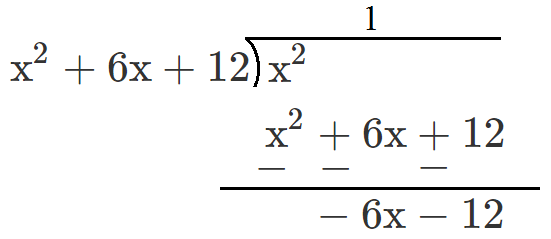
Therefore,
$\frac{\text{x}^2}{\text{x}^2+6\text{x}+12}=1-\frac{(6\text{x}+12)}{\text{x}^2+6\text{x}+12}\ ....(1)$Let $6\text{x}+12=\text{A}\frac{\text{d}}{\text{dx}}\big(\text{x}^2+6\text{x}+12\big)+\text{B}$
$\Rightarrow6\text{x}+12=\text{A}(2\text{x}+6)+\text{B}$
$\Rightarrow6\text{x}+12=(2\text{A})\text{x}+6\text{A}+\text{B}$
Equating coefficients of like terms $2\text{A}=6$ $\text{A}=3$ $6\text{A}+\text{B}=12$ $18+\text{B}=12$ $\text{B}=-6$ $\therefore\ \frac{\text{x}^2}{\text{x}^2+6\text{x}+12}=1-\frac{3(2\text{x}+6)}{\text{x}^2+6\text{x}+12}$ $\text{I}=\int\frac{\text{x}^2\text{ dx}}{\text{x}^2+6\text{x}+12}$ $=\int\text{dx}-3\int\frac{(2\text{x}+6)\text{ dx}}{\text{x}^2+6\text{x}+12}+6\int\frac{\text{dx}}{\text{x}^2+6\text{x}+12}$ $=\int\text{dx}-3\int\frac{(2\text{x}+6)\text{ dx}}{\text{x}^2+6\text{x}+12}+6\int\frac{\text{dx}}{\text{x}^2+6\text{x}+9+3}$ $=\int\text{dx}-3\int\frac{(2\text{x}+6)\text{ dx}}{\text{x}^2+6\text{x}+12}+6\int\frac{\text{dx}}{(\text{x}+3)^2+\big(\sqrt3\big)^2}$ $=\text{x}-3\log\big|\text{x}^2+6\text{x}+12\big|+\frac{6}{\sqrt3}\tan^{-1}\Big(\frac{\text{x}+3}{\sqrt3}\Big)+\text{C}$ $=\text{x}-3\log\big|\text{x}^2+6\text{x}+12\big|+2\sqrt3\tan^{-1}\Big(\frac{\text{x}+3}{\sqrt3}\Big)+\text{C}$ View full question & answer→Question 625 Marks
Evaluate the following integrals:$\int\frac{2\text{x}}{2+\text{x}-\text{x}^2}\text{ dx}$
Answer$\int\frac{2\text{x}\text{ dx}}{(2+\text{x}-\text{x}^2)}$ $2\text{x}=\text{A}\frac{\text{d}}{\text{dx}}\big(2+\text{x}-\text{x}^2\big)+\text{B}$ $2\text{x}=\text{A}(0+1-2\text{x})+\text{B}$ $2\text{x}=(-2\text{A})\text{x}+\text{A}+\text{B}$ Comparing the coefficients of like power of x, $-2\text{A}=2$ $\text{A}=-1$ $\text{A}+\text{B}=0$ $-1+\text{B}=0$ $\text{B}=1$ Now, $\int\frac{2\text{x}\text{ dx}}{(2+\text{x}-\text{x}^2)}$ $=\int\Big(\frac{-1(1-2\text{x})+1}{-\text{x}^2+\text{x}+2}\Big)\text{dx}$ $=-\int\Big(\frac{1-2\text{x}}{-\text{x}^2+\text{x}+2}\Big)\text{dx}+\int\frac{\text{dx}}{-\text{x}^2+\text{x}+2}$ $=-\text{I}_1+\text{I}_2\ ....(1)$ (say) where $\text{I}_1=\int\Big(\frac{1-2\text{x}}{-\text{x}^2+\text{x}+2}\Big)\text{dx}$ $\text{I}_2=\int\frac{\text{dx}}{-\text{x}^2+\text{x}+2}$ $\text{I}_1=\int\Big(\frac{1-2\text{x}}{-\text{x}^2+\text{x}+2}\Big)\text{dx}$ Let $-\text{x}^2+\text{x}+2=\text{t}$ $\Rightarrow(1-2\text{x})\text{dx}=\text{dt}$ $\text{I}_1=\int\frac{\text{dt}}{\text{t}}$ $\text{I}_1=\log|\text{t}|+\text{C}_1\ ....(2)$ $\text{I}_2=\int\frac{\text{dx}}{-\text{x}^2+\text{x}+2}$ $\text{I}_2=\int\frac{-\text{dx}}{\text{x}^2+\text{x}+2}$ $\text{I}_2=\int\frac{-\text{dx}}{\text{x}^2-\text{x}+\big(\frac{1}{2}\big)^2-\big(\frac{1}{2}\big)^2-2}$ $\text{I}_2=\int\frac{-\text{dx}}{\big(\text{x}-\frac{1}{2}\big)^2-\big(\frac{3}{2}\big)^2}$ $\text{I}_2=-\frac{1}{2\times\frac{3}{2}}\log\Bigg|\frac{\text{x}-\frac{1}{2}-\frac{3}{2}}{\text{x}-\frac{1}{2}+\frac{3}{2}}\Bigg|+\text{C}_2$ $\text{I}_2=-\frac{1}{3}\log\Big|\frac{\text{x}-2}{\text{x}+1}\Big|+\text{C}_2\ ....(3)$ From (1) (2) and (3) $\int\Big(\frac{2\text{x}}{2+\text{x}+\text{x}^2}\Big)\text{ dx}=-\log\big|2+\text{x}-\text{x}^2\big|-\frac{1}{3}\log\Big|\frac{\text{x}-2}{\text{x}+1}\Big|+\text{C}_1+\text{C}_2$ $=-\log\big|2+\text{x}-\text{x}^2\big|+\frac{1}{3}\log\Big|\frac{1+\text{x}}{\text{x}-2}\Big|+\text{C}$Where, $\text{C}=\text{C}_1+\text{C}_2$
View full question & answer→Question 635 Marks
Evaluate the following integrals:$\int\frac{\text{x}^3+\text{x}^2+2\text{x}+1}{\text{x}^2-\text{x}+1}\text{ dx}$
AnswerLet $\text{I}=\int\frac{\text{x}^3+\text{x}^2+2\text{x}+1}{\text{x}^2-\text{x}+1}\text{ dx}$ $=\int\Big[\text{x}+2+\frac{3\text{x}-1}{\text{x}^2-\text{x}+1}\Big]\text{dx}$ $\text{I}=\frac{\text{x}^2}{2}+2\text{x}+\int\frac{3\text{x}-1}{\text{x}^2-\text{x}+1}\text{ dx}+\text{C}_1\ ....(1)$ Let $\text{I}_1=\int\frac{3\text{x}-1}{\text{x}^2-\text{x}+1}\text{ dx}$ Let $3\text{x}-1=\lambda\frac{\text{d}}{\text{dx}}\big(\text{x}^2-\text{x}+1\big)+\mu$ $=\lambda(2\text{x}-1)+\mu$ $3\text{x}-1=(2\lambda)\text{x}-\lambda+\mu$Comparing the coefficients of like powers of x,
$3=2\lambda\Rightarrow\lambda=\frac{3}{2}$ $-\lambda+\mu=-1\Rightarrow-\Big(\frac{3}{2}\Big)+\mu=-1$ $\mu=\frac{1}{2}$ So, $\text{I}_1=\int\frac{\frac{3}{2}(2\text{x}-1)+\frac{1}{2}}{\text{x}^2-\text{x}+1}\text{ dx}$ $\text{I}_1=\frac{3}{2}\int\frac{(2\text{x}-1)}{\text{x}^2-\text{x}+1}\text{ dx}+\frac{1}{2}\int\frac{1}{\text{x}^2-2\text{x}\big(\frac{1}{2}\big)+\big(\frac{1}{2}\big)^2-\big(\frac{1}{2}\big)^2+1}\text{ dx}$ $\text{I}_1=\frac{3}{2}\int\frac{2\text{x}-1}{\text{x}^2-\text{x}+1}\text{ dx}+\frac{1}{2}\int\frac{1}{\big(\text{x}-\frac{1}{2}\big)^2-\Big(\frac{\sqrt3}{2}\Big)^2}\text{ dx}$ $\text{I}_1=\frac{3}{2}\log\big|\text{x}^2-\text{x}+1\big|+\frac{1}{2}\times\frac{2}{\sqrt3}\tan^{-1}\bigg(\frac{\text{x}+\frac{1}{2}}{\frac{\sqrt3}{2}}\bigg)+\text{C}_2$ $\Big[\text{since},\int\frac{1}{\text{x}^2+\text{a}^2}\text{ dx}=\frac{1}{\text{a}}\tan^{-1}\Big(\frac{\text{x}}{\text{a}}\Big)+\text{C}\Big]$ $\text{I}_1=\frac{3}{2}\log\big|\text{x}^2-\text{x}+1\big|+\frac{1}{\sqrt3}\tan^{-1}\Big(\frac{2\text{x}+1}{\sqrt3}\Big)+\text{C}_2\ .....(2)$ Using equation (1) and (2) $\text{I}=\frac{\text{x}^2}{2}+2\text{x}+\frac{3}{2}\log\big|\text{x}^2-\text{x}+1\big|+\frac{1}{\sqrt3}\tan^{-1}\Big(\frac{2\text{x}+1}{\sqrt3}\Big)+\text{C}$
View full question & answer→Question 645 Marks
Evaluate the following integrals:$\int\text{cosec}^3\text{x dx}$
AnswerLet $\text{I}=\int\text{cosec}^3\text{dx}$
$=\int\text{cosec x}-\text{cosec}^2\text{x dx}$
using integration by parts,
$=\text{cosec x}\times\int\text{cosec}^2\text{x dx}+\int(\text{cosec x}\cot\text{x}\int\text{cosec}^2\text{x dx})\text{dx}$
$=\text{cosec x}\times(-\cot\text{x})+\int\text{cosec x}\cot\text{x}(-\cot\text{x})\text{dx}$
$=-\text{cosec x}\cot\text{x}-\int\text{cosec x}\cot^2\text{x dx}$
$=-\text{cosec x}\cot \text{x}-\int\text{cosec x}(\text{cosec}^2\text{x}-1)\text{dx}$
$=-\text{cosec x}\cot\text{x}-\int\text{cosec}^3\text{x dx}+\int\text{cosec x dx}$
$\text{I}=-\text{cosec x}\cot\text{x}-\text{I}+\log\Big|\tan\frac{\text{x}}{2}\Big|+\text{C}_1$
$2\text{I}=-\text{cosec x}\cot\text{x}+\log\Big|\tan\frac{\text{x}}{2}\Big|+\text{C}_1$
$\text{I}=-\frac{1}{2}\text{cosec x}\cot\text{x}+\frac{1}{2}\log\Big|\tan\frac{\text{x}}{2}\Big|+\text{C}$
View full question & answer→Question 655 Marks
Evaluate the following integrals:$\int\frac{\cos\text{x}-\sin\text{x}}{\sqrt{8-\sin2\text{x}}}\text{ dx}$
AnswerLet $\text{I}=\int\frac{\cos\text{x}-\sin\text{x}}{\sqrt{8-\sin2\text{x}}}\text{ dx}$
$=\int\frac{\cos\text{x}-\sin\text{x}}{\sqrt{9-1-\sin2\text{x}}}\text{ dx}$
$=\int\frac{\cos\text{x}-\sin\text{x}}{\sqrt{9-\sin^2\text{x}-\cos^2\text{x}-2\sin\text{x}\cos\text{x}}}\text{ dx}$
$=\int\frac{\cos\text{x}-\sin\text{x}}{\sqrt{9-(\sin\text{x}+\cos\text{x})^2}}\text{ dx}$
Let $(\sin\text{x}+\cos\text{x})=\text{t}$
On differentiating both sides, we get
$(\cos\text{x}-\sin\text{x})\text{dx}=\text{dt}$
$\therefore\ \text{I}=\int\frac{1}{(3)^2-(\text{t})^2}\text{ dt}$
$=\sin^{-1}\Big(\frac{\text{t}}{3}\Big)+\text{C}$
$=\sin^{-1}\Big(\frac{\sin\text{x}-\cos\text{x}}{3}\Big)+\text{C}$
Hence, $\int\frac{\cos\text{x}-\sin\text{x}}{\sqrt{8-\sin2\text{x}}}\text{ dx}=\sin^{-1}\Big(\frac{\cos\text{x}-\sin\text{x}}{3}\Big)+\text{C}$
View full question & answer→Question 665 Marks
Evaluate the following integrals:$\int\sin^{-1}\sqrt{\text{x}}\text{dx}$
Answer$\int\sin^{-1}\sqrt{\text{x}}\text{dx}$
Let $\text{x} = \text{t}^{2}\ \ \ [\therefore\text{dx = 2tdt}]$
$\int\sin^{-1}\sqrt{\text{x}}\text{dx}=\int\sin^{-1}\sqrt{\text{t}^2}2\text{tdt}=\int\sin^{-1}\text{t}2\text{tdt}$
$=\sin^{-1}\text{t}\int2\text{tdt}-\Big(\int\frac{\text{d}\sin^{-1}\text{t}}{\text{dt}}\big(\int2\text{tdt}\big)\text{dt}\Big)$
$=\sin^{-1}\text{t}(\text{t}^2)-\int\frac{1}{\sqrt{1-\text{t}^2}}(\text{t}^2)\text{dt}$
Lets solve $\int\frac{1}{\sqrt{1-\text{t}^2}}(\text{t}^2)\text{dt}$
$\int\frac{1}{\sqrt{1-\text{t}^2}}(\text{t}^2)\text{dt}=\int\frac{\text{t}^2-1+1}{\sqrt{1-\text{t}^2}}\text{dt}=\int\frac{\text{t}^2-1}{\sqrt{1-\text{t}^2}}\text{dt}+\int\frac{1}{\sqrt{1-\text{t}^2}}\text{dt}$
We know that, value of $\int\frac{1}{\sqrt{1-\text{t}^2}}\text{dt}=\sin^{-1}\text{t}$
Remaining integral to evalute is $\int\frac{\text{t}^2-1}{\sqrt{1-\text{t}^2}}\text{dt}=\int-\sqrt{1-\text{t}^2}\text{dt}$
sub $\text{t}=\sin\text{u},\text{dt}=\cos\text{u du}$
$\int-\sqrt{1-\text{t}^2}\text{dt}=\int-\cos^2\text{u du}=-\int\Big[\frac{1+\cos2\text{u}}{2}\Big]\text{du}$
$=-\frac{\text{u}}{2}-\frac{\sin2\text{u}}{4}$
Substitute back $\text{u}=\sin^{-1}\text{t}$ and $\text{t}=\sqrt{\text{x}}$
$=-\frac{\sin^{-1}\sqrt{\text{x}}}{2}-\frac{\sin(2\sin^{-1}\sqrt{\text{x}})}{4}$
$\int\sin^{-1}\sqrt{\text{x}}\text{dx}=\text{x}\sin^{-1}\sqrt{\text{x}}-\frac{\sin^{-1}\sqrt{\text{x}}}{2}-\frac{\sin(2\sin^{-1}\sqrt{\text{x}})}{4}$
$\sin(2\sin^{-1}\sqrt{\text{x}})=2\sqrt{\text{x}}\sqrt{1-\text{x}}$
$\int\sin^{-1}\sqrt{\text{x}}\text{dx}=\text{x}\sin^{-1}\sqrt{\text{x}}-\frac{\sin^{-1}\sqrt{\text{x}}}{2}-\frac{\sqrt{\text{x}(1-\text{x})}}{2}$
View full question & answer→Question 675 Marks
Evaluate the following integrals:$\int\frac{\text{x}}{\text{x}^2+3\text{x}+2}\text{ dx}$
AnswerLet $\text{I}=\int\frac{\text{x}}{\text{x}^2+3\text{x}+2}\text{ dx}$
Let $\text{x}=\lambda\frac{\text{d}}{\text{dx}}\big(\text{x}^2+3\text{x}+2\big)+\mu$
$=\lambda(2\text{x}+3)+\mu$
$\text{x}=(2\lambda)\text{x}+(3\lambda+\mu)$
Comparing the coefficients of like powers of x,
$2\lambda=1\Rightarrow\lambda=\frac{1}{2}$
$3\lambda+\mu=0\Rightarrow3\Big(\frac{1}{2}\Big)+\mu=0$
$\mu=-\frac{3}{2}$
So, $\text{I}=\int\frac{\frac{1}{2}(2\text{x}+3)-\frac{3}{2}}{\text{x}^2+3\text{x}+2}\text{ dx}$
$\text{I}=\frac{1}{2}\int\frac{2\text{x}+3}{\text{x}^2+3\text{x}+2}\text{ dx}-\frac{3}{2}\int\frac{1}{\text{x}^2+3\text{x}+2}\text{ dx}$
$\text{I}=\frac{1}{2}\int\frac{2\text{x}+3}{\text{x}^2+3\text{x}+2}\text{ dx}-\frac{3}{2}\int\frac{1}{\text{x}^2+2\text{x}\big(\frac{3}{2}\big)+\big(\frac{3}{2}\big)^2-\big(\frac{3}{2}\big)^2+2}\text{ dx}$
$\text{I}=\frac{1}{2}\int\frac{2\text{x}+3}{\text{x}^2+3\text{x}+2}\text{ dx}-\frac{3}{2}\int\frac{1}{\big(\text{x}+\frac{3}{2}\big)^2-\big(\frac{1}{2}\big)^2}\text{ dx}$
$\text{I}=\frac{1}{2}\log\big|\text{x}^2+3\text{x}+2\big|-\frac{3}{2}\times\frac{1}{2\big(\frac{1}{2}\big)}\log\Bigg|\frac{\text{x}+\frac{3}{2}-\frac{1}{2}}{\text{x}+\frac{3}{2}+\frac{1}{2}}\Bigg|+\text{C}$ $\Big[\text{Since }\int\frac{1}{\text{a}^2-\text{x}^2}\text{ dx}=\frac{1}{2\text{a}}\log\Big|\frac{\text{x}-\text{a}}{\text{x}+\text{a}}\Big|+\text{C}\Big]$
$\text{I}=\frac{1}{2}\log\big|\text{x}^2+3\text{x}+2\big|-\frac{3}{2}\log\Big|\frac{\text{x}+1}{\text{x}+2}\Big|+\text{C}$
View full question & answer→Question 685 Marks
Evaluate the following integrals:$\int(\log\text{x})^2\cdot\text{x dx}$
AnswerLet $\text{I}=\int(\log\text{x})^2\text{x dx}$
Using integration by parts,
$=(\log\text{x})^2\int\text{x dx }-\int\Big(2(\log\text{x})\Big(\frac{1}{\text{x}}\Big)\int\text{x dx}\Big)\text{dx}$
$=\frac{\text{x}^2}{2}(\log\text{x})^2-2\int(\log\text{x})\Big(\frac{1}{\text{x}}\Big)\Big(\frac{\text{x}^2}{2}\Big)\text{dx}$
$=\frac{\text{x}^2}{2}(\log\text{x})^2-\int\text{x}(\log\text{x})\text{dx}$
$=\frac{\text{x}^2}{2}(\log\text{x})^2-\Big[\log\text{x}\int\text{x dx}-\int\Big(\frac{1}{\text{x}}\int\text{x dx}\Big)\text{dx}\Big]$
$=\frac{\text{x}^2}{2}(\log\text{x})^2-\Big[\frac{\text{x}^2}{2}\log\text{x}-\int\Big(\frac{1}{\text{x}}\times\frac{\text{x}^2}{2}\Big)\text{dx}\Big]$
$=\frac{\text{x}^2}{2}(\log\text{x})^2-\frac{\text{x}^2}{2}\log\text{x}+\frac{1}{2}\int\text{x dx}$
$=\frac{\text{x}^2}{2}(\log\text{x})^2-\frac{\text{x}^2}{2}\log\text{x}+\frac{1}{4}\text{x}^2+\text{C}$
$\text{I}=\frac{\text{x}^2}{2}\Big[(\log\text{x})^2-\log\text{x}+\frac{1}{2}\Big]+\text{C}$
View full question & answer→Question 695 Marks
Evaluate the following integrals:$\int\text{x}^2\sin^{-1}\text{x dx}$
AnswerLet $\text{I}=\int\text{x}^2\sin^{-1}\text{x dx}$
$\text{I}=\sin^{-1}\text{x}\int\text{x}^2\text{dx}-\int\Big(\frac{1}{\sqrt{1-\text{x}^2}}\int\text{x}^2\text{dx}\Big)\text{dx}$
$=\frac{\text{x}^3}{3}\sin^{-1}\text{x}-\int\frac{\text{x}^3}{3\sqrt{1-\text{x}^2}}\text{dx}$
$\text{I}=\frac{\text{x}^3}{3}\sin^{-1}\text{x}-\frac{1}{3}\text{I}_1+\text{C}_1\dots(1)$
$\text{I}_1=\int\frac{\text{x}^3}{\sqrt{1-\text{x}^2}}\text{dx}$
Let $1-\text{x}^2=\text{t}^2$
$-2\text{x dx}=2\text{t dt}$
$-\text{x dx}=\text{t dt}$
$\text{I}_1=-\int\frac{(1-\text{t}^2)\text{tdt}}{\text{t}}$
$=\int(\text{t}^2-1)\text{dt}$
$=\frac{\text{t}^3}{3}-\text{t}+\text{C}_2$
$=\frac{(1-\text{x}^2)^{\frac{3}{2}}}{3}-(1-\text{x}^2)^{\frac{1}{2}}+\text{C}_2$
Now,
$\text{I}=\frac{\text{x}^3}{3}\sin^{-1}\text{x}-\frac{1}{9}(1-\text{x}^2)^{\frac{3}{2}}+\frac{1}{3}(1-\text{x}^2)^{\frac{1}{2}}+\text{C}$
View full question & answer→Question 705 Marks
Evaluate the following integrals:$\int\sin^{-1}\Big(\frac{2\text{x}}{1+\text{x}^2}\Big)\text{dx}$
AnswerLet $\text{x}=\tan\theta\Rightarrow\text{dx}=\sec^2\theta\text{d}\theta$
$\therefore\sin^{-1}\Big(\frac{2\text{x}}{1+\text{x}^2}\Big)=\sin^{-1}\Big(\frac{2\tan\theta}{1+\tan^2\theta}\Big)=\sin^{-1}(\sin2\theta)=\theta$
$\Rightarrow\int\sin^{-1}\Big(\frac{2\text{x}}{1+\text{x}^2}\Big)\text{dx}=\int2\theta\cdot\sec^2\theta\text{d}\theta=2\int\theta\cdot\sec^2\theta\text{d}\theta$
Integrating by parts, we obtain
$2\Big[\theta\cdot\int\sec^2\theta\text{d}\theta-\int\Big\{\Big(\frac{\text{d}}{\text{d}\theta}\theta\Big)\int\sec^2\theta\text{d}\theta\Big\}\text{d}\theta\Big]$
$=2\big[\theta\cdot\tan\theta-\int\tan\theta\text{d}\theta\big]$
$=2\big[\theta\tan\theta+\log|\cos\theta|\big]+\text{C}$
$=2\Big[\text{x}\tan^{-1}\text{x}+\log\Big|\frac{1}{\sqrt{1+\text{x}^2}}\Big|\Big]+\text{C}$
$=2\text{x}\tan^{-1}\text{x}+2\log(1+\text{x}^2)^{-\frac{1}{2}}+\text{C}$
$=2\text{x}\tan^{-1}\text{x}+2\Big[-\frac{1}{2}\log(1+\text{x}^2)\Big]+\text{C}$
$=2\text{x}\tan^{-1}\text{x}-\log(1+\text{x}^2)+\text{C}$
View full question & answer→Question 715 Marks
Evaluate the following integrals:$\int\frac{\sin2\text{x}}{\sqrt{\sin^4\text{x}+4\sin^2\text{x}-2}}\text{ dx}$
Answer$\int\frac{\sin(2\text{x})\text{dx}}{\sqrt{\sin^4\text{x}+4\sin^2\text{x}-2}}$
Let $\sin^2\text{x}=\text{t}$
$\Rightarrow2\sin\text{x}\cos\text{x}\text{ dx}=\text{dt}$
$\Rightarrow\sin(2\text{x})\text{ dx}=\text{dt}$
Now, $\int\frac{\sin(2\text{x})\text{dx}}{\sqrt{\sin^4\text{x}+4\sin^2\text{x}-2}}$
$=\int\frac{\text{dt}}{\sqrt{\text{t}^2+4\text{t}-2}}$
$=\int\frac{\text{dt}}{\sqrt{\text{t}^2+4\text{t}+4-4-2}}$
$=\int\frac{\text{dt}}{\sqrt{(\text{t}+2)^2-\big(\sqrt6\big)^2}}$
$=\log\Big|\text{t}+2+\sqrt{(\text{t}+2)^2-6}\Big|+\text{C}$
$=\log\Big|\text{t}+2+\sqrt{\text{t}^2+4\text{t}-2}\Big|+\text{C}$
$=\log\Big|\sin^2\text{x}+2\sqrt{\sin^4\text{x}+4\sin^2\text{x}-2}\Big|+\text{C}$
View full question & answer→Question 725 Marks
Evaluate the following integrals:$\int\frac{\text{x}^3}{\text{x}^4+\text{x}^2+1}\text{ dx}$
Answer$\text{I}=\int\frac{\text{x}^3}{\text{x}^4+\text{x}^2+1}\text{ dx}$ $=\int\frac{\text{x}^2\cdot\text{x}}{(\text{x}^2)^2+\text{x}^2+1}\text{ dx}$ Let $\text{x}^2=\text{t}$ or $2\text{x}\text{ dx}=\text{dt}$ $\text{I}=\frac{1}{2}\int\frac{\text{t}}{\text{t}^2+\text{t}+1}\text{ dt}$ $=\frac{1}{4}\int\frac{2\text{t}}{\text{t}^2+\text{t}+1}\text{ dt}$$=\frac{1}{4}\int\frac{2\text{t}+1-1}{\text{t}^2+\text{t}+1}\text{ dt}$
$=\frac{1}{4}\int\Big[\frac{(2\text{t}+1)}{(\text{t}^2+\text{t}+1)}-\frac{1}{(\text{t}^2+\text{t}+1)}\Big]\text{dt}$
$=\frac{1}{4}\Big[\log\big|\text{t}^2+\text{t}+1\big|-\int\frac{1}{\big(\text{t}^2+\text{t}+\frac{1}{4}+\frac{3}{4}\big)}\text{ dt}\Big]$ $=\frac{1}{4}\begin{bmatrix}\log\big|\text{t}^2+\text{t}+1\big|-\int\frac{1}{\big(\text{t}+\frac{1}{2}\big)^2+\Big(\frac{\sqrt{3}}{2}\Big)^2}\text{ dt}\end{bmatrix}$ $=\frac{1}{4}\begin{bmatrix}\log\big|\text{t}^2+\text{t}+1\big|-\frac{2}{\sqrt3}\tan\frac{\big(\text{t}+\frac{1}{2}\big)}{\Big(\frac{\sqrt3}{2}\Big)}\end{bmatrix}+\text{C}$ $=\frac{1}{4}\Big[\log\big|\text{t}^2+\text{t}+1\big|-\frac{2}{\sqrt3}\tan\Big(\frac{2\text{t}+1}{\sqrt3}\Big)\Big]+\text{C}$ $=\frac{1}{4}\Big[\log\big|\text{x}^4+\text{x}^2+1\big|-\frac{2}{\sqrt3}\tan\Big(\frac{2\text{x}^2+1}{\sqrt3}\Big)\Big]+\text{C}$
View full question & answer→Question 735 Marks
Evaluate the following integrals:$\int\frac{1}{\sqrt{7-6\text{x}-\text{x}^2}}\text{ dx}$
Answer$7 - 6x - x^2$ can be written as $7 - (x^2 + 6x + 9 - 9).$
Therefore,$7-(\text{x}^2+6\text{x}+9-9)$
$=16-(\text{x}^2+6\text{x}+9)$ $=16-(\text{x}+3)^2$ $=(4)^2-(\text{x}+3)^2$
$\therefore\ \int\frac{1}{\sqrt{7-6\text{x}-\text{x}^2}}\text{ dx}$ $=\int\frac{1}{\sqrt{(4)^2-(\text{x}+3)^2}}\text{ dx}$
Let $x + 3 = t$
$\Rightarrow\text{dx}=\text{dt}$
$\Rightarrow\int\frac{1}{\sqrt{(4)^2-(\text{x}+3)^2}}\text{ dx}$
$=\int\frac{1}{\sqrt{(4)^2-(\text{t})^2}}\text{ dt}$
$=\sin^{-1}\Big(\frac{\text{t}}{4}\Big)+\text{C}$
$=\sin^{-1}\Big(\frac{\text{x}+3}{4}\Big)+\text{C}$
View full question & answer→Question 745 Marks
Evaluate the following integrals:$\int\text{e}^{\text{x}}\Big(\frac{\sin4\text{x}-4}{1-\cos4\text{x}}\Big)\text{dx}$
AnswerLet $\text{I}=\int\text{e}^{\text{x}}\Big(\frac{\sin4\text{x}-4}{2\sin^22\text{x}}\Big)\text{dx}$
$=\int\text{e}^{\text{x}}\Big\{\frac{2\sin2\text{x}\cos2\text{x}}{2\sin^22\text{x}}-\frac{4}{2\sin^{2}2\text{x}}\Big\}\text{dx}$
$=\int\text{e}^{\text{x}}\big(\cot2\text{x}-2\text{cosec}^22\text{x}\big)\text{dx}$
$=\int\text{e}^{\text{x}}\cot2\text{x dx}-2\int\text{e}^{\text{x}}\text{cosec}^22\text{x dx}$
integrating by parts
$=\text{e}^{\text{x}}\cot2\text{x}-\int\text{e}^{\text{x}}\frac{\text{d}}{\text{dx}}(\cot2\text{x})\text{dx}-2\int\text{e}^{\text{x}}\text{cosec}^22\text{x dx}$
$=\text{e}^{\text{x}}\cot2\text{x}+2\int\text{e}^{\text{x}}\text{cosec}^22\text{x}-2\int\text{e}^{\text{x}}\text{cosec}^22\text{x dx}$
$=\text{e}^{\text{x}}\cot2\text{x}+\text{C}$
View full question & answer→Question 755 Marks
Evaluate the following integrals:$\int\text{e}^{\text{x}}\frac{1+\text{x}}{(2+\text{x})^2}\text{dx}$
AnswerLet $\text{I}=\int\text{e}^{\text{x}}\frac{1+\text{x}}{(2+\text{x})^2}\text{dx}$
$=\int\text{e}^{\text{x}}\Big(\frac{\text{x}+2-1}{(2+\text{x})^2}\Big)\text{dx}$
$=\int\text{e}^{\text{x}}\bigg\{\frac{1}{\text{x}+2}-\frac{1}{(\text{x}+2)^2}\bigg\}\text{dx}$
$=\int\text{e}^{\text{x}}\frac{1}{\text{x}+2}\text{dx}-\int\text{e}^{\text{x}}\frac{1}{(\text{x}+2)^2}\text{dx}$
Integrating by parts
$=\text{e}^{\text{x}}\frac{1}{\text{x}+2}-\int\text{e}^{\text{x}}\Big(\frac{\text{d}}{\text{dx}}\Big(\frac{1}{\text{x}+2}\Big)\Big)\text{dx}-\int\text{e}^{\text{x}}\frac{1}{(\text{x}+2)^2}\text{dx}$
$=\text{e}^{\text{x}}\frac{1}{\text{x}+2}+\int\text{e}^{\text{x}}\frac{1}{(\text{x}+2)^2}\text{dx}-\int\text{e}^{\text{x}}\frac{1}{(\text{x}+2)^2}\text{dx}$
$=\frac{\text{e}^{\text{x}}}{\text{x}+2}+\text{C}$
View full question & answer→Question 765 Marks
Evaluate the following integrals:$\int\frac{\text{x}+2}{2\text{x}^2+6\text{x}+5}\text{ dx}$
AnswerLet $\text{I}=\int\frac{\text{x}+2}{2\text{x}^2+6\text{x}+5}\text{ dx}$
Let $\text{x}+2=\lambda\frac{\text{d}}{\text{dx}}\big(2\text{x}^2+6\text{x}+5\big)+\mu$
$=\lambda(4\text{x}+6)+\mu$
$\text{x}+2=(4\lambda)\text{x}+(6\lambda+\mu)$
Comparing the coefficients of like powers of x,
$4\lambda=1\Rightarrow\lambda=\frac{1}{4}$
$6\lambda+\mu=2\Rightarrow6\Big(\frac{1}{4}\Big)+\mu=2$
$\mu=\frac{1}{2}$
So, $\text{I}=\int\frac{\frac{1}{4}(4\text{x}+6)+\frac{1}{2}}{2\text{x}^2+6\text{x}+5}\text{ dx}$
$\text{I}=\frac{1}{4}\int\frac{4\text{x}+6}{2\text{x}^2+6\text{x}+5}\text{ dx}+\frac{1}{2}\int\frac{1}{2\text{x}^2+6\text{x}+5}\text{ dx}$
$\text{I}=\frac{1}{4}\int\frac{4\text{x}+6}{2\text{x}^2+6\text{x}+5}\text{ dx}+\frac{1}{2}\int\frac{1}{\text{x}^2+3\text{x}+\frac{5}{2}}\text{ dx}$
$\text{I}=\frac{1}{4}\int\frac{4\text{x}+6}{2\text{x}^2+6\text{x}+5}\text{ dx}+\frac{1}{4}\int\frac{1}{\text{x}^2+2\text{x}\big(\frac{3}{2}\big)+\big(\frac{3}{2}\big)^2-\big(\frac{3}{2}\big)^3+\frac{5}{2}}\text{ dx}$
$\text{I}=\frac{1}{4}\int\frac{4\text{x}+6}{2\text{x}^2+6\text{x}+5}\text{ dx}+\frac{1}{4}\int\frac{1}{\big(\text{x}+\frac{3}{2}\big)^2+\frac{1}{4}}\text{ dx}$
$\text{I}=\int\frac{4\text{x}+6}{2\text{x}^2+6\text{x}+5}\text{ dx}+\frac{1}{4}\int\frac{1}{\big(\text{x}+\frac{3}{2}\big)^2+\big(\frac{1}{2}\big)^2}\text{ dx}$
$\text{I}=\frac{1}{4}\int\frac{4\text{x}+6}{2\text{x}^2+6\text{x}+5}\text{ dx}+\frac{1}{4}\times\frac{1}{\frac{1}{2}}\tan^{-1}\bigg(\frac{\text{x}+\frac{3}{2}}{\frac{1}{2}}\bigg)+\text{C dx}$ $\Big[\text{Since }\int\frac{1}{\text{x}^2+\text{a}^2}\text{ dx}=\frac{1}{\text{a}}\tan^{-1}\Big(\frac{\text{x}}{\text{a}}\Big)+\text{C}\Big]$
$\text{I}=\frac{1}{4}\log\big|2\text{x}^2+6\text{x}+5\big|+\frac{1}{2}\tan^{-1}(2\text{x}+3)+\text{C}$
View full question & answer→Question 775 Marks
Evaluate the following integrals:$\int\text{e}^{\text{x}}.\frac{\sqrt{1-\text{x}^2}\sin^{-1}\text{x}+1}{\sqrt{1-\text{x}^2}}\text{dx}$
AnswerLet $\text{I}=\int\text{e}^{\text{x}}\bigg[\frac{\sqrt{1-\text{x}^2}\sin^{-1}\text{x}+1}{\sqrt{1-\text{x}^2}}\bigg]\text{dx}$
$=\int\text{e}^{\text{x}}\Big[\sin^{-1}\text{x}+\frac{1}{\sqrt{1-\text{x}^2}}\Big]\text{dx}$
Here, $\text{f(x)}=\sin^{-1}\text{x}$
$\Rightarrow\text{f}'\text{(x)}=\frac{1}{\sqrt{1-\text{x}^2}}$
Put $\text{e}^{\text{x}}\text{f(x)}=\text{t}$
$\Rightarrow\text{e}^{\text{x}}\sin^{-1}\text{x}=\text{t}$
Diff both sides w.r.t x
$\Big(\text{e}^{\text{x}}\sin^{-1}\text{x}+\text{e}^{\text{x}}\times\frac{1}{\sqrt{1-\text{x}^2}}\Big)\text{dx = dt}$
$\because\text{I}=\int\text{dt}$
$=\text{t + C}$
$=\text{e}^{\text{x}}\sin^{-1}\text{x + C}$
View full question & answer→Question 785 Marks
Evaluvate the following intregals:
$\int\frac{1}{3+4\cot\text{x}}\ \text{dx}$
AnswerLet $\text{I}=\int\frac{1}{3+4\cot\text{x}}\ \text{dx}$
$=\int\frac{1}{3+\frac{4\cos\text{x}}{\sin\text{x}}}\ \text{dx}$
$=\int\frac{\sin\text{x}}{3\sin\text{x}+4\cos\text{x}}\ \text{dx}$
Let $\sin\text{x}=\text{A}(3\sin\text{x}+4\cos\text{x})+\text{B}(3\cos\text{x}-4\sin\text{x})\dots(1)$
$\Rightarrow\sin\text{x}=(3\text{A}-4\text{B})\sin\text{x}+(4\text{A}+3\text{B})\cos\text{x}$
By compairing the coefficient of both sides we get,
$3\text{A}-4\text{B}=1\dots(2)$
$4\text{A}+3\text{B}=0\dots(3)$
Multiplying eq (2) by (3) and equation (3) by 4, then by adding them we get
$9\text{A}-12\text{B}+16\text{A}+12\text{B}=3+0$
$\Rightarrow25\text{A}=3$
$\text{A}=\frac{3}{25}$
Putting value of A in eq (3) we get,
$4\times\frac{3}{25}+3\text{B}=0$
$\Rightarrow3\text{B}=-\frac{12}{25}$
$\Rightarrow\text{B}=-\frac{4}{25}$
Thus, by substituting the value of A and B in eq (1) we get
$\text{I}=\int\bigg[\frac{\frac{3}{25}(3\sin\text{x}+4\cos\text{x})-\frac{4}{25}(3\cos\text{x}-4\sin\text{x})}{3\sin\text{x}+4\cos\text{x}}\bigg]\text{dx}$
$=\int\text{dx}-\frac{4}{25}\int\Big(\frac{3\cos\text{x}-4\sin\text{x}}{3\sin\text{x}+4\cos\text{x}}\Big)\ \text{dx}$
Putting $3\sin\text{x}+4\cos\text{x}=\text{t}$
$\Rightarrow(3\cos\text{x}-4\sin\text{x})\text{ dx}=\text{dt}$
$\therefore\text{I}=\frac{3}{25}\int\text{dx}-\frac{4}{25}\int\frac{\text{dt}}{\text{t}}$
$=\frac{3}{25}\text{x}-\frac{4}{25}\ln|\text{t}|+\text{C}$
$=\frac{3\text{x}}{25}-\frac{4}{25}\ln|3\sin\text{x}+4\cos\text{x}|+\text{C}$
View full question & answer→Question 795 Marks
Evaluate the following integrals:
$\int\text{x}\sqrt{\text{x}^2+\text{x}}\text{dx}$
AnswerLet $\text{I}=\int\text{x}\sqrt{\text{x}^2+\text{x}}\text{dx}$
Let $\text{x}=\lambda\frac{\text{d}}{\text{dx}}(\text{x}^2+\text{x})+\mu$
$=\lambda(2\text{x}+1)+\mu$
Equating similar terms, we get,
$2\lambda=1\Rightarrow\lambda=\frac{1}{2}$
$\lambda+\mu=0\Rightarrow\mu=-\frac{1}{2}$
So,
$\text{I}=\frac{1}{2}\int\Big(\frac{1}{2}(2\text{x}+1)-\frac{1}{2}\Big)\sqrt{\text{x}^2+\text{x}}\text{dx}$
$=\frac{1}{2}\int(2\text{x}+1)\sqrt{\text{x}^2+\text{x}}-\frac{1}{2}\int\sqrt{\text{x}^2+\text{x}}\text{dx}$
Let $\text{x}^2+\text{x}=\text{t}$
$\Rightarrow(2\text{x}+1)\text{dx = dt}$
So,
$\text{I}=\frac{1}{2}\int\sqrt{\text{t}}\text{dt}-\frac{1}{2}\int\sqrt{\Big(\text{x}+\frac{1}{2}\Big)^2-\Big(\frac{1}{2}\Big)^2}$
$\text{I}=\frac{1}{2}.\frac{\text{t}^{\frac{3}{2}}}{\frac{3}{2}}-\frac{1}{2}\begin{Bmatrix}\frac{\big(\text{x}+\frac{1}{2}\big)}{2}\sqrt{\text{x}^2+\text{x}}\\-\frac{1}{8}\log\Big|\Big(\text{x}+\frac{1}{2}\Big)+\sqrt{\text{x}^2+\text{x}}\Big|\end{Bmatrix}+\text{C}$
Hence,
$\text{I}=\frac{1}{3}(\text{x}^2+\text{x})^{\frac{3}{2}}-\frac{1}{8}{\Big(\text{x}+\frac{1}{2}\Big)}{2}\sqrt{\text{x}^2+\text{x}}\\+\frac{1}{16}\log\Big|\Big(\text{x}+\frac{1}{2}\Big)+\sqrt{\text{x}^2+\text{x}}\Big|+\text{C}$
View full question & answer→Question 805 Marks
Evaluate the following integrals: $\int\cot^6\text{x}\text{ dx}$
Answer$\int\cot^6\text{x}\text{ dx}$
$=\int\cot^4\text{x}\cdot\big(\text{cosec}^2-1\big)\text{dx}$
$=\int\cot^4\text{x}\cdot\text{ cosec}^2\text{x}\text{ dx}-\int\cot^4\text{x}\text{dx}$
$=\int\cot^4\text{x}\cdot\text{ cosec}^2\text{x}\text{ dx}-\int\cot^2\text{x}\cdot\cot^2\text{x}\text{ dx}$
$=\int\cot^4\text{x}-\text{ cosec}^2\text{x}\text{ dx}-\int\big(\text{cosec}^2\text{x}-1\big)\cot^2\text{x}\text{ dx}$
$=\int\cot^4\text{x}\cdot\text{ cosec}^2\text{x}\text{ dx}-\int\cot^2\text{x}\cdot\text{cosec}^2\text{x}\text{ dx}+\int\cot^2\text{x}\text{ dx}$
$=\int\cot^4\text{x}\cdot\text{ cosec}^2\text{x}\text{ dx}-\int\cot^2\text{x}\cdot\text{cosec}^2\text{x}\text{ dx}+\int(\text{cosec}^2\text{x}-1)\text{ dx}$
Now, let $\text{I}_1=\int\cot^4\text{x}\cdot\text{cosec}^2\text{x}\text{ dx}-\int\cot^2\text{x}\cdot\text{cosec}^2\text{x}\text{ dx}$
And $\text{I}_2=\int(\text{cosec}^2\text{x}-1)\text{dx}$
First we integrate $I_1$
$\text{I}_1=\int\cot^4\text{x}\cdot\text{cosec}^2\text{x}\text{ dx}-\int\cot^2\text{x}\cdot\text{cosec}^2\text{x}\text{ dx}$
Let $\cot\text{x}=\text{t}$
$-\text{cosec}^2\text{x}\text{ dx}=\text{dt}$
$\text{cosec}^2\text{x}\text{ dx}=-\text{dt}$
$\text{I}_1=-\int\text{t}^4\text{dt}+\int\text{t}^2\text{dt}$
$=\frac{-\text{t}^5}{5}+\frac{\text{t}^3}{3}+\text{C}_1$
$=-\frac{\cot^5\text{x}}{5}+\frac{\cot^3\text{x}}{3}+\text{C}_1$
Now we integrate $I_2$
$\text{I}_2=\int(\text{cosec}^2\text{x}-1)\text{dx}$
$=-\cot\text{x}-\text{x}+\text{C}_1$
Now, $\int\cot^6\text{x}\text{ dx}=\text{I}_1+\text{I}_2$
$=-\frac{1}{5}\cot^5\text{x}+\frac{1}{3}\cot^3\text{x}-\cot\text{x}-\text{x}+\text{x}+\text{C}_1+\text{C}_2$
$=-\frac{1}{5}\cot^5\text{x}+\frac{1}{3}\cot^3\text{x}-\cot\text{x}-\text{x}+\text{C}$ $\big[\therefore\text{ C}=\text{C}_1+\text{C}_2\big]$
View full question & answer→Question 815 Marks
Evaluvate the following intregals:
$\int\frac{\text{x}+2}{\sqrt{\text{x}^2+2\text{x}+3}}\ \text{dx}$
AnswerLet $\text{I}=\int\frac{\text{x}+2}{\sqrt{\text{x}^2+2\text{x}+3}}\ \text{dx}$
$\text{x}+2=\text{A}\frac{\text{d}}{\text{dx}}[\text{x}^2+2\text{x}+3]+\text{B}$
$\Rightarrow\text{x}+2=2\text{Ax}+2\text{A}+\text{B}$
Comparing the coefficient, we have,
$2\text{A}=1\text{ and }2\text{A}+\text{B}=2$
$\Rightarrow\text{A}=\frac{1}{2}$
Substituting the value of A in 2A + B = 2, we have,
$2\times\frac{1}{2}+\text{B}=2$
$\Rightarrow1+\text{B}=2$
$\Rightarrow\text{B}=2-1$
$\Rightarrow\text{B}=1$
Thus we have,
$\text{x}+2=\frac{1}{2}[2\text{x}+2]+1$
hence,
$\text{I}=\int\frac{\text{x}+2}{\sqrt{\text{x}^2+2\text{x}+3}}\text{dx}$
$=\int\frac{\big[\frac{1}{2}[2\text{x}+2]+1\big]}{\sqrt{\text{x}^2+2\text{x}+3}}\text{dx}$
$=\int\frac{\big[\frac{1}{2}[2\text{x}+2]\big]}{\sqrt{\text{x}^2+2\text{x}+3}}\text{dx}+\int\frac{\text{dx}}{\sqrt{\text{x}^2+2\text{x}+3}}$
$=\frac{1}{2}\int\frac{[2\text{x}+2]}{\sqrt{\text{x}^2+2\text{x}+3}}\text{dx}+\int\frac{\text{dx}}{\sqrt{\text{x}^2+2\text{x}+3}}$
Substituting t = x2 + 2x + 3 and dt = 2x + 2 in the first intrgrand, we have,
$\text{I}=\frac{1}{2}\int\frac{\text{dt}}{\sqrt{\text{t}}}+\int\frac{\text{dx}}{\sqrt{\text{x}^2+2\text{x}+3}}$
$=\frac{1}{2}\times2\sqrt{\text{t}}+\int\frac{\text{dx}}{\sqrt{\text{x}^2+2\text{x}+1+2}}+\text{C}$
$=\sqrt{\text{t}}+\int\frac{\text{dx}}{\sqrt{(\text{x}+1)^2+(\sqrt{2}})^2}+\text{C}$
$\text{I}=\sqrt{\text{x}^2+2\text{x}+3}+\log\big[|\text{x}+1|+\sqrt{(\text{x}+1)^2+(\sqrt{2}}^2\Big]+\text{C}$
$\text{I}=\sqrt{\text{x}^2+2\text{x}+3}+\log\Big[|\text{x}+1|+\sqrt{\text{x}^2+2\text{x}+3}\Big]+\text{C}$
View full question & answer→Question 825 Marks
Evaluate the following integrals:
$\int(\text{x}-2)\sqrt{2\text{x}^2-6\text{x}+5}\text{dx}$
AnswerLet $\text{I}=\int(\text{x}-2)\sqrt{2\text{x}^2-6\text{x}+5}\text{dx}$Also, $\text{x}-2=\lambda\frac{\text{d}}{\text{dx}}(2\text{x}^2-6\text{x}+5)+\mu$
$=(4\lambda)\text{x}+\mu-6\lambda$ Equating the co-efficient of like terms $4\lambda=1\Rightarrow\lambda=\frac{1}{4}$And
$\mu-6\lambda=-2$ $\Rightarrow\mu-6\times\frac{1}{4}=-2$ $\Rightarrow\mu=-2+\frac{3}{2}=-\frac{1}{2}$ $\therefore\ \text{I}=\int\Big[\frac{1}{4}(4\text{x}-6)-\frac{1}{2}\Big]\sqrt{2\text{x}^2-6\text{x}+5}\text{dx}$ $=\frac{1}{4}\int(4\text{x}-6)\sqrt{2\text{x}^2-6\text{x}+5}\text{dx}\\-\frac{1}{2}\int\sqrt{2\text{x}^2-6\text{x}+5}\text{dx}$ Let $2\text{x}^2-6\text{x}+5=\text{t}$ $\Rightarrow(4\text{x}-6)\text{dx = dt}$ $\therefore\ \text{I}=\frac{1}{4}\int\text{t}^{\frac{1}{2}}\text{dt}-\frac{1}{2}\int\sqrt{2\Big(\text{x}^2-3\text{x}+\frac{5}{2}\Big)}\text{dx}$ $=\frac{1}{4}\int\text{t}^{\frac{1}{2}}-\frac{\sqrt2}{2}\int\sqrt{\text{x}^2-3\text{x}\Big(\frac{3}{2}\Big)^2-\Big(\frac{3}{2}\Big)^2+\frac{5}{2}}\text{dx}$ $=\frac{1}{4}\Bigg[\frac{\text{t}^{\frac{3}{2}}}{\frac{3}{2}}\Bigg]-\frac{1}{\sqrt2}\int\sqrt{\Big(\text{x}-\frac{3}{2}\Big)^2-\frac{9}{4}+\frac{5}{2}}\text{dx}$ $=\frac{1}{6}\text{t}^{\frac{3}{2}}-\frac{1}{\sqrt2}\int\sqrt{\Big(\text{x}-\frac{3}{2}\Big)^2-\frac{9+10}{4}}\text{dx}$ $=\frac{1}{6}\text{t}^{\frac{3}{2}}-\frac{1}{\sqrt2}\int\sqrt{\Big(\text{x}-\frac{3}{2}\Big)^2+\Big(\frac{1}{2}\Big)^2}\text{dx}$ $=\frac{1}{6}\big(2\text{x}^2-6\text{x}+5)^{\frac{3}{2}}-\frac{1}{\sqrt2}\bigg[\bigg(\frac{\text{x}-\frac{3}{2}}{2}\bigg)\sqrt{\Big(\text{x}-\frac{3}{2}\Big)^2+\Big(\frac{1}{2}\Big)^2}\\+\frac{1}{8}\log\bigg|\Big(\text{x}-\frac{3}{2}\Big)+\sqrt{\text{x}^2-3\text{x}+\frac{5}{2}}\bigg|\bigg]+\text{C}$ $=\frac{1}{6}\big(2\text{x}^2-6\text{x}+5)^{\frac{3}{2}}-\frac{1}{\sqrt2}\bigg[\frac{2\text{x}-3}{4}\sqrt{\text{x}^2-3\text{x}+\frac{5}{2}}\\+\frac{1}{8}\log\bigg|\frac{2\text{x}-3}{2}+\sqrt{\text{x}^2-3\text{x}+\frac{5}{2}}\bigg|\bigg]+\text{C}$
View full question & answer→Question 835 Marks
Evaluate the following intregals:
$\int\frac{\cos\text{x}}{(1-\sin\text{x})^3(2+\sin\text{x})}\ \text{dx}$
AnswerLet
$\sin\text{x}=\text{t}$
$\Rightarrow\cos\text{x}=\text{dt}$
$\therefore\int\frac{\cos\text{x}}{(1+\sin\text{x})^3(2+\sin\text{x})}=\int\frac{1}{(1-\text{t})^3(2+\text{t})}\ \text{dt}$
Let $\text{f}(\text{t})=\frac{1}{(1-\text{t})^3(2+\text{t})}$
Then suppose
$\frac{1}{(1-\text{t})^3(2+\text{t})}=\frac{\text{A}}{1-\text{t}}+\frac{\text{B}}{(1-\text{t})^2}+\frac{\text{C}}{(1-\text{t})^3}+\frac{\text{D}}{(2+\text{t})}$
$\Rightarrow1=\text{A}(1-\text{t})^2(2+\text{t})+\text{B}(1-\text{t})(2+\text{t})\\+\text{C}(2+\text{t})+\text{D}(1-\text{t})^3$
Put t = 1
1 = 27D
$\Rightarrow\text{D}=\frac{1}{27}$
Similarly, we can find that $\text{A}=\frac{-1}{27}$ and $\text{B}=\frac{+1}{9}$
$\therefore\int\frac{1}{(1-\text{t})^3(2+\text{t})}\ \text{dt}=\frac{-1}{27}\int\frac{1}{1-\text{t}}\ \text{dt}+\frac{1}{9}\int\frac{\text{dt}}{(1-\text{t})^2}\\+\frac{1}{3}\int\frac{\text{dt}}{(1-\text{t})^3}+\frac{1}{27}\int\frac{\text{dt}}{2+\text{t}}$
$=\frac{-1}{27}\log|1-\text{t}|+\frac{1}{9(1-\text{t})}+\frac{1}{6(1-\text{t})^2}+\frac{1}{27}\log|2+\text{t}|+\text{C}$
Putting $\text{t}=\sin\text{x}$ we get
$\int\frac{\cos\text{x}}{(1-\sin\text{x})^3(2+\sin\text{x})}\ \text{dx}$
$=\frac{-1}{27}\log|1-\sin\text{x}|+\frac{1}{9(1-\sin\text{x})}\\+\frac{1}{6(1-\sin\text{x})^2}+\frac{1}{27}\log|2+\sin\text{x}|+\text{C}$
View full question & answer→Question 845 Marks
Evaluate the following intregals: $\int\frac{\text{x}^4}{(\text{x}-1)(\text{x}^2+1)}\ \text{dx}$
Answerwe have
$\text{I}=\int\frac{\text{x}^4\text{dx}}{(\text{x}-1)(\text{x}^2+1)}\ \text{dx}$
$=\int\Big[\frac{\text{x}^4-1+1}{(\text{x}-1)(\text{x}^2+1)}\Big]\text{dx}$
$=\int\frac{(\text{x}^4-1)\text{dx}}{(\text{x}-1)(\text{x}^2+1)}+\int\frac{\text{dx}}{(\text{x}-1)(\text{x}^2+1)}$
$=\int\frac{(\text{x}^2-1)(\text{x}^2+1)\text{ dx}}{(\text{x}-1)(\text{x}^2+1)}+\int\frac{\text{dx}}{(\text{x}-1)(\text{x}^2+1)}$
$=\int\frac{(\text{x}-1)(\text{x}-1)\text{ dx}}{(\text{x}-1)}+\frac{\text{dx}}{(\text{x}-1)(\text{x}^2+1)}$
$=\int(\text{x}+1)\ \text{dx}+\int\frac{\text{dx}}{(\text{x}-1)(\text{x}^2+1)}\ ...(1)$
Let $\frac{1}{(\text{x}-1)(\text{x}^2+1)}=\frac{\text{A}}{\text{x}+1}+\frac{\text{Bx}+\text{C}}{\text{x}^2+1}$
$\Rightarrow\frac{1}{(\text{x}-1)(\text{x}^2+1)}=\frac{\text{A}(\text{x}^2+1)+(\text{Bx}+\text{C})(\text{x}-1)}{(\text{x}-1)(\text{x}^2+1)}$
$\Rightarrow 1 = Ax^2 + A + Bx^2 - Bx + Cx - C$
$\Rightarrow 1 = (A + B)x^2 +(C - B)x + A - C$
Equating coefficient of like terms
$A + B = 0 ...(1)$
$C - B = 0 ...(2)$
$A - C = 1 ...(3)$
Solving $(1), (2), (3)$ we get
$\text{B}=-\frac{1}{2},\text{A}=\frac{1}{2},\text{C}=-\frac{1}{2}$
$\therefore\frac{1}{(\text{x}-1)(\text{x}^2+1)}=\frac{1}{2(\text{x}-1)}+\frac{-\frac{\text{x}}{2}-\frac{1}{2}}{\text{x}^2+1}$
$\Rightarrow\frac{1}{(\text{x}-1)(\text{x}^2+1)}=\frac{1}{2(\text{x}-1)}-\frac{1}{2}\Big(\frac{\text{x}}{\text{x}^2+1}\Big)-\frac{1}{2(\text{x}^2+1)}\ ...(2)$
From (1) and (2)
$\text{I}=\int(\text{x}+1)\ \text{dx}+\frac{1}{2}\int\frac{\text{dx}}{\text{x}-1}-\frac{1}{2}\int\frac{\text{x dx}}{\text{x}^2+1}-\frac{1}{2}\int\frac{\text{dx}}{\text{x}^2+1}$
Putting $\text{x}^2+1=\text{t}$
$\Rightarrow2\text{x dx}=\text{dt}$
$\Rightarrow\text{x dx}=\frac{\text{dt}}{2}$
$\therefore\text{I}=\int(\text{x}+1)\ \text{dx}+\frac{1}{2}\int\frac{\text{dx}}{\text{x}-1}-\frac{1}{4}\int\frac{\text{dt}}{\text{t}}-\frac{1}{2}\int\frac{\text{dx}}{\text{x}^2+1}$
$=\frac{\text{x}^2}{2}+\text{x}+\frac{1}{2}\log|\text{x}-1|-\frac{1}{4}\log|\text{t}|-\frac{1}{2}\tan^{-1}\text{x}+\text{C}$
View full question & answer→Question 855 Marks
Evaluate the following integrals:
$\int(2\text{x}-5)\sqrt{2+3\text{x}-\text{x}^2}\text{dx}$
AnswerLet $\text{I}=\int(2\text{x}-5)\sqrt{2+3\text{x}-\text{x}^2}\text{dx}$
Also, $2\text{x}-5=\lambda\frac{\text{d}}{\text{dx}}(2+3\text{x}-\text{x}^2)+\mu$
$\Rightarrow2\text{x}-5=\lambda(-2\text{x}+3)+\mu$
$\Rightarrow2\text{x}-5=(-2\lambda)\text{x}=3\lambda+\mu$
Equating co-efficients of like terms
$-2\lambda=2$
$\Rightarrow\lambda=-1$
And
$3\lambda+\mu=-5$
$\Rightarrow3(-1)+\mu=-5$
$\Rightarrow\mu=-5+3$
$\Rightarrow\mu=-2$
$\therefore\ 2\text{x}-5=-1(-2\text{x}+3)-2$
Hence, $\text{I}=\int[-(-2\text{x}+3)-2]\sqrt{2+3\text{x}-\text{x}^2}\text{dx}$
$=-\int(-2\text{x}+3)\sqrt{2+3\text{x}-\text{x}^2}\text{dx}-2\int\sqrt{2+3\text{x}-\text{x}^2}\text{dx}$
$=-\text{I}_1-2\text{I}_2\ \dots(1)$
$\text{I}_1=\int(-2\text{x}+3)\sqrt{2+3\text{x}-\text{x}^2}\text{dx}$
Let $2+3\text{x}-\text{x}^2=\text{t}$
$\Rightarrow(-2\text{x}+3)\text{dx}=\text{dt}$
$\therefore\ \text{I}_1=\int\text{t}^{\frac{1}{2}}\text{dt}$
$=\frac{\text{t}^{\frac{1}{2}+1}}{\frac{1}{2}+1}$
$=\frac{2}{3}\text{t}^{\frac{3}{2}}$
$=\frac{2}{3}\big(2+3\text{x}-\text{x}^2\big)^{\frac{3}{2}}\ \dots(2)$
And $\text{I}_2=\int\sqrt{2+3\text{x}-\text{x}^2}\text{dx}$
$\text{I}_2=\int\sqrt{2-(\text{x}^2-3\text{x})}\text{dx}$
$=\int\sqrt{2-\Big[\text{x}^2-3\text{x}+\Big(\frac{3}{2}\Big)^2-\Big(\frac{3}{2}\Big)^2\Big]}\text{dx}$
$=\int\sqrt{2+\frac{9}{4}-\Big(\text{x}-\frac{3}{2}\Big)^2}\text{dx}$
$=\int\sqrt{\Big(\frac{\sqrt{17}}{2}\Big)^2-\Big(\text{x}-\frac{3}{2}\Big)^2}\text{dx}$
$=\frac{\text{x}-\frac{3}{2}}{2}\sqrt{\Big(\frac{\sqrt{17}}{2}\Big)^2-\Big(\text{x}-\frac{3}{2}\Big)^2}+\frac{\Big(\frac{\sqrt{17}}{2}\Big)^2}{2}\sin^{-1}\Bigg(\frac{\text{x}-\frac{3}{2}}{\frac{\sqrt{17}}{2}}\Bigg)$
$=\frac{2\text{x}-3}{4}\sqrt{2+3\text{x}-\text{x}^2}+\frac{17}{8}\sin^{-1}\Big(\frac{2\text{x}-3}{\sqrt{17}}\Big)\ \dots(3)$
From eq. (1), (2) and (3) we have
$\text{I}=-\frac{2}{3}\big(2+3\text{x}-\text{x}^2\big)^{\frac{3}{2}}-\frac{(2\text{x}-3)}{2}\sqrt{2+3\text{x}-\text{x}^2}\\-\frac{17}{4}\sin^{-1}\Big(\frac{2\text{x}-3}{\sqrt{17}}\Big)+\text{C}$
View full question & answer→Question 865 Marks
Evaluate the following intregals:
$\int\frac{3}{(1-\text{x})(1+\text{x}^2)}\ \text{dx}$
AnswerWe have,
$\text{I}=\int\frac{3\text{dx}}{(1-\text{x})(1+\text{x}^2)}$
$=3\int\frac{\text{dx}}{(1-\text{x})(1+\text{x}^2)}$
Let $\frac{1}{(1-\text{x})(1+\text{x})^2}=\frac{\text{A}}{1-\text{x}}+\frac{\text{Bx}+\text{C}}{\text{x}^2+1}$
$\Rightarrow\frac{1}{(1-\text{x})(\text{x}^2+1)}=\frac{\text{A}(\text{x}^2+1)+(\text{Bx}+\text{C})(1-\text{x})}{(1-\text{x})(\text{x}^2+1)}$
$\Rightarrow1=\text{Ax}^2+\text{A}+\text{Bx}-\text{Bx}^2+\text{C}-\text{Cx}$
$\Rightarrow1=(\text{A}-\text{B})\text{x}^2+(\text{B}-\text{C})\text{x}+\text{A}+\text{C}$
Equating coefficient of like terms.
$\text{A}-\text{B}=0\ ...(1)$
$\text{B}-\text{C}=0\ ...(2)$
$\text{A}+\text{C}=1\ ...(3)$
Solving (1), (2) and (3), we get
$\text{A}=\frac{1}{2},\text{B}=\frac{1}{2},\text{C}=\frac{1}{2}$
$\therefore\frac{1}{(1-\text{x})(\text{x}^2+1)}=\frac{1}{2(1-\text{x})}+\frac{\frac{\text{x}}{2}+\frac{1}{2}}{\text{x}^2+1}$
$\int\frac{3\text{dx}}{(1-\text{x})(\text{x}^2+1)}=\frac{3}{2}\int\frac{\text{dx}}{1-\text{x}}+\frac{3}{2}\int\frac{\text{x dx}}{\text{x}^2+1}+\frac{3}{2}\int\frac{\text{dx}}{\text{x}^2+1}$
Putting $\text{x}^2+1=\text{t}$
$\Rightarrow\text{x dx}=\frac{\text{dt}}{2}$
$\therefore\text{I}=\frac{3}{2}\int\frac{\text{dx}}{1-\text{x}}+\frac{3}{4}\int\frac{\text{dt}}{\text{t}}+\frac{3}{2}\int\frac{\text{dx}}{\text{x}^2+1}$
$=\frac{3}{2}\frac{\log|1-\text{x}|}{-1}+\frac{3}{4}\log|\text{t}|+\frac{3}{2}\times\tan^{-1}\text{x}+\text{C}$
$=\frac{-3}{2}\log|1-\text{x}|+\frac{3}{4}\log|1+\text{x}^2|+\frac{3}{2}\tan^{-1}\text{x}+\text{C}$
$=\frac{-3}{4}\times2\log|1-\text{x}|+\frac{3}{4}\log|1+\text{x}^2|+\frac{3}{2}(2\tan^{-1}\text{x})+\text{C}$
$=\frac{3}{4}\big[\log|1+\text{x}^2|-\log|(1-\text{x}^2)|\big]+\frac{3}{4}(2\tan^{-1}\text{x})+\text{C}$
$=\frac{3}{4}\Big[\log\Big|\frac{1+\text{x}^2}{(1-\text{x})^2}\Big|+2\tan^{-1}(\text{x})\Big]+\text{C}$
View full question & answer→Question 875 Marks
Evaluvate the following intregals:
$\int\frac{3+2\cos\text{x}+4\sin\text{x}}{2\sin\text{x}+\cos\text{x}+3}\ \text{dx}$
AnswerLet $\text{I}=\int\frac{3+2\cos\text{x}+4\sin\text{x}}{2\sin\text{x}+\cos\text{x}+3}\ \text{dx}$
Let $3+2\cos\text{x}+4\sin\text{x}=\lambda\frac{\text{d}}{\text{dx}}(2\sin\text{x}+\cos\text{x}+3)+\mu(2\sin\text{x}+\cos\text{x}+3)+\text{v}$
$3+2\cos\text{x}+4\sin\text{x}=\lambda(2\cos\text{x}-\sin\text{x})+\mu(2\sin\text{x}+\cos\text{x}+3)+\text{v}$
$3+2\cos\text{x}+4\sin\text{x}=(-\lambda+2\mu)\sin\text{x}+(2\lambda+\mu)\cos\text{x}+3\mu+\text{v}$
Comparing the coefficient of $\sin\text{x}\ \&\cos\text{x}$ on the both the sides,
$-\lambda+2\mu\ =4\dots\dots(1)$
$2\lambda + \mu = 2 \ \dots\dots(2)$
$2\mu + \text{v} = 3 \ \dots\dots(3)$
Solving Equation (1), (2) and (3), we get
$\lambda=0,\mu=2,\text{v}=-3$
$\text{I}==\int\frac{2(2\sin\text{x}+\cos\text{x}+3)-3}{(2\sin\text{x}+\cos\text{x}+3)}\ \text{dx}$
$=2\int\text{dx}-2\int\frac{1}{2\sin\text{x}+\cos\text{x}+3}\ \text{dx}$
$\text{I}=2\text{x}-3\text{I}_1+\text{C}_1\dots\dots(4)$
Let $\text{I}_1=\int\frac{1}{2\sin\text{x}+\cos\text{x}+3}\ \text{dx}$
$\sin\text{x}=\frac{2\tan\frac{\text{x}}{2}}{\Big(1+\tan^2\frac{\text{x}}{2}\Big)},\cos\text{x}=\frac{1-\tan^2\frac{\text{x}}{2}}{\Big(1+\tan^2\frac{\text{x}}{2}\Big)}$
$\text{I}_1=\int\frac{1}{2\Bigg(\frac{2\tan\frac{\text{x}}{2}}{1+\tan^2\frac{\text{x}}{2}}\Bigg)+\Bigg(\frac{1-\tan^2\frac{\text{x}}{2}}{1+\tan^2\frac{\text{x}}{2}}\Bigg)+3}\ \text{dx}$
$=\int\frac{\Big(1+\tan^2\frac{\text{x}}{2}\Big)}{4\tan\frac{\text{x}}{2}+1-\tan^2\frac{\text{x}}{2}+3\Big(1+\tan^2\frac{\text{x}}{2}\Big)}\ \text{dx}$
$=\int\frac{\sec^2\frac{\text{x}}{2}}{2\tan^2\frac{\text{x}}{2}+4\tan\frac{\text{x}}{2}+4}\ \text{dx}$
Let $\tan\frac{\text{x}}{2}=\text{t}$
$\frac{1}{2}\sec^2\frac{\text{x}}{2}=\text{dt}$
$\text{I}_1=\int\frac{2\text{dt}}{2\text{t}^2+4\text{t}+4}$
$\frac{2}{2}\int\frac{\text{dt}}{\text{t}^2+2\text{t}+2}$
$=\int\frac{\text{dt}}{\text{t}^2+2\text{t}+1-1+2}$
$=\int\frac{\text{dt}}{(\text{t}+1)^2+1}$
$=\tan^{-1}\Big(\tan\frac{\text{x}}{2}+1)+\text{C}_2$
Now, using equation (1),
$\text{I}=2\times-3\tan^{-1}\Big(\tan\frac{\text{x}}{2}+1\Big)+\text{C}$
View full question & answer→Question 885 Marks
Evaluate the following intregals: $\int\frac{4\text{x}^2+3}{(\text{x}^2+2)(\text{x}^2+3)(\text{x}^2+4)}\ \text{dx}$
AnswerWe have,
$\int\frac{(4\text{x}^2+3)\text{dx}}{(\text{x}^2+2)(\text{x}^2+3)(\text{x}^2+4)}\ $
Putting $x^2 = t$
Then,
$\frac{4\text{x}^2+3}{(\text{x}^2+2)(\text{x}^2+3)(\text{x}^2+4)}=\frac{4\text{t}^2+3}{(\text{t}+2)(\text{t}+3)(\text{t}+4)}$
Let $\frac{4\text{x}^2+3}{(\text{x}^2+2)(\text{x}^2+3)(\text{x}^2+4)}=\frac{\text{A}}{\text{t}+2}+\frac{\text{B}}{\text{t}+3}+\frac{\text{C}}{\text{t}+4}$
$\Rightarrow\frac{4\text{x}^2+3}{(\text{x}^2+2)(\text{x}^2+3)(\text{x}^2+4)}=\frac{\text{A}(\text{t}+3)(\text{t}+4)+\text{C}(\text{t}+2)(\text{t}+3)}{(\text{t}+2)(\text{t}+3)(\text{t}+4)}$
$\Rightarrow 4t^2 + 3 = A(t + 3)(t+ 4 ) + B(t + 2)(t + 4) + C(t + 2)(t + 3)$
putting$ t + 3 = 0$
$\Rightarrow t = -3$
$\therefore 4 \times (-3)^2 + 3 = B(-3 + 2)(-3 + 4)$
$\Rightarrow 39 = B(-1)$
$\Rightarrow B = -39$
Putting $t + 2 = 0$
$\Rightarrow t = -2$
$\therefore 4(-2)^2 + 3 = A(-2 + 3)(-2 + 4)$
$\therefore 19 = A \times 1 \times 2$
$\Rightarrow\text{A}=\frac{19}{2}$
Let $t + 4 = 0$
$\Rightarrow t = -4$
$\therefore 4 \times (-4)^2 + 3 = C(-4 + 2)(-4 + 3)$
$\Rightarrow 67 = C(-2)(-1)$
$\Rightarrow\text{C}=\frac{67}{2}$
$\therefore\frac{4\text{t}^2+3}{(\text{t}+2)(\text{t}+3)(\text{t}+4)}=\frac{19}{2(\text{t}+2)}-\frac{39}{\text{x}^2+3}-\frac{39}{(2\text{t}+4)}$
$\Rightarrow\frac{4\text{t}^2+3}{(\text{x}^2+2)(\text{x}^2+3)(\text{x}^2+4)}=\frac{19}{2(\text{x}^2+2)}-\frac{39}{\text{x}^2+3}+\frac{67}{2(\text{x}^2+4)}$
$\therefore\text{I}=\frac{19}{2}\int\frac{\text{dx}}{\text{x}^2+(\sqrt{2})^2}-39\int\frac{\text{dx}}{\text{x}^2+(\sqrt{3})^2}-\frac{67}{2}\int\frac{\text{dx}}{\text{x}^2+2^2}$
$=\frac{19}{2}\times\frac{1}{\sqrt{2}}\tan^{-1}\Big(\frac{\text{x}}{\sqrt{2}}\Big)-\frac{39}{\sqrt{3}}\tan^{-1}\Big(\frac{\text{x}}{\sqrt{3}}\Big)-67\times\frac{1}2{}\tan^{-1}\Big(\frac{\text{x}}{2}\Big)+\text{C}$
$=\frac{19}{2\sqrt{2}}\tan^{-1}\Big(\frac{\text{x}}{\sqrt{2}}\Big)-\frac{39}{\sqrt{3}}\tan^{-1}\Big(\frac{\text{x}}{\sqrt{3}}\Big)-\frac{67}{4}\tan^{-1}\Big(\frac{\text{x}}{2}\Big)+\text{C}$
View full question & answer→Question 895 Marks
Evaluate the following integrals:
$\int\frac{1}{\sin^3\text{x}\cos^5\text{x}}\text{dx}$
AnswerLet $\text{I}=\int\frac{1}{\sin^3\text{x}\cos^5\text{x}}\text{dx}\ ...(\text{i})$
Then, $\text{I}=\int\sin^{-3}\text{x}\cos^{-5}\text{x}\text{ dx}$
Since -3 - 5 = -8, which is given integer. So, we divide both numerator and denominator by $\cos^8\text{x}$
$\therefore\ \text{I}=\int\frac{\frac{1}{\cos^8\text{x}}}{\frac{\sin^3\text{x}\cos^5\text{x}}{\cos^8\text{x}}}\text{ dx}$
$=\int\frac{\sec^8\text{x}}{\tan^3\text{x}}\text{ dx}$
$=\int\frac{(\sec^2\text{x})^3}{\tan^3\text{x}}\sec^2\text{x}\text{ dx}$
$=\int\frac{(1+\tan^2\text{x})^3}{\tan^3\text{x}}\sec^2\text{x}\text{ dx}$
$\text{I}=\int\frac{\big(1+\tan^6\text{x}+3\tan^4\text{x}+3\tan^2\text{x}\big)\sec^2\text{x}}{\tan^3\text{x}}\text{ dx}\ ...(\text{ii})$
Let $\text{t}=\tan\text{x}$ Then
$\text{d}(\tan\text{x})=\text{dt}$
$\sec^2\text{x}\text{ dx}=\text{dt}$
$\therefore\ \text{I}\int\frac{\big(1+\text{t}^6+3\text{t}^4+3\text{t}^2\big)}{\text{t}^3}\text{ dt}$
$=\int\big(\text{t}^{-3}+\text{t}^3+3\text{t}+3\text{t}^{-1}\big)\text{dt}$
$=-\frac{\text{t}^{-2}}{2}+\frac{\text{t}^{4}}{4}+\frac{3}{2}\text{t}^2+3\log\text{t}+\text{C}$
$=-\frac{1}{2\text{t}^{2}}+\frac{\text{t}^{4}}{4}+\frac{3}{2}\text{t}^2+3\log\text{t}+\text{C}$
$=-\frac{1}{2}\times\frac{1}{\tan^2\text{x}}+\frac{\tan^4\text{x}}{4}+\frac{3}{2}\times\tan^2\text{x}+3\log|\tan\text{x}|+\text{C}$
$\therefore\ \text{I}=\frac{-1}{2\tan^2\text{x}}+3\log|\tan\text{x}|+\frac{3}{2}\tan^2\text{x}+\frac{1}{4}\times\tan^4\text{x}+\text{C}$
View full question & answer→Question 905 Marks
Evaluate the following intregals:
$\int\frac{\text{x}+2}{\sqrt{\text{x}^2-1}}\text{dx}$
AnswerLet $\text{x}+2=\text{A}\frac{\text{d}}{\text{dx}}(\text{x}^2-1)+\text {B}\ ...(1)$
$\Rightarrow\text{x}+2=\text{A}(2\text{x})+\text{B}$
Equating the coefficient of x and constant term on both sides, we obtain
$2\text{A}=1\Rightarrow\text{A}=\frac{1}{2}$
$\text{B}=2$
From (1), we obtain
$(\text{x}+2)=\frac{1}{2}(2\text{x})+2$
Then, $\int\frac{\text{x}+2}{\sqrt{\text{x}^2-1}}\text{dx}=\int\frac{\frac{1}{2}(2\text{x})+2}{\sqrt{\text{x}^2-1}}\text{dx}$
$=\frac{1}{2}\int\frac{2\text{x}}{\sqrt{\text{x}^2-1}}\text{dx}+\int\frac{2}{\sqrt{\text{x}^2-1}}\text{dx}\ ...(2)$
$\text{In }\frac{1}{2}\int\frac{2\text{x}}{\sqrt{\text{x}^2-1}}\text{dx}, $
Let $\text{x}^2-1=\text{t}\Rightarrow2\text{x}\text{ dx}=\text{dt}$
In $\frac{1}{2}\int\frac{2\text{x}}{\sqrt{\text{x}^2-1}}\text{dx}$
let $\text{x}^2-1=\text{t}\Rightarrow2\text{x} \text{ dx}=\text{dt}$
$\frac{1}{2}\int\frac{2\text{x}}{\sqrt{\text{x}^2-1}}\text{dx}=\frac{1}{2}\int\frac{\text{dt}}{\sqrt{\text{t}}}$
$=\frac{1}{2}\big[2\sqrt{\text{t}}\big]$
$=\sqrt{\text{t}}$
$=\sqrt{\text{x}^2-1}$
Then, $\int\frac{2}{\sqrt{\text{x}^2-1}}\text{dx}=2\int\frac{1}{\sqrt{\text{x}^2-1}}\text{dx}=2\log\big|\text{x}+\sqrt{\text{x }+1}\big|$
From equation (2), we obtain
$\int\frac{\text{x}+2}{\sqrt{\text{x}^2-1}}\text{dx}=\sqrt{\text{x}^2-1}+2\log\big|\text{x}+\sqrt{\text{x}^2-1}\big|+\text{C}$
View full question & answer→Question 915 Marks
$\int\frac{\text{x}}{\sqrt{\text{x}+\text{a}}-\sqrt{\text{x}+\text{b}}}\text{dx}$
Answer$\int\frac{\text{x}}{\sqrt{\text{x}+\text{a}}-\sqrt{\text{x}+\text{b}}}\text{dx}$
$=\int\frac{\text{x}}{\sqrt{\text{x}+\text{a}}-\sqrt{\text{x}+\text{b}}}\times\frac{\sqrt{\text{x}+\text{a}}+\sqrt{\text{x}+\text{b}}}{\sqrt{\text{x}+\text{a}}+\sqrt{\text{x}+\text{b}}}\text{dx}$
$=\int\frac{\text{x}(\sqrt{\text{x}+\text{a}}+\sqrt{\text{x}+\text{b}})}{(\sqrt{\text{x}+\text{a}})^2-(\sqrt{\text{x}+\text{b}})^2}\text{dx}$
$=\int\frac{\text{x}(\sqrt{\text{x}+\text{a}}+\sqrt{\text{x}+\text{b}})}{\text{x}+\text{a}-\text{x}-\text{b}}\text{dx}$
$=\frac{1}{\text{a}-\text{b}}\int\text{x}(\sqrt{\text{x}+\text{a}}+\sqrt{\text{x}+\text{b}})\text{dx}$
$=\frac{1}{\text{a}-\text{b}}\big[\int\text{x}(\sqrt{\text{x}+\text{a}})\text{dx}+\int\text{x}(\sqrt{\text{x}+\text{b}})\text{dx}\big]$
$=\frac{1}{\text{a}-\text{b}}\big[\int(\text{x}+\text{a}-\text{a})(\sqrt{\text{x}+\text{a}})\text{dx}+\int(\text{x}+\text{b}-\text{b})(\sqrt{x+\text{b}})\text{dx}$
$=\frac{1}{\text{a}-\text{b}}\big[\int(\text{x}+\text{a})(\sqrt{\text{x}+\text{a}})\text{dx}-\text{a}\int(\sqrt{\text{x}+\text{a}})\text{dx}\\+\int(\text{x}+\text{b})(\sqrt{\text{x}+\text{b}})\text{dx}-\text{b}\int(\sqrt{\text{x}+\text{b}})\text{dx}\big]$
$=\frac{1}{\text{a}-\text{b}}\big[\int(\text{x}+\text{a})^\frac{3}{2}\text{dx}-\text{a}\int(\text{x}+\text{a})^\frac{1}{2}\text{dx}+\int(\text{x}+\text{b})^\frac{3}{2}\text{dx}-\text{b}\int(\text{x}+\text{b})^\frac{1}{2}\text{dx}\big]$
$=\frac{1}{\text{a}-\text{b}}\Big[\frac{(\text{x}+\text{a})^\frac{5}{2}}{\frac{5}{2}}-\text{a}\frac{(\text{x}+\text{a})^\frac{3}{2}}{\frac{3}{2}}+\frac{(\text{x}+\text{b})^\frac{5}{2}}{\frac{5}{2}}-\text{b}\frac{(\text{x}+\text{b})^\frac{3}{2}}{\frac{3}{2}}+\text{c}$ where, c is an arbitrary constant.
$=\frac{1}{\text{a}-\text{b}}\Big[\frac{2}{5}(\text{x}+\text{a})^\frac{5}{2}-\frac{2\text{a}}{3}(\text{x}+\text{a})^\frac{3}{2}+\frac{2}{5}(\text{x}+\text{b})^\frac{5}{2}-\frac{2\text{b}}{3}(\text{x}+\text{b})^\frac{3}{2}\Big]+\text{c}$ where, c is an arbitrary constant.
Hence, $\int\frac{\text{x}}{\sqrt{\text{x}+\text{a}}-\sqrt{\text{x}+\text{b}}}\text{dx}=$ $\frac{1}{\text{a}-\text{b}}\Big[\frac{2}{5}(\text{x}+\text{a})^\frac{5}{2}-\frac{2\text{a}}{3}(\text{x}+\text{a})^\frac{3}{2}+\frac{2}{5}(\text{x}+\text{b})^\frac{5}{2}-\frac{2\text{b}}{3}(\text{x}+\text{b})^\frac{3}{2}\Big]+\text{c}$ where, c is an arbitrary constant.
View full question & answer→Question 925 Marks
Evaluvate the following intregals:
$\int\frac{1}{\text{p}+\text{q}\tan\text{x}}\ \text{dx}$
AnswerLet $\text{I}=\int\frac{1}{\text{p}+\text{q}\tan\text{x}}\ \text{dx}$
$=\int\frac{1}{\text{P}+\frac{q\sin\text{x}}{\cos\text{x}}}\ \text{dx}$
$=\int\frac{\cos\text{x}}{q\sin\text{x}+\text{p}\cos\text{x}}\ \text{dx}$
Let $\cos\text{x}=\text{A}(q\sin\text{x}+\text{p}\cos\text{x})+\text{B}(q\cos\text{x}-\text{p}\sin\text{x})$
$\Rightarrow\cos\text{x}=(\text{Ap}+\text{Bq})\cos\text{x}+(\text{Aq}-\text{Bp})\sin\text{x}$
Compairing coefficient of like terms
$\text{Ap}+\text{Bq}=0\dots(1)$
$\text{Aq}+\text{Bp}=1\dots(2)$
Multipiying eq (1) by p and eq (2) by q and then adding
$\Rightarrow\text{Ap}^2+\text{Bpq}=\text{p}$
$\Rightarrow\text{Aq}^2+\text{Bpq}=0$
$\Rightarrow\text{A}=\frac{\text{p}}{\text{p}^2\text{q}^2}$
Putting value of A in eq (1)
$\frac{\text{p}^2}{\text{p}^2+\text{q}^2}+\text{Bq}=1$
$\Rightarrow\text{Bq}=1-\frac{\text{p}^2}{\text{p}^2+\text{q}^2}$
$\Rightarrow\text{Bq}=\frac{\text{p}^2+\text{q}^2-\text{p}^2}{\text{p}^2+\text{q}^2}$
$\Rightarrow\text{B}=\frac{\text{q}}{\text{p}^2+\text{q}^2}$
$\therefore\text{I}=\int\Big[\frac{\text{p}^2}{\text{p}^2+\text{q}^2}\times\frac{(\text{q}\sin\text{x}+\text{p}\cos\text{x})}{(q\sin\text{x}+\text{p}\cos\text{x})}+\frac{\text{q}}{\text{p}^2+\text{q}^2}\times\frac{(q\cos\text{x}-\text{p}\sin\text{x})}{(q\sin\text{x}+\text{p}\cos\text{x})}\Big]\text{dx}$
$=\frac{\text{q}}{\text{p}^2+\text{q}^2}\int\text{dx}+\frac{\text{p}^2}{\text{p}^2+\text{q}^2}\int\Big(\frac{q\cos\text{x}-\text{p}\sin\text{x}}{q\sin\text{x}+\text{p}\cos\text{x}}\Big)\text{dx}$
Putting $\text{q}\sin\text{x}+\text{p}\cos\text{x}=\text{t}$
$\Rightarrow(\text{q}\cos\text{x}-\text{p}\sin\text{x})\text{ dx}=\text{dt}$
$\therefore\text{I}=\frac{\text{p}}{\text{q}+\text{q}^2}\int\text{dx}+\frac{\text{q}}{\text{p}^2+\text{q}^2}\int\frac{1}{\text{t}}\text{dt}$
$=\frac{\text{p}}{\text{q}+\text{q}^2}\text{x}+\frac{\text{q}}{\text{p}^2+\text{q}^2}\ln|\text{q}\sin\text{x}+\text{p}\cos\text{x}|+\text{C}$
View full question & answer→Question 935 Marks
Evaluate the following integrals: $\int\frac{1}{\sin\text{x}(3+2\cos\text{x})}\ \text{dx}$
AnswerLet $\text{I}=\int\frac{1}{\sin\text{x}(3+2\cos\text{x})}\ \text{dx}$
$=\frac{\sin\text{x dx}}{\sin^2\text{x}(3+2\cos\text{x })}$
$=\frac{\sin\text{x dx}}{(1-\cos^2\text{x})(3+2\text{x})}$
Let $\cos\text{x}=\text{t}$
$\Rightarrow-\sin\text{x dx}=\text{dt}$
$\therefore\text{I}=\int\frac{\text{dt}}{(\text{t}^2-1)(3+2\text{t})}$
Now,
Let $\frac{1}{(\text{t}^2-1)(3+2\text{t})}=\frac{\text{A}}{\text{t}-1}+\frac{\text{B}}{\text{t}+1}+\frac{\text{C}}{3+2\text{t}}$
$\Rightarrow 1 = A(t + 1)(3 + 2t) + B(t - 1)(3 + 2t) + C (t^2- 1)$
Put $t = -1$
$\Rightarrow 1 = -2B$
$\Rightarrow\text{A}=\frac{1}{10}$
Put $\text{t}=-\frac{3}{2}$
$\Rightarrow1=\frac{5}{4}\text{C}$
$\Rightarrow\text{C}=\frac{4}{5}$
Thus,
$\text{I}=\frac{1}{10}\int\frac{\text{dt}}{\text{t}-1}-\frac{1}{2}\int\frac{\text{dt}}{\text{t}+1}+\frac{5}{4}\int\frac{\text{dt}}{3+2\text{t}}$
$=\frac{1}{10}\log|\text{t}-1|=\frac{1}{2}\log|\text{t}+1|+\frac{2}{5}\log|3+2\text{t}|+\text{C}$
Hence,
$\text{I}=\frac{1}{10}\log|\cos\text{x}-1|-\frac{1}{2}\log|\cos\text{x}+1|+\frac{2}{5}\log|3+2\cos\text{x}|+\text{C}$
View full question & answer→Question 945 Marks
Evaluate the following integrals: $\int\frac{(\text{x}^2+1)(\text{x}^2+2)}{(\text{x}^2+3)(\text{x}^2+4)}\ \text{dx}$
Answer$\text{f}(\text{x})=\frac{(\text{x}^2+1)(\text{x}^2+2)}{(\text{x}^2+3)(\text{x}^2+4)}$
Now,
$\frac{(\text{x}^2+1)(\text{x}^2+2)}{(\text{x}^2+3)(\text{x}^2+4)}$
$=\frac{\text{x}^4+3\text{x}^2+2}{\text{x}^4+7\text{x}^2+12}$
$=\frac{(\text{x}^4+7\text{x}^2+12)-4\text{x}^2-10}{\text{x}^4+7\text{x}^2+12}$
$=1-\frac{4\text{x}^2+10}{\text{x}^4+7\text{x}^2+12}$
Now,
$\frac{4\text{x}^2+10}{\text{x}^4+7\text{x}^2+12}=\frac{4\text{x}^2+10}{(\text{x}^2+3)(\text{x }^2+4)}$
let $\frac{4\text{x}^2+10}{(\text{x}^2+3)(\text{x}^2+4)}=\frac{\text{Ax}+\text{B}}{\text{x}^2+3}+\frac{\text{Cx}+\text{D}}{\text{x}^2+4}$
$\Rightarrow4\text{x}^2+10=(\text{Ax}+\text{B})(\text{x}^2+4)+(\text{Cx}+\text{D})(\text{x}^2+3)$
let $x = 0,$ we get
$10 = 4B + 3D ...(1)$
If $x = 1,$ we get
$14 = 5 (A + B) + 4 (C + D) = 5A + 5B + 4C + 4D ...(2)$
$If x = -1,$ we get
$14 = 5 (-A + B) + 4 (-C + D) = -5A + 5B + -4C + 4D ...(3)$
Applying $(2)$ and $(3),$ we get
$28 = 10B + 8D$
$\Rightarrow 14 = 5B + 4D ...(4)$
From $(1)$ we get,
$10 = 4B + 3D$
Multiplying equations $(4)$ by $3$ and $(1)$ by $4$ and substracting, we get
$42 - 40 = 15B - 16G$
$\Rightarrow 2 = -B$
or $B = -2 ...(5)$
putting value of $(B)$ in $(1),$ we get
$10 = 4 (-2) + 3D$
$\frac{10+8}{3}=\text{D}$
$\Rightarrow D = 6$
Compairing coefficient of $x^3$ in
$4x^2 + 10 = (Ax + B)(x^2+ 4) + (Cx + 4)(x^{2 }+3),$ we get,
$0 = A + C ...(8)$
Compairing coefficient of $x,$ we get
$0 = 4A + 3C$
$\Rightarrow A = C = 0$
$\therefore\text{f}(\text{x})=1-\frac{(-2)}{\text{x}^2+3}-\frac{6}{\text{x}^2+4}$
$=1+\frac{2}{\text{x}^2+3}-\frac{6}{\text{x}^2+4}$
$\therefore\int\text{f}(\text{x})\text{dx}=\int1+\frac{2}{\text{x}^2+3}-\frac{6}{\text{x}^2+4}\ \text{dx}$
$=\text{x}+\frac{2}{\sqrt{3}}\tan^{-1}\times\frac{\text{x}}{\sqrt{3}}-3\tan^{-1}\frac{\text{x}}{2}+\text{C}$
View full question & answer→Question 955 Marks
Evaluate the following integrals:
$\int\frac{1}{\sin\text{x}+\sin2\text{x}}\ \text{dx}$
AnswerLet $\text{I}=\int\frac{1}{\sin\text{x}+\sin2\text{x}}\ \text{dx}$
$=\int\frac{\text{dx}}{\sin\text{x}+2\sin\text{x}\cos\text{x}}$
$=\int\frac{\sin\text{x dx}}{(1-\cos^2\text{x})+2(1-\cos^2\text{x})\cos\text{x}}$
Let $\cos\text{x}=\text{t}\Rightarrow-\sin\text{x dx}=\text{dt}$
$\therefore\text{I}=\int\frac{\text{dt}}{(\text{t}^2-1)+2(\text{t}^2-1)\text{t}} $
$=\int\frac{\text{dt}}{(\text{t}^2-1)(1+2\text{t})}$
Let $\int\frac{1}{(\text{t}^2-1)(1+2\text{t})}=\frac{\text{A}}{\text{t}-1}+\frac{\text{B}}{\text{t}+1}+\frac{\text{C}}{1+2\text{t}}$
Put t = 1
⇒ 1 = 6A $\Rightarrow\text{A}=\frac{1}{6}$
Put t = -1
⇒ 1 = 2B $\Rightarrow\text{B}=\frac{1}{2}$
put $\text{t}=-\frac{1}{2}$
$\Rightarrow1=-\frac{3}{4}\text{C}\Rightarrow\text{C}=-\frac{4}{3}$
Thus,
$\text{I}=\frac{1}{6}\int\frac{\text{dt}}{\text{t}-1}+\frac{1}{2}\int\frac{\text{dt}}{\text{t}+1}-\frac{4}{3}\int\frac{\text{dt}}{1+2\text{t}}$
$=\frac{1}{6}\log|\text{t}-1|+\frac{1}{2}\log|\text{t}+1|-\frac{2}{3}\log|1+2\text{t}|+\text{C}$
Hence,
$\text{I}=\frac{1}{6}\log|\cos\text{x}-1|+\frac{1}{2}\log|\cos\text{x}+1|\\-\frac{2}{3}\log|1+2\cos\text{x}|+\text{C}$
View full question & answer→Question 965 Marks
Evaluate the following integrals:$\int\frac{1}{\cos\text{x}+\text{cosec x}}\text{dx}$
AnswerLet $\text{I}=\int\frac{1}{\cos\text{x}+\text{cosec x}}\text{dx}$
$=\int\frac{\sin\text{x}}{1+\cos\text{x}\sin\text{x}}\text{dx}$
$=\int\frac{2\sin\text{x}}{2+2\cos\text{x}\sin\text{x}}\text{dx}$
$=\int\frac{\sin\text{x}+\cos\text{x}+\sin\text{x}-\cos\text{x}}{2+2\cos\text{x}\sin\text{x}}\text{dx}$
$=\int\frac{\sin\text{x}+\cos\text{x}}{2+2\cos\text{x}\sin\text{x}}\text{dx}+\int\frac{\sin\text{x}-\cos\text{x}}{2+2\cos\text{x}\sin\text{x}}\text{dx}$
$=\int\frac{\sin\text{x}+\cos\text{x}}{3-\sin^2\text{x}-\cos^2\text{x}+2\cos\text{x}\sin\text{x}}\text{dx}+\int\frac{\sin\text{x}-\cos\text{x}}{1+\sin^2\text{x}+\cos^2\text{x}+2\cos\text{x}\sin\text{x}}\text{dx}$
$=\int\frac{\sin\text{x}+\cos\text{x}}{3-(\sin\text{x}-\cos\text{x})^2}\text{dx}+\int\frac{\sin\text{x}-\cos\text{x}}{1+(\sin\text{x}+\cos\text{x})^2}\text{dx}$
$=\text{I}_1+\text{I}_2 \dots(1)$
Where, $\text{I}_1=\int\frac{\sin\text{x}+\cos\text{x}}{3-(\sin\text{x}-\cos\text{x}^2)}\text{dx}$ and $\text{I}_2=\int\frac{\sin\text{x}-\cos\text{x}}{1+(\sin\text{x}+\cos\text{x})^2}\text{dx}$
Now,
$\text{I}_1=\int\frac{\sin\text{x}+\cos\text{x}}{3-(\sin\text{x}-\cos\text{x})^2}\text{dx}$
Let $(\sin\text{x}-\cos\text{x})=\text{t}$
On differentiating both sides, we get
$(\cos\text{x}+\sin\text{x})\text{dx = dt}$
$\therefore\text{I}_1=\int\frac{1}{3-(\text{t})^2}\text{dt}$
$=\frac{1}{2\sqrt{3}}\log\bigg|\frac{\sqrt{3}+\text{t}}{\sqrt{3}-\text{t}}\bigg|+\text{C}_1$
$=\frac{1}{2\sqrt{3}}\log\bigg|\frac{\sqrt{3}+\sin\text{x}-\cos\text{x}}{\sqrt{3}-(\sin\text{x}-\cos\text{x})}\bigg|+\text{C}_1 \dots(2)$
Now,
$\text{I}_2=\int\frac{\sin\text{x}-\cos\text{x}}{1+(\sin\text{x}+\cos\text{x})^2}\text{dx}$
Let $(\sin\text{x}+\cos\text{x})=\text{t}$
On differentiating both sides, we get
$(\cos\text{x}-\sin\text{x})\text{dx = dt}$
$\therefore\text{I}_2=-\int\frac{1}{1+(\text{t})^2}\text{dt}$
$=-\tan^{-1}\text{t}+\text{c}_2$
$=-\tan^{-1}(\sin\text{x}+\cos\text{x})+\text{c}_2 \dots(3)$
On substituting (2) and (3) in (1), we get
$\text{I}=\frac{1}{2\sqrt{3}}\log\bigg|\frac{\sqrt{3}+\sin\text{x}-\cos\text{x}}{\sqrt{3}-\sin\text{x}+\cos\text{x}}\bigg|-\tan^{-1}(\sin\text{x}+\cos\text{x})+\text{C}$
Hence, $\int\frac{1}{\cos\text{x}+\text{cosec x}}\text{dx}=\frac{1}{2\sqrt{3}}\log\bigg|\frac{\sqrt{3}+\sin\text{x}-\cos\text{x}}{\sqrt{3}-\sin\text{x}+\cos\text{x}}\bigg|-\tan^{-1}(\sin\text{x}+\cos\text{x})+\text{C}$
View full question & answer→Question 975 Marks
Evalute the following integrals:
$\int\frac{1}{(\text{x}+1)^2(\text{x}^2+1)}\ \text{dx}$
AnswerWe have,
$\text{I}=\int\frac{1}{(\text{x}+1)^2(\text{x}^2+1)}\ \text{dx}$
Let $\frac{1}{(\text{x}+1)^2(\text{x}^2+1)}=\frac{\text{A}}{\text{x}+1}+\frac{\text{Bx}+\text{C}}{(\text{x}+1)^2}+\frac{\text{Cx}+\text{D}}{\text{x}^2+1}$
$\Rightarrow\frac{1}{(\text{x}+1)^2(\text{x}^2+1)}=\frac{\text{A}(\text{x}+1)(\text{x}^2+1)+\text{B}(\text{x}^2+1)(\text{Cx}+\text{D})(\text{x}+)^2}{(\text{x}+1)^2(\text{x}^2+1)}$
$\Rightarrow1=\text{A}(\text{x}^3+\text{x}+\text{x}^2+1)+\text{B}(\text{x}^2+1)+(\text{Cx}+\text{D})(\text{x}^2+2\text{x}+1)$
$\Rightarrow1=\text{A}(\text{x}^3+\text{x}^2+\text{x}+1)+\text{B}(\text{x}^2+1)+\text{Cx}^3+2\text{Cx}^2+\text{Cx}+\text{Dx}^2+2\text{Dx}+\text{D}$
$\Rightarrow1=(\text{A}+\text{C})\text{x}^3+(\text{A}+\text{B}+2\text{C}+\text{D})\text{x}^2+(\text{A}+\text{C}+2\text{D})\text{x}+\text{A}+\text{B}+\text{D}$
Equating coefficients of like terms
A + C = 0 ...(1)
A + B + 2C + D = 0 ...(2)
A + C + 2D = 0 ...(3)
A + B + D = 1 ...(4)
$\text{A}=\frac{1}{2},\text{B}=\frac{1}{2},\text{C}=-\frac{1}2{}$ and $\text{D}=0$
$\therefore\frac{1}{(\text{x}+1)^2(\text{x}^2+1)}=\frac{1}{2(\text{x}+1)}+\frac{1}{2(\text{x}+1)^2}-\frac{1}{2}\times\frac{\text{x}}{\text{x}^2+1}$
$\Rightarrow\int\frac{\text{dx}}{(\text{x}+1)^2(\text{x}^+1)}=\frac{1}{2}\int\frac{\text{dx}}{\text{x}+1}+\frac{1}{2}\int\frac{\text{dx}}{(\text{x}+1)^2}-\frac{1}{2}\int\frac{\text{x dx}}{\text{x}^2+1}$
Putting $\text{x}^2+1=\text{dt}$
$\Rightarrow2\text{x dx}=\text{dt}$
$\Rightarrow\text{x dx}=\frac{\text{dt}}{2}$
$\therefore\text{I}=\frac{1}{2}\int\frac{\text{dx}}{\text{x}+1}+\frac{1}{2}\int\frac{\text{dx}}{(\text{x}+1)^2}-\frac{1}{4}\int\frac{\text{dt}}{\text{t}}$
$=\frac{1}{2}\log|\text{x}+1|-\frac{1}{2(\text{x}+1)}-\frac{1}{4}\log|\text{t}|+\text{C}'$
$=\frac{1}{2}\log|\text{x}+1|-\frac{1}{2(\text{x}+1)}-\frac{1}{4}\log|\text{x}^2+1|+\text{C}'$
View full question & answer→Question 985 Marks
Evaluvate the following intregals
$\int\frac{1}{4+3\tan\text{x}}\ \text{dx}$
AnswerLet $\text{I}=\int\frac{1}{4+3\tan\text{x}}\ \text{dx}$
$\text{I}=\int\frac{\cos\text{x}}{4\cos\text{x}+3\sin\text{x}}\ \text{dx}$
Let $\cos\text{x}=\lambda\frac{\text{d}}{\text{dx}}(4\cos\text{x}+3\cos\text{x})+\mu(4\cos\text{x}+3\sin\text{x})+\text{v}$
$\cos\text{x}=\lambda(-4\sin\text{x}+3\cos\text{x})+\mu(4\cos\text{x}+3\sin\text{x})+\text{v}$
$\cos\text{x}=(-4\lambda+3\mu)\sin\text{x}+(3\lambda+4\mu)\cos\text{x}+\text{v}$
Compairing the coefficient of $\sin\text{x}\ \&\cos\text{x}$ on the both the sides,
$-4\lambda+3\mu=0\ \dots\dots(1)$
$3\lambda+4\mu=1\ \dots\dots(2)$
$\text{v}=0\ \dots\dots(3)$
solving the equation (1), (2) and (3),
$\lambda=\frac{3}{25}$
$\mu=\frac{4}{25}$
$\text{v}=0$
$\text{I}=\int\frac{3}{25}\frac{(-4\sin\text{x}+3\cos\text{x})}{(4\cos\text{x}+3\sin\text{x})}\ \text{dx}+\frac{4}{25}\int\text{dx}$
$\text{I}=\frac{3}{25}\log|4\cos\text{x}+3\sin\text{x}|+\frac{4}{25}\text{x}+\text{C}$
View full question & answer→Question 995 Marks
Evaluate the following intregals:
$\int\frac{1}{5+7\cos\text{x}+\sin\text{x}}\ \text{dx}$
AnswerLet $\text{I}=\int\frac{1}{5+7\cos\text{x}+\sin\text{x}}\ \text{dx}$
Putting $\sin\text{x}=\frac{2\tan\frac{\text{x}}{2}}{1+\tan^2\frac{\text{x}}{2}}\text{ and }\cos\text{x}=\frac{1-\tan^2\frac{\text{x}}{2}}{1+\tan^2\frac{\text{x}}{2}}$
Now,
$\text{I}=\int\frac{1}{5+\frac{7\Big(1-\tan\frac{\text{x}}{2}\Big)}{\Big(1+\tan^2\frac{\text{x}}{2}\Big)}+\Bigg(\frac{2\tan\frac{\text{x}}{2}}{1+\tan^2\frac{\text{x}}{2}}\Bigg)}\text{ dx}$
$=\int\frac{\Big(1+\tan^2\frac{\text{x}}{2}\Big)}{5\Big(1+\tan^2\frac{\text{x}}{2}\Big)+7-7\tan^2\frac{\text{x}}{2}+2\tan\frac{\text{x}}{2}}\ \text{dx}$
$=\int\frac{\sec^2\frac{\text{x}}{2}}{-2\tan^2\frac{\text{x}}{2}+12+2\tan\frac{\text{x}}{2}}\ \text{dx}$
Let $\tan\frac{\text{x}}{2}=\text{t}$
$\frac{1}{2}\sec^2\frac{\text{x}}{2}\text{dx}=\text{dt}$
$\text{I}=\int\frac{2\text{dt}}{-2\text{t}^2+12+2\text{t}}$
$=-\int\frac{\text{dt}}{\text{t}^2-\text{t}-6}$
$=-\int\frac{\text{dt}}{\text{t}^2-2\text{t}\Big(\frac{1}{2}\Big)+\Big(\frac{1}{2}\Big)^2-\Big(\frac{1}{2}\Big)^2-6}$
$=-\int\frac{\text{dt}}{\Big(\text{t}-\frac{1}{2}\Big)^2-\Big(\frac{5}{2}\Big)^2}$
$=-\frac{1}{2\Big(\frac{5}{2}\Big)}\log\Bigg|\frac{\text{t}-\frac{1}{2}-\frac{5}{2}}{\text{t}-\frac{1}{2}+\frac{5}{2}}\Bigg|+\text{C}$
$=-\frac{1}{5}\log\Big|\frac{\text{t}-3}{\text{t}+2}\Big|+\text{C}$
$\text{I}=\frac{1}{5}\log\Bigg|\frac{\tan\frac{\text{x}}{2}+2}{\tan\frac{\text{x}}{2}-3}\Bigg|+\text{C}$
View full question & answer→Question 1005 Marks
Evaluate the following integrals: $\int\frac{\text{x}^2}{(\text{x}^2+1)(3\text{x}^2+4)}\ \text{dx}$
AnswerWe have,
$\text{I}=\int\frac{\text{x}^2\text{dx}}{(\text{x}^2+1)(3\text{x}^2+4)} $
Putting $x^2 = t$
Then, $\frac{\text{x}^2}{(\text{x}^2+1)(3\text{x}^2+4)}=\frac{\text{t}}{(\text{t}+1)(3\text{t}+4)}$
Let $\frac{\text{t}}{(\text{t}+1)(3\text{t}+4)}=\frac{\text{A}}{\text{t}+1}+\frac{\text{B}}{3\text{t}+4}$
$\Rightarrow\frac{\text{t}}{(\text{t}+1)(3\text{t}+4)}=\frac{\text{A}(3\text{t}+4)+\text{B}(\text{t}+1)}{(\text{t}+1)(3\text{t}+4)}$
$\Rightarrow\text{t}=\text{A}(3\text{t}+4)+\text{B}(\text{t}+1)$
putting $t + 1 = 0$
$\Rightarrow t = -1$
$\therefore-1 = A (-3 + 4) + 0$
$\Rightarrow A = -1$
putting $3t + 4 = 0$
$\Rightarrow\text{t}=-\frac{4}{3}$
$\therefore-\frac{4}{3}=0+\text{B}\big(-\frac{4}3{}+1\big)$
$\Rightarrow-\frac{4}{3}=\text{B}\times\big(-\frac{1}{3}\big)$
$\Rightarrow\text{B}=4$
$\therefore\frac{\text{t}}{(\text{t}+1)(3\text{t}+4)}=-\frac{1}{\text{t}+1}+\frac{4}{3\text{t}+4}$
$\Rightarrow\frac{\text{x}^2}{(\text{x}^2+1)(3\text{x}^2+4)}=\frac{1}{\text{x}^2+1}+\frac{4}{3\text{x}^2+4}$
$$$\Rightarrow\frac{\text{x}^2}{(\text{x}^2+1)(3\text{x}^2+4)}=\frac{1}{\text{x}^2+1}+\frac{4}{3\big(\text{x}^2+\frac{4}{3}\big)}$
$\Rightarrow\frac{\text{x}^2}{(\text{x}^2+1)(3\text{x}^2+4)}=-\int\frac{\text{dx}}{\text{x}^2+1}+\frac{4}{3}\int\frac{\text{dx}}{\text{x}^2+\big(\frac{2}{\sqrt{3}}\big)^2}$
$=-\tan^{-1}(\text{x})+\frac{4}{3}\times\frac{\sqrt{3}}{2}\tan^{-1}\big(\frac{\sqrt{3}\text{x}}{2}\big)+\text{C}$
$=-\tan^{-1}(\text{x})+\frac{2}{\sqrt{3}}\tan^{-1}\Big(\frac{\sqrt{3}\text{x}}{2}\Big)+\text{C}$
View full question & answer→