Question 13 Marks
Evaluate:
$\tan\Bigg\{ 2\tan ^{-1} \bigg(\frac{1}{5}\bigg) + \frac{\pi}{4}\Bigg\}$
Answer$\tan\Bigg\{\tan^{-1}\bigg(\frac{1}{5}\bigg) + \frac{\pi}{4}\Bigg\} = \tan \Bigg\{\tan^{-1} \Bigg(\frac{2/5}{1 - \frac{1}{25}}\Bigg) + \frac{\pi}{4}\Bigg\}$
$= \tan \Bigg\{\tan^{-1} \bigg(\frac{5}{12}\bigg) + \frac{\pi}{4}\Bigg\}$
$\frac{\frac{5}{12}+1}{1 - \frac{5}{12}} = \frac{17}{7}$
View full question & answer→Question 23 Marks
If $\tan^{-1} \frac{\text{x - 3}}{\text{x - 4}} + \tan^{-1} \frac{\text{x + 3}}{\text{x + 4}} = \frac{\pi}{4},$ then find the value of x.
Answer$\tan^{-1} \frac{\text{x - 3}}{\text{x - 4}} + \tan^{-1} \frac{\text{x + 3}}{\text{x + 4}} = \frac{\pi}{4}$
$\Rightarrow \tan^{-1} \Bigg(\frac{\frac{\text{x} - 3}{\text{x} - 4} + \frac{\text{x} + 3}{\text{x} + 4}}{1 - \frac{\text{x} - 3}{\text{x} - 4}. \frac{\text{x}+ 3}{\text{x} + 4}}\Bigg) = \frac{\pi}{4}$
$\Rightarrow \frac{\text{2x}^{2} - 24}{-7} = 1 \Rightarrow \text{x}^{2} = \frac{17}{2}$
$\Rightarrow \text{x} = \pm \sqrt{\frac{17}{2}}$
View full question & answer→Question 33 Marks
Solve the equation for $x: \sin^{-1}x + \sin^{-1}(1 - x) = \cos^{-1}x$
Answer$\sin^{-1}\text{x} + \sin^{-1}(1 - \text{x}) = \cos^{-1}\text{x}\Rightarrow\sin^{-1}(1 - \text{x})= \frac{\pi}{2} - 2\sin^{-1}\text{x}$
$\Rightarrow1 - \text{x} = \sin\bigg(\frac{\pi}{2}-2\sin^{-1}\text{x}\bigg)\Rightarrow1 - \text{x} = \cos(2\sin^{-1}\text{x})\Rightarrow1 - \text{x} = 1 - 2\sin^{2}(\sin^{-1}\text{x})$
$\Rightarrow1 - \text{x} = 1 - \text{2x}^{2}$
Solving we get, $\text{x} =0 \text{ or x} =\frac{1}{2}$
View full question & answer→Question 43 Marks
Solve the following equation:$\cos(\tan^{-1}\text{x}) = \sin\bigg(\cot^{-1}\frac{3}{4}\bigg).$
AnswerGiven $\cos(\tan^{-1}\text{x}) = \sin\bigg(\cot^{-1}\frac{3}{4}.\bigg)$
$\Rightarrow\cos(\tan^{-1}\text{x}) = \cos\bigg(\frac{\pi}{2} - \cot^{-1}\frac{3}{4}\bigg)$
$\Rightarrow\tan^{-1}\text{x} = \frac{\pi}{2} - \cot^{-1}\frac{3}{4}$
$\Rightarrow\frac{\pi}{2} - \cot^{-1}\text{x} = \frac{\pi}{2} - \cot^{-1}\frac{3}{4}\Rightarrow\cot^{-1}\text{x} = \cot^{-1}\frac{3}{4}$
$\Rightarrow\text{x} = \frac{3}{4}$
$ \begin{bmatrix} \text{ Note}: \sin\theta = \cos\bigg(\frac{\pi}{2} -\theta\bigg)\\ \tan^{-1}\text{x} + \cot^{-1}\text{x} = \frac{\pi}{2} \end{bmatrix} .$
View full question & answer→Question 53 Marks
Show that: $\tan\bigg(\frac{1}{2}\sin^{-1}\frac{3}{4}\bigg) = \frac{4-\sqrt{7}}{3}.$
AnswerLet $\sin^{-1}\Big(\frac{3}{4}\Big) = \theta\Rightarrow\sin\theta=\frac{3}{4}\Bigg[\theta\in\bigg(- \frac{\pi}{2},\frac{\pi}{2}\bigg)\Bigg]$
$\Rightarrow\frac{2\tan\frac{\theta}{2}}{1 + \tan^{2}\frac{\theta}{2}} = \frac{3}{4}\bigg[\because\sin2\text{x} = \frac{2\tan\text{x}}{1+ \tan^{2}\text{x}}\bigg]$
$\Rightarrow3 + 3\tan^{2}\frac{\theta}{2} = 8\tan\frac{\theta}{2}\Rightarrow3\tan^{2}\frac{\theta}{2} - 8\tan\frac{\theta}{2} + 3 = 0 $
$\Rightarrow\tan\frac{\theta}{2} = \frac{8\pm\sqrt{64 - 36}}{6}\Rightarrow\tan\frac{\theta}{2} = \frac{8\pm\sqrt{28}}{6}$
$\Rightarrow\tan\frac{\theta}{2} = \frac{8\pm2\sqrt{7}}{6}\Rightarrow\tan\frac{\theta}{2} = \frac{4\pm\sqrt{7}}{3}$
$\Rightarrow\tan\bigg(\frac{1}{2}\sin^{-1}\frac{3}{4}\bigg) = \frac{4 - \sqrt{7}}{3}\bigg[\because\theta = \sin^{-1}\frac{3}{4}\bigg].$
View full question & answer→Question 63 Marks
Show that $f : N \rightarrow N,$ given by $f(x) = \begin{matrix} \text{x + 1, if x is odd} & \\ \text{x - 1, if x is even} & \\ \end{matrix}$ is both one$-$one and onto.
AnswerLet $x_1$ be odd and $x_2$ be even and suppose $f(x_1) = f(x_2)$
$\Rightarrow x_1 + 1 = x_2 – 1$
$\Rightarrow x_2 – x_1 = 2$ which is not possible
simlarly, if $x_2$ is odd and $x_1$ is even, not possible to have $f(x_1) = f(x_2)$
Let $x_1$ and $x_2$ be both odd
$\Rightarrow f(x_1) = f(x_2)$
$\Rightarrow x_1 = x_2$
simlarly, if $x_1$ and $x_1$ are both even, then also $x_1 = x_{2}$
$\therefore f$ is one $–$ one
Also, any odd number $2r + 1$ in co$-$domain Nis the image of $(2r + 2)$ in domain $N$ and any even number $2r$ in the co$-$domainNis the image of $(2r – 1)$ in domain
$N\Rightarrow f $ is on to.
View full question & answer→Question 73 Marks
Prove the following:
$\cos\Bigg(\sin^{-1}\frac{3}{5}+\cot^{-1}\frac{3}{2}\Bigg)=\frac{6}{5\sqrt{13}}$.
Answer$\sin^{-1}\frac{3}{5}=\tan^{-1}\frac{3}{4},\cot^{-1}\frac{3}{2}=\tan^{-1}\frac{2}{3}$ $ \therefore\cos\Bigg(\tan^{-1}\frac{3}{4}+\tan^{-1}\frac{2}{3}\Bigg)=\cos\Bigg(\tan^{-1}\frac{\frac{3}{4}+\frac{2}{3}}{1-\frac{3}{4}\cdot\frac{2}{3}}\Bigg)=\cos\Bigg(\tan^{-1}\frac{17}{6}\Bigg)$= $\cos\Bigg(\cos^{-1}\frac{6}{5\sqrt{13}}\Bigg)=\frac{6}{5\sqrt{13}}=\text{RHS}$.
View full question & answer→Question 83 Marks
Consider the binary operations * : R × R → R and o : R × R → R defined as a * b = | a – b | and a o b = a for all a, b $\in$ R. Show that '*' is commutative but not associative, 'o' is associative but not commutative.
Answera * b = | a – b | and b * a = | b – a | . also | a – b | = | b – a | for all a, b $\in$ R$\therefore$ a * b = b * a $\Rightarrow$ * is commutative
Also, [(– 2) * 3] * 4 = | – 2 – 3 | * 4 = 5 * 4 = | 5 – 4 | = 1 and (– 2) * [3 * 4] = (– 2) * | 3 – 4 | = – 2 * 1 = | – 2 – 1 | = 3$\therefore$ * is not associative
2o3 = 2 and 3o2 = 3 $\Rightarrow$ o is not commutative
for any a, b, c $\in$ R (a o b) oc = a o c = a and ao (boc) = a o b = a$\Rightarrow$ o is a associative.
View full question & answer→Question 93 Marks
Prove that:$\tan^{-1}\Bigg|\frac{\sqrt{\text{1 + x}}-{\sqrt{\text{1 - x}}}}{\sqrt{\text{1 + x}}+{\sqrt{\text{1 - x}}}}\Bigg|=\frac{\pi}{4}-\frac{1}{2}\cos^{-1}\text{x},-\frac{1}{\sqrt{2}}\leq\text{x}\leq1$.
AnswerPutting $x = \cos \theta $ to get $LHS = ^{ }\tan^{-1}\Bigg|\frac{\sqrt{\text{1 + \cos}\theta}-{\sqrt{\text{1 - \cos}\theta}}}{\sqrt{\text{1 +\cos}\theta}+{\sqrt{\text{1 - \cos}\theta}}}\Bigg|$$\therefore\text{LHS = \tan}^{-1}\Bigg[\frac{\cos\theta/2-\sin\theta/2}{\cos\theta/2+\sin\theta/2}\Bigg]=\tan^{-1}\Bigg[\tan\Big(\frac{\pi}{4}-\theta/2\Big)\Bigg]$
$=\frac{\pi}{4}-\frac{1}{2}\theta=\frac{\pi}{4}-\frac{1}{2}\cos^{-1}\text{x}$.
View full question & answer→Question 103 Marks
Prove the following:$\tan^{-1}\text{x}+\tan^{-1}\Bigg(\frac{\text{2x}}{\text{1 - x}^{2}}\Bigg)=\tan^{-1}\Bigg(\frac{\text{3x - x}^{2}}{\text{1 - 3x}^{2}}\Bigg)$.
Answer$LHS = \tan^{-1 } \Bigg[\frac{\text{x}+\frac{\text{2x}}{\text{1 - x}^{2}}}{{\text{1 -x}\frac{\text{2x}}{\text{1 - x}^{2}}}}\Bigg] = \tan^{-1 } \Bigg[\frac{\text{x(1 - x}^{2})+\text{2x}}{\text{1 - x}^{2}-\text{2x}^{2}}\Bigg] $
$= \tan^{-1 } \Bigg[\frac{\text{3x - x}^{3}}{\text{1 - 3x}^{2}}\Bigg]=\text{RHS}.$
View full question & answer→Question 113 Marks
Prove the following:
$\cos [\tan^{–1} {\sin (\cot^{–1} x)}] = \sqrt{\frac{\text{1 + x}^{2}}{\text{2 + x}^{2}}}$.
Answer$LHS = \cos [\tan^{-1} {\sin (\cot^{–1} x)}]= \cos\Bigg[\tan^{-1}\left\{\sin\Bigg(\sin^{-1}\frac{1}{\sqrt{\text{1 + x}^{2}}}\Bigg)\right\}\Bigg]$
= \cos $\Bigg[\tan^{-1}\Bigg(\frac{1}{\sqrt{\text{1 + x}^{2}}}\Bigg)\Bigg]=\cos\Bigg[\cos^{-1}\frac{\sqrt{\text{1 + x}^{2}}}{\sqrt{\text{2 + x}^{2}}}\Bigg]$
$=\frac{\sqrt{\text{1 + x}^{2}}}{\sqrt{\text{2 + x}^{2}}}=\text{R.H.S.}$
View full question & answer→Question 123 Marks
Solve for $x:2 \tan^{-1}(\cos x) = \tan^{-1} (2 cosec x).$
Answer$2\tan^{-1}(\cos\text{x})=\tan^{-1}\Bigg(\frac{2\cos\text{x}}{1-\cos^{2}\text{x}}\Bigg)$
$=\tan^{-1}\Bigg(\frac{\text{2 \cos x}}{\text{\sin}^{2}\text{x}}\Bigg)$
$\therefore\tan^{-1}\Bigg(\frac{\text{2 \cos x}}{\text{\sin}^{2}\text{ x}}\Bigg)=\tan^{-1}(2\text{ cosec x})$
$\Rightarrow\frac{2\cos\text{x}}{\sin^{2}\text{x}}=\frac{2}{\text{\sin x}}\Rightarrow\sin\text{x}=\cos\text{x}$
$\Rightarrow\text{x}=\pi/4.$
View full question & answer→Question 133 Marks
Solve for x:$\tan^{-1}\Bigg(\frac{\text{x - 1}}{\text{x - 2}}\Bigg)+\tan^{-1}\Bigg(\frac{\text{x + 1}}{\text{x + 2}}\Bigg)=\frac{\pi}{4}.$
Answer$\tan^{-1}\Bigg(\frac{\text{x - 1}}{\text{x - 2}}\Bigg)+\tan^{-1}\Bigg(\frac{\text{x + 1}}{\text{x + 2}}\Bigg)=\frac{\pi}{4}$
$\tan^{-1}\Bigg(\frac{\frac{\text{x - 1}}{\text{x - 2}}+\frac{\text{x + 1}}{\text{x + 2}}}{1-\frac{\text{x - 1}}{\text{x - 2}}\times\frac{\text{x + 1}}{\text{x + 2}}}\Bigg)=\frac{\pi}{4}$
$\tan^{-1}\Bigg(\frac{\text{2x}^{2}-4}{-3}\Bigg)=\frac{\pi}{4}.$
$\Rightarrow\frac{\text{2x}^{2}-4}{-3}$ = 1
$\Rightarrow\text{2x}^{2}$ = 1
$\Rightarrow\text{x}$ $=\pm\frac{1}{\sqrt{2}}$.
View full question & answer→Question 143 Marks
Prove the following:$\tan^{-1}\Bigg(\frac{1}{3}\Bigg)+\tan^{-1}\Bigg(\frac{1}{5}\Bigg)+\tan^{-1}\Bigg(\frac{1}{7}\Bigg)+\tan^{-1}\Bigg(\frac{1}{8}\Bigg)=\frac{\pi}{4}.$
Answer$\text{LHS}=\Bigg(\tan^{-1}\frac{1}{3}+\tan^{-1}\frac{1}{5}\Bigg)+\Bigg(\tan^{-1}\frac{1}{7}+\tan^{-1}\frac{1}{8}\Bigg)$
$\tan^{-1}\frac{\frac{1}{3}+\frac{1}{5}}{1-\frac{1}{15}}=\tan^{-1}\frac{8}{14}=\tan^{-1}\frac{4}{7}\text{ and}$
$\tan^{-1}\frac{1}{7}+\tan^{-1}\frac{1}{8}=\tan^{-1}\frac{15}{55}=\tan^{-1}\frac{3}{11}$
$\therefore \tan^{-1}\frac{4}{7}+\tan^{-1}\frac{3}{11}=\tan^{-1}\frac{65/77}{1-\frac{12}{77}}=\tan^{-1}1=\pi/4.$
View full question & answer→Question 153 Marks
Prove that :
$\tan^{-1}\Bigg[\frac{\sqrt{1+\text{x}^2}+\sqrt{1-\text{x}^2}}{\sqrt{1+\text{x}^2}-\sqrt{1-\text{x}^2}}\Bigg]=\frac{\pi}{4}+\frac{1}{2}\cos^{-1}\text{x}^2;-1<\text{x}<1$
Answer$\text{Put}\ \text{x}^2 = \cos 2\theta \Rightarrow\theta= \frac1 2 \cos^{-1}\text{ x}^2$
$\text{LHS}=\tan^{-1}\Bigg[\frac{\sqrt{2\cos^2\theta}+\sqrt{2\sin^2\theta}}{\sqrt{2\cos^2\theta}-\sqrt{2\sin^2\theta}}\Bigg]$
$=\tan^{-1}\Big[\frac{\cos\theta+\sin\theta}{\cos\theta-\sin\theta}\Big]=\tan^{-1}\Big[\frac{1+\tan\theta}{1-\tan\theta}\Big]$
$=\tan^{-1}\Big[\tan\Big(\frac{\pi}{4}+\theta\Big)\Big]=\frac{\pi}{4}+\theta$
$=\frac{\pi}{4}+\frac{1}{2}\cos^{-1}\text{x}^2,-1<\text{x}<1=\text{RHS}$
View full question & answer→Question 163 Marks
Prove that : $\tan^{-1}2\text{x}+\tan^{-1}\frac{4\text{x}}{1-4\text{x}^2}=\tan^{-1}\Bigg(\frac{6\text{x}-8\text{x}^3}{1-12\text{x}^2}\Bigg);|\text{x}|<\frac{1}{2\sqrt3}$
Answer$\text{LHS}=\tan^{-1}\Bigg(\frac{2\text{x}+\frac{4\text{x}}{1-4\text{x}^2}}{1-2\text{x}+\frac{4\text{x}}{1-4\text{x}^2}}\Bigg)$
$=\tan^{-1}\Bigg(\frac{2\text{x}-8\text{x}^3+4\text{x}}{1-4\text{x}^2-8\text{x}^2}\Bigg)$
$=\tan^{-1}\Bigg(\frac{6\text{x}-8\text{x}^3}{1-12\text{x}^2}\Bigg)=\text{RHS}$
View full question & answer→Question 173 Marks
Prove that:
$\cot^{-1} \frac{\sqrt{1 + \sin x} + \sqrt{1 - \sin x}}{\sqrt{1 + \sin x} - \sqrt{1 - \sin x}} = \frac{x}{2}, 0 < x < \frac{\pi}{2}$
Answer$\text{LHS} = \cot^{-1} \Bigg[\frac{{\big(\cos\frac{\text{x}}{2} + \sin \frac{\text{x}}{2}\big) + \big(\cos \frac{\text{x}}{2} - \sin \frac{\text{x}}{2}\big)}}{{\big(\cos\frac{\text{x}}{2} + \sin \frac{\text{x}}{2}\big) - \big(\cos \frac{\text{x}}{2} - \sin \frac{\text{x}}{2}\big)}}\Bigg]$
$= \cot^{-1} \bigg(\cot \frac{\text{x}}{2}\bigg)$
$= \frac{\text{x}}{2} = \text{RHS}$
View full question & answer→Question 183 Marks
Find the value of $\cot \frac{1}{2} \bigg[ \cos^{-1} \frac{\text{2x}}{\text{1 + x}^{2}} + \sin^{-1} \frac{1- \text{y}^{2}}{\text{1+ y}^{2}}\bigg], \text{|x|} < 1, \text{y} > 0 \text{ and xy} < 1.$
Answer$\cot \frac{1}{2} \bigg[\cos^{-1} \bigg(\frac{\text{2x}}{\text{1 + x}^{2}}\bigg) + \sin^{-1} \bigg( \frac{1 - \text{y}^{2}}{1 + \text{y}^{2}}\bigg)\bigg]$
$= \cot \frac{1}{2} \bigg[ \frac{\pi}{2} - \sin^{-1} \bigg(\frac{\text{2x}}{\text{1 +x}^{2}}\bigg) + \frac{\pi}{2} - \cos^{-1} \bigg(\frac{1 - \text{y}^{2}}{\text{1 + y}^{2}}\bigg)\bigg]$
$= \cot \frac{1}{2} [\pi - 2 \tan^{-1} \text{x} - 2 \tan^{-1} \text{y}]$
$= \cot \bigg[\frac{\pi}{2} - (\tan^{-1}\text{x} + \tan^{-1} \text{y})\bigg]$
$= \tan \bigg[\tan^{-1} \bigg(\frac{\text{x + y}}{\text{1 - xy}}\bigg) \bigg] = \frac{\text{x + y}}{\text{1 - xy}}$
View full question & answer→Question 193 Marks
Solve for x:
$\tan^{-1} \bigg(\frac{x - 2}{x - 1}\bigg) + \tan^{-1} \bigg(\frac{x + 2}{x + 1}\bigg) = \frac{\pi}{4}$
Answer$\tan^{-1} \Bigg[\frac{\frac{\text{x - 2}}{\text{x -1}} + \frac{\text{x + 2}}{\text{x + 1}}}{1 - \frac{\text{x - 2}}{\text{x - 1}} . \frac{\text{x + 2}}{\text{x + 1}}}\Bigg] = \frac{\pi}{4}$
$\Rightarrow \frac{2\text{x}^{2} - 4}{3} = \tan \frac{\pi}{4}$
$\Rightarrow \text{x} = \pm \sqrt{\frac{7}{2}}$
View full question & answer→Question 203 Marks
Solve the following equation for x:
$\cos (\tan^{-1}x) = \sin$ $(\cot^{-1}\frac{3}{4})$
Answer$\cos (\tan^{–1} x) = \sin$ $(\cot^{-1}\frac{3}{4})$
$\Rightarrow\ \ \cos\Big(\cos^{-1}\frac{1}{\sqrt{1+\text{x}^2}}\Big)$
$=\sin\Big(\sin^{-1}\frac{4}{5}\Big)$
$\Rightarrow\ \frac{1}{\sqrt{1+\text{x}^2}}=\frac{4}{5}$
$\Rightarrow\ \text{x}=\pm\frac{3}{4}$
View full question & answer→Question 213 Marks
$\text{if}(\tan ^{-1} x)^{2} + (\cot^{-1} x)^{2} = \frac{5{\pi}^{2}}{8} ,\text{then find x}.$
Answer$(\tan^{-1}\text{x})^{2} + (\cot^{-1}\text{x})^{2} = \frac{5{\pi}^{2}}{8} \Rightarrow (\tan^{-1}\text{x})^{2} + \bigg(\frac{\pi}{2} - \tan^{-1}\text{x}\bigg)^{2} = \frac{5{\pi}^{2}}{8}$
$\therefore 2 (\tan^{-1}\text{x})^{2} - \pi \tan^{-1}\text{x} - \frac{3{\pi}^{2}}{8} = 0$
$\tan^{-1}\text{x} = \frac{\pi\pm\sqrt{\pi^2+3\pi^{2}}}{4} = \frac{3\pi}{4}, \frac{-\pi}{4}$
$\Rightarrow \text{x} = -1$
View full question & answer→Question 223 Marks
Prove that $\cot^{-1}\bigg(\frac{\sqrt{1 +\sin\text{x}} + \sqrt{1 -\sin\text{x}}}{\sqrt{1 + \sin\text{x}} - \sqrt{1 - \sin\text{x}}} \bigg)= \frac{\text{x}}{2}; \text{x}\in\bigg(0,\frac{\pi}{4}\bigg).$
Answer$\cot^{-1}\left\{\frac{\sqrt{1+ \sin\text{x}} + \sqrt{1 -\sin\text{x}}}{\sqrt{1 + \sin\text{x}} - \sqrt{1 -\sin\text{x}}}\right\}$
$ = \cot^{-1}\left\{\frac{\sqrt{\bigg(\cos\frac{\text{x}}{2} + \sin\frac{\text{x}}{2}\bigg)^{2}} + \sqrt{\bigg(\cos\frac{\text{x}}{2} - \sin\frac{\text{x}}{2}\bigg)}^{2}}{\sqrt{\bigg(\cos\frac{\text{x}}{2} + \sin\frac{\text{x}}{2}\bigg)^{2}} - \sqrt{\bigg(\cos\frac{\text{x}}{2} - \sin\frac{\text{x}}{2}\bigg)}^{2}}\right\}$
$ = \cot^{-1}\left\{\frac{2\cos\frac{\text{x}}{2}}{2\sin\frac{\text{x}}{2}}\right\} = \cot^{-1}\bigg(\cot\frac{\text{x}}{2}\bigg) = \frac{\text{x}}{2}.$
View full question & answer→Question 233 Marks
$\text{Prove that}:$
$\tan^{-1}\frac{1}{5} + \tan^{-1}\frac{1}{7} + \tan^{-1}\frac{1}{3} + \tan^{-1}\frac{1}{8} = \frac{\pi}{4}$
Answer$\text{L.H.S.} = \tan^{-1}\Bigg(\frac{\frac{1}{5} + \frac{1}{7}}{1 - \frac{1}{5}.\frac{1}{7}}\Bigg) + \tan^{-1}\Bigg(\frac{\frac{1}{3} + \frac{1}{8}}{1 - \frac{1}{3}.\frac{1}{8}}\Bigg)$
$= \tan^{-1}\bigg(\frac{6}{17}\bigg) + \tan^{-1}\bigg(\frac{11}{23}\bigg)$
$= \tan^{-1} \Bigg(\frac{\frac{6}{17} + \frac{11}{23}}{1 - \frac{6}{17}.\frac{11}{23}}\Bigg)= \tan^{-1}\bigg(\frac{325}{325}\bigg)$
$= \tan^{-1}\text{(1)} = \frac{\pi}{4}$
View full question & answer→Question 243 Marks
$\text{Solve for x:}$
$2\tan^{-1}(\cos x) = \tan^{-1}(2\text{cosec x)} $
Answer$2\tan^{-1}(\cos\text{x}) = \tan^{-1}(2\text{cosec x)}$
$\Rightarrow\tan^{-1}\bigg(\frac{2 \cos \text{x}}{1 - \cos^{2}\text{x}}\bigg)= \tan^{-1}\bigg(\frac{2}{\sin \text{x}}\bigg)$
$\Rightarrow \sin\text{x}(\sin\text{x} - \cos \text{x}) = 0$
$\Rightarrow\sin\text{x} = \cos\text{x}$
the solution is $\text{x} = \frac{\pi}{4}$
View full question & answer→Question 253 Marks
$\text{If} \sin [\cot^{-1} ( x + 1)] = \cos(\tan^{-1}x), \text{then find x}.$
Answer$\text{Writing} \cot^{-1} (\text{x + 1}) = \sin^{-1} \frac{1}{\sqrt{1 + ( \text{x + 1})^{2}}}$
$\text{and} \tan^{-1}\text{x} = \cos^{-1} \frac{1}{\sqrt{1 + \text{x}^{2}}}$
$\therefore \sin \bigg(\sin^{-1} \frac{1}{\sqrt{1+{\text{(x + 1)}}^{2}}}\bigg) = \cos \bigg(\cos^{-1} \frac{1}{\sqrt{1 + \text{x}^{2}}}\bigg)$
$1 + \text{x}^{2} + 2\text{x} + 1 = 1 + \text{x}^{2} \Rightarrow \text{x} = -\frac{1}{2}$
View full question & answer→Question 263 Marks
Prove that $2\tan^{-1}\bigg(\frac{1}{5}\bigg) + \sec^{-1}\bigg(\frac{5\sqrt{2}}{7}\bigg) + 2 \tan^{-1}\bigg(\frac{1}{8}\bigg) = \frac{\pi}{4}.$
Answer$\text{LHS} = 2\bigg(\tan^{-1}\frac{1}{5} + \tan^{-1}\frac{1}{8}\bigg) + \sec^{-1}\bigg(\frac{5\sqrt{2}}{7}\bigg)$$ = 2 \tan^{-1}\bigg(\frac{\frac{1}{5} + \frac{1}{8}}{1 - \frac{1}{40}}\bigg) + \tan^{-1}\frac{1}{7}$
$ = 2 \tan^{-1}\frac{1}{3} +\tan^{-1}\frac{1}{7} =\tan^{-1}\bigg(\frac{2.\frac{1}{3}}{1- \big(\frac{1}{3}\big)^{2}}\bigg) + \tan^{-1}\frac{1}{7}$
$ = \tan^{-1}\frac{3}{4} +\tan^{-1}\frac{1}{7} =\tan^{-1}\frac{25}{25} = \tan^{-1}(1) = \frac{\pi}{4} =\text{RHS}.$
View full question & answer→Question 273 Marks
Prove that $\tan\left\{\frac{\pi}{4} + \frac{1}{2} \cos^{-1} \frac{\text{a}}{\text{b}}\right\} + \tan \left\{\frac{\pi}{4} - \frac{1}{2} \cos^{-1} \frac{\text{a}}{\text{b}}\right\} = \frac{\text{2b}}{\text{a}}.$
Answer$\text{Let } \frac{1}{2} \cos^{-1} \frac{\text{a}}{\text{b}} = \text{x}$
$\text{LHS}= \tan \bigg(\frac{\pi}{4} + \text{x}\bigg) + \tan \bigg(\frac{\pi}{4} - \text{x}\bigg) = \frac{1 + \tan \text{x}}{1 - \tan \text{x}} + \frac{1 - \tan \text{x}}{1 + \tan \text{x}}$
$= \frac{2(1 + \tan^{2} \text{x})}{1 - \tan^{2}\text{x}} = \frac{2}{\cos 2\text{ x}}$
$= \frac{\text{2b}}{\text{a}} = \text{RHS}$
View full question & answer→Question 283 Marks
Prove that: $\tan^{-1}\big(\frac{1}{2}\big) + \tan^{-1}\big(\frac{1}{5}\big) + \tan^{-1}\big(\frac{1}{8}\big) =\frac{\pi}{4}.$
AnswerL.H.S. $\tan^{-1}\big(\frac{1}{2}\big) + \tan^{-1}\big(\frac{1}{5}\big) + \tan^{-1}\big(\frac{1}{8}\big)$
$ = \tan^{-1}\frac{\frac{1}{2} + \frac{1}{5}}{1 - \frac{1}{2}\times\frac{1}{5}} + \tan^{-1}\big(\frac{1}{8}\big)\bigg[\because\frac{1}{2}\times\frac{1}{5} = \frac{1}{10}<1\bigg]$
$\tan^{-1}\big(\frac{7}{9}\big)+ \tan^{-1}\big(\frac{1}{8}\big) =\tan^{-1}\bigg(\frac{\frac{7}{9} + \frac{1}{8}}{1- \frac{7}{9}\times\frac{1}{8}}\bigg) = \tan^{-1}\bigg(\frac{65}{72}\times\frac{72}{65}\bigg)$
$ =\tan^{-1}(1) = \frac{\pi}{4}.$
View full question & answer→Question 293 Marks
Find the value of the following:
$\tan\frac{1}{2}\bigg[\sin^{-1}\frac{2\text{x}}{1 + \text{x}^{2}} + \cos^{-1}\frac{ 1 - \text{y}^{2}}{1 + \text{y}^{2}}\bigg],|\text{x}|<1,\text{y}>0\text{ and } \text{xy} < 1.$
Answer$\tan\frac{1}{2}\bigg[\sin^{-1}\frac{2\text{x}}{1 + \text{x}^{2}} + \cos^{-1}\frac{1 -\text{y}^{2}}{1 +\text{y}^{2}}\bigg]$
$ = \tan\frac{1}{2}[2\tan^{-1}\text{x} + 2\tan^{-1}\text{y}]$
$ = \tan(\tan^{-1}\text{x} + \tan^{-1}\text{y})$
$ =\tan\bigg(\tan^{-1}\frac{\text{x} + \text{y}}{1 - \text{xy}}\bigg) =\frac{\text{x} + \text{y}}{1- \text{xy}}.$
View full question & answer→Question 303 Marks
Prove that $\sin^{–1} \Bigg(\frac{8}{17}\Bigg)+\sin^{-1}\Bigg(\frac{3}{5}\Bigg)=\cos^{-1}\Bigg(\frac{36}{85}\Bigg).$
AnswerWriting $\sin^{-1 }\Bigg(\frac{18}{17}\Bigg)=\tan^{-1}\frac{8}{15}$ and $\sin^{-1 }\Bigg(\frac{3}{5}\Bigg)=\tan^{-1}\frac{3}{4}$
$\therefore LHS = \tan^{-1 }\frac{8}{15}+\tan^{-1}\frac{3}{4}=\tan^{-1}\Bigg(\frac{\frac{8}{15}+\frac{3}{4}}{1-\frac{8}{15}\cdot\frac{3}{4}}\Bigg)=\tan^{1}\Bigg(\frac{77}{36}\Bigg)$
Getting $\tan^{–1 }\Bigg(\frac{77}{36}\Bigg)=\cos^{-1}\Bigg(\frac{36}{85}\Bigg).$
View full question & answer→Question 313 Marks
Prove that $\tan^{–1 }\Bigg(\frac{\text{\cos x}}{\text{1 + sinx}}\Bigg)=\frac{\pi}{4}-\frac{x}{2},\text{x}\in\Bigg(-\frac{\pi}{\text{2}},\frac{{\pi}}{2}\Bigg).$
Answer$\tan^{-1}\Bigg(\frac{\cos\text{x}}{\text{1+sinx}}\Bigg)=\tan^{-1}\Bigg(\frac{\sin\Big(\frac{\pi}{2}-\text{x}\Big)}{\text{1}+\cos\Big(\frac{\pi}{2}-\text{x}\Big)}\Bigg)$
$=\tan^{-1}\Bigg(\frac{2\sin\Big(\frac{\pi}{2}-\frac{\text{x}}{2}\Big)\cos\Big(\frac{\pi}{4}-\frac{\text{x}}{2}\Big)}{2\cos^{2}\Big(\frac{\pi}{2}-\frac{\text{x}}{2}\Big)}\Bigg)=\tan^{-1}\Bigg(\tan\frac{\pi}{4}-\frac{\text{x}}{2}\Bigg)$
$=\frac{\pi}{4}-\frac{\text{x}}{2}$.
View full question & answer→Question 323 Marks
Find the value of $\tan^{-1 }\Bigg(\frac{\text{x}}{\text{y}}\Bigg)-\tan^{-1}\Bigg(\frac{\text{x - y}}{\text{x + y}}\Bigg)$
Answer$\tan^{-1}\Bigg(\frac{\text{x}}{\text{y}}\Bigg)-\tan^{-1}\Bigg(\frac{\text{x - y}}{\text{x + y}}\Bigg)$
$=\tan^{-1}\Bigg(\frac{\text{x}}{\text{y}}\Bigg)-\tan^{-1}\Bigg(\frac{\frac{\text{x}}{\text{y}}-1}{\text{1+x/y}}\Bigg)$
$=\tan^{-1}\Bigg(\frac{\text{x}}{\text{y}}\Bigg)-\Bigg(\tan^{-1}\frac{\text{x}}{\text{y}}-\frac{\pi}{4}\Bigg)$
$=\tan^{-1}\Bigg(\frac{\text{x}}{\text{y}}\Bigg)-\tan^{-1}\Bigg(\frac{\text{x}}{\text{y}}\Bigg)+\frac{\pi}{4}$
$=\frac{\pi}{4}.$
View full question & answer→Question 333 Marks
Prove the following: $\cot^{-1}\Bigg[\frac{\sqrt{\text{1 + sin x}}+\sqrt{\text{1 - sin x}}}{\sqrt{\text{1 + sin x }}-\sqrt{\text{1 - sin x}}}\Bigg]=\frac{\text{x}}{2},\text{x}\in\Bigg(0,\frac{\pi}{4}\Bigg)$.
Answer$\text{LHS}=\cot^{-1}\Bigg[\frac{\sqrt{\text{1 + sin x}}+\sqrt{\text{1 - sin x}}}{\sqrt{\text{1 + sin x }}-\sqrt{\text{1 - sin x}}}\Bigg]$
$\therefore\text{ LHS}=\tan^{-1}\Bigg[\frac{(\cos\text{x/2}+\sin\text{x/2})+(\cos\text{x/2}-\sin\text{x/2})}{(\cos\text{x/2}+\sin\text{x/2})-(\cos\text{x/2}-\sin\text{x/2})}\Bigg]$
$=\cot^{-1}[\cot\text{x/2}]$
$=\frac{\text{x}}{2}$.
View full question & answer→Question 343 Marks
Prove the following:$\cos^{-1}\Bigg(\frac{12}{13}\Bigg)+\sin^{-1}\Bigg(\frac{56}{65}\Bigg)$.
Answer$\cos^{-1}\frac{12}{13}=\tan^{-1}\frac{5}{12} $ $\sin^{-1}\frac{3}{5}=\tan^{-1}\frac{3}{4}$ $\sin^{-1}\frac{56}{65}=\tan^{-1}\frac{56}{33}$ $\text{LHS}=\tan^{-1}\frac{5}{12}+\tan^{-1}\frac{3}{4}$ $=\tan^{-1}\Bigg[\frac{\frac{5+9}{12}}{1-\frac{5}{16}}\Bigg]=\tan^{-1}\Bigg(\frac{14}{12}\times\frac{16}{11}\Bigg)$ $=\tan^{-1}\Bigg[\frac{\frac{5+9}{12}}{1-\frac{5}{16}}\Bigg]=\tan^{-1}\Bigg(\frac{14}{3}\times\frac{4}{11}\Bigg)$$=\tan^{-1}\frac{56}{33}=\text{RHS}$.
View full question & answer→Question 353 Marks
Prove the following:
$\tan^{-1}\sqrt{x}=\frac{1}{2}\cos^{-1}\Bigg(\frac{1-x}{1+x}\Bigg),\text{x }\epsilon(0, 1)$.
AnswerLet $x = \tan^2\theta^{ }$
$\Rightarrow\sqrt{x}=\tan\theta LHS = \tan^{-1 }(\sqrt{x})=\tan^{-1}(\tan\theta)=\theta$
$RHS = \frac{1}{2}\cos^{-1}\frac{{1-\tan}^{2}\theta}{{1+\tan}^{2}\theta}=\frac{1} {2}\cos^{-1}(\cos2\theta) \frac{1}{2}2\theta=\theta$
$\Rightarrow LHS = RHS.$
View full question & answer→Question 363 Marks
$\text{Prove that:} \sin^{-1} \bigg(\frac{4}{5}\bigg) + \sin^{-1} \bigg(\frac{5}{13}\bigg) + \sin^{-1} \bigg(\frac{16}{65}\bigg) = \frac{\pi}{2}$
Answer$\text{Getting} \sin^{-1}\Big(\frac{4}{5}\Big) = \tan^{-1} \Big(\frac{4}{3}\Big), \sin^{-1}\Big(\frac{5}{13}\Big) = \tan^{-1} \Big(\frac{5}{12}\Big), \sin^{-1} \Big(\frac{16}{65}\Big) = \tan^{-1} \Big(\frac{16}{63}\Big)$$\text{LHS} = \tan^{-1} \Big(\frac{4}{3}\Big) + \tan^{-1}\Big(\frac{5}{12}\Big) + \tan^{-1} \Big(\frac{16}{63}\Big) = \tan^{-1} \Bigg (\frac{\frac{4}{3} + \frac{5}{12}}{1 - \frac{4}{3}. \frac{5}{12}}\Bigg) + \tan^{-1} \Big(\frac{16}{63}\Big)$
$= \tan^{-1} \bigg(\frac{63}{16}\bigg) + \cot^{-1} \bigg(\frac{63}{16}\bigg)$
$=\frac{\pi}{2}$
View full question & answer→Question 373 Marks
$\text{Solve for x:} \tan^{-1} 3x + \tan^{-1} 2x = \frac{ \pi}{4}$
Answer$\tan^{-1} 3x + \tan^{-1} 2x = \frac{\pi}{4} \Rightarrow \tan^{-1}\bigg(\frac{5x}{1 - 6x^{2}}\bigg) = \frac{\pi}{4}$$\Rightarrow \frac{5x}{1 - 6x^{2}} = 1 \Rightarrow 6x^{2} + 5x - 1 = 0$
$\text{Solving to get x} = -1, \text{x} = \frac{1}{6} $
$\text{x} = -1 \text{does not satisfy the equation,} \therefore \text{x} = \frac{1}{6} \text{is the solution}$
View full question & answer→Question 383 Marks
Prove the following: $\tan^{-1}\frac{1}{3} + \tan ^{-1}\frac{1}{5} + \tan ^{-1}\frac{1}{7} + \tan^{-1}\frac{1}{8}= \frac{\pi}{4}$
Answer$\text{LHS = } \bigg(\tan^{-1} \frac{1}{3}+\tan^{-1} \frac{1}{5}\bigg) + \bigg(\tan^{-1}{\frac{1}{7} + \tan^{-1} \frac{1}{8}}\bigg)$$= \tan^{-1}\frac{\frac{1}{3} + \frac{1}{5}}{1 - \frac{1}{3} \times\frac{1}{5}} + \tan^{-1}\frac{\frac{1}{7} + \frac{1}{8}}{1 - \frac{1}{7} \times\frac{1}{8}} $
$\tan^{-1}\frac{8}{14} + \tan^{-1}\frac{15}{55}$
$= \tan^{-1} \frac{4}{7} + \tan^{-1} \frac{3}{11} = \tan^{-1} \frac{\frac{4}{7} + \frac{3}{11}}{1 - \frac{4}{7} \times\frac{3}{11}} $
$\tan^{-1} \frac{65}{77 - 12} = \tan^{-1}\frac{65}{65} = \tan^{-1} 1 = \frac{\pi}{4} = \text{RHS}$
View full question & answer→Question 393 Marks
Using properties of determinants, prove the following:
$\begin{vmatrix}\text{a}+\text{b}+\text{c} & -\text{c} & -\text{b} \\-\text{c} & \text{a}+\text{b}+\text{c} & -\text{a}\\-\text{b} & -\text{a} & \text{a}+\text{b}+\text{c} \end{vmatrix}=2(\text{a}+\text{b})(\text{b}+\text{c})(\text{c}+\text{a}).$
Answer$\begin{vmatrix}\text{a}+\text{b}+\text{c} & -\text{c} & -\text{b} \\-\text{c} & \text{a}+\text{b}+\text{c} & -\text{a}\\-\text{b} & -\text{a} & \text{a}+\text{b}+\text{c} \end{vmatrix}$
Applying $\text{R}_1\rightarrow\text{R}_1+\text{R}_2+\text{R}_3,$ we get
$\begin{vmatrix}\text{a} & \text{b} & \text{c} \\-\text{c} & \text{a}+\text{b}+\text{c} & -\text{a}\\-\text{b} & -\text{a} & \text{a}+\text{b}+\text{c} \end{vmatrix}$
Applying $\text{R}_3\rightarrow\text{R}_3-\text{R}_1,+\text{R}_2\rightarrow\text{R}_2-\text{R}_1$
$\begin{vmatrix}\text{a} & \text{b} & \text{c} \\-(\text{a}+\text{c}) & (\text{a}+\text{c}) & -(\text{a}+\text{c})\\-(\text{a}+\text{b}) & -(\text{a}+\text{b}) & (\text{a}+\text{b}) \end{vmatrix}$
Taking $(a + c)$ and $(a + b)$ common from $R_2$ and $R_3$ respectively.
$(\text{a}+\text{b})(\text{a}+\text{c})\begin{vmatrix}\text{a} & \text{b} & \text{c} \\-1 & 1 & -1\\-1 & -1 & 1 \end{vmatrix}$
expanding along $R_3$
$(\text{a}+\text{c})(\text{a}+\text{b})[\text{a}(1-1)-\text{b}(-1-1)+\text{c}(1+1)]$
$(\text{a}+\text{c})(\text{a}+\text{b})[-2\text{b}-2\text{c}]$
$=2(\text{a}+\text{b})(\text{b}+\text{c})(\text{c}+\text{a})$
View full question & answer→Question 403 Marks
Solve: $\tan^{-1}4\text{x}+\tan^{-1}6\text{x}=\frac{\pi}{4}.$
AnswerWe have $\tan^{-1}4\text{x}+\tan^{-1}6\text{x}=\frac{\pi}{4}$
$\Rightarrow\tan(\tan^{-1}4\text{x}+\tan^{-1}6\text{x})=\tan\frac{\text{x}}4{}$
$\Rightarrow\frac{\tan(\tan^{-1}4\text{x})+\tan(\tan^{-1}6\text{x})}{1-\tan(\tan^{-1}4\text{x}).\tan(\tan^{-1}6\text{x})}=1$
$\Rightarrow\frac{4\text{x}+6\text{x}}{1-4\text{x}.6\text{x}}=1$
$\Rightarrow\frac{10\text{x}}{1-24\text{x}^2}=1$
$\Rightarrow24\text{x}^2+10\text{x}-1=0$
$\Rightarrow24\text{x}^2+12\text{x}-2\text{x}-1=0$
$\Rightarrow12\text{x}(2\text{x}+1)-1(2\text{x}+1)=0$
$\Rightarrow(2\text{x}+1)(12\text{x}-1)=0$
$\Rightarrow\text{x}=-\frac{1}{2},\frac{1}{12}$
But $\text{x}=\frac{-1}{2}$ does not satisfy the equation as the LHS will become negative
Therefore, the value of x is $\frac{1}{12}.$
View full question & answer→Question 413 Marks
If $\text{y}=(\sin^{-1}\text{x})^2,$ prove that $(1-\text{x}^2)\frac{\text{d}^2\text{y}}{\text{dx}^{2}}-\text{x}\frac{\text{dy}}{\text{dx}}-2=0.$
AnswerHere,
$\text{y}=(\sin^{-1}\text{x})^2$
Now,
$\text{y}_1=2\sin^{-1}\text{x}\frac{1}{\sqrt{1-\text{x}^2}}$
$\Rightarrow\text{y}_2=\frac{2}{1-\text{x}^2}+\frac{2\text{x}\sin^{-1}\text{x}}{(1-\text{x}^2)^\frac{3}{2}}$
$\Rightarrow\text{y}_2=\frac{2}{1-\text{x}^2}+\frac{2\text{x}\sin^{-1}\text{x}}{(1-\text{x}^2)\sqrt{1-\text{x}^2}}$
$\Rightarrow\text{y}_2=\frac{2}{1-\text{x}^2}+\frac{\text{xy}_1}{(1-\text{x}^2)}$
$\Rightarrow\text{y}_2(1-\text{x}^2)=2+\text{xy}_1$
$\text{y}_2(1-\text{x}^2)-\text{xy}_1-2=0$
Therefore, $(1-\text{x}^2)\frac{\text{d}^2\text{y}}{\text{dx}^2}-\text{x}\frac{\text{dy}}{\text{dx}}-2=0$
View full question & answer→Question 423 Marks
Find the value of the expression $\sin\Big(2\tan^{-1}\frac{1}{3}\Big)+\cos(\tan^{-1}2\sqrt{2}).$
Answer
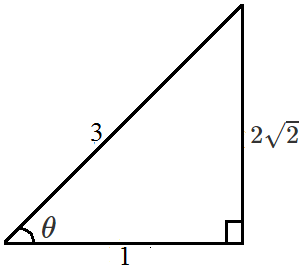 We have, $\sin\Big(2\tan^{-1}\frac{1}{3}\Big)+\cos(\tan^{-1}2\sqrt{2})$
$\sin\Big(2\tan^{-1}\frac{1}{3}\Big)=\sin\begin{pmatrix}\sin^{-1}\frac{2\times\frac{1}{3}}{1+\big(\frac{1}{3}\big)^2}\end{pmatrix}$
$\Big(\because\ 2\tan^{-1}\text{x}=\sin^{-1}\frac{2\text{x}}{1+\text{x}^2}\Big)$
$=\sin\Bigg(\sin^{-1}\frac{\frac{2}{3}}{\frac{10}{9}}\Bigg)$
$=\sin\Big(\sin^{-1}\frac{3}{5}\Big)=\frac{3}{5}$
$(\because\ \sin(\sin^{-1}\text{x})=\text{x},\ \text{x}\in[-1,1])$
$\cos(\tan^{-1}2\sqrt{2})=\cos\Big(\cos^{-1}\frac{1}{3}\Big)=\frac{1}{3}$
$(\because\ \cos(\cos^{-1}\text{x})=\text{x},\ \text{x}\in[-1,1])$
$\therefore\ \sin\Big(2\tan^{-1}\frac{1}{3}\Big)+\cos(\tan^{-1}2\sqrt{2})$
$=\frac{3}{5}+\frac{1}{3}=\frac{9+5}{15}=\frac{14}{15}$ View full question & answer→Question 433 Marks
Find the principal values of the following:
$\tan^{-1}\Big(\cos\frac{\pi}{2}\Big)$
AnswerLet $\tan^{-1}\Big(-\frac{1}{\sqrt3}\Big)=\text{y}$Then,
$\tan\text{y}=\cos\frac{\pi}{2}$
We know that the range of the principal value branch is $\Big(-\frac{\pi}{2},\frac{\pi}{2}\Big).$
Thus,
$\tan\text{y}=\cos\frac{\pi}{2}=0=\tan(0)$
$\Rightarrow\text{y}=0\in\Big(-\frac{\pi}{2},\frac{\pi}{2}\Big)$
Hence, the principal value of $\tan^{-1}\Big(\cos\frac{\pi}{2}\Big)$ is 0.
View full question & answer→Question 443 Marks
Solve the following equation for x:
$\tan^{-1}2\text{x}+\tan^{-1}3\text{x}=\text{n}\pi+\frac{3\pi}{4}$
AnswerGiven$\tan^{-1}2\text{x}+\tan^{-1}3\text{x}=\text{n}\pi+\frac{3\pi}{4}....(1)$
$\Rightarrow\tan^{-1}\Big(\frac{2\text{x}+3\text{x}}{1-2\text{x}\times3\text{x}}\Big)=\text{n}\pi+\frac{3\pi}{4}$
$\Big\{\text{Since}\tan^{-1}\text{x}+\tan^{-1}\text{y}=\tan^{-1}\Big(\frac{\text{x+y}}{1-\text{xy}}\Big)\text{ if }\text{xy}<1\Big\}$
$\Rightarrow\tan^{-1}\Big(\frac{5\text{x}}{1-6\text{x}^2}\Big)=\text{n}\pi+\frac{3\pi}{4},6\text{x}^2<1$
$\Rightarrow\frac{5\text{x}}{1-6\text{x}^2}=\tan\Big(\text{n}\pi+\frac{3\pi}{4}\Big),6\text{x}^2<1$
$\Rightarrow\frac{5\text{x}}{1-6\text{x}^2}-1,6\text{x}^2<1$
$\Rightarrow5\text{x}=-1+6\text{x}^2,6\text{x}^2<1$
$\Rightarrow6\text{x}^2-5\text{x}-1=0,\text{x}^2<\frac{1}{6}$
$\Rightarrow6\text{x}^2-6\text{x}+\text{x}-1=0,-\frac{1}{\sqrt6}<\text{x}<\frac{1}{6}$
$\Rightarrow6\text{x}(\text{x}-1)+1(\text{x}-1)=0,-\frac{1}{\sqrt6}<\text{x}<\frac{1}{6}$
$\Rightarrow(6\text{x}+1)(\text{x}-1)=0$
$\Rightarrow6\text{x}+1=0$ or $\text{x}-1=0$
$\Rightarrow\text{x}=-\frac{1}{6}$ or $\text{x}=1$
Since, $\text{x}=1\notin\Big(-\frac{1}{\sqrt6},\frac{1}{\sqrt6}\Big)$
So,
x = 1 is not root of the given equation (i).
Since,
$\text{x}=1\in\Big(-\frac{1}{\sqrt6},\frac{1}{\sqrt6}\Big)$
So,
$\text{x}=-\frac{1}{6}$ is the root of the given equation (i).
Hence,
$\text{x}=-\frac{1}{6}$
View full question & answer→Question 453 Marks
Solve the following equation $\cos(\tan^{-1}\text{x})=\sin\Big(\cot^{-1}\frac{3}{4}\Big).$
Answer
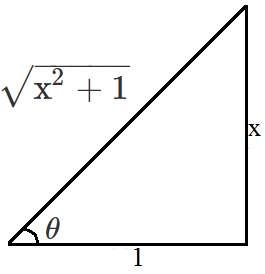 We have, $\cos(\tan^{-1}\text{x})=\sin\Big(\cot^{-1}\frac{3}{4}\Big)$
L.H.S. $=\cos(\tan^{-1}\text{x})$
$=\cos\Big(\cos^{-1}\frac{1}{\sqrt{\text{x}^2+1}}\Big)$
$=\frac{1}{\sqrt{\text{x}^2+1}}$
$(\because\ \cos(\cos^{-1}\text{x})=\text{x},\ \text{x}\in[-1,1])$
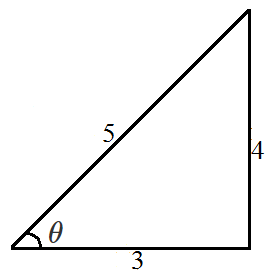 R.H.S. $=\sin\Big(\cot^{-1}\frac{3}{4}\Big)$
$=\sin\Big(\sin^{-1}\frac{4}{5}\Big)$
$=\frac{4}{5}$
$(\because\ \sin(\sin^{-1}\text{x})=\text{x},\ \text{x}\in[-1,1])$
$\therefore$ From given equation we get $\frac{1}{\sqrt{\text{x}^2+1}}=\frac{4}{5}$
$\Rightarrow\ 16(\text{x}^2+1)=25$
$\Rightarrow\ 16\text{x}^2=9$
$\Rightarrow\ \text{x}^2=\frac{9}{16}$
$\therefore\ \text{x}=\pm\frac{3}{4}$ View full question & answer→Question 463 Marks
Find the real solutions of the equation $\tan^{-1}\sqrt{\text{x}(\text{x}+1)}+\sin^{-1}\sqrt{\text{x}^2+\text{x}+1}=\frac{\pi}{2}.$
Answer
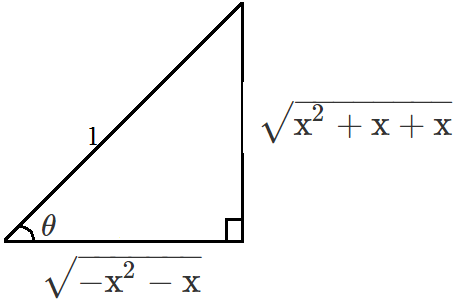 We have $\tan^{-1}\sqrt{\text{x}(\text{x}+1)}+\sin^{-1}\sqrt{\text{x}^2+\text{x}+1}=\frac{\pi}{2}$
$\Rightarrow\ \tan^{-1}\sqrt{\text{x}(\text{x}+1)}=\frac{\pi}{2}-\sin^{-1}\sqrt{\text{x}^2+\text{x}+1}$
$=\cos^{-1}\sqrt{\text{x}^2+\text{x}+1}$
$=\tan^{-1}\frac{\sqrt{-\text{x}^2-\text{x}}}{\sqrt{\text{x}^2+\text{x}+1}}$ (From the figure)
$\Rightarrow\ \sqrt{\text{x}(\text{x}+1)}=\frac{\sqrt{-\text{x}^2-\text{x}}}{\sqrt{\text{x}^2+\text{x}+1}}$
$\Rightarrow\ \text{x}^2+\text{x}=0$
$\Rightarrow\ \text{x}=0,-1$ View full question & answer→Question 473 Marks
Write the following in the simplest form:
$\tan^{-1}\sqrt{\frac{\text{a}-\text{x}}{\text{a}+\text{x}}},-\text{a}<\text{x}<\text{a}$
Answer Let, $\text{x}=\text{a}\cos\theta$
Now,
$\tan^{-1}\sqrt{\frac{\text{a}-\text{x}}{\text{a}+\text{x}}}=\tan^{-1}\sqrt{\frac{\text{a}-\text{a}\cos\theta}{\text{a}+\text{a}\cos\theta}}$
$=\tan^{-1}\sqrt{\frac{1-\cos\theta}{1+\cos\theta}}$
$=\tan^{-1}\sqrt{\frac{2\sin^2\frac{\theta}{2}}{2\cos^2\frac{\theta}{2}}}$
$=\tan^{-1}\Big(\tan\frac{\theta}{2}\Big)$
$=\frac{\theta}{2}$
$=\frac{1}{2}\cos^{-1}\Big(\frac{\text{x}}{\text{a}}\Big)$
$\therefore\ \tan^{-1}\sqrt{\frac{\text{a}-\text{x}}{\text{a}+\text{x}}}=\frac{\cos^{-1}\big(\frac{\text{x}}{\text{a}}\big)}{2}$
View full question & answer→Question 483 Marks
Show that $2\tan^{-1}(-3)=\frac{-\pi}{2}+\tan^{-1}\Big(\frac{-4}{3}\Big).$
AnswerLHS $=2\tan^{-1}(-3)=-2\tan^{-1}3$$[\because\ \tan^{-1}(-\text{x})=-\tan^{-1}\text{x},\ \text{x}\in\text{R}]$
$=-\Big[\cos^{-1}\frac{1-3^2}{1+3^2}\Big]$
$\Big[\because\ 2\tan^{-1}\text{x}=\cos^{-1}\frac{1-\text{x}^2}{1+\text{x}^2},\ \text{x}\geq0\Big]$
$=-\Big[\cos^{-1}\Big(\frac{-8}{10}\Big)\Big]=-\Big[\cos^{-1}\Big(\frac{-4}{5}\Big)\Big]$
$=-\Big[\pi-\cos^{-1}\Big(\frac{4}{5}\Big)\Big]$
$\{\because\ \cos^{-1}(-\text{x})=\pi-\cos^{-1}\text{x},\ \text{x}\in[-1,1]\}$
$=-\pi+\cos^{-1}\Big(\frac{4}{5}\Big)$
$\Big[\text{let}\ \cos^{-1}\Big(\frac{4}{5}\Big)=\theta\Rightarrow\ \cos\theta=\frac{4}{5}\Rightarrow\ \tan\theta=\frac{3}{4}\Rightarrow\ \theta=\tan^{-1}\frac{3}{4}\Big]$
$=-\pi+\tan^{-1}\Big(\frac{3}{4}\Big)=-\pi+\Big[\frac{\pi}{2}-\cot^{-1}\Big(\frac{3}{4}\Big)\Big]$
$=-\frac{\pi}{2}-\cot^{-1}\frac{3}{4}=-\frac{\pi}{2}-\tan^{-1}\frac{4}{3}$
$=-\frac{\pi}{2}+\tan^{-1}\Big(\frac{-4}{3}\Big)$
$[\because\ \tan^{-1}(-\text{x})=-\tan^{-1}\text{x}]$
= RHS (Hence proved)
View full question & answer→Question 493 Marks
Prove the following results:
$\sin^{-1}\frac{4}{5}+2\tan^{-1}\frac{1}{3}=\frac{\pi}{2}$
Answer$\text{L.H.S}=\sin^{-1}\frac{4}{5}+2\tan^{-1}\frac{1}{3}$
$=\sin^{-1}\frac{4}{5}+\tan^{-1}\Bigg\{\frac{2\times\frac{1}{2}}{1-\big(\frac{1}{3}\big)^2}\Bigg\}$ $\Big[\because\ 2\tan^{-1}\text{x}=\tan^{-1}\Big\{\frac{2\text{x}}{1-\text{x}^2}\Big\}\Big]$
$=\sin^{-1}\frac{4}{5}+\tan^{-1}\Bigg\{\frac{\frac{2}{3}}{\frac{8}{9}}\Bigg\}$
$=\sin^{-1}\frac{4}{5}+\tan^{-1}\frac{3}{4}$
$=\sin^{-1}\frac{4}{5}+\cos^{-1}\frac{1}{\sqrt{1+\frac{9}{16}}}$ $\Big[\because\ \tan^{-1}\text{x}=\cos^{-1}\frac{1}{\sqrt{1+\text{x}^2}}\Big]$
$=\sin^{-1}\frac{4}{5}+\cos^{-1}\frac{1}{\frac{5}{4}}$
$=\sin^{-1}\frac{4}{5}+\cos^{-1}\frac{4}{5}$
$=\frac{\pi}{2}=\text{R.H.S}$
View full question & answer→Question 503 Marks
Find the values:
If $\tan^{-1}\frac{x-1}{x-2}+\tan^{-1}\tan\frac{x+1}{x+2}=\frac{\pi}{4},$ then find the value of x
AnswerGiven: $\tan^{-1}\frac{x-1}{x-2}+\tan^{-1}\frac{x+1}{x+2}=\frac{\pi}{4}$
$\Rightarrow\tan^{-1}\frac{\frac{x-1}{x-2}+\frac{x+1}{x+2}}{1-\left(\frac{x-1}{x-2}\right)\left(\frac{x+1}{x+2}\right)}=\frac{\pi}{4}$ $\bigg[\because\tan^{-1}x+\tan^{-1}y=\tan^{-1}\frac{x+y}{1-xy}\bigg]$
$\Rightarrow\tan^{-1}\frac{\left(x-1\right)\left(x+2\right)+\left(x+1\right)\left(x-2\right)}{\left(x-2\right)\left(x+2\right)-\left(x-1\right)\left(x+1\right)}=\frac{\pi}{4}$
$\Rightarrow\tan^{-1}\frac{x^2+2x-x-2+x^2-2x+x-2}{x^2-4-\left(x^2-1\right)}=\frac{\pi}{4}$
$\Rightarrow\frac{2x^2-4}{x^2-4-x^2+1}=\tan\frac{\pi}{4}$ $\Rightarrow\frac{2x^2-4}{-3}=1$
$ \Rightarrow\ 2x^2-4=-3$ $\Rightarrow\ 2x^2=1$
$\Rightarrow\ x^2=\frac{1}{2}$ $ \Rightarrow\ x=\pm\frac{1}{\sqrt{2}}$
View full question & answer→