Questions

Assertion (A) & Reason (B) MCQ

Take a timed test

14 questions · self-marked practice — reveal the answer and mark yourself.

Question 11 Mark
Directions: In the following questions, the Assertions (A) and Reason(s) (R) have been put forward. Read both the statements carefully and choose the correct alternative from the following:
Assertion (A): The region represented by the set $\{(\text{x},\text{y}):4\leq\text{x}^2+\text{y}^2\leq9\}$ is a convex set.
Reason (R): The set $\{(\text{x},\text{y}):4\leq\text{x}^2+\text{y}^2\leq9\}$ represents the region between two concentric circles of radii 2 and 3.
  1. Both A and R are true and R is the correct explanation of A
  2. Both A and R are true but R is NOT the correct explanation of A
  3. A is true but R is false.
  4. A is false but R is true.
Answer
  1. A is false but R is true.
View full question & answer
Question 21 Mark
Directions: In the following questions, the Assertions (A) and Reason(s) (R) have been put forward. Read both the statements carefully and choose the correct alternative from the following:
Assertion: Maximum value of z = 11x + 7y, subjectto constraints $2\text{x}+\text{y}\leq6,\text{x}\leq2,\text{x}\geq0,\text{y}\geq0$ will be obtained at (0, 6).
Reason: In a bounded feasible region, it always exist a maximum and minimum value.
  1. A is true, R is true: R is a correct explanation for A.
  2. A is true,R is true; R is not a correct explanation for A.
  3. A is true: R is false.
  4. A is false: R is true.
Answer
  1. A is true,R is true; R is not a correct explanation for A.
View full question & answer
Question 31 Mark
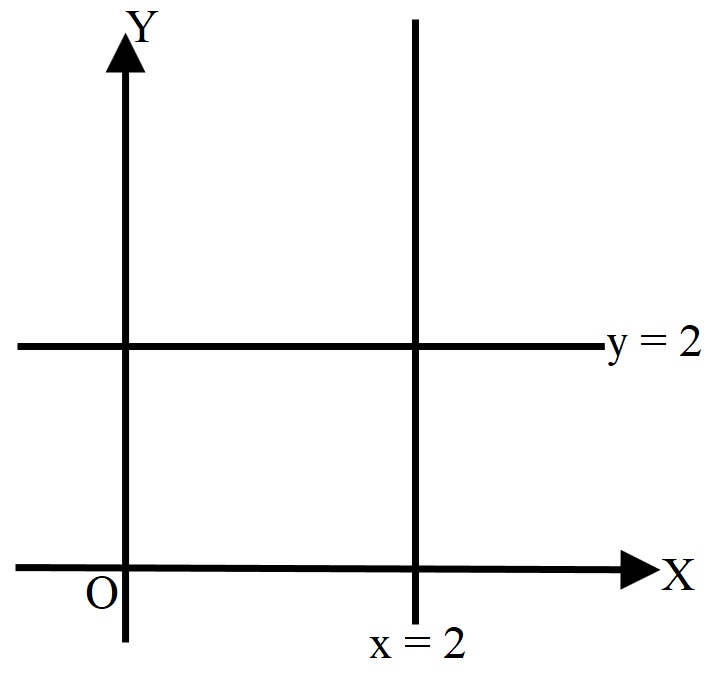
Directions: In the following questions, the Assertions (A) and Reason(s) (R) have been put forward. Read both the statements carefully and choose the correct alternative from the following Assertion (A): The graph of $\text{x}\leq2$ and $\text{y}\geq2$ will be situated in the first and second quadrants. Reason (R):
  1. Both A and R are true and R is the correct explanation of A
  2. Both A and R are true but R is NOT the correct explanation of A
  3. A is true but R is false.
  4. A is false but R is true.
Answer
  1. Both A and R are true and R is the correct explanation of A
View full question & answer
Question 41 Mark
Directions: In the following questions, the Assertions (A) and Reason(s) (R) have been put forward. Read both the statements carefully and choose the correct alternative from the following:
Assertion (A): The linear programming problem, maximize Z = x + 2y subject to constraints $\text{x}-\text{y}\leq10,2\text{x}+3\text{y}\leq20$ and $\text{x}\geq0; \text{y}\geq0.$ It gives the maximum value of Z as $\frac{40}{3}.$
Reason (R): To obtain maximum value of Z, we need to compare value of Z at all the corner points of the shaded region.
  1. Both A and R are true and R is the correct explanation of A
  2. Both A and R are true but R is NOT the correct explanation of A
  3. A is true but R is false.
  4. A is false but R is true.
Answer
  1. Both A and R are true and R is the correct explanation of A
View full question & answer
Question 51 Mark
Directions: In the following questions, the Assertions (A) and Reason(s) (R) have been put forward. Read both the statements carefully and choose the correct alternative from the following:
Assertion: The linear programming problem,maximize z = 2x + 3y subject to constraints $\text{x}+\text{y}\leq4,\text{x}\geq0,\text{y}\geq0$ It gives the maximum value of Z as 8 .
Reason: To obtain maximum value of Z, we need to compare value of Zat all the corner points of the feasible region.
  1. A is true, R is true: R is a correct explanation for A.
  2. A is true,R is true; R is not a correct explanation for A.
  3. A is true: R is false.
  4. A is false: R is true.
Answer
  1. A is false: R is true.
View full question & answer
Question 61 Mark
Directions: In the following questions, the Assertions (A) and Reason(s) (R) have been put forward. Read both the statements carefully and choose the correct alternative from the following:
Assertion (A): :Consider the linear programming problem. Maximise Z = 4x + y Subject to constraints $\text{x}+\text{y}\leq50;\text{x}+\text{y}\geq100$ and $\text{x},\text{y}\geq0,$ Then, maximum value of Z is 50.
Reason (R): If the shaded region is bounded then maximum value of objective function can be determined.
  1. Both A and R are true and R is the correct explanation of A
  2. Both A and R are true but R is NOT the correct explanation of A
  3. A is true but R is false.
  4. A is false but R is true.
Answer
  1. A is false but R is true.
View full question & answer
Question 71 Mark
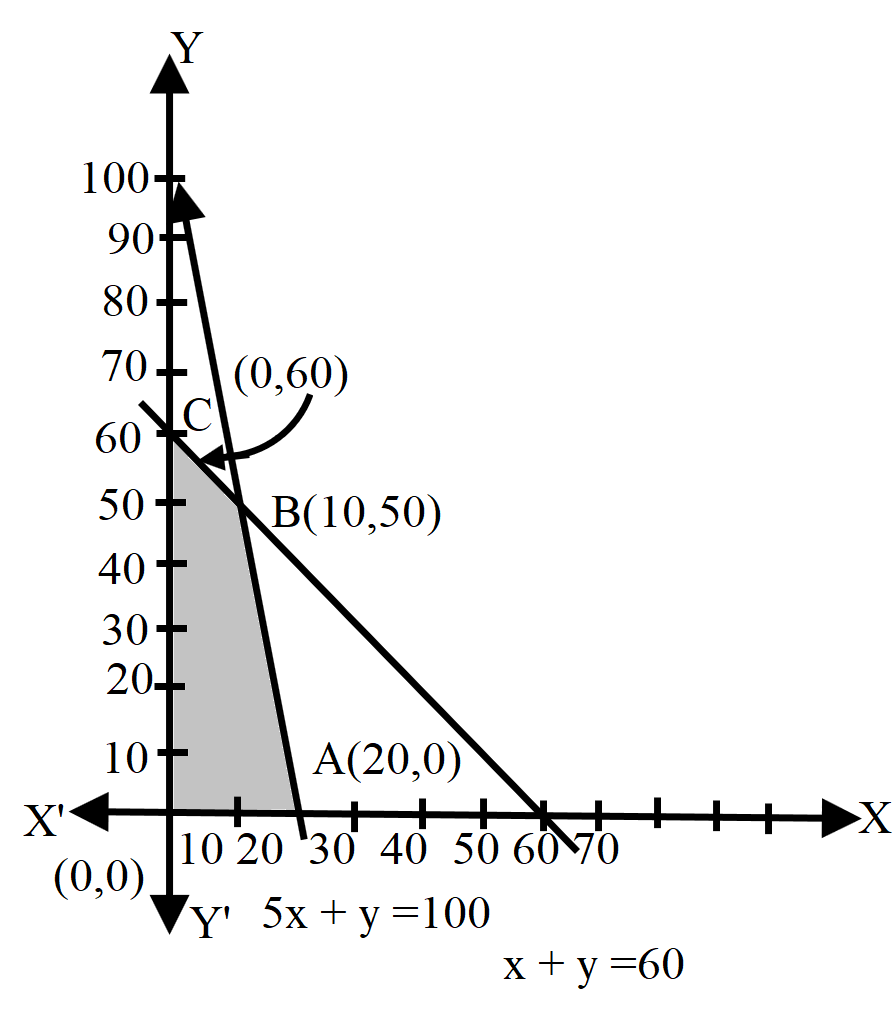
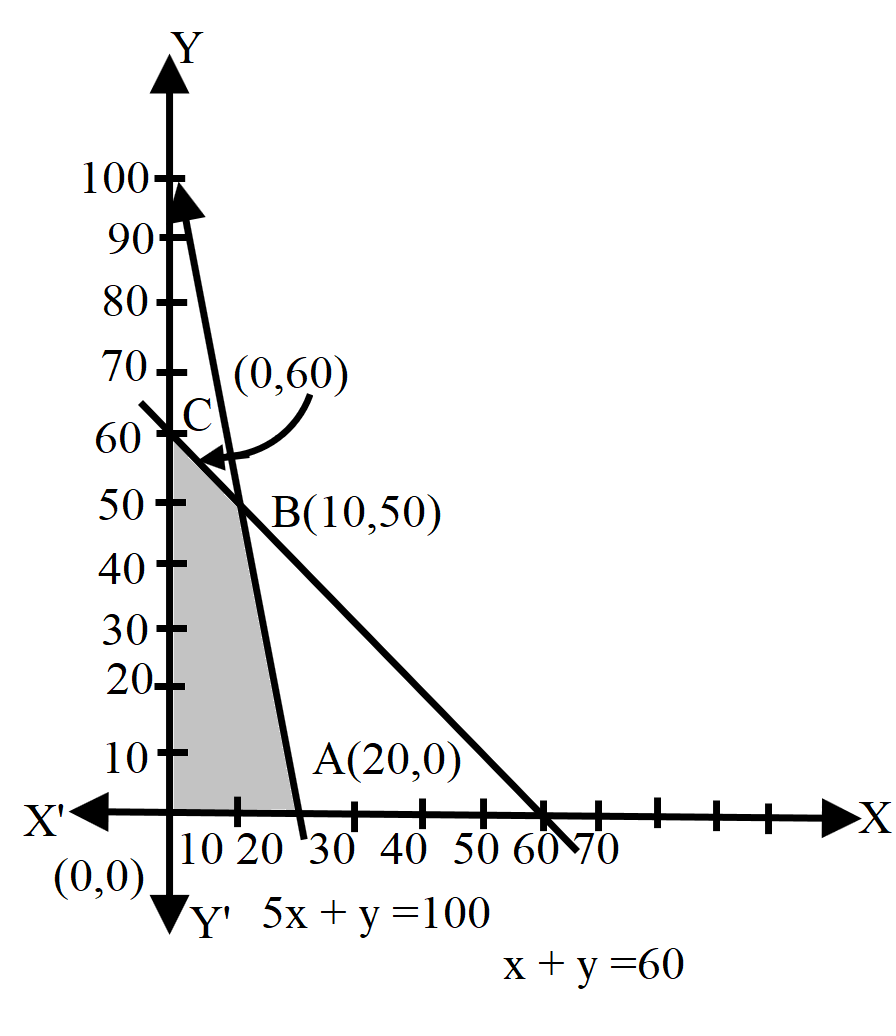
Directions: In the following questions, the Assertions (A) and Reason(s) (R) have been put forward. Read both the statements carefully and choose the correct alternative from the following: Consider, the graph of constraints stated as linear inequalities as below: $5\text{x}+\text{y}\leq100,\text{x}+\text{y}\leq60,\text{x},\text{y}\geq0.$
Assertion (A): (25, 40) is an infeasible solution of the problem. Reason (R): Any point inside the feasible region is called an infeasible solution.
  1. Both A and R are true and R is the correct explanation of A
  2. Both A and R are true but R is NOT the correct explanation of A
  3. A is true but R is false.
  4. A is false but R is true.
Answer
  1. A is true but R is false.
View full question & answer
Question 81 Mark
Directions: In the following questions, the Assertions (A) and Reason(s) (R) have been put forward. Read both the statements carefully and choose the correct alternative from the following:
Assertion (A): If an LPP attains its maximum value at two corner points of the feasible region then it attains maximum value at infinitely many points.
Reason (R): if the value of the objective function of a LPP is same at two corners then it is same at every point on the line joining two corner points.
  1. Both A and R are true and R is the correct explanation of A
  2. Both A and R are true but R is NOT the correct explanation of A
  3. A is true but R is false.
  4. A is false but R is true.
Answer
  1. Both A and R are true and R is the correct explanation of A
View full question & answer
Question 91 Mark
Directions: In the following questions, the Assertions (A) and Reason(s) (R) have been put forward. Read both the statements carefully and choose the correct alternative from the following:
Assertion (A): Feasible region is the set of points which satisfy all of the given constraints.
Reason (R): The optimal value of the objective function is attained at the points on X - axisonly.
  1. Both A and R are true and R is the correct explanation of A
  2. Both A and R are true but R is NOT the correct explanation of A
  3. A is true but R is false.
  4. A is false but R is true.
Answer
  1. A is true but R is false.
View full question & answer
Question 101 Mark
Directions: In the following questions, the Assertions (A) and Reason(s) (R) have been put forward. Read both the statements carefully and choose the correct alternative from the following:
Assertion (A): The maximum value of Z = 11x + 7y Subject to the constraints are $2\text{x}+\text{y}\leq6,\text{x}\leq2,\text{x,y}\geq0.$x,y 0. Occurs at the point (0,6).
Reason (R): If the feasible region of the given LPP is bounded, then the maximum and minimum values of the objective function occurs at corner points.
  1. Both A and R are true and R is the correct explanation of A
  2. Both A and R are true but R is NOT the correct explanation of A
  3. A is true but R is false.
  4. A is false but R is true.
Answer
  1. Both A and R are true and R is the correct explanation of A
View full question & answer
Question 111 Mark
Directions: In the following questions, the Assertions (A) and Reason(s) (R) have been put forward. Read both the statements carefully and choose the correct alternative from the following:
Assertion (A): For the LPP Z= 3x + 2y, subject to the constraints $\text{x}+2\text{y}\leq2;\text{x}\geq;\text{y}\geq0$ both maximum value of Z and Minimum value of Z can be obtained.
Reason (R): If the feasible region is bounded then both maximum and minimum values of Z exists.
  1. Both A and R are true and R is the correct explanation of A
  2. Both A and R are true but R is NOT the correct explanation of A
  3. A is true but R is false.
  4. A is false but R is true.
Answer
  1. Both A and R are true and R is the correct explanation of A
View full question & answer
Question 121 Mark
Directions: In the following questions, the Assertions (A) and Reason(s) (R) have been put forward. Read both the statements carefully and choose the correct alternative from the following:
Assertion: Maximise Z = 3x + 4y, subjectto constraints: $\text{x}+\text{y}\leq1,\text{x}\geq0,\text{y}\geq0$ Then maximum value of Z is 4.
Reason: If the shaded region is not bounded then maximum value cannot be determined.
  1. A is true, R is true: R is a correct explanation for A.
  2. A is true,R is true; R is not a correct explanation for A.
  3. A is true: R is false.
  4. A is false: R is true.
Answer
  1. A is true: R is false.
View full question & answer
Question 131 Mark
Directions: In the following questions, the Assertions (A) and Reason(s) (R) have been put forward. Read both the statements carefully and choose the correct alternative from the following: Consider, the graph of constraints stated as linear inequalities as below: $5\text{x}+\text{y}\leq100,\text{x}+\text{y}\leq60,\text{x},\text{y}\geq0.$
Assertion (A): The points (10, 50), (0, 60) , (10, 10) and (20, 0) are feasible solutions. Reason (R): Points within and on the boundary of the feasible region represent feasible solutions of the constraints.
  1. Both A and R are true and R is the correct explanation of A
  2. Both A and R are true but R is NOT the correct explanation of A
  3. A is true but R is false.
  4. A is false but R is true.
Answer
  1. Both A and R are true and R is the correct explanation of A
View full question & answer
Question 141 Mark
Directions: In the following questions, the Assertions (A) and Reason(s) (R) have been put forward. Read both the statements carefully and choose the correct alternative from the following:
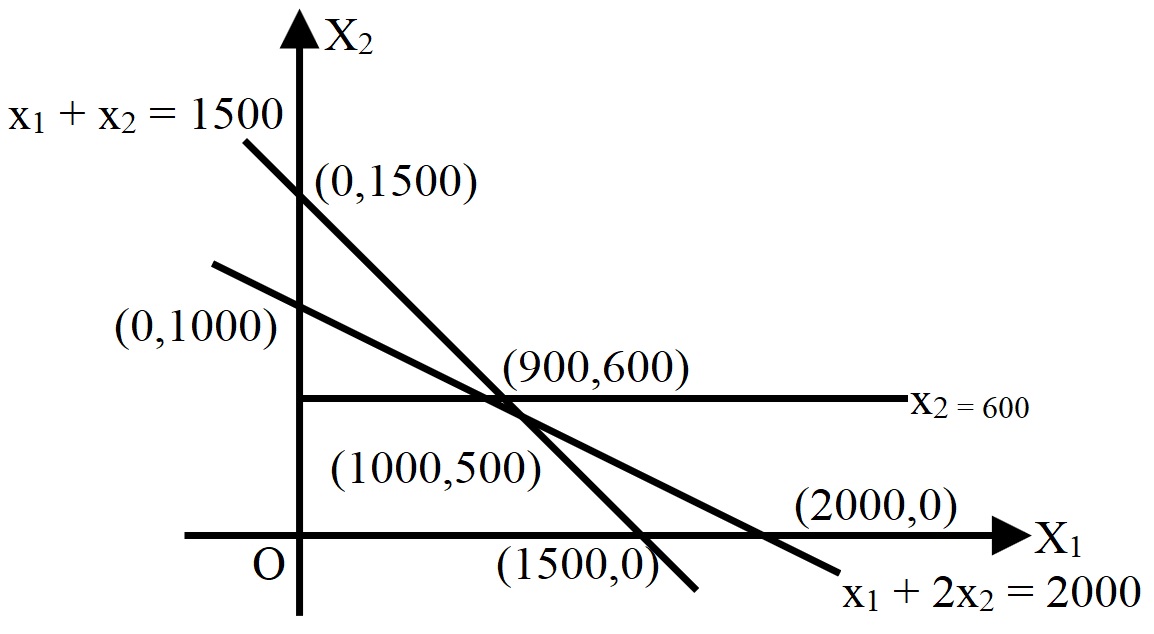
Assertion (A): For the constraints of a LPP problem given by $\text{x}_1+2\text{x}_2\leq2000,\text{x}_1+\text{x}_2\leq1500,\text{x}^2\leq600$ and $\text{x}_1,\text{x}_2\geq0$ the points (1000, 0), (0, 500), (2, 0) lie in the positive bounded region, but point (2000, 0) does not lie in the positive boundedregion.
Reason (R):
  1. Both A and R are true and R is the correct explanation of A
  2. Both A and R are true but R is NOT the correct explanation of A
  3. A is true but R is false.
  4. A is false but R is true.
Answer
  1. Both A and R are true and R is the correct explanation of A
View full question & answer
Assertion (A) & Reason (B) MCQ - MATHS STD 12 Science Questions - Vidyadip