Questions

3 Marks Question

🎯

Test yourself on this topic

9 questions · timed · auto-graded

Question 13 Marks
Find all points of discontinuity of $f$ where $f$ is defined as follows$, f(x)$
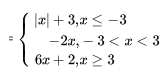
Image
Answer
$=3+3=6$ and $\text{RHL}=\lim _{x \rightarrow(-3)^{+}} f(x)$
$=\lim _{x \rightarrow(-3)^{+}}(-2 x)$
$\Rightarrow \text{RHL} =\lim _{h \rightarrow 0}[-2(-3+h)]$
$=\lim _{h \rightarrow 0}(6-2 h)$
$\Rightarrow \text{RHL}=6$
Also, $f (-3)=$ value of $f ( x )$ at $x =-3$
$=-(-3)+3$
$=3+3=6$
$\because \text { LHL }=\text { RHL }=f(-3)$
$\therefore f ( x )$ is continuous at $x =-3$
So, $x =-3$ is the point of continuity.
Continuity at $x =3$
$\text { LHL }=\lim _{x \rightarrow 3^{-}} f(x)=\lim _{x \rightarrow 3^{-}}[-(2 x)]$
$\Rightarrow \text{LHL}=\lim _{h \rightarrow 0^{-}}[-2(3-h)]$
$=\lim _{h \rightarrow 0}(-6+2 h)$
$\Rightarrow \text { LHL }=-6$ and $\text{RHL}=\lim _{x \rightarrow 3^{+}} f(x)=\lim _{x \rightarrow 3^{+}}(6 x+2)$
$\Rightarrow \text { RHL }=\lim _{h \rightarrow 0}[6(3+h)+2]$
$\Rightarrow \text { RHL }=20$
$\because \text { LHL } \neq \text { RHL }$
$\therefore f$ is discontinuous at $x=3$
Now, as $f(x)$ is a polynomial function for $x<-3,-33$ so it is continuous in these intervals.
Hence, only $x=3$ is the point of discontinuity of $f(x)$.
View full question & answer
Question 23 Marks
Evaluate the integral: $\sec ^{-1} \sqrt{x} d x$
Answer
Let the given integral be,
$I=\int \sec ^{-1} \sqrt{x} d x$
$\text { Putting } \sqrt{x}=\sec \theta$
$\Rightarrow x=\sec ^2 \theta$
$\Rightarrow dx=2 \sec \theta \sec \theta \tan \theta d \theta$
$=2 \sec ^2 \theta \tan \theta d \theta$
$\therefore I=2 \int \theta \sec ^2 \theta \tan \theta d \theta$
$=2 \int \theta \tan \theta \sec ^2 \theta d \theta$
Considering $\theta$ as first function and $\tan \theta \sec ^2 \theta$ as second function
$I=2\left[\theta \frac{\tan ^2 \theta}{2}-\int 1 \frac{\tan ^2 \theta}{2} d \theta\right]\left(\because \int \tan \theta \sec ^2 \tan \theta d \theta=\frac{\tan ^2 \theta}{2}\right)$
$=\theta \tan ^2 \theta-\int\left(\sec ^2 \theta-1\right) d \theta$
$=\theta \tan ^2 \theta-\tan \theta+\theta+C$
$=\theta\left(1+\tan ^2 \theta\right)-\tan \theta+C$
$=\theta \sec ^2 \theta-\sqrt{\sec ^2 \theta-1}+C$
$=\sec ^{-1} \sqrt{x} x-\sqrt{x-1}+C$
$=x \sec ^{-1} \sqrt{x}-\sqrt{x-1}+C$
View full question & answer
Question 33 Marks
Let $\vec{a}=i+4 j+2 k, b=3 i-2 j+7 k$ and $c=2 i-j+4 k$. Find a vector $d$ which is perpendicular to both $\vec{a}$ and $\vec{b}$, and $\vec{c} . \vec{d}=15$.
Answer
Given : Vectors $\vec{a}=\hat{i}+4 \hat{j}+2 \hat{k}$ and $\vec{b}=3 \hat{i}-2 \hat{j}+7 \hat{k}$
We know that the cross $-$ product of two vectors $ ,\vec{a} \times \vec{b}$ is a vector perpendicular to both $\vec{a}$ and $\vec{b}$
Hence, vector $\vec{d}$ which is also perpendicular to both $\vec{a}$ and $\vec{b}$ is $\vec{d}=\lambda(\vec{a} \times \vec{b})$ where $\lambda=1$ or some other scalar.
Therefore, $\vec{d}=\lambda\left|\begin{array}{ccc}\vec{i} & \vec{j} & \vec{k} \\ 1 & 4 & 2 \\ 3 & -2 & 7\end{array}\right|$
$=\lambda[\hat{i}(28+4)-\hat{j}(7-6)+\hat{k}(-2-12)]$
$\Rightarrow \vec{d}=32 \lambda \hat{i}-\lambda \hat{j}-14 \lambda \hat{k} \ldots . .(i)$
Now given $\vec{c}=2 \hat{i}-\hat{j}+4 \hat{k}$ and $\vec{c} . \vec{d}=15$
$\vec{c} . \vec{d}=15$
$=2(32 \lambda)+(-1)(-\lambda)+4(-14 \lambda)=15$
$\Rightarrow 64 \lambda+\lambda-56 \lambda=15$
$\Rightarrow 9 \lambda=15$
$\Rightarrow \lambda=\frac{15}{9}$
$\Rightarrow \lambda=\frac{5}{3}$
Putting $\lambda=\frac{5}{3}$ in eq. $(i),$ we get
$\vec{d}=\frac{5}{3}[32 \hat{i}-\hat{j}-14 \hat{k}]$
$\Rightarrow \vec{d}=\frac{1}{3}[160 \hat{i}-5 \hat{j}-70 \hat{k}]$
View full question & answer
Question 43 Marks
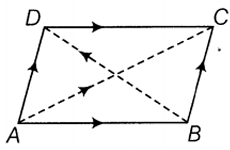
The two adjacent sides of a parallelogram are $2 i-4 j-5 k$ and $2 i+2 j+3 k$. Find the two unit vectors parallel to its diagonals. Using the diagonal vectors, find the area of the parallelogram.
Answer
Image
According to the question,
$\overrightarrow{A B}=2 \hat{i}-4 \hat{j}-5 \hat{k} \text { and } \overrightarrow{A D}=2 \hat{i}+2 \hat{j}+3 \hat{k}$
By using parallelogram law of addition, we get
The diagonal $\overrightarrow{A C}$ is given by $\overrightarrow{A B}+\overrightarrow{A D}=4 \hat{i}-2 \hat{j}-2 \hat{k}$
The diagonal $\overrightarrow{B D}$ is given by $\overrightarrow{B C}+\overrightarrow{B A}=\overrightarrow{A D}-\overrightarrow{A B}=6 \hat{j}+8 \hat{k}$
Now, the unit vector along $\overrightarrow{A C}$ is given by
$\frac{\overrightarrow{A C}}{\overrightarrow{A C \mid}}=\frac{4 \hat{i}-2 \hat{j}-2 \hat{k}}{\sqrt{16+4+4}}$
$=\frac{4 \hat{i}-2 \hat{j}-2 \hat{k}}{\sqrt{24}}$
$=\frac{4 \hat{i}-2 \hat{j}-2 \hat{k}}{2 \sqrt{6}}$
$=\frac{1}{\sqrt{6}}(2 \hat{i}-\hat{j}-\hat{k})$
the unit vector along $\overrightarrow{B D}$ is given by
$\frac{\overrightarrow{B D}}{|\overrightarrow{B D}|}=\frac{6 \dot{j}+8 \dot{k}}{\sqrt{36+64}}$
$=\frac{6 \dot{j}+8 \dot{k}}{10}$
$=\frac{1}{5}(3 \hat{j}+4 \hat{k})$
Now, area of parallelogram $A B C D$
$=\frac{1}{2}|\overrightarrow{A C} \times \overrightarrow{B D}|$
Here, $\overrightarrow{A C} \times \overrightarrow{B D}=\left|\begin{array}{ccc}\hat{i} & \hat{j} & \hat{k} \\ 4 & -2 & -2 \\ 0 & 6 & 8\end{array}\right|$
$=\hat{i}(-16+12)-\hat{j}(32-0)+\hat{k}(24-0)$
$=-4 \hat{i}-32 \hat{j}+24 \hat{k}$
$|\overrightarrow{A C} \times \overrightarrow{B D}|=\sqrt{(-4)^2+(-32)^2+(24)^2}$
$=\sqrt{4^2\left(1+8^2+6^2\right)}$
$=4 \sqrt{1+64+36}$
$=4 \sqrt{101}$
$\therefore$ Area of parallelogram $ABCD =\frac{1}{2} \times 4 \sqrt{101}$
$=2 \sqrt{101} sq$ units.
View full question & answer
Question 53 Marks
Solve differential equation: $\frac{d y}{d x}-y \tan x=e^x$
Answer
The given differential equation is,
$\frac{d y}{d x}-y \tan x=e^x$
It is a linear differential equation.
Comparing it with $\frac{d y}{d x}+p y=Q$
$P=-\tan X, Q=e^{X}$
$\text { L.F. }=e^{\int pdx x}$
$=e^{-\int \tan x dx}$
$=e^{-\log \sec x}$
$=\cos x$
Solution of the given equation is given by,
$y \text { (I.F.) }=\int Q \times(I . F) d x+c_1$
$y \cos x=\int e^x \cos x d x+c_1$
$y \cos x=I+c_1 \ldots .(1)$
$I=\int e^x \cos x d x$
Using equation by parts
$I=e^x \int \cos x d x-\int\left(e^x \int \cos x d x\right) d x+c_2$
$=e^x \sin x-\int e^x \sin x d x+c_2$
$=e^x \sin x-\left[e^x\left(\int \sin x d x\right)-\int\left(e^x\left(\int \sin x d x\right) d x\right]+c_2\right.$
$I=e^x \sin x+e^x \cos x-\int e^x \cos x d x+c_2$
$I=e^x(\sin x+\cos x)-I+c_2$
$2 I=e^x(\sin x+\cos x)+c_2$
$I=\frac{1}{2} e^x(\sin x+\cos x)+c_3$
Using equation $(i)$
$y \cos x=\frac{1}{2} e^x(\sin x+\cos x)+c$
View full question & answer
Question 63 Marks
Prove that: $\int_0^\pi \frac{x}{1-\cos \alpha \sin x} d x=\frac{\pi(\pi-\alpha)}{\sin \alpha}$
Answer
Let $I=\int_0^\pi \frac{x}{1-\cos \alpha \sin x} d x$. Then,
$I=\int_0^\pi \frac{(\pi-x)}{1-\cos \alpha \sin (\pi-x)} d x$
By using property of defnite integrals,
$\Rightarrow I=\int_0^\pi \frac{\pi}{1-\cos \alpha \sin x} d x-\int_0^\pi \frac{x}{1-\cos \alpha \sin x} d x$
$\Rightarrow I=\pi \int_0^\pi \frac{1}{1-\cos \alpha \sin x} d x-I$
$\Rightarrow 2 I=\pi \int_0^\pi \frac{1}{1-\cos \alpha \sin x} d x$
$\Rightarrow 2 I=\pi \int_0^\pi \frac{1+\tan ^2 x / 2}{\left(1+\tan ^2 x / 2\right)-2 \cos \alpha \tan x / 2} d x$
$\Rightarrow 2 I=\pi \int_0^\pi \frac{\sec ^2 x / 2}{\tan ^2 x / 2-2 \cos \alpha \tan x / 2+1} d x$
$\Rightarrow I=\frac{\pi}{2} \int_0^\pi \frac{\sec ^2 x / 2}{\tan ^2 x / 2-2 \cos \alpha \tan x / 2+1} d x$
Let $ \tan \frac{x}{2}=t$. Then, $d\left(\tan \frac{x}{2}\right)=d t \Rightarrow \sec ^2 \frac{x}{2} d x=2 d t$
Also, $ x=0 \Rightarrow t=\tan 0=0$ and $x=\pi \Rightarrow t=\tan \frac{\pi}{2}=\infty$
$\therefore I=\frac{\pi}{2} \int_0^{\infty} \frac{2 d t}{t^2-2 t \cos \alpha+1}$
$\Rightarrow I=\pi \int_0^{\infty} \frac{1}{(t-\cos \alpha)^2+\left(1-\cos ^2 \alpha\right)} d t$
$\Rightarrow I=\pi \int_0^{\infty} \frac{1}{\sin ^2 \alpha+(t-\cos \alpha)^2} d t$
$\Rightarrow I=\frac{\pi}{\sin \alpha}\left[\tan ^{-1}\left(\frac{t-\cos \alpha}{\sin \alpha}\right)\right]_0^{\infty}$
$\Rightarrow I=\frac{\pi}{\sin \alpha}\left[\tan ^{-1} \alpha-\tan ^{-1}(-\cot \alpha)\right]$
$\Rightarrow I=\frac{\pi}{\sin \alpha}\left[\frac{\pi}{2}+\tan ^{-1}(\cot \alpha)\right]$
$\left.\Rightarrow I=\frac{\pi}{\sin \alpha}\left[\frac{\pi}{2}+\tan ^{-1}\left\{\tan \left(\frac{\pi}{2}-\alpha\right)\right)\right\}\right]=\frac{\pi}{\sin \alpha}\left[\frac{\pi}{2}+\frac{\pi}{2}-\alpha\right]=\frac{\pi(\pi-\alpha)}{\sin \alpha}$
View full question & answer
Question 73 Marks
A doctor claims that $60 \%$ of the patients he examines are allergic to some type of weed. What is the probability that exactly $3$ of his next $4$ patients are allergic to weeds?
Answer
Let us define the following events:
$A =$ First patient is allergic to weeds,
$B =$ Second patient is allergic to weeds
$C =$ Third patient is allergic to weeds,
$D =$ Fourth patient is allergic to weeds
Clearly, $\text{A, B, C, D}$ are independent events such that
$P(A)=P(B)=P(C)=P(D)=\frac{60}{100}=\frac{3}{5}$
Therefore, required probability is given by,
$=P[(A \cap B \cap C \cap \bar{D}) \cup(A \cap B \cap \bar{C} \cap D)$
$\cup(A \cap \bar{B} \cap C \cap \cup(\bar{A} \cap B \cap C \cap D)]$
$=P(A \cap B \cap C \cap \bar{D})+P(A \cap B \cap \bar{C} \cap D)+$
$P(A \cap \bar{B} \cap C \cap D)+P(\bar{A} \cap B \cap C \cap D)$
$=P(A) P(B) P(C) P(\bar{D})+ P(A) P(B) P(\bar{C}) P(D)$
$+P(A) P(\bar{B}) P(C) P(D)+P(\bar{A}) P(B) P(C) P(D)$
$=\frac{3}{5} \times \frac{3}{5} \times \frac{3}{5} \times \frac{2}{5}+\frac{3}{5} \times \frac{3}{5} \times \frac{2}{5} \times \frac{3}{5}$
$+\frac{3}{5} \times \frac{2}{5} \times \frac{3}{5} \times \frac{3}{5}+\frac{2}{5} \times \frac{3}{5} \times \frac{3}{5} \times \frac{3}{5}=\frac{216}{625}$
View full question & answer
Question 83 Marks
Evaluate $\int_{\frac{\pi}{6}}^{\frac{\pi}{3}} \frac{d x}{1+\sqrt{\tan x}}$
Answer
$I=\int_{\pi / 6}^{\pi / 3} \frac{d x}{1+\sqrt{\tan x}}$
$I=\int_{\pi / 6}^{\pi / 3} \frac{d x}{1+\sqrt{\frac{\operatorname{siz} z}{\cos z}}}=\int_{\pi / 6}^{\pi / 3} \frac{\sqrt{\cos x}}{\sqrt{\operatorname{\omega s} x}+\sqrt{\sin x}} d x .$
$I=\int_{\pi / 6}^{\pi / 3} \frac{\sqrt{\cos \left(\frac{\pi}{3}+\frac{\pi}{6}-x\right)}}{\sqrt{\cos \left(\frac{x}{3}+\frac{\pi}{6}-x\right)}+\sqrt{\sin \left(\frac{\pi}{3}+\frac{\pi}{6}-x\right)}} d x$
${\left[\because \int_a^b f(x) d x=\int_a^b f(a+b-x) d x\right]}$
$I=\int_{\pi / 6}^{\pi / 3} \frac{\sqrt{\cos \left(\frac{\pi}{2}-x\right)}}{\sqrt{\cos \left(\frac{x}{2}-x\right)}+\sqrt{\sin \left(\frac{\pi}{2}-x\right)}} d x$
$I=\int_{\pi / 6}^{\pi / 3} \frac{\sqrt{\sin x}}{\sqrt{\sin x}+\sqrt{\operatorname{\omega s} x}} d x$
Adding $(1)$ and $(2)$, we get
$I=\int_{\pi / 6}^{\pi / 3} 1 d x$
$=[x]_{\pi / 6}^{\pi / 3}$
$=\frac{\pi}{3}-\frac{\pi}{6}=\frac{\pi}{6}$
$I=\frac{\pi}{12}$
View full question & answer
Question 93 Marks
Solve the initial value problem : $\frac{d y}{d x}+ y \tan x =2 x + x ^2 \tan x , y (0)=1$
Answer
The given differential equation is,
$\frac{d y}{d x}+y \tan x=2 x+x^2 \tan x, y(0)=1$
It is a linear differential equation. Comparing it with,
$\frac{d y}{d x}+P y=Q$
$P=\tan x, Q=2 x+x^2 \tan x$
$\text { L.F. }=e^{\int p d x}$
$=e^{\int \tan x d x}$
$=e^{\log |\sec x|}$
Solution of the equation is given by,
$y \times(\text { I.F. })=\int Q \times(\text { I.F. }) d x+c$
$y \sec x=\int\left(2 x+x^2 \tan x\right) \sec d\ x+c$
$=\int 2 x \sec x \ d x+\int x^2 \sec \tan x\ d x+c$
$=\int 2 x \times \sec x\ d x+\left[x^2 \times \int \sec x \tan x\ d x-\int\left(2 x \int \sec \tan x\ d x\right) d x\right]+c$
$y \sec x=\int 2 x \sec d x+x^2 \sec x-\int 2 x \sec x\ d x+c$
$y \sec x=x^2 \sec x+c \ldots \text { (i) }$
Put $x =0, y =1$
$1=0+c$
$c=1$
Put $c =1$ in equation $(i),$
$y \sec x=x^2 \sec x+1$
$y=x^2+\frac{1}{\sec x}$
$y=x^2+\cos x$
View full question & answer
3 Marks Question - MATHS STD 12 Science Questions - Vidyadip