Question 15 Marks
Show that the semi$-$vertical angle of a cone of maximum volume and given slant height is $\tan ^{-1} \sqrt{2}$ or $\cos ^{-1} \frac{1}{\sqrt{3}}$.
Answer
View full question & answer→Let $\alpha$ be the semi$-$vertical angle of a cone $\text{VAB}$ of given slant height $1$ .
In $\triangle \text{AOV},$
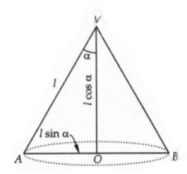
$\cos \alpha=\frac{V O}{V A}$ and $\sin \alpha=\frac{O A}{V A}$
$\Rightarrow \cos \alpha=\frac{V O}{l}$ and $\sin \alpha=\frac{O A}{l}$
$\Rightarrow V O=1 \cos a, OA=1 \sin \alpha$
Let $V$ be the volume of the cone, Then,
$V=\frac{1}{3} \pi(OA)^2(VO)$
$\Rightarrow V=\frac{1}{3} \pi(1 \sin \alpha)^2(1 \cos \alpha)$
$\Rightarrow V=\frac{1}{3} \pi 1^3 \sin ^2 \alpha \cos \alpha$
$\Rightarrow \frac{d V}{d \alpha}=\frac{\pi}{3} 1^3\left(-\sin ^3 \alpha+2 \sin \alpha \cos ^2 \alpha\right)$
$\Rightarrow \frac{d V}{d \alpha}=\frac{\pi l^3}{3} \sin \alpha\left(-\sin ^2 \alpha+2 \cos ^2 \alpha\right) \ldots$
The critical points of $V$ are given by $\frac{d V}{d \alpha}=0$.
$\because \frac{d V}{d \alpha}=0$
$\Rightarrow \frac{\pi l^3}{3} \sin \alpha\left(-\sin ^2 \alpha+2 \cos ^2 \alpha\right)=0$
$\Rightarrow 2 \cos ^2 \alpha=\sin ^2 \alpha$
$\Rightarrow \tan ^2 \alpha=2 $
$\Rightarrow \tan \alpha=\sqrt{2}\ [\because \text { a is acute } \because \sin \alpha \neq 0]$
$\because \cos \alpha=\frac{1}{\sqrt{1+\tan ^2 \alpha}}=\frac{1}{\sqrt{3}}[\because \tan \alpha=\sqrt{21}]$
Differentiating $(i)$ with respect to a, we get
$\frac{d^2 V}{d \alpha^2}=\frac{\pi l^3}{3}\left(-3 \sin ^2 \alpha \cos \alpha+2 \cos ^3 \alpha-4 \sin ^2 \alpha \cos \alpha\right)$
$=\frac{\pi l^3}{3} \cos ^3 \alpha\left(2-7 \tan ^2 \alpha\right)$
$\because\left(\frac{d^2 V}{d \alpha^2}\right)_{\tan \alpha=\sqrt{2}}$$=\frac{1}{3} \pi l^3\left(\frac{1}{\sqrt{3}}\right)^3(2-7 \times 2)=\frac{-4 \pi l^3}{3 \sqrt{3}}<0$
Thus$, V$ is maximum, when $\tan \alpha=\sqrt{2}$ or $\alpha=\tan ^{-1} \sqrt{2}$ i.e. when the semi$-$vertical angle of the cone is $\tan ^{-1} \sqrt{2}$.
In $\triangle \text{AOV},$
$\cos \alpha=\frac{V O}{V A}$ and $\sin \alpha=\frac{O A}{V A}$
$\Rightarrow \cos \alpha=\frac{V O}{l}$ and $\sin \alpha=\frac{O A}{l}$
$\Rightarrow V O=1 \cos a, OA=1 \sin \alpha$
Let $V$ be the volume of the cone, Then,
$V=\frac{1}{3} \pi(OA)^2(VO)$
$\Rightarrow V=\frac{1}{3} \pi(1 \sin \alpha)^2(1 \cos \alpha)$
$\Rightarrow V=\frac{1}{3} \pi 1^3 \sin ^2 \alpha \cos \alpha$
$\Rightarrow \frac{d V}{d \alpha}=\frac{\pi}{3} 1^3\left(-\sin ^3 \alpha+2 \sin \alpha \cos ^2 \alpha\right)$
$\Rightarrow \frac{d V}{d \alpha}=\frac{\pi l^3}{3} \sin \alpha\left(-\sin ^2 \alpha+2 \cos ^2 \alpha\right) \ldots$
The critical points of $V$ are given by $\frac{d V}{d \alpha}=0$.
$\because \frac{d V}{d \alpha}=0$
$\Rightarrow \frac{\pi l^3}{3} \sin \alpha\left(-\sin ^2 \alpha+2 \cos ^2 \alpha\right)=0$
$\Rightarrow 2 \cos ^2 \alpha=\sin ^2 \alpha$
$\Rightarrow \tan ^2 \alpha=2 $
$\Rightarrow \tan \alpha=\sqrt{2}\ [\because \text { a is acute } \because \sin \alpha \neq 0]$
$\because \cos \alpha=\frac{1}{\sqrt{1+\tan ^2 \alpha}}=\frac{1}{\sqrt{3}}[\because \tan \alpha=\sqrt{21}]$
Differentiating $(i)$ with respect to a, we get
$\frac{d^2 V}{d \alpha^2}=\frac{\pi l^3}{3}\left(-3 \sin ^2 \alpha \cos \alpha+2 \cos ^3 \alpha-4 \sin ^2 \alpha \cos \alpha\right)$
$=\frac{\pi l^3}{3} \cos ^3 \alpha\left(2-7 \tan ^2 \alpha\right)$
$\because\left(\frac{d^2 V}{d \alpha^2}\right)_{\tan \alpha=\sqrt{2}}$$=\frac{1}{3} \pi l^3\left(\frac{1}{\sqrt{3}}\right)^3(2-7 \times 2)=\frac{-4 \pi l^3}{3 \sqrt{3}}<0$
Thus$, V$ is maximum, when $\tan \alpha=\sqrt{2}$ or $\alpha=\tan ^{-1} \sqrt{2}$ i.e. when the semi$-$vertical angle of the cone is $\tan ^{-1} \sqrt{2}$.