Questions

Case study (4 Marks)

Take a timed test

3 questions · self-marked practice — reveal the answer and mark yourself.

Question 14 Marks
View full question & answer
Question 24 Marks
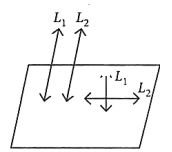
Read the following text carefully and answer the questions that follow:
If $a_1, b_1, c_1$ and $a_2, b_2, c_2$ are direction ratios of two lines say $L_1$ and $L_2$ respectively.
Then $L_1 \| L_2$ iff $\frac{a_1}{a_2}=\frac{b_1}{b_2}=\frac{c_1}{c_2}$ and $L _1 \perp L_2$ if $a _1 a _2+ b _1 b_2+ c _1 c _2=0$.
Image
$i.$ Find the coordinates of the foot of the perpendicular drawn from the point $A (1,2,1)$ to the line joining $B (1$, $4,6)$ and $C(5,4,4) \cdot(1)$
$ii.$ Find the direction ratios of the line which is perpendicular to the lines with direction ratios proportional to $(1, -2,-2)$ and $(0,2,1) \cdot(1)$
$iii.$ What is the relation between lines $\frac{x-2}{3}=\frac{y+1}{-2}=\frac{z-2}{0}$ and $\frac{x-1}{1}=\frac{y+\frac{3}{2}}{3}=\frac{z+5}{2} \cdot(2)$
$OR$
If $l _1, m_1, n _1$ and $l _2, m_2, n _2$ are direction cosines of $L _1$ and $L _2$ respectively, then what is the condition for $L _1$ parallel to $L _2. (2)$
Answer
$i.$ Equation of line joining $B$ and $C$ is
$\frac{x-x_1}{x_2-x_1}=\frac{y-y_1}{y_2-y_1}=\frac{z-z_1}{z_2-z_1}$
$\frac{x-1}{4}=\frac{y-4}{0}=\frac{z-6}{-2}=\lambda$
Let coordinates of foot of perpendicular be $D (4 \lambda+1,4,-2 \lambda+6) \ldots (i)$
$\therefore \text { D.R.'s}$ of $AD$ are $(4 \lambda, 2,-2 \lambda+5).$
Now, $4(4 \lambda)+0(2)+(-2)(-2 \lambda+5)=0$
$\lambda=\frac{1}{2}$
Putting in eqn $(i)$
Coordinates of $D$ are $(3,4,5)$
$\therefore$ Required coordinates are $(3,4,5)$.
$ii.$ Let $a , b , c$ be the direction ratios of the required line.
Since it is perpendicular to the lines whose direction ratios are $(1, -2, -2 )$ and $(0,2,1)$ respectively.
$\therefore a-2 b-2 c=0$
$a+2 b+c=0$
On solving $(i)$ and $(ii)$ by cross$-$multiplication, we get
$\frac{a}{-2+4}=\frac{b}{0-1}=\frac{c}{2} $
$\Rightarrow \frac{a}{2}=\frac{b}{-1}=\frac{c}{2}$
Thus, the direction ratios of the required line are $(2,-1,2)$
$iii.$ Direction ratio of given lines are $(3,-2,0)$ and $\left(1, \frac{3}{2}, 2\right)$
Now,
as $3 \cdot 1+(-2) \cdot\left(\frac{3}{2}\right)+0 \cdot 2=3-3+0=0$
$\therefore$ Given lines are perpendicular to each other.
$OR$
Since, direction ratio's are proportional to direction cosine's, therefore $L _1$ will be parallel to $L _2$, if
$\frac{h_1}{h_2}=\frac{m_1}{m_2}=\frac{n_1}{n_2}$
View full question & answer
Question 34 Marks
Read the following text carefully and answer the questions that follow:
A building contractor undertakes a job to construct 4 flats on a plot along with parking area. Due to strike the probability of many construction workers not being present for the job is 0.65 . The probability that many are not present and still the work gets completed on time is 0.35 . The probability that work will be completed on time when all workers are present is 0.80 .
Let: $E _1$ : represent the event when many workers were not present for the job;
$E _2$ : represent the event when all workers were present; and
E: represent completing the construction work on time.
i. What is the probability that all the workers are present for the job? (1)
ii. What is the probability that construction will be completed on time? (1)
iii. What is the probability that many workers are not present given that the construction work is completed on time? (2)
OR
What is the probability that all workers were present given that the construction job was completed on time?(2)
Answer
$
\text { i. } P\left(E_2\right)=1-P\left(E_1\right)=1-0.65=0.35
$
$
\text { ii. } \begin{aligned}
& P(E)=P\left(E_1\right) \cdot P\left(\frac{E}{E_1}\right)+P\left(E_2\right) \cdot P\left(\frac{E}{E_2}\right) \\
= & 0.65 \times 0.35+0.35 \times 0.8 \\
= & 0.35 \times 1.45 \\
= & 0.51
\end{aligned}
$
iii. $P \left(\frac{ E _1}{ E }\right)=\frac{ P \left( E _1\right) \cdot P \left(\frac{ E }{ E _1}\right)}{ P \left( E _1\right) \cdot P \left(\frac{ E }{ E _1}\right)+ P \left( E _2\right) P \left(\frac{ E }{ E _2}\right)}=\frac{0.55 \times 0.35}{0.51}=0.45$
OR
$
P\left(\frac{E_2}{E}\right)=\frac{P\left(E_2\right) \cdot P\left(\frac{E}{E_2}\right)}{P\left(E_1\right) \cdot P\left(\frac{E}{E_1}\right)+P\left(E_2\right) \cdot P\left(\frac{E}{E_2}\right)}=\frac{0.35 \times 0.8}{0.51}=0.55
$
View full question & answer
Case study (4 Marks) - MATHS STD 12 Science Questions - Vidyadip