Questions

2 Marks Questions

Take a timed test

7 questions · self-marked practice — reveal the answer and mark yourself.

Question 12 Marks
Show that the function $f(x)=x^3-3 x^2+6 x-100$ is increasing on $R.$
Answer
Given, $f(x)=x^3-3 x^2+6 x-100$
Therefore, on differentiating both sides $\text{w.r.t. x}$, we get,
$ f^{\prime}(x)=3 x^2-6 x+6$
$=3 x^2-6 x+3+3$
$=3\left(x^2-2 x+1\right)+3$
$=3(x-1)^2+3 > 0$
$\therefore f^{\prime}(x) > 0 $
This shows that function $f(x)$ is increasing on $R$.

View full question & answer
Question 22 Marks
Evaluate $\int_{-1}^2(|x+1|+|x|+|x-1|) d x$
Answer
Let
$I =\int_{-1}^2(|x+1|+|x|+|x-1|) d x$,
then $ I=\int_{-1}^2|x+1| d x+\int_{-1}^2|x| d x+\int_{-1}^2|x-1| d x$
$=\int_{-1}^2(x+1) d x-\int_{-1}^0 x d x+\int_0^2 x d x-\int_{-1}^1(x-1) d x+\int_1^2(x-1) d x$
$=\left\{\frac{x^2}{2}+x\right\}_{-1}^2-\left\{\frac{x^2}{2}\right\}_{-1}^0+\left\{\frac{x^2}{2}\right\}_0^2-\left\{\frac{x^2}{2}-x\right\}_{-1}^1+\left\{\frac{x^2}{2}-x\right\}_1^2$
$=\left\{(4)-\left(-\frac{1}{2}\right)\right\}-\left\{-\frac{1}{2}\right\}+\{2\}-\left\{\left(-\frac{1}{2}\right)-\left(\frac{3}{2}\right)\right\}+\left\{(0)-\left(-\frac{1}{2}\right)\right\}$
$=\left\{4+\frac{1}{2}\right\}+\left\{\frac{1}{2}\right\}+\{2\}+\{2\}+\left\{\frac{1}{2}\right\}=\frac{19}{2}$
View full question & answer
Question 32 Marks
Find the intervals in which $f(x)=\frac{4 x^2+1}{x}$ is increasing or decreasing.
Answer
Given: $f ( x )=\frac{4 x^2+1}{x}$
$\Rightarrow f(x)=4 x+\frac{1}{x}$
$\Rightarrow f^{\prime}(x)=4-\frac{1}{x^2}=\frac{4 x^2-1}{x^2}$
For $f(x)$ to be increasing, we must have
$f^{\prime}(x) > 0$
$\Rightarrow \frac{4 x^2-1}{x^2} > 0$
$\Rightarrow 4 x^2-1 > 0$
$\Rightarrow \quad(2 x-1)(2 x+1) > 0$
$(x-1 / 2)(x+1 / 2) > 0$
$x < -1 / 2 \text { or }, x > 1 / 2$
$x \in(-\infty,-1 / 2) \cup(1 / 2, \infty)$
So , $f(x)$ is increasing on $(-\infty,-1 / 2) \cup(1 / 2, \infty)$
for $f(x)$ is to be decreasing, we must have
$\Rightarrow \frac{4 x^2-1}{x^2} < 0$
$\Rightarrow 4 x^2-1 < 0$
$(2 x-1)(2 x+1) < 0$
$-\frac{1}{2} < x < \frac{1}{2}$
$x \in(-1 / 2,1 / 2)$
But domain $f R -\{0\}$. So, $f(x)(-1 / 2,0) \cup(0,1 / 2)$
View full question & answer
Question 42 Marks
Find the intervals in which the function f given by $f(x)=x^2-4 x+6$ is
a. increasing
b. decreasing
Answer
We have
$f(x)=x^2-4 x+6$
or $f ^{\prime}( x )=2 x -4$
Therefore, $f ^{\prime}( x )=0$ gives $x =2$. Now the point $x=2$ divides the real line into two disjoint intervals namely, $(-\infty, 2)$ and $(2, \infty)$
Image
In the interval $(-\infty, 2), f ^{\prime}(x)=2 x-4<0$.
And in interval $(2, \infty), f^{\prime}(x)=2 x-4;0$
$\therefore$ (i) f is increasing in $(2, \infty)$
and (ii) $f$ is decreasing in $(-\infty, 2)$
View full question & answer
Question 52 Marks
A man $1.6m$ tall walks at the rate of $0.3 \ m/s$ away from a street light is $4 m$ above the ground. At what rate is the tip of his shadow moving? At what rate is his shadow lengthening?
Answer
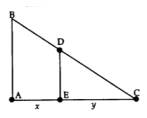
Let $AB$ represent the height of the street light from the ground. At any time $t$ seconds, let the man represented as $ED$ of height $1.6 m$ be at a distance of $x$ m from $AB$ and the length of his shadow $EC$ by y m. Using similarity of triangles, we have
$\frac{4}{1.6}=\frac{x+y}{y}$
$\Rightarrow 3 y =2 x $
Image
Differentiating both sides $\text{w.r.t. t}$, we get
$3 \frac{d y}{d t}=2 \frac{d z}{d t}$
$\frac{d y}{d t}=\frac{2}{3} \times 0.3 \Rightarrow \frac{d y}{d t}=0.2$
At any time t seconds, the tip of his shadow is at a distance of $(x + y) m$ from $АВ$.
The rate at which the tip of his shadow moving = $\left(\frac{d z}{d t}+\frac{d y}{d t}\right) m / s =0.5 m / s$
The rate at which his shadow is lengthening $=\frac{d y}{d t} m / s =0.2 m / s$
View full question & answer
Question 62 Marks
Find the value $\tan ^{-1}\left(\tan \frac{2 \pi}{3}\right)$
Answer
We have,
$\tan ^{-1}\left(\tan \frac{2 \pi}{3}\right)=\tan ^{-1} \tan \left(\pi-\frac{\pi}{3}\right)$
$ =\tan ^{-1}\left(-\tan \frac{\pi}{3}\right)\left[\because \tan ^{-1}(-x)=-\tan ^{-1} x\right]$
$=\tan ^{-1} \tan \left(\frac{-\pi}{3}\right)=-\frac{\pi}{3}\left[\because \tan ^{-1}(\tan x)=x, x \in\left(\frac{-\pi}{2}, \frac{\pi}{2}\right)\right] $
Note: Remember that, $\tan ^{-1}\left(\tan \frac{2 \pi}{3}\right) \neq \frac{2 \pi}{3}$
Since, $\tan ^{-1}(\tan x )= x$, if $x \in\left(-\frac{\pi}{2}, \frac{\pi}{2}\right)$ and $\frac{2 \pi}{3} \notin\left(\frac{-\pi}{2}, \frac{\pi}{2}\right)$
View full question & answer
Question 72 Marks
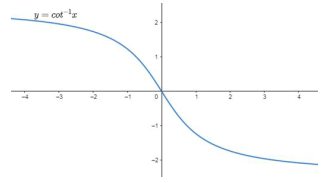
Write the interval for the principal value of function and draw its graph: $\cot ^{-1} x$
Answer
Principal value branch of $\cot ^{-1} x$ is $(0, \pi)$and its graph is shown below.
Image
View full question & answer
2 Marks Questions - MATHS STD 12 Science Questions - Vidyadip