Questions

3 Marks Question

Take a timed test

9 questions · self-marked practice — reveal the answer and mark yourself.

Question 13 Marks
Evaluate: $\int \frac{x^2+1}{\left(x^2+2\right)\left(2 x^2+1\right)} d x$
Answer
Let
$x^2=y$. Then,
$\frac{x^2+1}{\left(x^2+2\right)\left(2 x^2+1\right)}=\frac{y+1}{(y+2)(2 y+1)} $
Using partial fractions,
$\frac{y+1}{(y+2)(2 y+1)}=\frac{A}{y+2}+\frac{B}{2 y+1} \ldots \ldots \text { (i) }$
$\Rightarrow y+1=A(2 y+1)+B(y+2)$
Putting $y+2=0$ i.e. $y=-2$ in $(ii)$, we get
$-1=-3 A \Rightarrow A=\frac{1}{3}$
Putting $2 y +1=0$ i.e. $y =-\frac{1}{2}$ in $(ii)$, we get
$\frac{1}{2}=B\left(\frac{3}{2}\right) \Rightarrow B=\frac{1}{3}$
Substituting the values of $A$ and $B$ in $(i)$, we obtain
$\frac{y+1}{(y+2)(2 y+1)}=\frac{1}{3} \cdot \frac{1}{y+2}+\frac{1}{3} \frac{1}{(2 y+1)}$
Replacing $y$ by $x^2$, we get
$ \frac{x^2+1}{\left(x^2+2\right)\left(2 x^2+1\right)}=\frac{1}{3} \cdot \frac{1}{x^2+2}+\frac{1}{3\left(2 x^2+1\right)}$
$\therefore I=\int \frac{x^2+1}{\left(x^2+2\right)\left(2 x^2+1\right)} d x=\frac{1}{3} \int \frac{1}{x^2+2} d x+\frac{1}{3} \int \frac{1}{(\sqrt{2} x)^2+1} d x$
$\Rightarrow I=\frac{1}{3} \times \frac{1}{\sqrt{2}} \tan ^{-1}\left(\frac{x}{\sqrt{2}}\right)+\frac{1}{3 \sqrt{2}} \tan ^{-1}(\sqrt{2} x)+C$
$\Rightarrow I=\frac{1}{3 \sqrt{2}}\left\{\tan ^{-1} \frac{x}{\sqrt{2}}+\tan ^{-1} \sqrt{2}x\right\}+C$
View full question & answer
Question 23 Marks
Evaluate: $\int \frac{x}{\sqrt{x+z} \sqrt{x+z}} d x$
Answer
Rationalize the given integrand we get
$ \Rightarrow \int \frac{x}{\sqrt{x+a}-\sqrt{x-b}} \times \frac{\sqrt{x+a}+\sqrt{x-b}}{\sqrt{x+a}+\sqrt{x-b}} dx$
$\Rightarrow \int \frac{x(\sqrt{x+a}-\sqrt{x-b})}{x+a-x-b} d x$
$\Rightarrow \int \frac{x(\sqrt{x+a}-\sqrt{x-b})}{a-b} d x$
$\Rightarrow \frac{1}{a-b} \int x(\sqrt{x+a}-\sqrt{x-b}) d x$
Assume $x =\sqrt{t}$
$\Rightarrow dx=\frac{dt}{2 \sqrt{t}}$
Substituting values of $t $, and $dt ,$
$\Rightarrow \int \sqrt{t} \frac{(\sqrt{\sqrt{t}+a}-\sqrt{\sqrt{t}-b)}}{2 \sqrt{t}(a-b)} d t$
$\Rightarrow \frac{1}{2(a-b)} \int(\sqrt{\sqrt{t}+a}-\sqrt{\sqrt{t}-b}) d t$
$\Rightarrow \frac{1}{2(a-b)} \int(\sqrt{t}+a)^{1 / 2} d t-\int(\sqrt{t}-b)^{1 / 2} d t$
$\Rightarrow \frac{1}{2(a-b)}\left(\frac{4}{3}\left(\sqrt{t}+a^2\right)^{\frac{3}{2}}-\frac{4}{3}\left(t-a^2\right)^{\frac{3}{2}}\right) $
$\text { now replacing } x =\sqrt{t}$
$\Rightarrow \frac{1}{2(a-b)}\left(\frac{2}{3}(x+a)^{\frac{3}{2}}-\frac{2}{3}(x-b)^{\frac{3}{2}}\right)$
View full question & answer
Question 33 Marks
Solve the Linear Programming Problem graphically : Maximize $Z = 3x + 4y$ Subject to $2 x+2 y \leq 80\  2 x+4 y \leq 120$
Answer
We have to maximize $z = 3x + 4y$
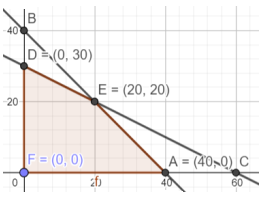
First, we will convert the given inequations into equations, we obtain the following equations : $2x + 2y = 80, 2x + 4y = 120$
Region represented by $2 x+2 y \leq 80$ the line $2x + 2y = 80$
Clearly $(0,0)$ satisfies the inequation $2 x+2 y \leq 80C(60,0)$ and $D(0,30)$ respectively.
By joining these points we obtain the line $2 x+4 y \leq 120$
Image
The corner points of the feasible region are $O(0,0), A(40,0) E(20,20)$ and $D(0,30)$
The values of objective function at the corner points are as follows:
Corner Points $Z = 3x + 4y$
$O(0, 0)$ $3 x 0 + 4 x 0 = 0$
$A(40, 0)$ $3 x 40 + 4 x 0 = 120$
$F(20, 20)$ $3 x 20 + 4 x 20 = 140$
$D(0, 30)$ $10 x 0 + 4 x 30 = 120$
We see that the maximum value of the objective function $Z$ is $140$ which is at $E(20, 20)$ that means at $x = 20$ and $y = 20$
Thus, the optimal value of objective function $z$ is $140.$
View full question & answer
Question 43 Marks
If $x = a \left(\cos t+\log \tan \frac{t}{2}\right), y = a \sin t$, then evaluate $\frac{d^2 y}{d x^2}$ at $t=\frac{\pi}{3}$.
Answer
Given, $x = a \left(\cos t+\log \tan \frac{t}{2}\right).........(i)$ and $y= a \sin t ...........(ii)$
Therefore, on differentiating both sides $\text{w.r.t t,}$ we get,
$\frac{d x}{d t}=a\left[\frac{d}{d t}(\cos t)+\frac{d}{d t} \log \tan \frac{t}{2}\right]$
$=a\left[-\sin t+\frac{1}{\tan \frac{t}{2}} \frac{d}{d t}\left(\tan \frac{t}{2}\right)\right]\ [$by using chain rule of derivative $]$
$=a\left[-\sin t+\frac{1}{\tan \frac{t}{2}} \cdot \sec ^2 \frac{t}{2} \frac{d}{d t}\left(\frac{t}{2}\right)\right]$
$=a\left[-\sin t+\frac{1}{\tan \frac{t}{2}} \times \sec ^2 \frac{t}{2} \times \frac{1}{2}\right]$
$=a\left[-\sin t+\frac{1}{\frac{\sin t / 2}{\cos t / 2}} \times \frac{1}{\cos ^2 \frac{t}{2}} \times \frac{1}{2}\right]$
$=a\left[-\sin t+\frac{1}{2 \sin \frac{t}{2} \cdot \cos \frac{t}{2}}\right]$
$=a\left[-\sin t+\frac{1}{\sin t}\right][\because \sin 2 \theta=2 \sin \theta \cos \theta]$
$=a\left(\frac{1-\sin ^2 t}{\sin t}\right)$
$ \Rightarrow \frac{d x}{d t}=a\left(\frac{\cos ^2 t}{\sin t}\right)\left[\because 1-\sin ^2 \theta=\cos ^2 \theta\right]$
Again, on differentiating both sides of $(ii)\  \text{w.r.t t,}$ we get
$\frac{d y}{d t}= a \cos t.....................(iv)$
Therefore, $\frac{d y}{d x}=\frac{\frac{d y}{d t}}{\frac{d x}{d t}}=\frac{a \cos t}{a\left(\frac{\cos ^2 t}{\sin t}\right)}$ [ from Eqs(iii) and (iv)]
$=\frac{a \cos t}{a \cos ^2 t} \times \sin t=\tan t$
Therefore, on differentiating both sides of above equation $\text{w.r.t x,}$ we get,
$ \frac{d}{d x}\left(\frac{d y}{d x}\right)=\frac{d}{d x}(\tan t)$
$=\frac{d}{d t}(\tan t) \frac{d t}{d x}\left[\because \frac{d}{d x} f(t)=\frac{d}{d t} f(t) \cdot \frac{d t}{d x}\right]$
$\Rightarrow \frac{d^2 y}{d x^2}=\sec ^2 t \times \frac{\sin t}{a \cos ^2 t} \ [$From Eq.$(iii)]$
$\Rightarrow \frac{d^2 y}{d x^2}=\frac{\sin t \sec ^4 t}{a} $
Therefore, on putting $t=\frac{\pi}{3}$, we get,
$ {\left[\frac{d^2 y}{d x^2}\right]_{t=\frac{\pi}{3}}=\frac{\sin \frac{\pi}{3} \times \sec ^4 \frac{\pi}{3}}{a}=\frac{\frac{\sqrt{3}}{2} \times(2)^4}{a}}$
$=\frac{8 \sqrt{3}}{a}$
View full question & answer
Question 53 Marks
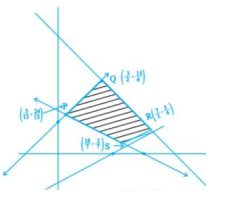
In Fig, the feasible region $($shaded$)$ for a $\text{LPP}$ is shown. Determine the maximum and minimum value of $Z =x+2y$
Image

Solve the Linear Programming Problem graphically:
Maximize $Z = 3x + 4y$ Subject to
$2 x+2 y \leq 80$
$2 x+4 y \leq 120$
Answer
From the shaded bounded region, it is clear that the coordinates of corner points are $\left(\frac{3}{13}, \frac{24}{13}\right),\left(\frac{18}{7}, \frac{2}{7}\right),\left(\frac{7}{2}, \frac{3}{4}\right)$ and $\left(\frac{3}{2}, \frac{15}{4}\right)$
Also, we have to determine maximum and minimum value of $Z = x +2 y$
Corner Points Corresponding value of $Z$
$\left(\frac{3}{13}, \frac{24}{13}\right)$ $\frac{3}{13}+\frac{48}{13}=\frac{51}{13}=3 \frac{12}{13}$
$\left(\frac{18}{7}, \frac{2}{7}\right)$ $\frac{18}{7}+\frac{4}{7}=\frac{22}{7}=3 \frac{1}{7}($ Minimum $)$
$\left(\frac{7}{2}, \frac{3}{4}\right)$ $\frac{7}{2}+\frac{6}{4}=\frac{20}{4}=5$
$\left(\frac{3}{2}, \frac{15}{4}\right)$ $\frac{3}{2}+\frac{30}{4}=\frac{36}{4}=9$ (Maximum)
Hence, the maximum and minimum value of are $9$ and $3 \frac{1}{7}$ respectively
View full question & answer
Question 63 Marks
Find the general solution of the differential equation $\left(1+x^2\right) \frac{d y}{d x}-x=2 \tan ^{-1} x$
Answer
The given differential equation can be rewritten as
$\frac{d y}{d x}=\frac{2 \tan ^{-1} x}{\left(1+x^2\right)}+\frac{x}{\left(1+x^2\right)}$
$\Rightarrow d y=\left\{\frac{2 \tan ^{-1} x}{\left(1+x^2\right)}+\frac{x}{\left(1+x^2\right)}\right\} d x\  [$separating the variables$]$
$\Rightarrow \int d y=\int \frac{2 \tan ^{-1} x}{\left(1+x^2\right)} d x+\int \frac{x}{\left(1+x^2\right)} d x+C$
where $C$ is an arbitrary constant
$ \Rightarrow y=2 \int t d t+\frac{1}{2} \int \frac{2 x}{\left(1+x^2\right)} d x+C$
$[$put $\tan ^{-1} x = t$ and $\frac{1}{\left(1+ x ^2\right)} d x=d t$ in $1^{st}$ integral$]$
$\Rightarrow y=t^2+\frac{1}{2} \log \left|1+x^2\right|+C$
$\Rightarrow y=\left(\tan ^{-1} x\right)^2+\frac{1}{2} \log \left|1+x^2\right|+C $
Therefore, $y=\left(\tan ^{-1} x\right)^2+\frac{1}{2} \log \left|1+x^2\right|+C$ is the required solution.
View full question & answer
Question 73 Marks
In the differential equation show that it is homogeneous and solve it : $x^2 \frac{d y}{d x}= x ^2+ xy + y ^2$
Answer
The given differential equation is,
$ x^2 \frac{d y}{d x}=x^2+x y+y^2$
$\Rightarrow \frac{d y}{d x}=\frac{x^2+x y+y^2}{x^2}$
$\Rightarrow \frac{d y}{d x}=1+\frac{y}{x}+\left(\frac{y}{x}\right)^2$
$\Rightarrow \frac{d y}{d x}=f\left(\frac{y}{x}\right)$
$\Rightarrow$ the given differential equation is a homogenous equation.
The solution of the given differential equation is:
Put  $y=vx$
$\Rightarrow \frac{dy}{dx}=v+x \frac{dv}{dx}$
$v+x \frac{d v}{d x}=1+\frac{v x}{x}+\left(\frac{v x}{x}\right)^2=1+v+(v)^2$
$\Rightarrow x \frac{d v}{d x}=1+v+(v)^2-v=1+(v)^2$
$\Rightarrow \frac{d v}{1+(v)^2}=\frac{d x}{x} $
Integrating both the sides we get:
$ \Rightarrow \int \frac{d v}{1+(v)^2}=\int \frac{d x}{x}+c$
$\Rightarrow \tan ^{-1} v=\ln |x|+c $
Resubstituting the value of $y=v x$, we get,
$\Rightarrow \tan {-}\left(\frac{y}{x}\right)=\ln |x|+c$
View full question & answer
Question 83 Marks
Urn $A$ contains $1$ white $, 2$ black and $3$ red balls; urn $B$ contains $2$ white $,1$ black and $1$ red ball; and urn $C$ contains $4$ white $,5$ black and $3$ red balls. One urn is chosen at random and two balls are drawn. These happen to be one white and one red. What is the probability that they come from urn $A$?
Answer
Let $E _1, E _2, E _3$ be the events that the balls are drawn from urn $A,$ urn $B$ and urn $C$ respectively, and let $E$ be the event that the balls drawn are one white and one red.
Therefore, we have,
$P \left( E _1\right)= P \left( E _2\right)= P \left( E _3\right)=\frac{1}{3}$
Since $E_1, E_2, E_3$are mutually exclusive and exhaustive, therefore, we have,
$P\left(\frac{E}{E_1}\right)=$ probability that the balls drawn are one white and one red, given that the balls are from urn $A$
$=\frac{1 C_1 \times{ }^3 C_1}{{ }^6 C_2}=\frac{3}{15}=\frac{1}{5}$
$P\left(\frac{E}{E_2}\right)=$ probability that the balls drawn are one white and one red, given that the balls are from urn $B$
$=\frac{{ }^2 C_1 \times{ }^1 C_1}{{ }^4 C_2}=\frac{2}{6}=\frac{1}{3}$
$P\left(\frac{E}{E_3}\right)=$ probability that the balls drawn are one white and one red, given that the balls are from urn $C$
$=\frac{{ }^4 C_1 \times{ }^3 C_1}{{ }^{12} C_2}=\frac{12}{66}=\frac{2}{11}$
Therefore, we have,
Probability that the balls drawn are from urn $A,$ it being given that the balls drawn are one white and one red
$=P\left(\frac{E_1}{E}\right)$
$=\frac{P\left(\frac{E}{E_1}\right) \cdot P\left(E_1\right)}{P\left(\frac{E}{E_1}\right) \cdot P\left(E_1\right)+P\left(\frac{E}{E_2}\right) \cdot P\left(E_2\right)+P\left(\frac{E}{E_3}\right) \cdot P\left(E_3\right)} \ [$by Bayes's theorem$]$
$=\frac{\left(\frac{1}{5} \times \frac{1}{3}\right)}{\left(\frac{1}{5} \times \frac{1}{3}\right)+\left(\frac{1}{3} \times \frac{1}{3}\right)+\left(\frac{2}{11} \times \frac{1}{3}\right)}$
$=\left(\frac{1}{15} \times \frac{495}{118}\right)=\frac{33}{118}$
Hence, the required probability is $\frac{33}{118}$
View full question & answer
Question 93 Marks
Evaluate $\int e^{2 x}\left(\frac{1-\sin 2 x}{1-\cos 2 x}\right) d x$
Answer
According to the question,
$I=\int e^{2 x}\left(\frac{1-\sin 2 x}{1-\cos 2 x}\right) d x$
$=\int e^{2 x} (\frac{1-2 \sin x \cos x}{2 \sin ^2 x}) d x\  [\because 1-\cos 2 x=2 \sin ^2 x$ and $\sin 2 x=2 \sin x \cos x]$
$=\frac{1}{2} \int e^{2 x}\left(\operatorname{cosec}^2 x-2 \cot x\right) d x$
$=\frac{1}{2} \int e_I^{2 x} \operatorname{cosec}_{I I}^2 x d x-\int e^{2 x} \cot x d x $
Using integration by parts for first integral :
$ =\frac{1}{2}\left[e^{2 x} \int \operatorname{cosec} e^2 x d x-\int\left\{\frac{d}{d x}\left(e^{2 x}\right) \int \operatorname{cosec} e^2 x d x\right\} d x\right]-\int e^{2 x} \cot x d x$
$=\frac{1}{2}\left[-e^{2 x} \cot x+\int 2 e^{2 x} \cot x d x\right]+C-\int e^{2 x} \cot x d x$
$=-\frac{e^{2 x}}{2} \cot x+\int e^{2 x} \cot x d x-\int e^{2 x} \cot x d x+C$
$I=-\frac{e^{2 z}}{2} \cot x+C$
View full question & answer
3 Marks Question - MATHS STD 12 Science Questions - Vidyadip