Questions

5 Marks Questions

Take a timed test

6 questions · self-marked practice — reveal the answer and mark yourself.

Question 15 Marks
Find the image of the point $(0,2,3)$ in the line $\frac{x+3}{5}=\frac{y-1}{2}=\frac{z+4}{3}$
Answer
We have,
$ \frac{x+3}{5}=\frac{y-1}{2}=\frac{z+4}{3}=\lambda$
Therefore, the foot of the perpendicular is $(5 \lambda-3,2 \lambda+1,3 \lambda-4)$
The direction ratios of the perpendicular is
$ (5 \lambda-3-0):(2 \lambda+1-2):(3 \lambda-4-3)$
$\Rightarrow(5 \lambda-3):(2 \lambda-1):(3 \lambda-7) $
Direction ratio of the line is $5: 2: 3$
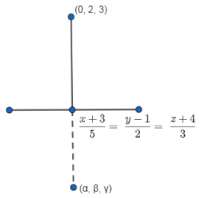
Image
From the direction ratio of the line and direction ratio of its perpendicular, we have
$5(5 \lambda-3)+2(2 \lambda-1)+3(3 \lambda-7)=0$
$\Rightarrow 25 \lambda-15+4 \lambda-2+9 \lambda-21=0$
$\Rightarrow 38 \lambda=38$
$\Rightarrow \lambda=1$
Therefore, the foot of the perpendicular is $(2, 3, -1)$
The foot of the perpendicular is the mid $-$ point of the line joining $(0, 2, 3)$ and $(a,$ beta $, y)$
Therefore, we have
$\frac{\alpha+0}{2}=2 $
$\Rightarrow \alpha=4$
$\frac{\beta+2}{2}=3 $
$\Rightarrow \beta=4$
$\frac{\gamma+3}{2}=-1 $
​​​​​​​$\Rightarrow \gamma=-5$
Thus, the imgae is $(4,4,-5)$
View full question & answer
Question 25 Marks
Let $A =\{1,2,3\}$ and $R =\left\{( a , b )\}: a , b \in A\right.$ and $\left|a^2-b^2\right| \leq 5$. Write $R$ as set of ordered pairs. Mention whether $R$ is
i. reflexive
ii. symmetric
iii. transitive
Give reason in each case.
Answer
Given that
Let $A =\{1,2,3\}$ and $R =\left\{( a , b )\}: a , b \in A\right.$ and $\left|a^2-b^2\right| \leq 5$
Put $a =1, b=1\left|1^2-1^2\right| \leq 5,(1,1)$ is an ordered pair.
Put $a =1, b=2\left|1^2-2^2\right| \leq 5,(1,2)$ is an ordered pair.
Put $a=1, b=3\left|1^2-3^2\right|>5,(1,3)$ is not an ordered pair.
Put $a =2, b=1\left|2^2-1^2\right| \leq 5,(2,1)$ is an ordered pair.
Put $a =2, b=2\left|2^2-2^2\right| \leq 5,(2,2)$ is an ordered pair.
Put $a =2, b=3\left|2^2-3^2\right| \leq 5,(2,3)$ is an ordered pair.
Put $a=3, b=1\left|3^2-1^2\right|>5,(3,1)$ is not an ordered pair.
Put $a =3, b=2\left|3^2-2^2\right| \leq 5,(3,2)$ is an ordered pair.
Put $a =3, b =3\left|3^2-3^2\right| \leq 5,(3,3)$ is an ordered pair.
$R=\{(1,1),(1,2),(2,1),(2,2),(2,3),(3,2),(3,3)\}$
$i$. For $(a, a) \in R$
$\left|a^2-a^2\right|=0 \leq 5$.
Thus, it is reflexive.
$ii$. Let $( a , b ) \in R$
$(a, b) \in R,\left|a^2-b^2\right| \leq 5$
$\left|b^2-a^2\right| \leq 5$
$(b, a) \in R$
Hence, it is symmetric
$iii$. Put $a =1, b=2, c =3$
$ \left|1^2-2^2\right| \leq 5$
$\left|2^2-3^2\right| \leq 5$
But $\left|1^2-3^2\right|>5$
Thus, it is not transitive
View full question & answer
Question 35 Marks
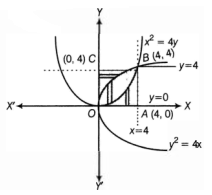
Prove that the curves $y^2=4 x$ and $x^2=4 y$ divide the area of the square bounded by sides $x=0, x=4, y=4$ and $y$
$=0$ into three equal parts.
Answer
The given curves are $y^2=4 x$ and $x^2=4 y$
Let $\text{OABC}$ be the square whose sides are represented by following equations
Equation of $OA$ is $y = 0$
Equation of $AB$ is $x = 4$
Equation of $BC$ is $y = 4$
Equation of $CO$ is $x = 0$
Image

On solving equations $y^2=4 x$ and $x^2=4 y$, we get $A(0,0)$ and $B(4,4)$ as their points of intersection.
The Area bounded by these curves
$=\int_0^4\left[y_{\left(\text {parabola } y^2=4 x\right)}-y_{\left(\text {parabola } x^2=4 y\right)}\right] d x$
$=\int_0^4\left(2 \sqrt{x}-\frac{x^2}{4}\right) d x$
$=\left[2 \cdot \frac{2}{3} x^{3 / 2}-\frac{x^3}{12}\right]_0^4$
$=\left[\frac{4}{3} x^{3 / 2}-\frac{x^3}{12}\right]_0^4$
$=\frac{4}{3} \cdot(4)^{3 / 2}-\frac{64}{12}$
$=\frac{4}{3} \cdot\left(2^2\right)^{3 / 2}-\frac{64}{12}$
$=\frac{4}{3} \cdot(2)^3-\frac{64}{12}$
$=\frac{32}{3}-\frac{16}{3}$
$=\frac{16}{3} \text { sq units }$
Hence, area bounded by curves $y^2=4 x$ and $x=4 y$ is $\frac{16}{3}$ sq units $\qquad$
Area bounded by curve $x^2=4 y$ and the lines $x=0, x=4$ and $X-$axis $=\int_0^4 y_{\left(\text {parabola } x^2=4 y\right)} d x$
$=\int_0^4 \frac{x^2}{4} d x$
$=\left[\frac{x^3}{12}\right]_0^4$
$=\frac{64}{12}$
$=\frac{16}{3} \text { sq units }.........(ii)$
The area bounded by curve $y^2=4 x$, the lies $y=0, y=4$ and $Y-$axis
$=\int_0^4 x_{\left(\text {parabola } y^2=4 x\right)} d y$
$=\int_0^4 \frac{y^2}{4} d y$
$=\left[\frac{y^3}{12}\right]_0^4$
$=\frac{64}{12}$
$=\frac{16}{3} \text { sq units .......(iii) }$
From Equations. $(i), (ii)$ and $(iii),$ area bounded by the parabolas $y^2=4 x$ and $x^2=4 y$ divides the area of square into three equal parts.
View full question & answer
Question 45 Marks
Show that the lines $\frac{x-1}{3}=\frac{y+1}{2}=\frac{z-1}{5}$ and $\frac{x-2}{2}=\frac{y-1}{3}=\frac{z+1}{-2}$ intersect and find their point of intersection.
Answer
Given Cartesian equations of lines
$L_1=\frac{x-1}{3}=\frac{y+1}{2}=\frac{z-1}{5}$
Line $L1$ is passing through point $(1, -1, 1)$ and has direction ratios $(3, 2, 5)$ Thus, vector equation of line L1 is
$\overrightarrow{ r }=(\hat{ i }-\hat{ j }+\hat{ k })+\lambda(3 \hat{ i }+2 \hat{ j }+5 \hat{ k })$
And
$L _2: \frac{ x -2}{2}=\frac{ y -1}{3}=\frac{z+1}{-2}$
Line $L_2$ passing through point $(2, -1, 1)$ and has direction ratios $(2, 3, -2)$ Thus, vector equation of line $L_2$ is
$\overrightarrow{ r }=(2 \hat{ i }+\hat{ j }-\hat{ k })+\mu(2 \hat{ i }+3 \hat{ j }-2 \hat{ k })$
Now, to calculate distance between the lines,
$\overrightarrow{ r }=(\hat{\imath}-\hat{ j }+\hat{ k })+\lambda(3 \hat{ i }+2 \hat{ j }+5 \hat{ k })$
$\overrightarrow{ r }=(2 \hat{ i }+\hat{ j }-\hat{ k })+\mu(2 \hat{ i }+3 \hat{ j }-2 \hat{ k })$
Here, we have
$\overrightarrow{a_1}=1-j+\hat{k}$
$\overrightarrow{b_1}=3 \hat{ i }+2 \hat{ j }+5 \hat{ k }$
$\overrightarrow{a_2}=2 \hat{\imath}+\hat{\jmath}-\hat{k}$
$\overrightarrow{b_2}=2 \hat{ i }+3 \hat{ j }-2 \hat{ k }$
Thus,
$\overrightarrow{ b _1} \times \overrightarrow{ b _2}=\left|\begin{array}{ccc}\hat{\imath} \hat{\jmath} \hat{ k } \\ 3 2 5 \\ 2 3 -2\end{array}\right|$
$=\hat{i}(-4-15)-\hat{j}(-6-10)+\hat{k}(9-4)$
$\Rightarrow \overrightarrow{ b _1} \times \overrightarrow{ b _2}=-19 \hat{ i }+16 \hat{ j }+5 \hat{ k }$
$\Rightarrow\left|\overrightarrow{ b _1} \times \overrightarrow{ b _2}\right|=\sqrt{(-19)^2+16^2+5^2}$
$=\sqrt{361+256+25}$
$=\sqrt{642}$
$\overrightarrow{a_2}-\overrightarrow{a_1}=(2-1) \hat{i}+(1+1) \hat{\jmath}+(-1-1) \hat{k}$
$\therefore \overrightarrow{a_2}-\overrightarrow{a_1}=1+2 \hat{\jmath}-2 \hat{k}$
Now,
$\left(\overrightarrow{b_1} \times \overrightarrow{b_2}\right) \cdot\left(\overrightarrow{a_2}-\overrightarrow{a_1}\right)=(-19 \hat{i}+16 \hat{\jmath}+5 \hat{k}) \cdot(\hat{i}+2 \hat{j}-2 \hat{k})$
$=((-19) \times 1)+(16 \times 2)+(5 \times(-2))$
$=-19+32-10$
$=3$
Thus, the shortest distance between the given lines is
$d=\left|\frac{\left(\overrightarrow{b_1} \times \overrightarrow{b_2}\right) \cdot\left(\overrightarrow{a_2}-\overrightarrow{a_1}\right)}{\left|\overrightarrow{b_1} \times \overrightarrow{b_2}\right|}\right|$
$\Rightarrow d=\left|\frac{3}{\sqrt{642}}\right|$
$\left.\therefore d=\frac{3}{\sqrt{642}} \right\rvert\,$
As $d \neq 0$
Hence, given lines do not intersect each other.
View full question & answer
Question 55 Marks
Given $A=\left[\begin{array}{ccc}2 & 2 & -4 \\ -4 & 2 & -4 \\ 2 & -1 & 5\end{array}\right], B=\left[\begin{array}{ccc}1 & -1 & 0 \\ 2 & 3 & 4 \\ 0 & 1 & 2\end{array}\right]$, find $B A$ and use this to solve the system of equations $y$ $+2 z=7, x-y=3,2 x+3 y+4 z=17$
Answer
We have,
$A =\left[\begin{array}{ccc}2 & 2 & -4 \\ -4 & 2 & -4 \\ 2 & -1 & 5\end{array}\right], B =\left[\begin{array}{ccc}1 & -1 & 0 \\ 2 & 3 & 4 \\ 0 & 1 & 2\end{array}\right]$ $\therefore BA =\left[\begin{array}{ccc}1 & -1 & 0 \\ 2 & 3 & 4 \\ 0 & 1 & 2\end{array}\right]\left[\begin{array}{ccc}2 & 2 & -4 \\ -4 & 2 & -4 \\ 2 & -1 & 5\end{array}\right]=\left[\begin{array}{lll}6 & 0 & 0 \\ 0 & 6 & 0 \\ 0 & 0 & 6\end{array}\right]=6 I$ $\therefore B ^{-1}=\frac{A}{6}=\frac{1}{6} A=\frac{1}{6}\left[\begin{array}{ccc}2 & 2 & -4 \\ -4 & 2 & -4 \\ 2 & -1 & 5\end{array}\right]$
Also, $x-y=3,2 x+3 y+4 z=17$ and $y+2 z=7$ $\Rightarrow\left[\begin{array}{ccc}1 & -1 & 0 \\ 2 & 3 & 4 \\ 0 & 1 & 2\end{array}\right]\left[\begin{array}{l}x \\ y \\ z\end{array}\right]=\left[\begin{array}{c}3 \\ 17 \\ 7\end{array}\right]$
$\therefore\left[\begin{array}{l}x \\ y \\ z\end{array}\right]=\left[\begin{array}{ccc}1 & -1 & 0 \\ 2 & 3 & 4 \\ 0 & 1 & 2\end{array}\right]^{-1}\left[\begin{array}{c}3 \\ 17 \\ 7\end{array}\right]$
$=\frac{1}{6}\left[\begin{array}{ccc}2 & 2 & -4 \\ -4 & 2 & -4 \\ 2 & -1 & 5\end{array}\right]\left[\begin{array}{c}3 \\ 17 \\ 7\end{array}\right]$ [using Eq. (i)] $=\frac{1}{6}\left[\begin{array}{c}6+34-28 \\ -12+34-28 \\ 6-17+35\end{array}\right]=\frac{1}{6}\left[\begin{array}{c}12 \\ -6 \\ 24\end{array}\right]=\left[\begin{array}{c}2 \\ -1 \\ 4\end{array}\right]$
$\therefore x=2, y=-1$ and $z=4$
View full question & answer
Question 65 Marks
Show that the function $f: R \rightarrow\{x \in R:-1< x < 1\}$ defined by $f(x)=\frac{x}{1+|x|}, x \in R$ is one$-$one and onto function.
Answer
$f$ is one-one: For any $x , y \in R -\{+1\}$, we have $f(x)=f(y)$
$ \Rightarrow \frac{x}{1+|x|}=\frac{y}{|y|+1}$
$\Rightarrow x y+x=x y+y$
$\Rightarrow x=y$
Therefore, $f$ is one-one function.
If $f$ is one$-$one, let $y = R -\{1\}$, then $f( x )= y$
$\Rightarrow \frac{x}{x+1}=y$
$\Rightarrow x=\frac{y}{1-y}$
It is cleat that $x \in R$ for all $y=R-\{1\}$, also $x=\neq-1$
Because $x=-1$
$ \Rightarrow \frac{y}{1-y}=-1$
$\Rightarrow y=-1+y$
which is not possible.
Thus for each $R -\{1\}$ there exists $x=\frac{y}{1-y} \in R -\{1\}$ such that
$f(x)=\frac{x}{x+1}=\frac{\frac{y}{1-y}}{\frac{y}{1-y}+1}=y$
Therefore f is onto function.
View full question & answer
5 Marks Questions - MATHS STD 12 Science Questions - Vidyadip