Questions

M.C.Q (1 Marks)

Take a timed test

18 questions · self-marked practice — reveal the answer and mark yourself.

Question 11 Mark
If $A=\left|\begin{array}{lll}1 & -1 & 1 \\ 2 & -1 & 0 \\ 1 & 0 & 0\end{array}\right|$ then what is the value of $A^{-1}$.
Answer
$(a)A ^2$
Explanation : $ A=\left|\begin{array}{ccc} 1 & -1 & 1 \\2 & -1 & 0 \\ 1 & 0 & \end{array}\right|,$
$|A|=0+1=1 \\ A^2=\left|\begin{array}{ccc} 1 & -1 & 1 \\ 2 & -1 & 0 \\ 1 & 0 & 0 \end{array}\right| \left|\begin{array}{ccc} 1 & -1 & 1 \\ 2 & -1 & 0 \\ 1 & 0 & 0 \end{array}\right| =\left|\begin{array}{ccc} 0 & 0 & 1 \\ 0 & -1 & 2 \\ 1 & -1 & 1 \end{array}\right|$ 
$\operatorname{adj}(A)=\left|\begin{array}{ccc} 0 & 0 & 1 \\ 0 & -1 & 2 \\ 1 & -1 & 1 \end{array}\right|$ 
$\therefore A^{-1}=\frac{\operatorname{aj} / A}{|A|}=\frac{1}{1}\left[\begin{array}{ccc} 0 & 0 & 1 \\ 0 & -1 & 2 \\1 & -1 & 1 \end{array}\right]$
$=\left[\begin{array}{ccc} 0 & 0 & 1 \\ 0 & -1 & 2 \\ 1 & -1 & 1 \end{array}\right]$
$=A^2$
View full question & answer
Question 21 Mark
Minimize $Z=5 x+10$ y subject to $x+2 y \leq 120, x+y \geq 60, x-2 y \geq 0, x, y \geq 0$
Answer
(d) Minimum Z = 300 at (60, 0)
Explanation: Objective function is Z = 5x + 10y ................. (1)
The given constraints are$: x+2 y \leq 120, x+y \geq 60, x-2 y \geq 0, x, y \geq 0$.
The corner points are obtained by drawing the lines x + 2y = 120 x + y = 60 and x - 2y = 0.
The points so obtained are (60,30), (120,0), (60,0) and (40,20)
Corner pointsZ = 5x + 10y
D(60.3)600
A(120, 0)600
B(60, 0)300………………(min.)
C(40,20)400
Here, Z = 300 is minimum at (60, 0).
View full question & answer
Question 31 Mark
Direction cosines of a line perpendicular to both x-axis and z-axis are
Answer
(a) 0, 1, 0
Explanation: 0, 1, 0
View full question & answer
Question 41 Mark
If $f(x)=\left\{\begin{array}{cl}\frac{1}{1+e^{1 x}} & , x \neq 0 \\ 0 & , x=0\end{array}\right.$ then $f ( x )$ is
Answer
Given that $f(x)=\left\{\begin{array}{l}\frac{1}{1+e^{\frac{1}{x}}}, x \neq 0 \\ 0, x=0\end{array}\right\}$
Checking continuity at $x =0$,
$\text{LHL} :  \lim _{x \rightarrow 0^{-}} \frac{1}{1+e^{\frac{1}{x}}}=1$
But $f(x = 0) = 0$
Hence, function is neither continuous nor differentiable at $x = 0$
View full question & answer
Question 51 Mark
Which of the following is the general solution of $\frac{d^2 y}{d x^2}-2 \frac{d y}{d x}+y=0 ?$
Answer
$(d) y=(A x+B) e^x$
Explanation: For $y=(A x+B) e^x$
$\frac{d y}{d x}=( Ax + B ) e ^{ x }+ Ae ^{ x }=( Ax + A + B ) e ^{ x }$
$\Rightarrow \frac{d^2 y}{d x^2}=( Ax + A + B ) e ^{ x }+ Ae ^{ x }=( Ax +2 A+ B ) e ^{ x }$
$\therefore \frac{d^2 y}{d x^2}-2\left(\frac{d y}{d x}\right)+y$
$=( Ax +2 A+ B ) e ^{ x }-2( Ax + A + B ) e ^{ x }+( Ax + B ) e ^{ x }$
$=0$
View full question & answer
Question 61 Mark
If the position vectors of P and Q are $\hat{i}+3 \hat{j}-7 \hat{k}$ and $5 \hat{i}-2 \hat{j}+4 \hat{k}$ respectively, then the cosine of the angle between $\overrightarrow{P Q}$ and $y$-axis is
Answer
(d) $-\frac{5}{\sqrt{162}}$
Explanation: Given position vectors $\overrightarrow{O P}=\hat{i}+3 \hat{j}-7 \hat{k}$ and $\overrightarrow{O Q}=5 \hat{i}-2 \hat{j}+4 \hat{k}$
$\Longrightarrow d r s$ of $\overrightarrow{P Q}=\overrightarrow{O Q}-\overrightarrow{O P}=4 \hat{i}-5 \hat{j}+11 \hat{k}$ and drs along with y-axis are $(0,1,0)$ or $\hat{j}$ direction cosines between $\overrightarrow{P Q}$ and y-axis is $\frac{(4 \hat{i}-5 \dot{j}+11 k) \cdot \hat{j}}{\sqrt{16+25+121}}=\frac{-5}{\sqrt{162}}$
View full question & answer
Question 71 Mark
You are given that A and B are two events such that $P ( B )=\frac{3}{5}, P ( A \mid B )=\frac{1}{2}$ and $P ( A \cup B )=\frac{4}{5}$, then $P ( A )$ equals
Answer
$(a) \frac{1}{2}$
Explanation: We have,
$P(B)=\frac{3}{5}, P(A \mid B) \text { and } P(A \cup B)=\frac{4}{5}$
Now, We know that
$P(A \mid B) \times P(B)=P(A \cap B)$
$[$Property of conditional Probability$]$
$\Rightarrow \frac{1}{2} \times \frac{3}{5}=P(A \cap B)$
$\Rightarrow P(A \cap B)=\frac{3}{10}$
Now,
$P(A \cup B)=P(A)+P(B)-P(A \cap B)$
(Additive Law of Probability)
$\therefore \frac{4}{5}=P(A)+\frac{3}{5}-\frac{3}{10}$
$\Rightarrow P(A)=\frac{4}{5}-\frac{3}{5}+\frac{3}{10}$
$\Rightarrow P(A)=\frac{1}{5}+\frac{3}{10}$
$\Rightarrow P(A)=\frac{2+3}{10}$
$\Rightarrow P(A)=\frac{5}{10}=\frac{1}{2}$
View full question & answer
Question 81 Mark
What is the projection of $\vec{a}=(2 \hat{i}-\hat{j}+\hat{k})$ on $\vec{b}=(\hat{i}-2 \hat{j}+\hat{k}) ?$
Answer
(c) $\frac{5}{\sqrt{6}}$
Explanation: Given vectors $\vec{a}=2 \hat{i}-\hat{j}+\hat{k}$ and $\vec{b}=\hat{i}-2 \hat{j}+\hat{k}$
Now, projection $\vec{a}$ on $\vec{b}$ is $\vec{a} . \hat{b}=\frac{2+2+1}{\sqrt{4+1+1}}=\frac{5}{\sqrt{6}}$
View full question & answer
Question 91 Mark
If, $A$ is square matrix of order 3 such that $|A|=3$, then $|\operatorname{adj} A|$ is equal to$ ......$
Answer
$(b) 9$
Explanation:$\because|\operatorname{adj} A|=|A|^{n-1}$
Here, $n =3$
$\therefore|\operatorname{adj} A|=|A|^{3-1}$
$=|A|^2=(3)^2=9$
View full question & answer
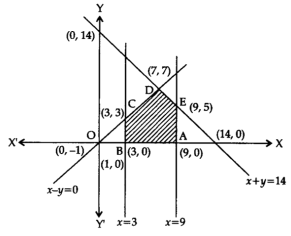
Question 101 Mark
A Linear Programming Problem is as follows:
Minimize Z = 2x + y
Subject to the constraints $x \geq 3, x \leq 9, y \geq 0$
$x-y \geq 0, x+y \leq 14$
The feasible region has
View full question & answer
Question 111 Mark
Let $A=\left|\begin{array}{ll}1 & 1 \\ 0 & 0\end{array}\right|,$ then
Answer
$A^2=\left|\begin{array}{ll}1 & 1 \\ 0 & 0\end{array}\right|\left|\begin{array}{ll}1 & 1 \\ 0 & 0\end{array}\right|$
$=\left|\begin{array}{ll}1 & 1 \\ 0 & 0\end{array}\right|$
$=A$
View full question & answer
Question 121 Mark
$\int \sec ^2(7-4 x) d x=?$
Answer
$(b) \frac{-1}{4} \tan (7-4 x)+C$
Explanation: Given integral is $\int \sec ^2(7-4 x) d x=$ ?
Let, $7-4 x = z$
$\Rightarrow-4 dx=dz$
So,
$\int \sec ^2(7-4 x) dx=?$
$=\int \sec ^2 z \frac{d z}{-4}$
$=-\frac{1}{4} \int \sec ^2 z d z$
$\int \sec ^2(7-4 x) d x \text { where } c \text { is the integrating constant. }$
$=\int \sec ^2 z \frac{d z}{-4}$
$=-\frac{1}{4} \int \sec ^2 z d z$
$=-\frac{1}{4} \tan z+c$
$=-\frac{1}{4} \tan (7-4 x)+c$
View full question & answer
Question 131 Mark
What is the degree of the differential equation $y =x \frac{d y}{d x}+\left(\frac{d y}{d x}\right)^{-1}$ ?
Answer
$(d) 2$
Explanation: Given differential equation is
$ y = x \frac{d y}{d x}+\left(\frac{d y}{d x}\right)^{-1} $
$\Rightarrow y = x \frac{d y}{d x}+\frac{1}{(d y / d x)}$
$\Rightarrow y \left(\frac{d p}{d x}\right)= x \left(\frac{d y}{d x}\right)^2+1$
$\therefore$ Degree $=$ Power of highest derivative $=2$
View full question & answer
Question 141 Mark
Consider the vectors $\vec{a}=\hat{i}-2 \hat{j}+\hat{k}$ and $b =4 \hat{i}-4 \hat{j}+7 \hat{k}$.
What is the vector perpendicular to both the vectors?
Answer
$(c) -10 \hat{i}-3 \hat{j}+4 \hat{k}$
The vector perpendicular to both the vectors $\vec{a}$ and $\vec{b}=\vec{a} \times \vec{b}$
${l}=\left|\begin{array}{ccc}\hat{i} & \hat{j} & \hat{k} \\1 & -2 & 1 \\4 & -4 & 7\end{array}\right|$
$=i(-14+4)-\hat{j}(7-4)+\hat{k}(-4+8) $
$=-10 \hat{i}-3\hat{j}+4\hat{k}$
View full question & answer
Question 151 Mark
The shortest distance between the lines $\frac{x-3}{3}=\frac{y-8}{-1}=\frac{z-3}{1}$ and $\frac{x+3}{-3}=\frac{y+7}{2}=\frac{z-6}{4}$ is
Answer
(d) $3 \sqrt{30}$
Explanation: Use formula for shortest distance between two skew lines.
View full question & answer
Question 161 Mark
If $A, B$ are square matrices of order $3, A$ is non-singular and $AB = 0$ then $B$ is a
Answer
$(b)$ null matrix
Explanation: Since $AB = 0$ Given $A$ is non$-$singular. Therefore
$A^{-1} \text { exist }$
$\text { Now, } A B=0$
$\Rightarrow A \times(A B)=0$
$\Rightarrow(A \times A) B=0$
$\Rightarrow I . B=0$
$\Rightarrow B=0$
Thus, $B$ must be null matrix.
View full question & answer
Question 171 Mark
If $f(x)=x^2 \sin \frac{1}{x}$ where $x \neq 0$ then the value of the function $f$ at $x =0$, so that the function is continuous at $x = 0 ,$ is
Answer
$(c) 0$
Explanation: We have, $f(x)=x^2 \sin \left(\frac{1}{x}\right)$, where $x \neq 0$
Since the function is continuous at $x=0$, we have$
f(0)=\lim _{x \rightarrow 0} x^2 \sin \left(\frac{1}{x}\right)
....(i)$
Now, $-1 \leq \sin \frac{1}{x} \leq 1$
$\Rightarrow-x^2 \leq x^2 \sin \frac{1}{x} \leq x^2$
$\Rightarrow \lim _{x \rightarrow 0}\left(-x^2\right) \leq \lim _{x \rightarrow 0}\left(x^2 \sin \frac{1}{x}\right) \leq \lim _{x \rightarrow 0}\left(x^2\right)$
$\Rightarrow 0 \leq \lim _{x \rightarrow 0}\left(x^2 \sin \frac{1}{x}\right) \leq 0$
Therefore by squeeze principle, we have
$f(0)=\lim _{x \rightarrow 0}\left(x^2 \sin \frac{1}{x}\right)=0$
Hence, value of the function $f$ at $x=0$
so that it is continuous at $x=0$ is $0 .$
View full question & answer
Question 181 Mark
If A is a 2-rowed square matrix and IAI = 6 then A adj A = ?
Answer
(d) $\left[\begin{array}{ll}6 & 0 \\ 0 & 6\end{array}\right]$
Explanation:  A.(adj A) = |A|I
$=6\left(\begin{array}{ll}1 & 0 \\ 0 & 1\end{array}\right)$
$=\left(\begin{array}{ll}6 & 0 \\ 0 & 6\end{array}\right)$
View full question & answer
M.C.Q (1 Marks) - MATHS STD 12 Science Questions - Vidyadip