Questions

5 Marks Questions

Take a timed test

6 questions · self-marked practice — reveal the answer and mark yourself.

Question 15 Marks
Find the perpendicular distance of the point $(1, 0, 0)$ from the line $\frac{x-1}{2}=\frac{y+1}{-3}=\frac{z+10}{8}$. Also, find the coordinates of the foot of the perpendicular and the equation of the perpendicular.
Answer
Suppose the point $(1, 0, 0)$ be $P$ and the point through which the line passes be $Q(1,-1,-10)$.
The line is parallel to the vector
$ \vec{b}=2 \hat{i}-3 \hat{j}+8 \hat{k} $
Now,
$\overrightarrow{P Q}=0 \hat{i}-\hat{j}-10 \hat{k} \\ \therefore \vec{b} \times \overrightarrow{P Q}=\left|\begin{array}{ccc}\hat{i} & \hat{j} & \hat{k} \\ 2 & -3 & 8 \\ 0 & -1 & -10\end{array}\right|$
$=38 \hat{i}+20 \hat{j}-2 \hat{k}$
$\Rightarrow|\vec{b} \times \overrightarrow{P Q}|=\sqrt{38^2+20^2+2^2}$
$=\sqrt{1444+400+4}$
$=\sqrt{1848}$
$d=\frac{\overrightarrow{\mid b} \times \overrightarrow{P Q \mid}}{|\vec{b}|}$
$=\frac{\sqrt{1848}}{\sqrt{77}}$
$=\sqrt{24}$
$=2 \sqrt{6}$
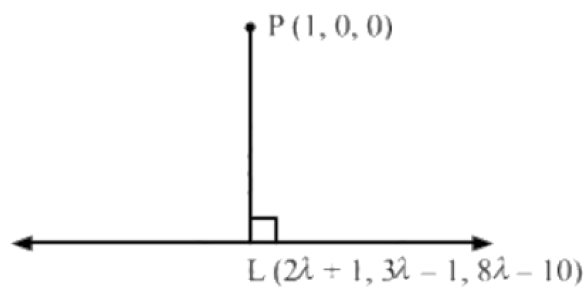
Suppose $L$ be the foot of the perpendicular drawn from the point $P(1,0,0)$ to the given line $-$
Image
The coordinates of a general point on the line
$\frac{x-1}{2}=\frac{y+1}{-3}=\frac{z+10}{8}$ are given by
$\frac{x-1}{2}=\frac{y+1}{-3}=\frac{z+10}{8}=\lambda$
$\Rightarrow x=2 \lambda+1$
$y=-3 \lambda-1$
$z=8 \lambda-10$
Suppose the coordinates of $L$ be
$(2 \lambda+1,-3 \lambda-1,8 \lambda-10)$
Since, The direction ratios of $PL$ are proportional to, $2 \lambda+1-1,-3 \lambda-1-0,8 \lambda-10-0 $
i.e., $2 \lambda,-3 \lambda-1,8 \lambda-10$
Since, The direction ratios of the given line are proportional to $2,-3,8$, but $PL$ is perpendicular to the given line.
$\therefore 2(2 \lambda)-3(-3 \lambda-1)+8(8 \lambda-10)=0$
$\Rightarrow \lambda=1$ Substituting $\lambda=1$ in $(2 \lambda+1,-3 \lambda-1,8 \lambda-10)$ we get the coordinates of $L$ as $(3,-4,-2)$.
Equation of the line $PL$ is given by
$\frac{x-1}{3-1}=\frac{y-0}{-4-0}=\frac{z-0}{-2-0}$
$=\frac{x-1}{1}=\frac{y}{-2}=\frac{z}{-1}$
$\Rightarrow \vec{r}=\hat{i}+\lambda(\hat{i}-2 \hat{j}-\hat{k})$
View full question & answer
Question 25 Marks
Let $R$ be a relation on $N \times N$ defined by $(a, b) R(c,d) \Leftrightarrow a + d = b + c$ for all $( a , b ),( c , d ) \in N \times N .$ Show tha is an equivalence relation.
Answer
Here R is a relation on $N \times N$, defined by $( a , b ) R ( c , d ) \Leftrightarrow a + d = b + c$ for all $( a , b ), c , d ) \in N \times N$ We shall show that $R$ satisfies the following properties
i. Reflexivity:
We know that $a + b = b + a$ for all $a , b \in N$.
$\therefore( a , b ) R ( a , b )$ for all $( a , b ) \in(N \times N)$
So, $R$ is reflexive.
ii. Symmetry:
Let $( a , b ) R ( c , d )$. Then,
$(a, b) R(c, d) \Rightarrow a+d=b+c$
$\Rightarrow c+b=d+a$
$\Rightarrow(c, d) R(a, b)$
$\therefore(a, b) R(c, d) \Rightarrow(c, d) R(a, b) \text { for all }(a, b),(c, d) \in N \times N$
This shows that $R$ is symmetric.
iii. Transitivity:
Let $(a, b) R (c, d)$ and $(c, d) R (e, f).$ Then,
$\text { (a, b) } R(c, d) \text { and }(c, d) R(e, f)$
$\Rightarrow a+d=b+c \text { and } c+f=d+e$
$\Rightarrow a+d+c+f=b+c+d+e$
$\Rightarrow a+f=b+e$
$\Rightarrow(a, b) R(e, f)$
Thus, $(a, b) R (c, d)$ and $(c, d) R (e, f)$
$\Rightarrow( a , b ) R ( e , f )$
This shows that $R$ is transitive.
$\therefore \ R$ is reflexive, symmetric and transitive
Hence, $R$ is an equivalence relation on $N \times N$
View full question & answer
Question 35 Marks
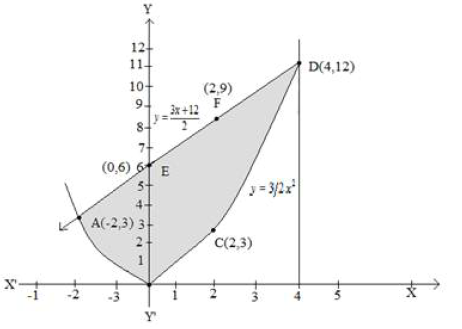
Find the area enclosed by the parabola $4 y=3 x^2$ and the line $2 y=3 x+12$.
Answer

Image
$4 y=3 x^2 ....(1)$
$2 y=3 x+12 \ldots \ldots(2)$
$\text { From }(2), y=\frac{3 x+12}{2}$
Using this value of $y$ in $(1),$ we get,
$x^2-6 x-8=0$
$\Rightarrow(x+2)(x-4)=0$
$\Rightarrow x=-2,4$
From $(2),$
When, $x = - 2 y = 3$
When, $x = 4 y = 12$
Thus, points of intersection are, $(-2, 3)$ and $(4, 12).$
$\text { Area }=\int_{-2}^4 \frac{3 x+12}{2} d x-\int_{-2}^4 \frac{3}{4} x^2 d x$
$=\frac{1}{2}\left[\frac{3 x^2}{2}+12 x\right]_{-2}^4-\frac{3}{4}\left[\frac{x^3}{3}\right]_{-2}^4$
$\frac{1}{2}[(24+48)-(6-24)]-\frac{1}{4}[64-(-8)]$
$=45-18=27 \text { sq units. }$
View full question & answer
Question 45 Marks
Solve the system of the following equations: $($Using matrices$):$
$\frac{2}{x}+\frac{3}{y}+\frac{10}{z}=4 ; \frac{4}{x}-\frac{6}{y}+\frac{5}{z}=1 ; \frac{6}{x}+\frac{9}{y}-\frac{20}{z}=2$
Answer
Put $\frac{1}{x}=u, \frac{1}{y}=v$ and $\frac{1}{z}=w$ in the given equations,
$2 u+3 v+10 w=4 ; 4 u-6 v+5 w=1 ; 6 u+9 v-20 w=2$
$\therefore$ The matrix form of given equations is $\left[\begin{array}{ccc}2 & 3 & 10 \\ 4 & -6 & 5 \\ 6 & 9 & -20\end{array}\right]\left[\begin{array}{l}x \\ v \\ z\end{array}\right]=\left[\begin{array}{l}4 \\ 1 \\ 2\end{array}\right][ AX = B ]$
Here, $A=\left[\begin{array}{ccc}2 & 3 & 10 \\ 4 & -6 & 5 \\ 6 & 9 & -20\end{array}\right], X\left[\begin{array}{l}x \\ v \\ z\end{array}\right]$ and $B=\left[\begin{array}{l}4 \\ 1 \\ 2\end{array}\right]$
$\begin{array}{l}
\therefore|A|=\left|\begin{array}{ccc}
2 & 3 & 10 \\
4 & -6 & 5 \\
6 & 9 & -20
\end{array}\right| \\
=2(120-45)-3(-80-30)+10(36+36) \\
=150+330+750=1200 \neq 0
\end{array}$
$\therefore A^{-1}$ exists and unique solution is $X=A^{-1} B \ldots.(i)$
Now $A_{11}=75, A_{12}=110, A_{13}=72$ and $A_{21}=150, A_{22}=-100, A_{23}=0$ and $A_{31}=75, A_{32}=30, A_{33}=-24$
$\therefore a d j . A=\left[\begin{array}{ccc}
75 & 110 & 72 \\
150 & -100 & 0 \\
75 & 30 & -24
\end{array}\right]^{\prime}=\left[\begin{array}{ccc}
75 & 150 & 75 \\
110 & -100 & 30 \\
72 & 0 & -24
\end{array}\right]$
And $A^{-1}=\frac{a d j . A}{|A|}=\frac{1}{1200}\left[\begin{array}{ccc}75 & 150 & 75 \\ 110 & -100 & 30 \\ 72 & 0 & -24\end{array}\right]$
$\therefore$ From eq. $(i),$
$\begin{array}{l}
{\left[\begin{array}{l}
x \\
y \\
z
\end{array}\right]=\frac{1}{1200}\left[\begin{array}{ccc}
75 & 150 & 75 \\
110 & -100 & 30 \\
72 & 0 & -24
\end{array}\right]\left[\begin{array}{l}
4 \\
1 \\
2
\end{array}\right]} \\
\Rightarrow\left[\begin{array}{l}
x \\
y \\
z
\end{array}\right]=\frac{1}{1200}\left[\begin{array}{c}
300+150+150 \\
440-100+60 \\
288+0-48
\end{array}\right]
\end{array}$
$\begin{array}{l}=\frac{1}{1200}\left[\begin{array}{l}600 \\ 400 \\ 240\end{array}\right] \\ =\left[\begin{array}{l}\frac{1}{2} \\ \frac{1}{3} \\ \frac{1}{5}\end{array}\right] \\ \therefore u=\frac{1}{2}, v=\frac{1}{3}, w=\frac{1}{5} \\ \Rightarrow x=\frac{1}{u}=2, y=\frac{1}{v}=3, z=\frac{1}{w}=5\end{array}$
View full question & answer
Question 55 Marks
Find the shortest distance between the lines $\vec{r}=(\hat{i}+2 \hat{j}+3 \hat{k})+\lambda(\hat{i}-3 \hat{j}+2 \hat{k})$ and $\vec{r}=(4 \hat{i}+5 \hat{j}+6 \hat{k})+\mu(2 \hat{i}+3 \hat{j}+\hat{k})$
Answer
$\vec{a}_1=\hat{i}+2 \hat{j}+3 \hat{k}$
$\vec{b}_1=\hat{i}-3 \hat{j}+2 \hat{k}$
$\vec{a}_2=4 \hat{i}+5 \hat{j}+6 \hat{k}$
$\vec{b}_2=2 \hat{i}+3 \hat{j}+\hat{k}$
$\vec{a}_2-\vec{a}_1=3 \hat{i}+3 \hat{j}+3 \hat{k} $
$\vec{b}_1 \times \vec{b}_2$
$=\left|\begin{array}{ccc}\ \hat{i} & \hat{j} & \hat{k} \\ 1 & -3 & 2 \\ 2 & 3 & 1 \end{array}\right|$
$=-9 \hat{i}+3 \hat{j}+9 \hat{k}$
$\therefore\left|\vec{b}_1 \times \vec{b}_2\right|
=\sqrt{(-9)^2+3^2+9^2}$
$=\sqrt{3^2} \sqrt{3^2+1+3^2}=3 \sqrt{19}$
Required shortest distance
$=\left|\frac{\left(a_2-a_1\right) \cdot\left(b_2-b_1\right)}{\left|b_1 \times b_2\right|}\right|=\left|\frac{-9 \times 3+3 \times 3+9 \times 3}{3 \sqrt{19}}\right|$
$=\left|\frac{9}{3 \sqrt{19}}\right|=\frac{3}{\sqrt{19}} $ units 
View full question & answer
Question 65 Marks
Show that the function $f : R \rightarrow R$ defined by $f(x)=\frac{x}{x^2+1}, \forall x \in R$ is neither one-one nor onto.
Answer
For $x_1, x_2 \in R$, consider
$ f\left(x_1\right)=f\left(x_2\right)$
$\Rightarrow \frac{x_1}{x_1^2+1}=\frac{x_2}{x_2^2+1}$
$\Rightarrow x_1 x_2^2+x_1=x_2 x_1^2+x_2$
$\Rightarrow x_1 x_2\left(x_2-x_1\right)=x_2-x_1$
$\Rightarrow x_1=x_2 \text { or } x_1 x_2=1 $
We note that there are point, $x_1$ and $x_2$ with $x_1 \neq x_2$ and $f\left(x_1\right)=f\left(x_2\right)$ for instance, if
we take $x_1=2$ and $x_2=\frac{1}{2}$,
then we have $f\left(x_1\right) \frac{2}{5}$ and $f\left(x_2\right)=\frac{2}{5}$ but $2 \neq \frac{1}{2}$.
Hence $f$ is not one$-$one.
Also, $f$ is not onto for if so then for $1 \in R \exists x \in R$ such that $f ( x )=$ which gives $\frac{x}{x^2+1}=1$.
But there is no such $x$ in the domain $R$, since the equation $x^2-x+1=0$ does not give any real value of $x$.
View full question & answer