Question 14 Marks
Read the following text carefully and answer the questions that follow:
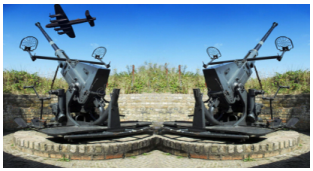
There are two antiaircraft guns, named as $A$ and $B$. The probabilities that the shell fired from them hits an airplane are $0.3$ and $0.2$ respectively. Both of them fired one shell at an airplane at the same time.
i. What is the probability that the shell fired from exactly one of them hit the plane?
ii. If it is known that the shell fired from exactly one of them hit the plane, then what is the probability that it was fired from $B$ ?
iii. What is the probability that the shell was fired from $A$ ?
OR
How many hypotheses are possible before the trial, with the guns operating independently? Write the conditions of these hypotheses.
There are two antiaircraft guns, named as $A$ and $B$. The probabilities that the shell fired from them hits an airplane are $0.3$ and $0.2$ respectively. Both of them fired one shell at an airplane at the same time.
i. What is the probability that the shell fired from exactly one of them hit the plane?
ii. If it is known that the shell fired from exactly one of them hit the plane, then what is the probability that it was fired from $B$ ?
iii. What is the probability that the shell was fired from $A$ ?
OR
How many hypotheses are possible before the trial, with the guns operating independently? Write the conditions of these hypotheses.
Answer
View full question & answer→i. Let $P$ be the event that the shell fired from $A$ hits the plane and $Q$ be the event that the shell fired from $B$ hits the plane.
The following four hypotheses are possible before the trial, with the guns operating independently:
$E _1= PQ , E _2=\bar{P} \bar{Q}, E _3=\bar{P} Q, E _4=P \bar{Q}$
Let $E = $ The shell fired from exactly one of them hits the plane.
$ P \left( E _1\right)=0.3 \times 0.2=0.06, P $
$\left( E _2\right)=0.7 \times 0.8=0.56, P$
$ \left( E _3\right)=0.7 \times 0.2=0.14, P$
$ \left( E _4\right)=0.3 \times 0.8=0.24$
$P\left(\frac{E}{E_1}\right)=0, P\left(\frac{E}{E_2}\right)=0, P\left(\frac{E}{E_3}\right)=1, P\left(\frac{E}{E_4}\right)=1$
$P ( E )= P \left( E _1\right) \cdot P\left(\frac{E}{E_1}\right)+P\left(E_2\right) \cdot P\left(\frac{E}{E_2}\right)+P\left(E_3\right) \cdot P\left(\frac{E}{E_3}\right)+P\left(E_4\right) \cdot P\left(\frac{E}{E_4}\right)$
$=0.14+0.24+=0.38$
ii. By Bayes' Theorem,
$P \left(\frac{E_3}{E}\right)=\frac{P\left(E_3\right) \cdot P\left(\frac{E}{E_3}\right)}{P\left(E_1\right) \cdot P\left(\frac{E}{E_1}\right)+P\left(E_2\right) \cdot P\left(\frac{E}{E_2}\right)+P\left(E_3\right) \cdot P\left(\frac{E}{E_3}\right)+P\left(E_4\right) \cdot P\left(\frac{E}{E_4}\right)}$
$=\frac{0.14}{0.38}=\frac{7}{19}$
$\text{NOTE}$: The four hypotheses form the partition of the sample space and it can be seen that the sum of their probabilities is $1$ .
The hypotheses $E _1$ and $E _2$ are actually eliminated as $P\left(\frac{E}{E_1}\right)=P\left(\frac{E}{E_2}\right)=0$
$iii$. By Bayes' Theorem $, P \left(\frac{E_4}{E}\right)=\frac{P\left(E_4\right) \cdot P\left(\frac{E}{E_4}\right)}{P\left(E_1\right) \cdot P\left(\frac{E}{E_1}\right)+P\left(E_2\right) \cdot P\left(\frac{E}{E_2}\right)+P\left(E_3\right) \cdot P\left(\frac{E}{E_3}\right)+P\left(E_4\right) \cdot P\left(\frac{E}{E_4}\right)}$
$=\frac{0.24}{0.38}=\frac{12}{19}$
OR
Let $P$ be the event that the shell fired from $A$ hits the plane and $Q$ be the event that the shell fired from $B$ hits the plane.
The following four hypotheses are possible before the trial, with the guns operating independently:
$E _1= PQ , E _2=\bar{P} \bar{Q}, E _3=\bar{P} Q, E _4=P \bar{Q}$
Let $E =$ The shell fired from exactly one of them hits the plane.
$P\left(E_1\right)=0.3 \times 0.2=0.06,$
$P\left(E_2\right)=0.7 \times 0.8=0.56,$
$P\left(E_3\right)=0.7 \times 0.2=0.14,$
$P\left(E_4\right)=0.3 \times 0.8=0.24$
The following four hypotheses are possible before the trial, with the guns operating independently:
$E _1= PQ , E _2=\bar{P} \bar{Q}, E _3=\bar{P} Q, E _4=P \bar{Q}$
Let $E = $ The shell fired from exactly one of them hits the plane.
$ P \left( E _1\right)=0.3 \times 0.2=0.06, P $
$\left( E _2\right)=0.7 \times 0.8=0.56, P$
$ \left( E _3\right)=0.7 \times 0.2=0.14, P$
$ \left( E _4\right)=0.3 \times 0.8=0.24$
$P\left(\frac{E}{E_1}\right)=0, P\left(\frac{E}{E_2}\right)=0, P\left(\frac{E}{E_3}\right)=1, P\left(\frac{E}{E_4}\right)=1$
$P ( E )= P \left( E _1\right) \cdot P\left(\frac{E}{E_1}\right)+P\left(E_2\right) \cdot P\left(\frac{E}{E_2}\right)+P\left(E_3\right) \cdot P\left(\frac{E}{E_3}\right)+P\left(E_4\right) \cdot P\left(\frac{E}{E_4}\right)$
$=0.14+0.24+=0.38$
ii. By Bayes' Theorem,
$P \left(\frac{E_3}{E}\right)=\frac{P\left(E_3\right) \cdot P\left(\frac{E}{E_3}\right)}{P\left(E_1\right) \cdot P\left(\frac{E}{E_1}\right)+P\left(E_2\right) \cdot P\left(\frac{E}{E_2}\right)+P\left(E_3\right) \cdot P\left(\frac{E}{E_3}\right)+P\left(E_4\right) \cdot P\left(\frac{E}{E_4}\right)}$
$=\frac{0.14}{0.38}=\frac{7}{19}$
$\text{NOTE}$: The four hypotheses form the partition of the sample space and it can be seen that the sum of their probabilities is $1$ .
The hypotheses $E _1$ and $E _2$ are actually eliminated as $P\left(\frac{E}{E_1}\right)=P\left(\frac{E}{E_2}\right)=0$
$iii$. By Bayes' Theorem $, P \left(\frac{E_4}{E}\right)=\frac{P\left(E_4\right) \cdot P\left(\frac{E}{E_4}\right)}{P\left(E_1\right) \cdot P\left(\frac{E}{E_1}\right)+P\left(E_2\right) \cdot P\left(\frac{E}{E_2}\right)+P\left(E_3\right) \cdot P\left(\frac{E}{E_3}\right)+P\left(E_4\right) \cdot P\left(\frac{E}{E_4}\right)}$
$=\frac{0.24}{0.38}=\frac{12}{19}$
OR
Let $P$ be the event that the shell fired from $A$ hits the plane and $Q$ be the event that the shell fired from $B$ hits the plane.
The following four hypotheses are possible before the trial, with the guns operating independently:
$E _1= PQ , E _2=\bar{P} \bar{Q}, E _3=\bar{P} Q, E _4=P \bar{Q}$
Let $E =$ The shell fired from exactly one of them hits the plane.
$P\left(E_1\right)=0.3 \times 0.2=0.06,$
$P\left(E_2\right)=0.7 \times 0.8=0.56,$
$P\left(E_3\right)=0.7 \times 0.2=0.14,$
$P\left(E_4\right)=0.3 \times 0.8=0.24$