Question 12 Marks
A ladder $13 \ m$ long is leaning against a vertical wall. The bottom of the ladder is dragged away from the wall along the ground at the rate of $2 \ cm/ \sec$. How fast is the height on the wall decreasing when the foot of the ladder is $5\ m$ away from the wall?
Answer
View full question & answer→Let $AB$ be the ladder length of ladder is $5\ m$
i..e $, AB = 5$
$OB$ be the wall $OA$ be the ground.
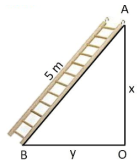
Suppose $OA = x OB = y$
Given that
The bottom of the ladder is pulled along the ground, away the wall at the rate of $2\ cm/s$
i.e., $\frac{d x}{d t}=2 \ cm / \sec ......(i)$
We need to calculate at which rate height of ladder on the wall.
Decreasing when foot of the ladder is $4 \ m$ away from the wall
i.e. we need to calculate $\frac{d y}{d t}$ when $x=4 \ cm$
Wall $OB$ is perpendicular to the ground $OA$
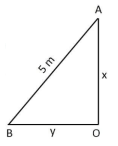
Using Pythagoras theorem, we get
$(OB)^2+(OA)^2=(AB)^2$
$y^2+x^2=(5)^2$
$y^2+x^2=24 \ldots . \text { (ii) }$
Differentiating $\text{w.r.t}$. time, we get
$\frac{d\left(y^2+x^2\right)}{d t}=\frac{d(25)}{d t}$
$\frac{d\left(y^2\right)}{d t}+\frac{d\left(x^2\right)}{d t}=0$
$\frac{d\left(y^2\right)}{d t} \times \frac{d y}{d y}+\frac{d\left(x^2\right)}{d t} \times \frac{d x}{d x}=0$
$2 y \times \frac{d y}{d t}+2 x \times \frac{d z}{d t}=0$
$2 y \times \frac{d y}{d z}+2 x \times(2)=0$
$2 y \frac{d y}{d t}+4 x=0$
$2 y \frac{d y}{d t}=-4 x$
$\frac{d y}{d t}=\frac{-4 x}{2 y}$
We need to find $\frac{d y}{d t}$ when $x =4 \ cm$
$\left.\frac{d y}{d t}\right|_{x=4}=\frac{-4 \times 4}{2 y}$
$\left.\frac{d y}{d t}\right|_{x=4}=\frac{-16}{2 y} .....(iii)$
Finding value of $y$ From $(ii)$
$x^2+y^2=25$
Putting $x = 4$
$(4)^2+y^2=25$
$y^2=9$
$y=3$
i..e $, AB = 5$
$OB$ be the wall $OA$ be the ground.
Suppose $OA = x OB = y$
Given that
The bottom of the ladder is pulled along the ground, away the wall at the rate of $2\ cm/s$
i.e., $\frac{d x}{d t}=2 \ cm / \sec ......(i)$
We need to calculate at which rate height of ladder on the wall.
Decreasing when foot of the ladder is $4 \ m$ away from the wall
i.e. we need to calculate $\frac{d y}{d t}$ when $x=4 \ cm$
Wall $OB$ is perpendicular to the ground $OA$
Using Pythagoras theorem, we get
$(OB)^2+(OA)^2=(AB)^2$
$y^2+x^2=(5)^2$
$y^2+x^2=24 \ldots . \text { (ii) }$
Differentiating $\text{w.r.t}$. time, we get
$\frac{d\left(y^2+x^2\right)}{d t}=\frac{d(25)}{d t}$
$\frac{d\left(y^2\right)}{d t}+\frac{d\left(x^2\right)}{d t}=0$
$\frac{d\left(y^2\right)}{d t} \times \frac{d y}{d y}+\frac{d\left(x^2\right)}{d t} \times \frac{d x}{d x}=0$
$2 y \times \frac{d y}{d t}+2 x \times \frac{d z}{d t}=0$
$2 y \times \frac{d y}{d z}+2 x \times(2)=0$
$2 y \frac{d y}{d t}+4 x=0$
$2 y \frac{d y}{d t}=-4 x$
$\frac{d y}{d t}=\frac{-4 x}{2 y}$
We need to find $\frac{d y}{d t}$ when $x =4 \ cm$
$\left.\frac{d y}{d t}\right|_{x=4}=\frac{-4 \times 4}{2 y}$
$\left.\frac{d y}{d t}\right|_{x=4}=\frac{-16}{2 y} .....(iii)$
Finding value of $y$ From $(ii)$
$x^2+y^2=25$
Putting $x = 4$
$(4)^2+y^2=25$
$y^2=9$
$y=3$