Question 14 Marks
Read the following text carefully and answer the questions that follow:
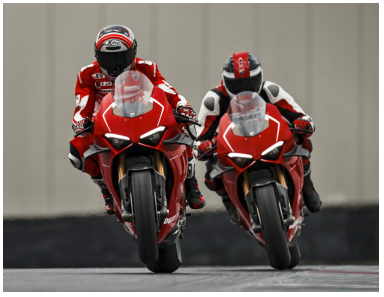
Two motorcycles $A$ and $B$ are running at the speed more than allowed speed on the road along the lines
$\vec{r}=\lambda(\hat{i}+2 \hat{j}-\hat{k})$ and $\vec{r}=3 \hat{i}+3 \hat{j}+\mu(2 \hat{i}+\hat{j}+\hat{k})$, respectively.
$i.$ Find the cartesian equation of the line along which motorcycle $A$ is running.$ (1)$
$ii.$ Find the direction cosines of line along which motorcycle $A$ is running. $(1)$
$iii.$ Find the direction ratios of line along which motorcycle $B$ is running. $(2)$
$OR$
Find the shortest distance between the given lines. $(2)$
Two motorcycles $A$ and $B$ are running at the speed more than allowed speed on the road along the lines
$\vec{r}=\lambda(\hat{i}+2 \hat{j}-\hat{k})$ and $\vec{r}=3 \hat{i}+3 \hat{j}+\mu(2 \hat{i}+\hat{j}+\hat{k})$, respectively.
$i.$ Find the cartesian equation of the line along which motorcycle $A$ is running.$ (1)$
$ii.$ Find the direction cosines of line along which motorcycle $A$ is running. $(1)$
$iii.$ Find the direction ratios of line along which motorcycle $B$ is running. $(2)$
$OR$
Find the shortest distance between the given lines. $(2)$
Answer
View full question & answer→$i.$ The line along which motorcycle $A$ is running, $\vec{r}=\lambda(\hat{i}+2 \hat{j}-\hat{k})$,
which can be rewritten as
$(x \hat{i}+y \hat{j}+z \hat{k})=\lambda \hat{i}+2 \lambda \hat{j}-\lambda \hat{k} $
$ \Rightarrow x =\lambda, y =2 \lambda, z =-\lambda $
$\Rightarrow \frac{x}{1}=\lambda, \frac{y}{2}=\lambda, \frac{z}{-1}=\lambda$
$ii.$ Clearly, $D.R.'s$ of the required line are $<1,2,-1\rangle$
$\therefore D.C.$'s are
$\begin{array}{l}\left(\frac{1}{\sqrt{1^2+2^2+(-1)^2}}, \frac{2}{\sqrt{1^2+2^2+(-1)^2}}, \frac{-1}{\sqrt{1^2+2^2+(-1)^2}}\right) \\ \text { i.e., }\left(\frac{1}{\sqrt{6}}, \frac{2}{\sqrt{6}}, \frac{-1}{\sqrt{6}}\right)\end{array}$
$iii.$ The line along which motorcycle $B$ is running, is $\vec{r}=(3 \hat{i}+3 \hat{j})+\mu(2 \hat{i}+\hat{j}+\hat{k})$, which is parallel to the vector $2 \hat{i}+\hat{j}+\hat{k}$
$\therefore D.R.'s$ of the required line are $(2,1,1)$.
$OR$
$\begin{array}{l}\text { Here, } \vec{a}_1=0 \hat{i}+0 \hat{j}+0 \hat{k}, \vec{a}_2=3 \hat{i}+3 \hat{j}, \vec{b}_1=\hat{i}+2 \hat{j}-\hat{k}, \vec{b}_2=2 \hat{i}+\hat{j}+\hat{k}\end{array}$
$ \therefore \vec{a}_2-\vec{a}_1=3 \hat{i}+3 \hat{j}$
and
$\vec{b}_1 \times \vec{b}_2=\left|\begin{array}{ccc}\hat{i} & \hat{j} & \hat{k} \\ 1 & 2 & -1 \\ 2 & 1 & 1\end{array}\right|=3 \hat{i}-3 \hat{j}-3 \hat{k}$
Now,
$\left(\vec{a}_2-\vec{a}_1\right) \cdot\left(\vec{b}_1 \times \vec{b}_2\right)=(3 \hat{i}+3 \hat{j}) \cdot(3 \hat{i}-3 \hat{j}-3 \hat{k})$
$=9-9$
$=0$
Hence, shortest distance between the given lines is $0 .$
which can be rewritten as
$(x \hat{i}+y \hat{j}+z \hat{k})=\lambda \hat{i}+2 \lambda \hat{j}-\lambda \hat{k} $
$ \Rightarrow x =\lambda, y =2 \lambda, z =-\lambda $
$\Rightarrow \frac{x}{1}=\lambda, \frac{y}{2}=\lambda, \frac{z}{-1}=\lambda$
$ii.$ Clearly, $D.R.'s$ of the required line are $<1,2,-1\rangle$
$\therefore D.C.$'s are
$\begin{array}{l}\left(\frac{1}{\sqrt{1^2+2^2+(-1)^2}}, \frac{2}{\sqrt{1^2+2^2+(-1)^2}}, \frac{-1}{\sqrt{1^2+2^2+(-1)^2}}\right) \\ \text { i.e., }\left(\frac{1}{\sqrt{6}}, \frac{2}{\sqrt{6}}, \frac{-1}{\sqrt{6}}\right)\end{array}$
$iii.$ The line along which motorcycle $B$ is running, is $\vec{r}=(3 \hat{i}+3 \hat{j})+\mu(2 \hat{i}+\hat{j}+\hat{k})$, which is parallel to the vector $2 \hat{i}+\hat{j}+\hat{k}$
$\therefore D.R.'s$ of the required line are $(2,1,1)$.
$OR$
$\begin{array}{l}\text { Here, } \vec{a}_1=0 \hat{i}+0 \hat{j}+0 \hat{k}, \vec{a}_2=3 \hat{i}+3 \hat{j}, \vec{b}_1=\hat{i}+2 \hat{j}-\hat{k}, \vec{b}_2=2 \hat{i}+\hat{j}+\hat{k}\end{array}$
$ \therefore \vec{a}_2-\vec{a}_1=3 \hat{i}+3 \hat{j}$
and
$\vec{b}_1 \times \vec{b}_2=\left|\begin{array}{ccc}\hat{i} & \hat{j} & \hat{k} \\ 1 & 2 & -1 \\ 2 & 1 & 1\end{array}\right|=3 \hat{i}-3 \hat{j}-3 \hat{k}$
Now,
$\left(\vec{a}_2-\vec{a}_1\right) \cdot\left(\vec{b}_1 \times \vec{b}_2\right)=(3 \hat{i}+3 \hat{j}) \cdot(3 \hat{i}-3 \hat{j}-3 \hat{k})$
$=9-9$
$=0$
Hence, shortest distance between the given lines is $0 .$