Questions

2 Marks Questions

Take a timed test

7 questions · self-marked practice — reveal the answer and mark yourself.

Question 12 Marks
Prove that the determinant $\left|\begin{array}{ccc}x & \sin \theta & \cos \theta \\ -\sin \theta & -x & 1 \\ \cos \theta & 1 & x\end{array}\right|$ is independent of $\theta.$
Answer
Let $\Delta=\left[\begin{array}{ccc}x & \sin \theta & \cos \theta \\ -\sin \theta & -x & 1 \\ \cos \theta & 1 & x\end{array}\right]$
Expanding along first row, $\Delta=x\left|\begin{array}{cc}-x & 1 \\ 1 & x\end{array}\right|-\sin \theta\left|\begin{array}{cc}-\sin \theta & 1 \\ \cos \theta & x\end{array}\right|+\cos \theta\left|\begin{array}{cc}-\sin \theta & -x \\ \cos \theta & 1\end{array}\right|$,
$\Rightarrow \Delta=x\left(-x^2-1\right)-\sin \theta(-x \sin \theta-\cos \theta)+\cos \theta(-\sin \theta+x \cos \theta)$
$\Rightarrow \Delta=-x^3-x+x \sin ^2 \theta+\sin \theta \cos \theta-\sin \theta \cos \theta+x \cos ^2 \theta$
$\Rightarrow \Delta=-x^3-x+x\left(\sin ^2 \theta+\cos ^2 \theta\right)=- x ^3- x + x =- x ^3$
which is independent of $ \theta$
View full question & answer
Question 22 Marks
For the principal value, evaluate $\cot \left[\sin ^{-1}\left\{\cos \left(\tan ^{-1} 1\right)\right\}\right]$
Answer
We know that $\tan ^{-1} 1=\frac{\pi}{4}$
$\therefore \cot \left[\sin ^{-1}\left\{\cos \left(\tan ^{-1} 1\right)\right\}\right]$
$=\cot \left\{\sin ^{-1}\left(\cos \frac{\pi}{4}\right)\right\}$
$=\cot \left(\sin ^{-1} \frac{1}{\sqrt{2}}\right)$
$=\cot \frac{\pi}{4}=1$
View full question & answer
Question 32 Marks
Evaluate: $\int \tan ^3 x \sec ^3 x d x$
Answer
Let $I=\int \tan ^3 x \sec ^3 x d x$, then we have
$I=\int \tan ^2 x \sec ^2 x(\sec x \tan x) d x=\int\left(\sec ^2 x-1\right) \sec ^2 x(\sec x \tan x) d x$
Substituting sec x = t and sec x tan x dx = dt, we obtain
$I =\int\left( t ^2-1\right) t ^2 dt =\int\left( t ^4- t ^2\right) dt =\frac{t^5}{5}-\frac{t^3}{3}+C=\frac{1}{5} \sec ^5 x-\frac{1}{3} \sec ^3 x+C$
View full question & answer
Question 42 Marks
Show that the function $f(x)=x^{100}+\sin x-1$ is increasing on the interval $\left(\frac{\pi}{2}, \pi\right)$
Answer
Given interval : $x \in(\pi / 2, \pi)$
$\Rightarrow \pi / 2 < x<\pi$
$x^{99}>1$
$100 x^{99}>100$
Again, $x \in(\pi / 2, \pi) \Rightarrow-1<\cos x<0$
$ \Rightarrow 0>\cos x>-1$
$100 x^{99}>100 \text { and } \cos x>-1$
$100 x^{99}+\cos x>100-1=99$
$100 x^{99}+\cos x>0$
$f^{\prime}(x)>0$
Thus $f(x)$ is increasing on $(\pi / 2, \pi)$
View full question & answer
Question 52 Marks
A stone is dropped into a quiet lake and waves move in circles at a speed of 4 cm/s. At the instant, when the radius of the circular wave is 10 cm, how fast is the enclosed area increasing?
Answer
Let A be the area of the circle of radius r.
Then, $A =\pi r^2$
Therefore, the rate of change of area A with respect to time 't' is
$\frac{d A }{d t}=\frac{d}{d t}\left(\pi r^2\right)=\frac{d}{d r}\left(\pi r^2\right) \cdot \frac{d r}{d t}=2 \pi r \frac{d r}{d t}$...(By Chain Rule)
Given that $\frac{d r}{d t}=4 cm / s$
Therefore, when $r =10, \frac{d A}{d t}=2 \pi \times 10 \times 4=80 \pi$
Thus, the enclosed area is increasing at a rate of $80 \pi cm^2 / s$, when $r =10 cm$.
View full question & answer
Question 62 Marks
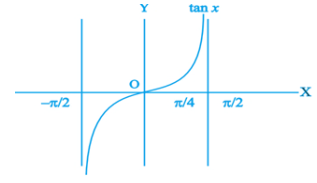
Which is greater$, \tan 1$ or $\tan ^{-1} 1 ?$
Answer
From Fig. we note that $\tan x$ is an increasing function in the interval $1\left(\frac{-\pi}{2}, \frac{\pi}{2}\right)$, since $1;\frac{\pi}{4}$ $\Rightarrow \tan 1;\tan \frac{\pi}{4}$. This gives
$\tan 1;1$
$\Rightarrow \tan 1;1;\frac{\pi}{4}$
$\Rightarrow \tan 1;1;\tan ^{-1}(1)$
Image
View full question & answer
Question 72 Marks
Show that $f(x)=\sin x-\cos x$ is an increasing function on $\left(\frac{-\pi}{4}, \frac{\pi}{4}\right)$.
Answer
Given : $f(x) = \sin x - \cos x$
$f (x) = \cos x + \sin x$
$=\sqrt{2}\left(\frac{1}{\sqrt{2}} \cos x+\frac{1}{\sqrt{2}} \sin x\right)$
$=\sqrt{2}\left(\frac{\sin \pi}{4} \cos x+\frac{\cos \pi}{4} \sin x\right)$
$=\sqrt{2} \sin \left(\frac{\pi}{4}+x\right)$
Now,
$x \in\left(-\frac{\pi}{4}, \frac{\pi}{4}\right)$
$\Rightarrow-\frac{\pi}{4}< x < \frac{\pi}{4}$
$\Rightarrow 0 < \frac{\pi}{4}+x < \frac{\pi}{2}$
$\Rightarrow \sin 0^{\circ}<\sin \left(\frac{\pi}{4}+x\right)<\sin \frac{\pi}{2}$
$\Rightarrow 0<\sin \left(\frac{\pi}{4}+x\right)<1$
$\Rightarrow \sqrt{2} \sin \left(\frac{\pi}{4}+x\right);0$
$=f^{\prime}(x);0$
Hence $, f(x)$ is an increasing function on $\left(\frac{-\pi}{4}, \frac{\pi}{4}\right)$
View full question & answer
2 Marks Questions - MATHS STD 12 Science Questions - Vidyadip