Questions

2 Marks Questions

Take a timed test

7 questions · self-marked practice — reveal the answer and mark yourself.

Question 12 Marks
Show that $f(x)=\cos \left(2 x+\frac{\pi}{4}\right)$ is an increasing function on $\left(\frac{3 \pi}{8}, \frac{7 \pi}{8}\right)$
Answer
Given: $f(x)=\cos \left(2 x+\frac{\pi}{4}\right)$
$f^{\prime}(x)=-2 \sin \left(2 x+\frac{\pi}{4}\right)$
Now,
$x \in\left(\frac{3 \pi}{8}, \frac{7 \pi}{8}\right)$
$\Rightarrow \quad \frac{3 \pi}{4}<2 x<\frac{7 \pi}{4}$
$\Rightarrow \quad \frac{\pi}{4}+\frac{3 \pi}{4}<2 x+\frac{\pi}{4}<\frac{7 \pi}{4}+\frac{\pi}{4}$
$\Rightarrow \quad \pi<2 x+\frac{\pi}{4}<2 \pi$
$\Rightarrow \quad \sin \left(2 x+\frac{\pi}{4}\right)<0$
$\Rightarrow \quad-2 \sin \left(2 x+\frac{\pi}{4}\right)>0$
$\Rightarrow \quad f^{\prime}(x)>0$
Hence, $f(x)$ is increasing on $\left(\frac{3 \pi}{8}, \frac{7 \pi}{8}\right)$
View full question & answer
Question 22 Marks
The volume of a cube is increasing at the rate of $7 \ cm^3 / sec$. How fast is its surface area increasing at the instant when the length of an edge of the cube is $12 \ cm$ ?
Answer
At any instant t, let the length of each edge of the cube be $x, V$ be its volume and $S$ be its surface area.
Then,
$\frac{d V}{d t}=7 \ cm^3 / \sec \ldots$ given $(i)$
Now, $V = x ^3 $
$\Rightarrow \frac{d V}{d t}=\frac{d V}{d x} \cdot \frac{d x}{d t}$
$\Rightarrow 7=\frac{d}{d x}\left(x^3\right) \cdot \frac{d x}{d t} \ldots . .$
$\left[\because V = x ^3\right]$
$\Rightarrow 3 x^2 \cdot \frac{d x}{d t}=7$
$\Rightarrow \frac{d x}{d t}=\frac{7}{3 x^2}$
$\therefore S =6 x ^2 $
$\Rightarrow \frac{d S}{d t}=\frac{d S}{d x} \cdot \frac{d x}{d t}$
$=\frac{d}{d x}\left(6 x^2\right) \cdot \frac{7}{3 x^2}$
$=\left(12 x \times \frac{7}{3 x^2}\right)=\frac{28}{x}$
$\Rightarrow\left[\frac{d S}{d t}\right]_{x=12}=\left(\frac{28}{12}\right) \ cm ^2 / \sec $
$=2 \frac{1}{3} \ cm^2 / \sec $
Hence, the surface area of the cube is increasing at the rate of $2 \frac{1}{3} \ cm^2 / \sec$ at the instant when its edge is $12 \ cm$ .
View full question & answer
Question 32 Marks
Find the maximum and minimum values of $2 x^3-24 x+107$ on the interval $[-3,3]$.
Answer
We have maximum value is $139$ at $x = - 2$ and minimum value is $89$ at $x = 3$
$\text { Also } F^{\prime}(x)=6 x^2-24=0$
$6\left(x^2-4\right)=0$
$6\left(x^2-2^2\right)=0$
$6(x-2)(x+2)=0$
$x=2,-2$
Now, we shall evaluate the value of $f$ at these points and the end points
$F(2)=2(2)^3-24(2)+107=75$
$F(-2)=2(-2)^3-24(-2)+107=139$
$F(-3)=2(-3)^3-24(-3)+107=125$
$F(3)=2(3)^3-24(3)+107=89$
View full question & answer
Question 42 Marks
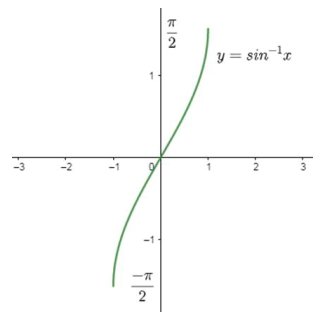
Write the interval for the principal value of function and draw its graph: $\sin ^{-1} X$…
Answer
Principal value branch of $\sin ^1 x$ is $\left[-\frac{\pi}{2}, \frac{\pi}{2}\right]$
And its graph is given here

Image
View full question & answer
Question 52 Marks
Using the principal values, write the value of $\cos ^{-1}\left(\frac{1}{2}\right)+2 \sin ^{-1}\left(\frac{1}{2}\right)$.
Answer
We have, $\cos ^{-1}\left(\frac{1}{2}\right)=\cos ^{-1}\left(\cos \frac{\pi}{3}\right)$
$=\frac{\pi}{3}\left[\because \frac{\pi}{3} \in[0, \pi]\right]$
Also $\sin ^{-1}\left(-\frac{1}{2}\right)=\sin ^{-1}\left(-\sin \frac{\pi}{6}\right)$
$=\sin ^{-1}\left(\sin \left(-\frac{\pi}{6}\right)\right)$
$=-\frac{\pi}{6}\left[\because-\frac{\pi}{6} \in\left[-\frac{\pi}{2}, \frac{\pi}{2}\right]\right]$
$\therefore \cos ^{-1}\left(\frac{1}{2}\right)-2 \sin ^{-1}\left(-\frac{1}{2}\right)=\frac{\pi}{3}-2\left(-\frac{\pi}{6}\right)$
$=\frac{\pi}{3}+\frac{\pi}{3}=\frac{2 \pi}{3}$]
View full question & answer
Question 62 Marks
Show that the function $f(x)=\frac{x}{3}+\frac{3}{x}$ decreases in the intervals $(-3,0) \cup(0,3)$.
Answer
$f(x)=\frac{1}{3}-\frac{3}{x^2}$
for decreasing $f^{\prime}(x)<0 \Rightarrow \frac{1}{3}-\frac{3}{x^2}<0$
$\Rightarrow x^2$ < 9 $\Rightarrow$ -3 < x < 3
since, f(x) is not defined at x = 0
so $f(x)$ decreasing in $(-3,0) \cup(0,3)$
View full question & answer
Question 72 Marks
Evaluate: $\int \frac{(3 x+5)}{\left(x^3-x^2-x+1\right)} d x$
Answer
Let $I =\int \frac{(3 x+5)}{\left(x^3-x^2-x+1\right)} d x$
where $\left(x^3-x^2-x+1\right)=x^2(x-1)-(x-1)=(x-1)\left(x^2-1\right)=(x-1)^2(x+1)$
Now let $\frac{3 x+5}{\left(x^3-x^2-x+1\right)}=\frac{3 x+5}{(x-1)^2(x+1)}=\frac{A}{(x-1)}+\frac{B}{(x-1)^2}+\frac{C}{(x+1)}$
$\Rightarrow(3 x +5)= A ( x -1)( x +1)+ B ( x +1)+ C ( x -1)^2$
Putting $x=1$ on both sides of (i), we get $B=4$
Putting $x=-1$ on both sides of (i), we get $C=\frac{1}{2}$
Comparing the coefficient of $x^2$ on both sides of ( $i$ ), we get
$A+C=0 \Rightarrow A=-C=\frac{-1}{2}$
$\therefore \frac{(3 x+5)}{\left(x^3-x^2-x+1\right)}=\frac{-1}{2(x-1)}+\frac{4}{(x-1)^2}+\frac{1}{2(x+1)}$
$\Rightarrow I=\int \frac{(3 x+5)}{\left(x^3-x^2-x+1\right)} d x=-\frac{1}{2} \int \frac{d x}{(x-1)}+4 \int \frac{d x}{(x-1)^2}+\frac{1}{2} \int \frac{d x}{(x+1)}$
$=-\frac{1}{2} \log |x-1|-\frac{4}{(x-1)}+\frac{1}{2} \log |x+1|+C$
View full question & answer
2 Marks Questions - MATHS STD 12 Science Questions - Vidyadip