Questions

3 Marks Question

Take a timed test

9 questions · self-marked practice — reveal the answer and mark yourself.

Question 13 Marks
Evaluate : $\int \frac{x+2}{\sqrt{x^2+2 x+3}}$
Answer
Let $I =\int \frac{x+2}{\sqrt{x^2+2 x+3}}$
$x +2=A \frac{d}{d z}\left[ x ^2+2 x +3\right]+ B$
$\Rightarrow x +2=2 Ax +2 A+ B$
Comparing the coefficients, we have $, 2A = 1$ and $2A + B = 2$
$\Rightarrow A =\frac{1}{2}$
Substituting the value of $A$ in $2 A+B=2$, we have, $2 \times \frac{1}{2}+B=2$
$\Rightarrow 1+B=2$
$\Rightarrow B=2-1$
$\Rightarrow B=1$
Thus we have, $x +2=\frac{1}{2}[2 x+2]+1$
Hence, using values of $A,$ and $B,$ we have
$I=\int \frac{x+2}{\sqrt{x^2+2 x+3}} d x$
$\left.=\int \frac{\left[\frac{1}{2}[2 x+2]+1\right]}{\sqrt{x^2+2 x+3}}\right] d x$
$=\int \frac{\left[\frac{1}{2}[2 x+2]\right]}{\sqrt{x^2+2 x+3}} d x+\int \frac{d x}{\sqrt{x^2+2 x+3}}$
$=\frac{1}{2} \int \frac{[2 x+2]}{\sqrt{x^2+2 x+3}} d x+\int \frac{d x}{\sqrt{x^2+2 x+3}}$
Substituting $t = x ^2+2 x +3$ and $dt =2 x +2$
in the first integrand, we have, $I =\frac{1}{2} \int \frac{d t}{\sqrt{t}}+\int \frac{d x}{\sqrt{x^2+2 x+3}}$
$=\frac{1}{2} \times 2 \sqrt{t}+\int \frac{d x}{\sqrt{x^2+2 x+1+2}}+C$
$=\sqrt{t}+\int \frac{d x}{\sqrt{(x+1)^2+(\sqrt{2})^2}}+c$
$ I =\sqrt{x^2+2 x+3}+\log \left[| x +1|+\sqrt{(x+1)^2+(\sqrt{2})^2}\right]+C$
$\Rightarrow I =\sqrt{x^2+2 x+3}+\log \left[| x +1| \sqrt{x^2+2 x+3}\right]+ c $
View full question & answer
Question 23 Marks
If $x=a \sin 2 t(1+\cos 2 t)$ and $y=b \cos 2 t(1-\cos 2 t)$, then find $\frac{d y}{d x}$ at $t=\frac{\pi}{4}$.
Answer
We know that, $x=a \sin 2 t(1+\cos 2 t)$ and $y=b \cos 2 t(1-\cos 2 t)$
$\Rightarrow \frac{d y}{d t}= a [-2 \sin 2 t \sin 2 t +2 \cos 2 t (1+\cos 2 t )] \ldots$ (I)
and $\frac{d x}{d t}= b [2 \sin 2 t \cos 2 t -2 \sin 2 t (1-\cos 2 t )] \ldots( ii )$
$\therefore \frac{d y}{d x}=\frac{d y}{d t} \times \frac{d t}{d x}=\frac{b[2 \sin 2 t \cos 2 t-2 \sin 2 t(1-\cos 2 t)]}{a\left[-2 \sin ^2 2 t+2 \cos 2 t(1+\cos 2 t)\right]}$. [Using (i) and (ii)]
$\left.\Rightarrow \frac{d y}{d x}\right]_{\text {at } t=\pi / 4}=\frac{b\left[2 \sin \frac{\pi}{2} \cos \frac{\pi}{2}-2 \sin \frac{\pi}{2}\left(1-\cos \frac{\pi}{2}\right)\right]}{a\left[-2 \sin ^2\left(\frac{\pi}{2}\right)+2 \cos \frac{\pi}{2}\left(1+\cos \frac{\pi}{2}\right)\right]}=\frac{b}{a} \cdot \frac{(0-1)}{(-1-0)}=\frac{b}{a}$

View full question & answer
Question 33 Marks
Solve the following $\ce{LPP}$ by graphical method:
Minimize $Z = 20x + 10y$
Subject to
$x+2 y \leq 40$
$3 x+y \geq 30$
$4 x+3 y \geq 60$
and $x, y \geq 0$
Answer
Converting the given inequations into equations, we obtain the following equations:
$x+2 y=40,$
$3 x+y=30,$
$4 x+3 y=60,$
$x=0$ and $y=0$
Region represented by $x+2 y \leq 40 :$
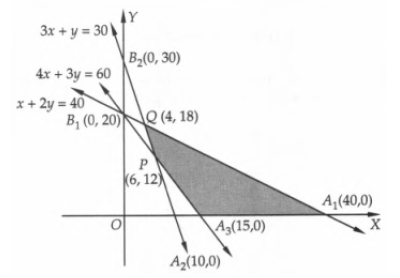
The line $x+2 y=40$ meets the coordinate axes at $A_1(40,0)$ and $B_1(0,20)$ respectively.
Join these points to obtain the line $x+2 y=40$
Clearly, $(0,0)$ satisfies the inequation $x+2 y \leq 40$.
So, the region in $x y-$plane that contains the origin represents the solution set of the given inequation.
Region represented by $3 x+y \geq 30 :$
The line $3 x+y=30$ meets $x$ and $y$ axes at $A_2(10,0)$ and $B_2(0,30)$ respectively.
Join these points to obtain this line.
We find that the point $O(0,0)$ does not satisfy the inequation $3 x+y \geq 30$.
So, that region in $xy-$plane which does not contain the origin is the solution set of this inequation.
Region represented by $x \geq 0, y \geq 0 :$
Clearly, the region represented by the non$-$negativity restrictions $x \geq 0$ and $y \geq 0$ is the first quadrant in $xy-$plane.
The shaded region $\ce{A _3 A_1 QP}$ in a figure represents the common region of the regions represented by the above inequations.
This region represents the feasible region of the given $\text{LPP.}$
Image
The coordinates of the corner points of the shaded feasible region are $A_3(15,0), A_1(40,0), Q(4,18)$ and $P(6,12)$ These points
have been obtained by solving the equations of the corresponding intersecting lines, simultaneously.
The values of the objective function at these points are given in the following table:
Point $(x, y)$ Value of the objective function $z = 20x + 10y$
$A_3(15, 0)$ $Z = 20 x 15 + 10 x 0 = 300$
$A_1(40, 0)$ $Z = 20 x 40 + 10 x 0 = 800$
$P(6,12)$ $Z = 20 x 4 + 0 x 18 = 260$
$P(6,12)$ $Z = 20 x 6 + 10 x 12 = 240$
Out of these values of $Z,$ the minimum value is $240$ which is attained at point $P (6,12).$
Hence, $x = 6 y = 12$ the optimal solution of the given $\text{LPP}$ and the optimal value of $Z$ is $240.$
View full question & answer
Question 43 Marks
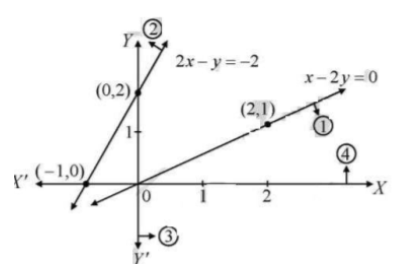
Show that the solution set of the linear constraints is empty $x-2 y \geq 0,2 x-y \leq-2, x \geq 0$ and $y \geq 0$
Answer
Here, it is given that the equations
$x-2 y \geq 0 \ldots \ldots \text { (i) }$
$2 x-y \leq-2 \ldots \ldots . \text { (ii) }$
$x \geq 0 \ldots(iii)$
$y \geq 0 \ldots . .(iv)$
and $x=2 $
$\Rightarrow 2-2 y=0=y=1$
$(0,0)$ and $(2,1)$ are on the line $(v)$
$(0,1)$ is not on this line and it lies in the half
plane of $(i)$ which is not true The line corresponding to $(ii)$ is
$2 x-y=-2 \ldots \ldots( vi )$
on the line $(vi)$ put $x=0$
$ \Rightarrow 0-y=-2$
$\Rightarrow y=2$
and $y =0$
$ \Rightarrow 2 x-0=-2$
$ \Rightarrow x=-1$
The inequation $x > 0$ represents the closed half-plane on the right of the y-axis.
The inequation $y > 0$ represent the closed half-plane above the x-axis
The graph of the given system is the intersection of half-planes of the inequation
The intersection of half-planes is empty
The solution set of the given inequation is empty. This is the required solution
Image
View full question & answer
Question 53 Marks
Find the particular solution of the differential equation $\left(1+ y ^2\right)+\left( x -e^{\tan ^{-1} y}\right) \frac{d y}{d x}=0$ given that y = 0 when x =1
Answer
Given differential equation can be written as
$\frac{d x}{d y}+\frac{x}{1+y^2}=\frac{e^{\tan ^{-1} y}}{1+y^2}$
L.F $=e^{\int \frac{d y}{1+y^2}}=e^{\tan ^{-1} y}$
Solution is given by
$x e^{\tan ^{-1} y}=\int \frac{e^{\tan ^{-1} y}}{1+y^2} \times e^{\tan ^{-1} y} d y=\int \frac{e^{2 \tan ^{-1} y}}{1+y^2} d y$
or $x e^{\tan ^{-1} y}=\frac{e^{2 \tan ^{-1} y}}{2}+ c$
when $x =1, y =0$ or $c =\frac{1}{2}$
$\therefore$ Solution is given by $x e^{\tan ^{-1} y}=\frac{1}{2} e^{2 \tan ^{-1} y}+\frac{1}{2}$
or $x=\frac{1}{2}\left(e^{\tan -1} y+e^{-\tan ^{-1} y}\right)$
View full question & answer
Question 63 Marks
Solve: $\frac{d y}{d x}+\frac{y}{x}=\cos x +\frac{\sin x}{x}$
Answer
We have,
$\frac{d y}{d x}+\left(\frac{1}{x}\right) y=\cos x+\frac{\sin x}{x} \ldots$
This is a linear differential equation of the form
$\frac{d y}{d x}+ Py = Q$, where $P =\frac{1}{x}$ and $Q =\cos x +\frac{\sin x}{x}$
$\therefore$ I. $F=e^{\int P d x}=e^{\int \frac{1}{x} d x}=e^{\log x}=x$
Multiplying both sides of $(i)$ by $I.F. = x,$ we get
$x \frac{d y}{d x}+y=x \cos x+\sin x$
Integrating both sides with respect to $x,$ we get
$y x=\int(x \cos x+\sin x) d x+C\left[\right.$ Using: $y=( I.F. )=\int Q( I.F. \left.) d x+C\right]$
$\Rightarrow xy =\int \underset{I}{x} \cos xdx +\int \sin x dx + C$
$\Rightarrow x y=x \sin x-\int \sin x d x+\int \sin x d x+C\ [$Integrating $1^{st}$ integral by parts$]$
$\Rightarrow x y=x \sin x+C$
$\Rightarrow y=\sin x+\frac{C}{x}$
View full question & answer
Question 73 Marks
Find $\int \frac{\sqrt{x}}{\sqrt{a^3-x^3}} d x$.
Answer
Given $I=\int \frac{\sqrt{x}}{\sqrt{a^3-x^3}} d x=\int \frac{\sqrt{x}}{\sqrt{\left(a^{3 / 2}\right)^2-\left(x^{3 / 2}\right)^2}} d x$
$\text { Let, } x^{3 / 2}=a^{3 / 2} t$
$\Rightarrow \frac{3}{2} x^{1 / 2} d x=a^{3 / 2} d t$
$\Rightarrow \sqrt{x} d x=\frac{2}{3} a^{3 / 2} d t$
$\therefore I=\int \frac{\frac{2}{3} a^{3 / 2}}{\sqrt{\left(a^{3 / 2}\right)^2-\left(a^{3 / 2} t\right)^2}} d t$
$=\frac{2}{3} a^{3 / 2} \int \frac{d t}{a^{3 / 2} \sqrt{1-t^2}}$
$=\frac{2}{3} \int \frac{d t}{\sqrt{1-t^2}}=\frac{2}{3} \sin ^{-1}\left(\frac{t}{1}\right)+C$
$\left[\because \int \frac{d x}{a^2-x^2}=\sin ^{-1}\left(\frac{x}{a}\right)+c\right]$
$=\frac{2}{3} \sin ^{-1}\left(\frac{x^{3 / 2}}{a^{3 / 2}}\right)+C \quad\left[\text { put } t=\frac{x^{3 / 2}}{a^{3 / 2}}\right]$
$=\frac{2}{3} \sin ^{-1}\left(\sqrt{\frac{x^3}{a^3}}\right)+C$
View full question & answer
Question 83 Marks
Evaluate: $\int_0^{1 / \sqrt{2}} \frac{\sin ^{-1} x}{\left(1-x^2\right)^{3 / 2}} d x$
Answer
Let $\sin ^{-1} x=\theta$ or, $x=\sin \theta$. Then, $d x=d(\sin \theta)=\cos \theta d \theta$
Now, $ x=0$
$\Rightarrow \sin \theta=0$
$\Rightarrow \theta=0$ and $x=\frac{1}{\sqrt{2}}$
$\Rightarrow \sin \theta=\frac{1}{\sqrt{2}} $$\Rightarrow \theta=\frac{\pi}{4}$
$\therefore I=\int_0^{1 / \sqrt{2}} \frac{\sin ^{-1} x}{\left(1-x^2\right)^{3 / 2}} d x$
$\Rightarrow I=\int_0^{\pi / 4} \frac{\theta}{\cos ^3 \theta} \cos \theta d \theta=\int_0^{\pi / 4} \theta \sec ^2 \theta d \theta$
Now using integratio by parts.
$\Rightarrow I=\left[\theta \tan \theta\right]_0^{\pi / 4}+[\log \cos \theta]_0^{\pi / 4}=\frac{\pi}{4}+\left\{\log \left(\frac{1}{\sqrt{2}}\right)-\log 1\right\}=\frac{\pi}{4}-\frac{1}{2} \log 2$
View full question & answer
Question 93 Marks
Bag $I$ contains $3$ white and $4$ black balls, while Bag $II$ contains $5$ white and $3$ black balls. One ball is transferred at random from Bag $I$ to Bag $II$ and then a ball is drawn at random from Bag $II$. The ball so drawn is found to be white. Find the probability that the transferred ball is also white.
Answer
Let $E_{1}$ : Transferred ball is white
$E_2$ : Transferred ball is black
$A$ : white ball is found
 Here $,P \left( E _1\right)=\frac{3}{7}, P \left( E _2\right)=\frac{4}{7}$
$P \left( A / E _1\right)=\frac{6}{9}, P \left( A / E _2\right)=\frac{5}{9}$
Using Baye's theorem
$P\left(E_1 / A\right)=\frac{P\left(E_1\right) \cdot P\left(A / E_1\right)}{P\left(E_1\right) \cdot P\left(A / E_1\right)+P\left(E_2\right) \cdot P\left(A / E_2\right)}$
$=\frac{\frac{3}{7} \times \frac{6}{9}}{\frac{3}{7} \times \frac{6}{9}+\frac{4}{7} \times \frac{5}{9}}$
$=\frac{18}{18+20}=\frac{9}{19}$
View full question & answer
3 Marks Question - MATHS STD 12 Science Questions - Vidyadip